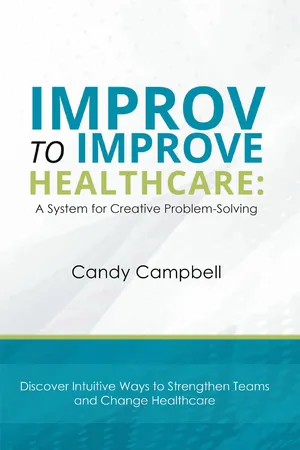
Healthcare organizations cry out for a toll to decrease untoward events and bridge the communication gap between professional clinical teams and clients. Discover how to guide your team to creatively problem-solve, build emotional and social intelligence, increase workplace safety and employee retention, and guarantee client satisfaction with the results-don't-lie Improv to Improve Healthcare system.
- 146 pages
- English
- ePUB (mobile friendly)
- Available on iOS & Android
eBook - ePub
About this book
Information
PART ONE
The Science


WHY the World Needs Improv
Calm Before the Storm
It was a Tuesday at three in the morning in an upscale community hospital in middle America.
Within the Neonatal Intensive Care Unit, the Registered Nurse (RN) was assigned to care for a 25-week gestation infant who weighed less than 500 g or approximately one pound, one ounce. Besides the intravenous solution lines running through his infinitesimal umbilical arteries and one vein, and in addition to the orogastric tube that ran to his stomach, the baby was connected to an oscillating ventilator that delivered more than 300 soft, quick breaths per minute to his still-developing lungs. The nurse dutifully sat at the bedside, monitoring vital signs and every move.
Suddenly, an alarm sounded. It was the pulse oximeter connected to a tiny infrared light wrapped around his hand. It measured the amount of saturated oxygen delivered to the capillary bed. She looked up at the telemetry monitor and paused it for two minutes to evaluate the change.
The baby’s chest was retracting, and his color wasn’t looking good, so she called the respiratory therapist (RT) to assist. They suctioned the baby’s mouth and endotracheal tube and found a large amount of cloudy, white returns.
While the RN changed the baby’s equally tiny, wet diaper, the RT collected a small amount of blood for an arterial blood gas test from one of the umbilical lines. Both agreed the child’s breaths still appeared labored, even after suctioning. The blood gas test, completed in less than five minutes, confirmed the status change.
The RT called for a STAT chest X-ray and the RN phoned the in-house pediatrician, who was on-call for the neonatologist.
When the physician arrived, the X-ray was completed, and the films were displayed at the central station across from the patient area. Results? Just as they thought: a pneumothorax.
Up to this point, the process worked well; they congratulated themselves that only a few minutes had passed.
The RN hurried to prepare the area for the chest tube placement, a sterile, bedside procedure. She assisted the MD with his gown and pulled the instrument tray to the left side of the bed.
It looked like the situation was well in hand.
Then, to her surprise, the physician asked the RN to move the instruments to the opposite side of the bed. She complied, and asked, “Do you need anything else?”
“Nope,” he quipped. “Got it.”
The nurse went back to the central station and looked again at the X-ray. She thought the lung collapsed on the left side, not the right side. However, she reminded herself, she was sometimes confused when interpreting X-rays. She wished the RT was nearby to confer with him, but he was charting next to the bedside, in case the physician needed assistance. So, she decided against it and went back to her charting.
That was the first mistake.
03:34 am: The alarms sounded loudly, the RT jumped up, and the physician swore. The stronger lung had been punctured with the chest tube; now both sides were compromised.
That was the second mistake.
It did not go well for the baby.
Consider the crushing news of this miscommunication on the parents. These sorts of sentinel events are like a wound that festers. In the end, the insult (an interesting moniker for a wound), plus the ripple effect of the impact of grief upon the family, the employees, the hospital administration, and everyone concerned, is tragic ... and preventable. This problem seems to be evergreen in healthcare.
My premise? There is a better way to learn to communicate at work. This closed-loop communication method, deliberately practiced through improvisational exercises, leads to safer teams, increased patient safety and patient satisfaction, and happier employees.
Now, if you are a person who has heard the word improv, but you equate it with one of the television programs that showcases highly edited versions of comedy-based scenes, please believe me, it’s not the same thing.
For more than two decades, I have had the pleasure of leading groups of people of all ages and stages to learn this valuable method of communicating. Some take the classes for personal growth and also for the fun of it! Others, who are fortunate to work for business execs that value teamwork and innovation, jump at the chance to embrace this tool. Alas, the healthcare industry seems to be a late comer to the party (Note: I was happy to learn that some medical schools and at least one school of pharmacology have begun to include improv in their classes. Interestingly, I have found no school of nursing that has encompassed this proven technique. That sad truth prevails, even with the second edition of this book!)
So, what do YOU say? Are you ready to dive in?
A Question That Deserves an Answer
You are likely aware of the problems in the U.S. healthcare industry related to unexpected incidents of patient morbidity and mortality. These problems are borderless. Whether here in the United States, or anywhere, we all could use some help to stem the tide of mistakes that cause patient harm.
According to IOM reports between 1999 and 2015, more people die from mistakes made in hospitals by healthcare personnel each year than from highway accidents, breast cancer, or HIV/AIDS! Clearly, this is not new news. Instinctively, we have known what Florence Nightingale told the world in 1863, that—hospitals shouldn’t make people feel worse or kill them! Yet, only since the advent of computers, have we been able to gather and quantify the latest international patient population data.
One would think, since the undeniable results from the IOM were first announced two decades ago, that by now we would have found solutions to reverse the problem. Alas, that is not the case. Of course, we have approached it scientifically, because we are scientists after all. We have evaluated the problem. We have spent, perhaps wasted, over 15 years to look at it under a microscope and from every angle. We have dissected the causes and empirically proven that the problem is multifactorial. And although statistical data vary, the IOM and TJC, both independent watchdogs over healthcare, have long-since reported that the first step, identifying the problem, that is, the root cause, is clear. This is because communication error ranks as the second-most frequent contributor to so-called never events. These events should never occur because they include:
• Wrong body part
• Wrong patient
• Wrong procedure
• Unintended retention of a foreign object
• Operative and postoperative complications
• Intraoperative, immediate postoperative, or postprocedure death
Aside from not speaking up, what are other found causes?
The IOM has repeatedly stated that communication error also continues to be cited as the number one cause of delay in treatment.
In 2002, TJC launched their annual National Patient Safety Goals (NPSG).8 Included on that original list was the goal “to improve the effectiveness of Interprofessional Communication (IPC) among caregivers,” which they defined as including oral, written, and Internet communications. According to a 2016 report by the Agency for Healthcare Research and Quality (AHRQ), because it is an evergreen problem, the IPC goal remains on each NPSG list.9
However, when healthcare consumers (that includes all of us, eventually) look at the scientific community, we may lose hope in the scientific method, which so far has yielded no positive change. Indeed, the needle of concern has now moved to the more worrisome side of the measurement scale. Righteously indignant consumers might cry out, “Isn’t there some way to impact this problem?”
Attempts to Fix the Problem
In 2008, TJC delivered a Sentinel Event Alert (SEA) publication titled Behaviors That Undermine a Culture of Safety.10 The report discusses, “intimidating and disruptive behaviors in healthcare organizations,” and outlines perceived root causes of th...
Table of contents
- Cover
- Half-Title Page
- Title Page
- Copyright
- Dedication
- Description
- Contents
- Testimonials
- Previous Works
- Foreword
- The Improv Principles
- Preface
- Preface—2nd Edition
- Acknowledgments
- Part One The Science
- Part Two The Art of the ‘Tudes
- Appendix A
- Appendix B
- Glossary
- Notes
- References
- About the Author
- Index
- Backcover
Trusted by 375,005 students
Access to over 1.5 million titles for a fair monthly price.
Study more efficiently using our study tools.
Frequently asked questions
Yes, you can cancel anytime from the Subscription tab in your account settings on the Perlego website. Your subscription will stay active until the end of your current billing period. Learn how to cancel your subscription
No, books cannot be downloaded as external files, such as PDFs, for use outside of Perlego. However, you can download books within the Perlego app for offline reading on mobile or tablet. Learn how to download books offline
Perlego offers two plans: Essential and Complete
- Essential is ideal for learners and professionals who enjoy exploring a wide range of subjects. Access the Essential Library with 800,000+ trusted titles and best-sellers across business, personal growth, and the humanities. Includes unlimited reading time and Standard Read Aloud voice.
- Complete: Perfect for advanced learners and researchers needing full, unrestricted access. Unlock 1.5M+ books across hundreds of subjects, including academic and specialized titles. The Complete Plan also includes advanced features like Premium Read Aloud and Research Assistant.
We are an online textbook subscription service, where you can get access to an entire online library for less than the price of a single book per month. With over 1.5 million books across 990+ topics, we’ve got you covered! Learn about our mission
Look out for the read-aloud symbol on your next book to see if you can listen to it. The read-aloud tool reads text aloud for you, highlighting the text as it is being read. You can pause it, speed it up and slow it down. Learn more about Read Aloud
Yes! You can use the Perlego app on both iOS and Android devices to read anytime, anywhere — even offline. Perfect for commutes or when you’re on the go.
Please note we cannot support devices running on iOS 13 and Android 7 or earlier. Learn more about using the app
Please note we cannot support devices running on iOS 13 and Android 7 or earlier. Learn more about using the app
Yes, you can access Improv to Improve Healthcare by Candy Campbell in PDF and/or ePUB format, as well as other popular books in Business & Leadership. We have over 1.5 million books available in our catalogue for you to explore.