![]()
1
German cockroach infestations in the world and their social and economic impacts
Chow-Yang Lee and Changlu Wang
Introduction
Some 4300 species of cockroaches belonging to more than 500 genera are found throughout various habitats worldwide (Roth 2003). About 30 species have been reported as pests in urban environments. Among the 54 species in the genus Blattella (Wang et al. 2010; Beccaloni 2014), the German cockroach, Blattella germanica (L.) is the most widespread and abundant species. It is found on all continents in association with humans and their food or waste (Atkinson et al. 1991). It is a perennial pest of kitchens, hotels, restaurants, hospitals, food manufacturing industries, swine farms, transportation systems and other facilities with suitable temperature and food sources. It is also an important mechanical vector of diseases and producer of allergens (Brenner 1995; Gore & Schal 2007; Ahmad et al. 2011).
B. germanica is highly successful as a major indoor pest due to its extreme generalist and omnivorous characteristics, and the major expansions of its gene families with functions related to insecticide and allelochemical detoxication, defence against pathogen, digestion, sensory perception and gene regulation (Harrison et al. 2018). Its establishment is principally limited by temperature and thus is greatly impacted by increased urbanisation and living standards. This species is only found in indoor environments and occasionally around buildings (Friauf 1953; Appel & Tucker 1986). Due to its close relationship with human environment, it is one of the most problematic indoor pests in many parts of the world.
The origin of this species remains debatable. Originally described as Blatta germanica by Linnaeus (1767) based on a specimen collected from Denmark, Rehn (1945) deduced that B. germanica originated from Africa based on 15 closely related species in north-eastern Africa. This was later debunked by several authors who suggested that this species has an Asian origin as more than half of the 49 species of Blattella were endemic to Asia (Princis 1950; Roth 1997; Wang et al. 2010). However, because B. germanica has never been found in natural habitats, it was recently hypothesised that the ancestors of B. germanica may have been transported to Europe from southern Asia, and then naturally selected to survive in heated buildings and evolved as an indoor species, before they spread out of Europe to other parts of the world through human-mediated activities such as trade and exploration (Tang et al. 2019). This is possible as the earliest museum specimens in Asia were a century later than in Europe (e.g. Sumatra in 1877, Borneo in 1880, India in 1881, China in 1900) (Tang et al. 2016).
Occurrence of German cockroaches
North America
The best data on cockroach infestation in various communities was from a 1990 survey by the US Environmental Protection Agency (EPA) (Whitmore et al. 1993). Of 2078 housing units in 29 states, 9.84% experienced major cockroach infestations, and 24.46% had treated cockroach infestations in the past. Cockroaches are one of the two most common nuisance pest groups (the other group is ants). Blattella germanica is the dominant species among the species found in buildings. Occurrence of different cockroaches in buildings is influenced by the type of property and location. Wright (1965) reported that B. germanica, oriental cockroach (Blatta orientalis (L.), American cockroach (Periplaneta americana (L.)) and Brownbanded cockroach (Supella longipalpa F.) were found in buildings in North Carolina. Disregarding the type of structure, the four species occurred in the proportion of 54%, 34%, 8% and 4%. In a garden-style low-income community in Gary, Indiana, German cockroach (49%) and oriental cockroach (26%) were the two dominant cockroach species (Wang et al. 2008). All 3342 cockroaches found in traps laid in high-rise apartment buildings in two cities in New Jersey were B. germanica (Wang et al. 2019). The most recent survey during 2018–2019 by Rutgers researchers in 19 low-rise and high-rise apartment buildings (1753 apartments) occupied by low-income residents in four cities in New Jersey found 640 apartments were infested with cockroaches. German, American and oriental cockroaches occurred in the proportion of 97.8%, 0.8% and 2.5% (Abbar et al., unpublished data). Among the 640 apartments with cockroaches, 1.1% of them had two species of cockroach.
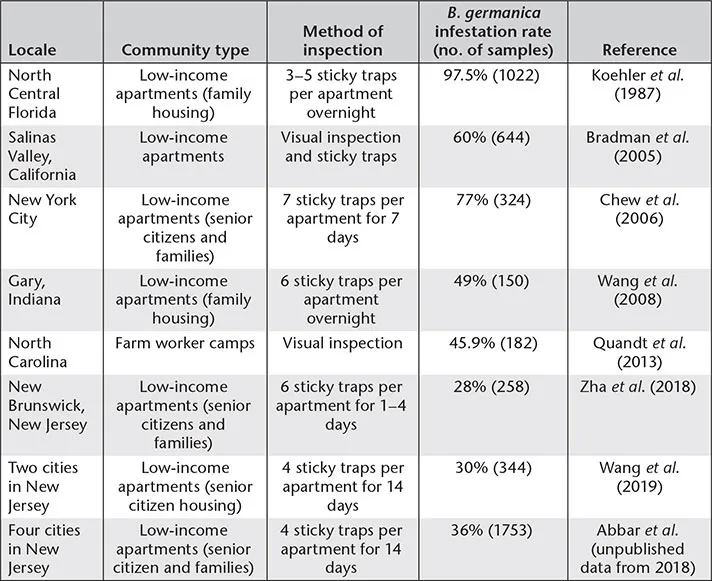
In residential homes, high B. germanica infestation rates are frequently recorded in communities associated with lower socioeconomic status or house disrepair (Table 1.1). The presence of peeling paint, water damage and poor sanitary conditions were associated with increased risks of cockroach infestation (Bradman et al. 2005). Similarly, Wang et al. (2019) found that apartments with a ‘poor’ sanitation rating in kitchens and bathrooms were 2.7 times more likely to have B. germanica than apartments with better sanitation conditions.
Infestations of B. germanica can develop into very high densities if not properly managed. As many as 3657 cockroaches were trapped in 24 h on six sticky traps placed in one occupied apartment in 2006 (Wang & Bennett 2010). The apartment was estimated to have ~122 000 cockroaches based on estimation that only 3% of the cockroaches were trapped (Wang & Bennett 2010). One of the highest densities of German cockroaches was reported from swine farms. The mean population estimate was 12 818 cockroaches (range: 4900–21 000) per 15 min visual transect in each of 16 barns surveyed in North Carolina (Waldvogel et al. 1999).
Negative perceptions about German cockroaches are associated with cockroach infestations. Dingha et al. (2013) surveyed 100 homes in rural counties in North Carolina based on residents’ observations of German cockroaches. Of these participants, only 23% indicated that B. germanica was a major indoor pest, whereas 48% indicated that mosquitoes and 50% indicated that ants were major pests in their homes. The low percentage of residents considering cockroaches a major pest was suggested to be partially attributed to the social stigma associated with the presence of cockroaches and partially due to many respondents have a high tolerance of cockroaches. In another study, residents’ tolerance of cockroaches was significantly associated with presence of cockroaches (Wang et al. 2019). The median cockroach count when residents were bothered by cockroaches was ≥3, based on deployment of four sticky traps per apartment, over a two-week period. In this study, 54% of the infested apartments had cockroach counts <3. Therefore, the majority of tenants who had cockroaches would not be bothered by the presence of cockroaches.
Table 1.1. German cockroach infestation rates based on surveys in dwellings in the USA
Data on the prevalence of B. germanica in commercial facilities is scarce. In a random survey of 100 commercial food-handling establishments in Los Angeles, 62 were infested with German cockroaches. All of them had professional pest control service (Rust & Reierson 1991).
German cockroaches are usually controlled by insecticide applications. Historically, the insecticides used include organochlorines, organophosphates, pyrethroids, inorganic dust and various bait products. The US EPA withdrew the residential registrations for commonly applied organophosphate pesticides, chlorpyrifos and diazinon, in 2000–2001. To evaluate the impact of US EPA regulations on pest infestation levels, Williams et al. (2008) monitored pest infestation levels in inner-city communities in New York City occupied by African American and Dominican women. Among the 511 enrolled subjects, the number of subjects reporting cockroaches in the home increased significantly over each six-month interval from 63% in 2000 to 93% in 2006. Resistance to pyrethroids was suggested as one possible reason for increased cockroach sightings. Numerous studies revealed high levels of B. germanica resistance to commonly used pyrethroids (see Chapter 11). Highly effective cockroach gel bait products became widely available in the USA since the late 1990s (see Chapter 10). While professionals use bait as a primary method for B. germanica control, adoption of bait by consumers for B. germanica control has been minimal. A recent study found 55% of the surveyed residents used insecticide sprays, compared with 6% that used baits to control cockroaches in apartments (Wang et al. 2019). Over-the-counter sprays such as Raid® and Hotshot® (active ingredients: imiprothrin, cypermethrin, prallethrin) were most frequently reported (Zha et al. 2018).
Europe
Cornwell (1968) compared the prevalence of cockroaches in pre- and post-war buildings. There are two pest species which occur regularly in Britain, namely, B. germanica and B. orientalis. The relative abundance of the two species changed after World War II with the change in people’s eating habits, the growth of hotel and catering industries and the gradual introduction of central heating. The ratio of infestations by German and oriental cockroaches in pre-war properties was 1:4.5. The ratio in post-war buildings was 1:2.2. Greater incidence of German cockroaches in post-war buildings reflects the presence of German cockroaches in almost every type of property. Taking the British Isles as a whole, B. germanica was found in 21% of the properties and B. orientalis was found in 89% of the properties.
Alexander et al. (1991) published more recent results on the distribution of B. germanica and B. orientalis in the UK b...