- English
- ePUB (mobile friendly)
- Available on iOS & Android
eBook - ePub
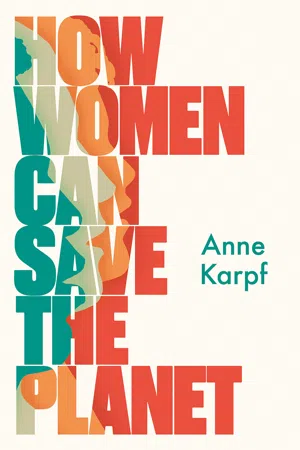
How Women Can Save The Planet
About this book
Here's a perverse truth: from New Orleans to Bangladesh, women—especially poor women of colour—are suffering most from a crisis they have done nothing to cause. Yet where, in environmental policy, are the voices of elderly European women dying in heatwaves? Of African girls dropping out of school due to drought? Our highest-profile climate activists are women and girls; but, at the top table, it's men deciding the earth's future.
We're not all in it together—but we could be. Instead of expecting individual women to save the planet, what we need are visionary, global climate policies that are gender-inclusive and promote gender equality.
Anne Karpf shines a light on the radical ideas, compelling research and tireless campaigns, led by and for women around the world, that have inspired her to hope. Her conversations with female activists show how we can fight back, with strength in diversity. And, faced with the most urgent catastrophe of our times, she offers a powerful vision: a Green New Deal for Women.
Information
PART ONE
WOMEN AND THE CLIMATE CRISIS
1
ON THE FRONTLINE
HOW THE CLIMATE CRISIS IS HARMING WOMEN
It’s dawn, but the women are already up and on the road.
Margaret Atiir, a 40-year-old mother of four from Kapua, Kenya, describes her daily trek to collect water: “I have to walk four kilometres from my home to the well just to fill a twenty litre bucket. I … make several trips to have enough water for my children. Some days I’m too weak to go so we either borrow from our neighbors, or wait until I’m strong enough.”1
In Afdera, north-east Ethiopia, where Fatuma lives, it’s a similar story: there’s no fresh water for 200 kilometres. “All my life, since I was a young girl, I walked miles every day for water. The only time I had a day off were on the days I gave birth. We would get up at dawn, and return at midday.” Fatuma has carried, on her back, up to 30 kilos at a time—the equivalent of a British luggage allowance for a long-haul flight.2 Also in Ethiopia, Aysha, 13 years old, leaves home at 6.30am every day for an 8-hour round trip to collect water, with just her camel for company.3
Margaret, Fatuma and Aysha are water pilgrims. They’re responsible for meeting the daily drinking, cooking and washing needs of their family—a job that costs women and children around the world 200 million hours a day,4 and which can use up nearly one third of their daily calorie intake.5 And climate change has made the chore unimaginably harder. In southern Mozambique, for example, women and girls used to spend 2 to 5 hours a day fetching water. Now, because of drought intensified by the climate crisis, these trips often take them 10 to 12 hours.6 The longer journeys carrying heavy pots can damage their spines, neck muscles and lower backs,7 while also causing chronic fatigue, pelvic deformities and miscarriages. To make it back in time even though they have further to travel, they set out earlier in the morning, in the dark—leaving them open to sexual attacks.
The ‘we’re all in it together’ slogan of some climate campaigners is curiously reassuring, as though global warming were a sort of secret socialist, bestowing its damage on everyone equally and in the same way. On first thought, it seems perverse to believe otherwise: don’t men and women breathe the same air, drink the same water, eat the same food? Surely the climate can’t search out one gender and select them for especially brutal treatment?
No, the climate doesn’t do this; but human societies do. Rules and roles, norms and divisions of labour mean that, both in the global South but also in the global North, women’s lives and experiences differ from men’s in a bundle of different ways. The climate emergency then swells these differences, multiplying and amplifying inequalities already bedded in. This chapter explores some of the direct and demonstrable ways that women’s lives are changed, often dramatically, by global heating and the disasters it provokes, while the next chapter shows some of its many profound, but indirect, effects on them.
The climate crisis is no abstract concept for women in the global South. The long-term changes it is bringing to their environments are reflected in long-term changes to their lifestyles, making them even more taxing. Because of the work that they do, women are the ones shouldering many of the burdens that have come with global heating.
Women, for instance, are usually responsible for collecting and burning the wood, charcoal and animal dung (sometimes called solid fuel) for cooking and heating. Burning solid fuels damages women’s health: we associate air pollution with cities choking on carbon monoxide from cars, or industrial plants belching out toxic fumes—not with rural residential cooking—yet indoor air pollution prematurely kills around 3.8 million people a year,8 and women are more exposed to household air pollution than men. They breathe in the smoke generated by burning firewood or coal, charcoal, animal dung or kerosene while preparing meals, often in small and poorly ventilated rooms.9
This increases women’s risk of respiratory infections and of having a low-birthweight baby.10 Nearly half a million newborn babies died in 2019 from air pollution, two thirds of them from household air pollution caused by their mothers’ and their own exposure to solid fuels burnt for cooking.11 There’s a terrible postscript to this: Covid-19 is a respiratory disease, and you are more likely to contract it if you have been exposed to air pollution, or suffer from the conditions pollution often brings in its wake—diabetes, cardiovascular disease and chronic obstructive lung disease.12
Global heating has added to the harms women suffer in their role as keepers of the household’s fuel. Collecting fuel is as time-sapping as collecting water: in South Asia, women can spend more than 20 hours a week on the task.13 And, as with water, so with firewood: deforestation driven by heat, drought and illegal logging—all linked to the climate crisis—means that women now have to travel further just to gather the essentials they need.14 To obtain energy for cooking and heating, women have to expend more of their own. There’s an additional sting here too: burning biomass fuels contributes to deforestation, itself a major cause of climate change, and so women are bound, unavoidably, into a grim and growing cycle: because of the climate crisis, they’re making longer journeys to find the fuel which, when it’s burnt, aggravates the crisis, therefore making their journeys even longer…
The climate crisis changes the lives not only of women, but of girls too, since it’s mostly girls and not boys who are called upon to share these essential daily tasks. Global warming makes poor women and girls time-poorer. Because of these demands, they often have to drop out of primary school, and can’t go to evening classes or participate in communal activities. And so the cycles of marginalisation and exclusion are perpetuated.
Disasters discriminate
The language around climate change can conceal as much as it reveals. As commentators like Amartya Sen have observed, there’s nothing ‘natural’ about natural disasters: they may occur in nature, but ‘nature’ itself didn’t cause them. For large stretches of time, these climate-induced changes to daily life are gradual—until they accelerate, and climax in catastrophe. Disasters are mostly just the tail end of creeping environmental degradation, even though they’re often portrayed as something that arrived out of nowhere, something elemental and inescapable—an event in their own right, unconnected to what went before or what comes after. Of course the climate crisis isn’t the sole cause of extreme weather events like tropical cyclones, heatwaves, drought or apocalyptic wildfires; but it’s almost certainly made them more frequent and more intense. Floods, for example, are having increasingly catastrophic effects because of the rise in sea levels.
The impact of the climate crisis on the natural world and biodiversity is widely known now, but some of its consequences on the human, social world—and especially on women and girls—are only just becoming apparent. Until recently, it was assumed, in public debate at least, that disasters like these didn’t discriminate—that this, surely, was the whole point of them: they tear through entire communities bringing random, universal destruction. Yet there’s now reams of evidence to show that women are affected by disasters in different ways from men. Again, this isn’t because cyclones and floods single out women in some bizarrely vengeful way, but because these catastrophic events aggravate and multiply the gender inequalities that existed before they struck: their impact falls upon real, embodied human beings, situated in communities where social roles bring unequal power.
Disasters overwhelm not just the land women live on, but also their capacity to escape and save themselves. Women and children are fourteen times more likely than men to die in climate disasters like floods and drought, especially in the global South.15 In India, Sri Lanka and Indonesia, Oxfam found, far more men survived the 2004 Asian tsunami than women.16 A staggering ninety per cent of the 140,000 Bangladeshis who died in the 1991 cyclone were women.17 Nor is this phenomenon confined to the global South: of the more than 70,000 people who died over two months from the severe heatwave that hit Europe in 2003, nearly two thirds were women.18
The after-effects of climate change-induced disasters also fall differently on men and women. In the chaos after a hurricane, families get separated, leaving women and girls more vulnerable to offers of help that can end in their being sexually trafficked. This phenomenon, known as ‘hurricane trafficking’, happened after Typhoon Haiyan hit the Philippines in 2013,19 and migration induced by climate change is predicted to ramp it up even more.20
And then there’s child marriage. The climate emergency is creating a new generation of child brides, and that number is now predicted to increase by 2.5 million over the next five years because of the hardship resulting from Covid-19—the greatest surge in a quarter-century.21 In countries like Malawi and Mozambique, climate disasters bring so much extra poverty that families have no choice but to arrange quick marriages for their young daughters.22 The risk of domestic violence increases if there’s a large age gap between husband and wife, but child marriage is an economic survival strategy for struggling households—there’s just not enough food to go round. “This is a place affected by river erosion,” Azima B’s parents told her, explaining why she had to marry at 13. “If the river takes our house it will be hard for you to get married so it’s better if you get married now.”23
Ill health caused by the climate crisis is also gendered: women, young and old, are especially affected by global heating, which is having a profound effect on food security—degrading the land, leading to desertification, decreased yields and food shortages.24 When food is in short supply, women eat least and last.25 And, of course, cyclones, hurricanes and floods bring in their wake water-borne diseases like malaria, cholera and diarrhoea. Whenever families get sick, the responsibility of caring for them falls, inevitably, on women. The care tasks—tending to young children and old relatives; seeking out medicinal plants as well as food, fuel and water; upkeep of the home; myriad other daily invisible micro-tasks where love meets duty—are essential, but also taken for granted. And the climate crisis makes all of them harder.
If, amid all this care for others, the women themselves fall ill, they will have greater difficulty accessing medical facilities: older women in particular often can’t afford to pay for medicines or visits to clinics, or they may not manage to get to a treatment centre in the first place. Mobility problems may prevent older women from travelling beyond the home, and cultural restrictions governing when and where women should move around on their own can make it hard to even contemplate undertaking such a visit.26
Is that right?
In these ways and many more, global heating has been reshaping the lives of women around the world.
But stop! Everything you’ve read here so far is true—but it’s also not. Or rather, it’s misleading: this picture flattens and thins out reality, presuming that only women in the global South are affected by the climate crisis, and portraying them purely as victims without agency. It reinforces stereotypes of these women as Other—as poor, brown-skinned, pot-carrying, suffering but mute—in a way disconcertingly similar to the recurring images itemised so wryly by Binyavanga Wainaina in his 2019 essay How to Write About Africa:
Among your characters you must always include The Starving African, who wanders the refugee camp nearly naked, and waits for the benevolence of the West. Her children have flies on their eyelids and pot bellies, and her breasts are flat and empty. She must look utterly helpless. She can have no past, no history; such diversions ruin the dramatic moment. Moans are good. She must never say anything about herself in the dialogue except to speak of her (unspeakable) suffering.27
Look at the most common images of women and girls affected by climate change, and what stares back at you are pictures strikingly similar to those stubbornly enduring representations of poverty in the global South that—despite oh-so-many critiques—the major NGOs are still disseminating. In these images it’s sometimes hard to distinguish Africans from Asians from Pacific Islanders, since all are similarly passive, emptied of diversity and complexity.28 Nandita Dogra studied a year’s worth of public me...
Table of contents
- Cover
- Title Page
- Copyright
- Dedication
- Contents
- Acknowledgements
- Introduction
- Part One: Women and the Climate Crisis
- Part Two: Women and Climate Justice
- Conclusion
- What Now? Further Resources
- Notes
- Bibliography
- Index
Trusted by 375,005 students
Access to over 1.5 million titles for a fair monthly price.
Study more efficiently using our study tools.
Frequently asked questions
Yes, you can cancel anytime from the Subscription tab in your account settings on the Perlego website. Your subscription will stay active until the end of your current billing period. Learn how to cancel your subscription
No, books cannot be downloaded as external files, such as PDFs, for use outside of Perlego. However, you can download books within the Perlego app for offline reading on mobile or tablet. Learn how to download books offline
Perlego offers two plans: Essential and Complete
- Essential is ideal for learners and professionals who enjoy exploring a wide range of subjects. Access the Essential Library with 800,000+ trusted titles and best-sellers across business, personal growth, and the humanities. Includes unlimited reading time and Standard Read Aloud voice.
- Complete: Perfect for advanced learners and researchers needing full, unrestricted access. Unlock 1.5M+ books across hundreds of subjects, including academic and specialized titles. The Complete Plan also includes advanced features like Premium Read Aloud and Research Assistant.
We are an online textbook subscription service, where you can get access to an entire online library for less than the price of a single book per month. With over 1.5 million books across 990+ topics, we’ve got you covered! Learn about our mission
Look out for the read-aloud symbol on your next book to see if you can listen to it. The read-aloud tool reads text aloud for you, highlighting the text as it is being read. You can pause it, speed it up and slow it down. Learn more about Read Aloud
Yes! You can use the Perlego app on both iOS and Android devices to read anytime, anywhere — even offline. Perfect for commutes or when you’re on the go.
Please note we cannot support devices running on iOS 13 and Android 7 or earlier. Learn more about using the app
Please note we cannot support devices running on iOS 13 and Android 7 or earlier. Learn more about using the app
Yes, you can access How Women Can Save The Planet by Anne Karpf in PDF and/or ePUB format, as well as other popular books in Biological Sciences & Ecology. We have over 1.5 million books available in our catalogue for you to explore.