The pioneering political scientist presents his "fragment theory" of class, culture and ideology in post-colonial societies around the world.
In his groundbreaking work,
The Liberal Tradition in America, Louis Hartz demonstrated that beneath America's history of political conflict was an enduring consensus around Lockean liberal principles. In
The Founding of New Societies, Hartz continues his examination of ideology and national identity with a study of five societies established by European migration and colonization.
The diverse political and cultural traditions of the United States, Latin America, South Africa, Canada, and Australia share little in common. Yet, as Hartz demonstrates, they each represent a cultural fragment of the European countries from which they sprang. Each new society retains the ideology that had been dominant at home at the time of their founding.
Extraordinarily influential when it was first published in 1964, The Founding of New Societies is a classic work of political science. Hartz's fragment theory continues to offer powerful insight into today's political landscape.
eBook - ePub
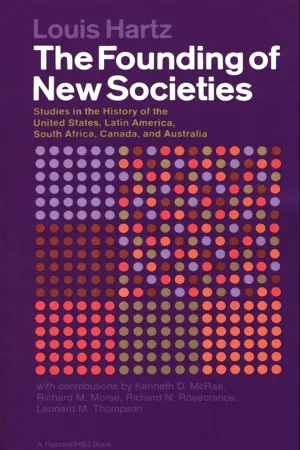
The Founding of New Societies
Studies in the History of the United States, Latin America, South Africa, Canada, and Australia
- 362 pages
- English
- ePUB (mobile friendly)
- Available on iOS & Android
eBook - ePub
The Founding of New Societies
Studies in the History of the United States, Latin America, South Africa, Canada, and Australia
About this book
Information
Part One
A Theory of the Development of the New Societies
by Louis Hartz
Chapter One
The Fragmentation of European Culture and Ideology
1 The Fragment
There is a problem of traditionalism and change common to the societies studied in this book, and it derives from the fact that all of them are fragments of the larger whole of Europe struck off in the course of the revolution which brought the West into the modern world. For when a part of a European nation is detached from the whole of it, and hurled outward onto new soil, it loses the stimulus toward change that the whole provides. It lapses into a kind of immobility. Nor does it matter what stage of European history the part embodies, whether it is feudal, as in Latin America and French Canada, bourgeois, as in the United States, Dutch South Africa, and English Canada, or actually radical, charged with the proletarian turmoil of the Industrial Revolution, as in Australia and British South Africa. The fragments reflect every phase of the European revolution, but they evince alike the immo-bilities of fragmentation. Moreover they are involved alike, because of this, in one of the strangest issues of change that the world impact of the modern era has produced. For it is the irony of that impact that it has hurled back at the fragments, after centuries and from wholly unexpected angles, the very Western revolution they originally fled. Their escape has turned out to be an illusion, and they are forced now to transcend the conservatism to which it gave birth.
All of this is to say that these societies, in the midst of the variations they contain, are governed by the ultimate experience of the American liberal tradition.* That tradition arose as a result of the extrication of a bourgeois fragment from the turmoil of seventeenth-century England, and it gave to the United States over three hundred years of liberal immobility, but it now confronts on the world plane, thrust back at it from places as distant as Russia and China, the very alien ideologies it managed to escape. On the surface it might seem, precisely because the content of many of the other fragment cultures differs so widely from our own, that there could be no possible connection. What could the hacienda culture of Peru have to do with the bourgeois farming of Wisconsin, the socialism of Sydney with the almost hysterical antiradicalism of Nebraska? But if we focus on the element of sheer traditionalism that all of these cultures contain, and on the loss of the European challenges out of which it arose, these differences recede into the background. Nor does this happen only in connection with the feudal world of Latin America, or French Canada, a milieu where one might expect conservatism to flourish. It happens also in connection with the radical setting of Australia which enshrines, no less passionately than the United States enshrines Locke, the spirit of the Chartists and of Cobbett. The paradox of a liberal conservatism is proof enough of the traditionalizing impact of fragmentation, but surely the paradox of a radical conservatism places the matter beyond any doubt at all.
When a fragment of Europe becomes the whole of a new nation, it becomes unrecognizable in European terms. We must not assume, because the fragment cultures do not shout out at us the European terms feudal or liberal, that the European ideologies are not there: they have lost the need for shouting, which is proof of the new conservative power that fragmentation has given them. Of course there is some intrinsic complexity here. None of the new societies is exhausted by an ideological category, whatever it is. Not only are there always “imperfections” in this respect, as when feudal remnants cling to the American fragment or capitalist Whiggery to the Australian, but there are a wide variety of factors alien to ideology which can twist it out of shape. Some of these are to be found in the peculiar stamp of the European homeland, the nature of the colonial relationship, and the sort of contact the fragment has with African and aboriginal peoples. Latin America, which might have had as a feudal fragment a quiet, French-Canadian kind of history, was actually streaked with revolution as a result of these forces. Iberian feudalism was anarchic to begin with,1* the imperial discrimination against the Spanish creole drove him toward the Enlightenment, and the absorption of non-Western peoples at the lower grades of the feudal order inflamed the usual hierarchical relationships.
But after these complexities have been noticed, it remains a fact that the very triumph of the European ideology in the fragment traditions makes it unrecognizable in the old sense. We know the European ideology, indeed we name it, in terms of its enemies, in terms of the whole of the classical European social struggle. When fragmentation detaches it from this context, and makes it master of a whole region, all sorts of magic inevitably take place. First of all it becomes a universal, sinking beneath the surface of thought to the level of an assumption. Then, almost instantly, it is reborn, transformed into a new nationalism arising out of the necessities of fragmentation itself. Feudalism comes back at us as the French-Canadian Spirit, liberalism as the American Way of Life, radicalism as the Australian Legend. But even this is not all. The European ideology, buried and refurbished, is extended to African and Indian relationships which in Europe it did not have, so that it inspires a series of racial formulations apparently outside its compass. Suárez lies hidden beneath the Latin-American encomienda, Calvin beneath the slavery of Dutch South Africa. By the time we are through, the European ethic, so familiar to us on the streets of Paris and London, has been buried almost completely.
But surely this does not mean that it has disappeared. On the contrary, the very things which hide the European ideology are proof of the enormous new power it has acquired in the fragment world, the very power which produces its problem under the impact of world events today. Where else could an ideology become a moral absolute, a national essence, a veritable way of racial life?
2 The Making of the Fragment Tradition
Beneath these metamorphoses, these psychic inflations and disguises, a purely mechanistic process is at work. That process begins with the escape of the fragment from its original European enemy, the flight of the Puritan, as it were, from the hungry clutch of Laud. But it goes far beyond that. For the fragment is protected against a whole series of later enemies as a result of its original movement, enemies which in the renewing process of European history arise out of those it has escaped. Marx fades because of the fading of Laud. There is a stifling of the future as well as an escape from the past, and it is at the heart of the process of fragmentation that the one is determined by the other. Nor is even this all. Once the fragment has escaped the European challenges past and future, once it has achieved its curiously timeless place in Western history, an unfolding within it takes place which would have been inconceivable in the constricted atmosphere of Europe. To continue with the American example, Jacksonian democracy burgeons, the New Deal flowers, because both the right and the left are missing. The fixity of the fragment liberates in the end a rich interior development.
If we look more closely at the European struggle, it will not be hard to discover why the escape from past leads inevitably to an escape from future enemies. There is a process of contagion at work in Europe, enormously subtle and ramifying, in which ideologies give birth to one another over time. This process actually begins with the feudal world which, in a queer Hegelian sense, helps to generate the very attack against it. That world not only gives its own “class consciousness” to every Enlightenment ideology, bourgeois or socialist, but it holds out as well the memory of a corporate community which, in the midst of revolution, men seek to recapture. Marx no less than Rousseau yearned for that community, which is why there could be such a thing as “feudal socialism,” a kind of reactionary Marxism which sought to absorb the industrial question into the medieval framework. But even within the Enlightenment world itself there is a complex contagion. Whiggery inspires with its first grand liberal formulations the Jacobin who later assails it. The Jacobin inspires with his more radical version of the Enlightenment the socialist whom he ultimately fears. So that at every point, from medievalism to modernity, and within modernity itself, the European contagion is at work. Europe renews itself out of its own materials.
Under these circumstances it is not hard to see why the extrication of the fragment from Europe at any point should have fateful consequences for its future conservatism. When it leaves Europe, it cuts short the process of the European contagion at the point of its leaving. When it leaves its first antagonist, it leaves all of the future antagonists that the first inspires. I have cited the case of socialism fading in America because feudalism has been left behind. We can now see, not only in the United States but in other bourgeois fragments like Dutch South Africa and English Canada, the enormous complexity of this negative connection: Marx dies because there is no sense of class, no spirit of revolution, no yearning for the corporate past. But the same principle, in a different way, holds true of the feudal and radical fragments as well. The French Canadian, having escaped the Enlightenment, escapes also Jacobinism and Marxism, since these later radicalisms are fed by the Enlightenment spirit. He is an American, as it were, but, starting earlier, he has had a wider “future” that has faded. One might suppose, perhaps, since radicalism is the “last” ideology, that the Australian out of the world of Cobbett might have no prospective damage to impose because of his escape from the past. But that is not true. In his case a radical migration in the eighteenth and the nineteenth centuries blocks the doctrinaire socialism of the twentieth, for without the continuing pressure of the English feudal and bourgeois challenges the spirit of Harold Laski loses its source. Australian radicalism, even after the Labour Party, even after the blood and thunder of the early Commonwealth period, remains morally fixed at the point of its origin. So that the process here works within ideologies as well as among them, smothering later versions of a single theme as well as the later themes themselves. There is, in fact, no shrinking of the European past at any point which does not shrink the European future as well.
Given this protection through time of its boundaries, it is not surprising that the fragment should nourish an affirmative unfolding not to be found in Europe. Every fragment, in the dynamic context of the Old World, contains a potential whose development is constricted by the multiplying challenges it confronts. Europe gives us a series of strangled social visions. Thus the feudal order has the solution of Tory socialism, of Young England and the French Legitimists, for the problem of modern industry. But where liberalism has already hit, and the masses have become infected with it, how can this idea ever be completely appealing? But this does not mean that liberalism is in perfect shape. Its Utopia is a Utopia of individualists where Jacobin democracy would come spontaneously to power. But precisely because feudalism still has a grip on the land, and socialism is emerging to claim the factory, that Utopia is perpetually frustrated. The Jacobin must stave off the Tory and the Marxist, which means that his Whig opponent crushes him again and again through the manipulation of various interests. Needless to say, the socialist does not emerge unscathed in this situation. He has a glorious vision too, as we know. But not only is that vision challenged by aristocratic and bourgeois forces, the proletariat itself, the very hope of the future, continually “sells out” to those forces. The Marxian lamentation on this score is a matter of legend, and in its very bitterness summarizes the frustration of every social idea that the Old World has. Europe develops many teleologies but because it intertwines them with one another, because it locks them together in a seething whole, it gives none of them the freedom to evolve.
The fragments provide that freedom. By extricating the European ideologies from the European battle, by cutting short the process of renewal which keeps that battle going, they permit precisely that unfolding of potentialities which the Old World denies. The story here is marvelous, like a succession of Cinderella dreams. Bossuet, Locke, and Cobbett, miserable men abroad, all wake up in worlds finer than any they have known. When the revolution hits France, French Canada clings to the spirit of divine right, and if Latin America is touched by the Enlightenment, the underlying tide of feudal traditionalism moves forward there as well. When the masses organize in the bourgeois fragments, whether English Canada, the United States, or Dutch South Africa, the tortured European Jacobin becomes a mighty man. Instead of being hemmed in by the forces of the land and the factory, he has absorbed them, has become himself both peasant and proletarian, so that he is able to isolate the Whig and knock the props from under him. The fulfillment of radicalism in Australia speaks for itself. After the depression and the great strikes of the nineties the Labour Party mastered the Australian scene with an ease unheard of in the annals of European socialism. In every case the conservatism of the fragment unlooses the drama, the embryonic telos, that Europe has contained and stifled. The world has shrunk, but precisely for that reason, it has blossomed as well.
Now there is nothing mysterious about this mechanism of fragmentation. A part detaches itself from the whole, the whole fails to renew itself, and the part develops without inhibition. The process is as simple, as intelligible as any historical process we normally take for granted. And yet it is in the nature of fragmentation, perhaps its greatest irony, that it prevents both the European who stays and the European who leaves from understanding the pattern involved. The European who stays is bound to think of national histories in terms of the revolutionary process which it is the genius of the fragment to escape. He can understand an England in which the bourgeoisie carries the aristocracy along with it, a France where the two fight it out, or even a Germany where the Junker dominance persists. But how is he to understand a North America where the bourgeoisie, having escaped both past and future, unfolds according to interior laws? On the other hand, the men of the fragment are in no better position: they are the European in reverse. They take their world for granted as he takes his, and if he cannot understand the European mechanics of an isolated bourgeosie, they, being isolated, cannot understand that any European mechanics are involved. Peering outward from the interior of the fragment, they can even attribute their history to the open land of the frontier.* Of course each side could find out the secret of the other if it wanted to. Europe could study itself bit by bit, and the fragment could study Europe as a whole. But given life as both live it, why should either attempt to do so?
And yet we must not assume that this burying from sight of the fragmentation process is due entirely to this inherent matter of separated perspectives. Does not the fragment do everything it can to hide its European origin, its ideological character, its “fragmentary” existence? Does it not claim to be an absolute principle, the great spirit of a nation, the clue to racial truth? Actually there is a splendid collaboration between the unconscious perspectives generated by the separations of fragmentation and the psychic needs of the fragment itself. Which brings us back, after a view of the mechanistic process of fragmentation, to the moral inflations and disguises which it generates.
3 New Nations Out of Old
Being part of a whole is psychologically tolerable, but being merely a part, isolated from a whole, is not. It is obvious that there is a major problem of self-definition inherent in the process of fragmentation. Universalism itself comes fairly easily. The fragmented British Puritan can make Calvin universal in New England simply by virtue of his migration. It is nationalism that is more difficult. What “nation” does the universal Puritan belong to? He is no longer completely “English.” Being English means sharing a community in which there are not only Calvinists but Anglicans, indeed all of the future organicists whom Anglicanism will proliferate and New England will also escape. It means being connected precisely to that totality, past and future, which the fragment has fled. Nor are Englishmen unaware of this fact when they look at the migrant Puritan: they see him as a mere “colonial.” What then is to be done? How is wholeness to be recaptured? There is only one way out, determined practically by a bootstrap necessity. The Puritan must convert Puritanism itself, the one thing he has, into a new nationalism which denies the humilation of the old. He must convert it into “Americanism,” a new national spirit under the sun, grander than anything the world has ever seen. Or, if he happens to be a French-Canadian Catholic rather than a New England Puritan, he must subject that ethic to the same process. Or if he is an Australian radical, he must do the same for the spirit of the Chartists. It does not make much difference which segment of the European revolution we are dealing with: they can all become substitute nationalisms. If one becomes “Americanism,” another becomes the spirit of the French-Canadian race, and another the national legend of “mateship.”
It may seem that there is something meretricious about this, a sleight of hand, forgivable perhaps because of the moral necessity out of which it arises. In fact this is far from being the case, and we will not be able to understand the force of the fragment nationalism if we do not grasp its utter historical honesty. The need for the new nationalism obviously increases as the fragment loses more and more of the European homeland, as future enemies begin to wither because old enemies have been left behind. But as this happens, new generations emerge within the fragment to whom it is, in sober truth, a “nation.” The conversion of ideology into nationalism is not accomplished by the first settlers, whether they are Spanish treasure seekers, transported convicts, or embattled Pilgrims. These men still identify with the European homeland. But their children are not in the same position. Their children do not remember the “old country.” They have lived inside the fragment all their lives, their battles have been the battles of its unfolding, and to them it is a true land. Indeed there are moments when, the process of detachment from Europe having finally matured, the new generations burst forth with a “discovery” of their national essence, amazed that its novelty has never been recognized before. These can be moments of great literary expression, as when Whitman discovered American democracy or Furphy Australian mateship.2 In terms of “honesty” it makes no difference that what is discovered is really something very old and European, in this case bits of Puritan and Victorian England. It does not even make a difference that the peculiarity of the fragment language, now cherished as something remarkable, reflects this antiquity, as when American English or Canadian French or Brazilian Portuguese turn out in surprising degree to be stamped archaically with the spirit of the migration. The new generations of the fragment have lived inside this culture, not outside of it, and to them it is national. And who, on their own terms, is to challenge the view they advance? Europe invented the fragment, but it did not live ...
Table of contents
- Title Page
- Contents
- Copyright
- Preface
- Part One
- Chapter One
- Chapter Two
- Chapter Three
- Part Two
- Chapter Four
- Chapter Five
- Chapter Six
- Chapter Seven
- Chapter Eight
- Notes
- Index
- About the Author
- Footnotes
Trusted by 375,005 students
Access to over 1.5 million titles for a fair monthly price.
Study more efficiently using our study tools.
Frequently asked questions
Yes, you can cancel anytime from the Subscription tab in your account settings on the Perlego website. Your subscription will stay active until the end of your current billing period. Learn how to cancel your subscription
No, books cannot be downloaded as external files, such as PDFs, for use outside of Perlego. However, you can download books within the Perlego app for offline reading on mobile or tablet. Learn how to download books offline
Perlego offers two plans: Essential and Complete
- Essential is ideal for learners and professionals who enjoy exploring a wide range of subjects. Access the Essential Library with 800,000+ trusted titles and best-sellers across business, personal growth, and the humanities. Includes unlimited reading time and Standard Read Aloud voice.
- Complete: Perfect for advanced learners and researchers needing full, unrestricted access. Unlock 1.5M+ books across hundreds of subjects, including academic and specialized titles. The Complete Plan also includes advanced features like Premium Read Aloud and Research Assistant.
We are an online textbook subscription service, where you can get access to an entire online library for less than the price of a single book per month. With over 1.5 million books across 990+ topics, we’ve got you covered! Learn about our mission
Look out for the read-aloud symbol on your next book to see if you can listen to it. The read-aloud tool reads text aloud for you, highlighting the text as it is being read. You can pause it, speed it up and slow it down. Learn more about Read Aloud
Yes! You can use the Perlego app on both iOS and Android devices to read anytime, anywhere — even offline. Perfect for commutes or when you’re on the go.
Please note we cannot support devices running on iOS 13 and Android 7 or earlier. Learn more about using the app
Please note we cannot support devices running on iOS 13 and Android 7 or earlier. Learn more about using the app
Yes, you can access The Founding of New Societies by Louis Hartz in PDF and/or ePUB format, as well as other popular books in Politics & International Relations & Global Politics. We have over 1.5 million books available in our catalogue for you to explore.