"A stunning piece of work—perhaps the best single book ever produced about our energy economy and its environmental implications" (Bill McHibbon,
The New York Review of Books).
Petroleum is so deeply entrenched in our economy, politics, and daily lives that even modest efforts to phase it out are fought tooth and nail. Companies and governments depend on oil revenues. Developing nations see oil as their only means to industrial success. And the Western middle class refuses to modify its energy-dependent lifestyle.
But even by conservative estimates, we will have burned through most of the world's accessible oil within mere decades. What will we use in its place to maintain a global economy and political system that are entirely reliant on cheap, readily available energy?
In
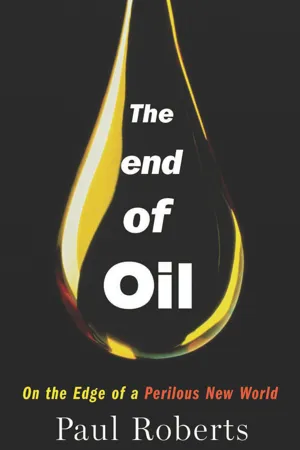
The End of Oil, journalist Paul Roberts talks to both oil optimists and pessimists around the world. He delves deep into the economics and politics, considers the promises and pitfalls of oil alternatives, and shows that—even though the world energy system has begun its epochal transition—we need to take a more proactive stance to avoid catastrophic disruption and dislocation.
- 401 pages
- English
- ePUB (mobile friendly)
- Available on iOS & Android
eBook - ePub
About this book
Information
Table of contents
- Title Page
- Contents
- Copyright
- Dedication
- Prologue
- Part I
- Lighting the Fire
- The Last of the Easy Oil
- The Future’s So Bright
- Energy Is Power
- Too Hot
- Part II
- Give the People What They Want
- Big Oil Gets Anxious
- And Now for Something Completely Different
- Less Is More
- Part III
- Energy Security
- The Invisible Hand
- Digging In Our Heels
- How Do We Get There?
- Notes
- Bibliography
- Acknowledgments
- Index
- Questions for Discussion
- About the Author
Trusted by 375,005 students
Access to over 1.5 million titles for a fair monthly price.
Study more efficiently using our study tools.
Frequently asked questions
Yes, you can cancel anytime from the Subscription tab in your account settings on the Perlego website. Your subscription will stay active until the end of your current billing period. Learn how to cancel your subscription
No, books cannot be downloaded as external files, such as PDFs, for use outside of Perlego. However, you can download books within the Perlego app for offline reading on mobile or tablet. Learn how to download books offline
Perlego offers two plans: Essential and Complete
- Essential is ideal for learners and professionals who enjoy exploring a wide range of subjects. Access the Essential Library with 800,000+ trusted titles and best-sellers across business, personal growth, and the humanities. Includes unlimited reading time and Standard Read Aloud voice.
- Complete: Perfect for advanced learners and researchers needing full, unrestricted access. Unlock 1.5M+ books across hundreds of subjects, including academic and specialized titles. The Complete Plan also includes advanced features like Premium Read Aloud and Research Assistant.
We are an online textbook subscription service, where you can get access to an entire online library for less than the price of a single book per month. With over 1.5 million books across 990+ topics, we’ve got you covered! Learn about our mission
Look out for the read-aloud symbol on your next book to see if you can listen to it. The read-aloud tool reads text aloud for you, highlighting the text as it is being read. You can pause it, speed it up and slow it down. Learn more about Read Aloud
Yes! You can use the Perlego app on both iOS and Android devices to read anytime, anywhere — even offline. Perfect for commutes or when you’re on the go.
Please note we cannot support devices running on iOS 13 and Android 7 or earlier. Learn more about using the app
Please note we cannot support devices running on iOS 13 and Android 7 or earlier. Learn more about using the app
Yes, you can access The End of Oil by Paul Roberts in PDF and/or ePUB format, as well as other popular books in Business & Energy Industry. We have over 1.5 million books available in our catalogue for you to explore.