Just as investors want the companies they hold equity in to do well, homeowners have a financial interest in the success of their communities. If neighborhood schools are good, if property taxes and crime rates are low, then the value of the homeowner's principal asset—his home—will rise. Thus, as William Fischel shows, homeowners become watchful citizens of local government, not merely to improve their quality of life, but also to counteract the risk to their largest asset, a risk that cannot be diversified. Meanwhile, their vigilance promotes a municipal governance that provides services more efficiently than do the state or national government.
Fischel has coined the portmanteau word "homevoter" to crystallize the connection between homeownership and political involvement. The link neatly explains several vexing puzzles, such as why displacement of local taxation by state funds reduces school quality and why local governments are more likely to be efficient providers of environmental amenities. The Homevoter Hypothesis thereby makes a strong case for decentralization of the fiscal and regulatory functions of government.
eBook - PDF
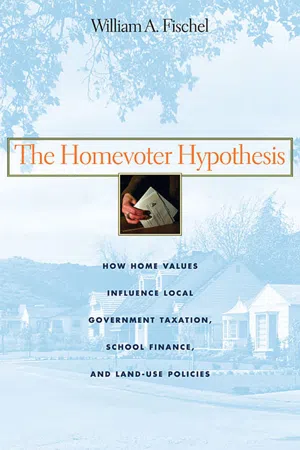
The Homevoter Hypothesis
How Home Values Influence Local Government Taxation, School Finance, and Land-Use Policies
- 346 pages
- English
- PDF
- Available on iOS & Android
eBook - PDF
The Homevoter Hypothesis
How Home Values Influence Local Government Taxation, School Finance, and Land-Use Policies
About this book
Information
Publisher
Harvard University PressYear
2009Print ISBN
9780674015951
9780674006096
eBook ISBN
9780674036901
Table of contents
- Contents
- Preface
- 1. An Asset-Market Approach to Local Government
- 2. Local Government’s Corporate Form
- 3. Capitalization, Zoning, and the Tiebout Hypothesis
- 4. The Median Voter in Local Government Politics
- 5. Serrano and the California Tax Revolt
- 6. The Fruits of School-Finance Centralization
- 7. The Race to the Top in Environmental Protection
- 8. “Beggar Thy Neighbor” and Landfill Location
- 9. How Homevoters Remade Metropolitan Areas
- 10. Sprawl, Metropolitanism, and Local Control
- 11. Reforming and Reaffirming Local Government
- Case References
- General References
- Index
Trusted by 375,005 students
Access to over 1.5 million titles for a fair monthly price.
Study more efficiently using our study tools.
Frequently asked questions
Yes, you can cancel anytime from the Subscription tab in your account settings on the Perlego website. Your subscription will stay active until the end of your current billing period. Learn how to cancel your subscription
No, books cannot be downloaded as external files, such as PDFs, for use outside of Perlego. However, you can download books within the Perlego app for offline reading on mobile or tablet. Learn how to download books offline
Perlego offers two plans: Essential and Complete
- Essential is ideal for learners and professionals who enjoy exploring a wide range of subjects. Access the Essential Library with 800,000+ trusted titles and best-sellers across business, personal growth, and the humanities. Includes unlimited reading time and Standard Read Aloud voice.
- Complete: Perfect for advanced learners and researchers needing full, unrestricted access. Unlock 1.5M+ books across hundreds of subjects, including academic and specialized titles. The Complete Plan also includes advanced features like Premium Read Aloud and Research Assistant.
We are an online textbook subscription service, where you can get access to an entire online library for less than the price of a single book per month. With over 1.5 million books across 990+ topics, we’ve got you covered! Learn about our mission
Look out for the read-aloud symbol on your next book to see if you can listen to it. The read-aloud tool reads text aloud for you, highlighting the text as it is being read. You can pause it, speed it up and slow it down. Learn more about Read Aloud
Yes! You can use the Perlego app on both iOS and Android devices to read anytime, anywhere — even offline. Perfect for commutes or when you’re on the go.
Please note we cannot support devices running on iOS 13 and Android 7 or earlier. Learn more about using the app
Please note we cannot support devices running on iOS 13 and Android 7 or earlier. Learn more about using the app
Yes, you can access The Homevoter Hypothesis by William A. Fischel in PDF and/or ePUB format, as well as other popular books in Law & Environmental Law. We have over 1.5 million books available in our catalogue for you to explore.