- 265 pages
- English
- PDF
- Available on iOS & Android
eBook - PDF
About this book
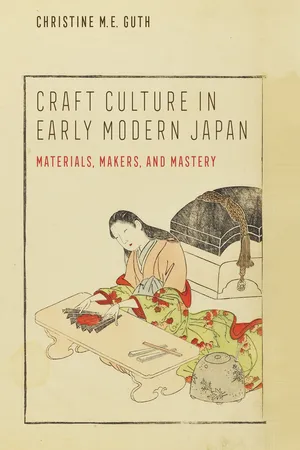
Articles crafted from lacquer, silk, cotton, paper, ceramics, and iron were central to daily life in early modern Japan. They were powerful carriers of knowledge, sociality, and identity, and their facture was a matter of serious concern among makers and consumers alike. In this innovative study, Christine M. E. Guth offers a holistic framework for appreciating the crafts produced in the city and countryside, by celebrity and unknown makers, between the late sixteenth and mid-nineteenth centuries. Her study throws into relief the confluence of often overlooked forces that contributed to Japan's diverse, dynamic, and aesthetically sophisticated artifactual culture. By bringing into dialogue key issues such as natural resources and their management, media representations, gender and workshop organization, embodied knowledge, and innovation, she invites readers to think about Japanese crafts as emerging from cooperative yet competitive expressive environments involving both human and nonhuman forces. A focus on the material, sociological, physiological, and technical aspects of making practices adds to our understanding of early modern crafts by revealing underlying patterns of thought and action within the wider culture of the times.
Information
22
Natural
Resources
Lacquer’s
connotations
of
luxury
made
it
a
valuable
natural
resource.
In
the
early
modern
era,
men
and
women
alike
were
deeply
concerned
with
the
facture
of
their
houses,
furnishings,
clothing,
and
other
goods—how,
by
whom,
and
of
what
materials
they
were
made.
Indeed,
with
rising
standards
of
living
and
growing
purchasing
power
among
commoners
in
both
city
and
countryside,
many
articles
that
had
previously
been
luxuries
now
became
necessities.
e
flourishing
market
economy
fostered
growing
consumption
across
all
levels
of
society,
and
many
craft
professionals
found
employment
in
the
manufacture
of
goods
for
domestic
use.
Furniture
historian
Koizumi
Kazuko
estimates
that
by
1800,
urban
households
owned
a
profusion
of
arti-
Figure
1.1.
Tapper
preparing
to
draw
sap
from
a
lacquer
tree.
Photo
courtesy
of
Guenther
Heckmann.
Table of contents
- Cover
- Craft Culture in Early Modern Japan
- Title
- Copyright
- Dedication
- CONTENTS
- Acknowledgments
- Prologue
- Introduction
- 1. Natural Resources
- 2. Picturing the Early Modern Craftscape
- 3. Craft Organizations and Operations
- 4. Tacit Knowledge
- 5. Technology, Innovation, and Craft Mastery
- Conclusion
- Notes
- Bibliography
- List of Illustrations
- Index
Trusted by 375,005 students
Access to over 1.5 million titles for a fair monthly price.
Study more efficiently using our study tools.
Frequently asked questions
Yes, you can cancel anytime from the Subscription tab in your account settings on the Perlego website. Your subscription will stay active until the end of your current billing period. Learn how to cancel your subscription
No, books cannot be downloaded as external files, such as PDFs, for use outside of Perlego. However, you can download books within the Perlego app for offline reading on mobile or tablet. Learn how to download books offline
Perlego offers two plans: Essential and Complete
- Essential is ideal for learners and professionals who enjoy exploring a wide range of subjects. Access the Essential Library with 800,000+ trusted titles and best-sellers across business, personal growth, and the humanities. Includes unlimited reading time and Standard Read Aloud voice.
- Complete: Perfect for advanced learners and researchers needing full, unrestricted access. Unlock 1.5M+ books across hundreds of subjects, including academic and specialized titles. The Complete Plan also includes advanced features like Premium Read Aloud and Research Assistant.
We are an online textbook subscription service, where you can get access to an entire online library for less than the price of a single book per month. With over 1.5 million books across 990+ topics, we’ve got you covered! Learn about our mission
Look out for the read-aloud symbol on your next book to see if you can listen to it. The read-aloud tool reads text aloud for you, highlighting the text as it is being read. You can pause it, speed it up and slow it down. Learn more about Read Aloud
Yes! You can use the Perlego app on both iOS and Android devices to read anytime, anywhere — even offline. Perfect for commutes or when you’re on the go.
Please note we cannot support devices running on iOS 13 and Android 7 or earlier. Learn more about using the app
Please note we cannot support devices running on iOS 13 and Android 7 or earlier. Learn more about using the app
Yes, you can access Craft Culture in Early Modern Japan by Christine M. E. Guth in PDF and/or ePUB format, as well as other popular books in Art & Art General. We have over 1.5 million books available in our catalogue for you to explore.