This comprehensive book describes the design, synthesis, mechanisms, characterization, fundamental properties, functions and development of self-healing smart materials and their composites with their allied applications. It covers cementitious concrete composites, bleeding composites, elastomers, tires, membranes, and composites in energy storage, coatings, shape-memory, aerospace and robotic applications. The 21 chapters are written by researchers from a variety of disciplines and backgrounds.
eBook - ePub
Self-Healing Smart Materials
- English
- ePUB (mobile friendly)
- Available on iOS & Android
eBook - ePub
About this book
Information
1
Self-Healing Polymer Coatings
Facundo I. Altuna* and Cristina E. Hoppe†
Instituto de Investigaciones en Ciencia y Tecnología de Materiales (INTEMA), Universidad Nacional de Mar del Plata—CONICET, Mar del Plata, Argentina
Abstract
Traditional coatings made of thermosetting polymers could not be healed or mended because of their cross-linked structure, so damage implied the end of their service life cycle. This picture has dramatically changed since the first self-healing systems reports, moment in which this “disadvantage” of thermosets has started to vanish with the continuous increase in the availability of self-healing and recyclable thermosetting polymers. These advances constitute a breakthrough, as they would avoid replacement and catastrophic failure, encourage recycling and re-processing and prevent the generation of a considerable amount of waste, with obvious environmental and economic benefits. This chapter describes some of the more recent advances in the field of self-healing thermosetting polymers with potential application as coatings. Extrinsic self-healing thermosets use an external agent to perform the healing whereas intrinsic ones require the intervention of an external trigger for repair damage. The first part of the chapter describes the work in extrinsic self-healing thermosets, and the second part in intrinsic ones, with emphasis on polymeric networks with dynamic covalent bonds (DCBs). The most common strategies for the external triggering of intrinsic self-healing polymers are also described. Finally, challenges are discussed with the aim put in attaining the so expected end-user applications.
Keywords: Self-healing, thermosets, dynamic covalent bonds (DCBs), coatings, crosslinked polymers
1.1 Introduction
Traditionally, materials science and technology research has been a quest for improving one or several properties of any given class of materials, so that they can have an enhanced performance. With this aim, all kinds of materials from ceramics and metals to glasses and soft polymers are nowadays designed based on strong scientific knowledge. However, during their service life, materials can suffer damages with consequences that range from affecting the way in which the materials are supposed to work to catastrophically break down or, in the case of a damaged coating, leaving the substrate deprived from its protection. In such cases, besides all the relevant physicochemical, mechanical, thermal and other properties, it would be highly desirable that the material could be mended. Doing so, it would avoid its replacement and save lots of time and economic resources. It would also prevent the generation of a considerable amount of waste, with obvious environmental and economic benefits. With this purpose, the development of self-healing polymers is gaining momentum since the first works studying healing mechanisms in polymers were published about 40 years ago [1, 2]. Another leap forward followed with the design of self-healing polymeric systems containing vessels with healing agents [3, 4], which demonstrated autonomous healing ability.
Thermosetting polymers constitute one of the two great polymer groups according to the most usual polymers classification. They distinguish themselves from thermoplastic polymers—which form the other group—by their crosslinked structure, which provides them with a set of distinctive properties, such as an improved resistance to solvents and chemical reagents, good mechanical strength and thermal stability [5]. Owed to these properties their use as protective coatings, among other applications, has become very popular. Unfortunately and also because of its crosslinked structure, typical thermosetting polymers cannot be healed. This is their main disadvantage in comparison with thermoplastics, which can be not only healed but also reprocessed and recycled by applying the proper processing that often includes a thermal treatment [6, 7]. These differences, however, are starting to vanish, as proved by the continuously increasing number of systems based on self-healing and recyclable thermosetting polymers appearing in the scientific literature. The relevance of the role that self-healing materials and recyclable thermosets are called to play has been already highlighted by the World Economic Forum, which listed them among the Top 10 Emerging Technologies in 2013 and 2015 respectively [8, 9].
In this chapter, we will describe some of the more recent advances in the field of self-healing thermosetting polymers with potential application as coatings. One of the most popular classification of self-healing thermosets is between extrinsic and intrinsic healing systems [10, 11]. The category of extrinsic self-healing thermosets encompasses all those systems that make use of an external agent to perform the healing of the damage. The self-healing composites with hollow microspheres or microfibers filled with a repairing agent, usually a thermosetting polymer precursor, are the most common examples. The healing mechanism of these materials intends to mimic how nature acts to heal wounds in animals, through a vascular system that delivers the healing agent. The healing process in polymers starts when a crack propagates through it and breaks the vessels that contain the repairing agent, which is released within the crack. At this moment, the repairing agent comes in contact with a catalyst dispersed in the matrix and reacts, forming a new polymeric network that fills the crack, restoring the mechanical properties to the material. To this group belong the first developed self-healable polymers [3, 4, 12, 13]. Figure 1.1 shows schematically the concept of extrinsic self-healing thermosetting polymers.
The other large group is formed by those self-healing polymers that do not require the intervention of an external healing agent. There are some examples of mixtures of thermoplastics and thermosets, either homogeneous or with a multi-phase structure, that use respectively the entanglements of dangling chains or the melted thermoplastic to mend an eventual crack [15, 16]. The majority of the reported intrinsic self-healing thermosets, however, are based on either reversible or dynamic covalent bonds. During healing, such crosslinked polymers are depolymerized or undergo a topological rearrangement, depending on whether the bonds that form the macromolecule are of reversible, or of dynamic nature [17–19]. In both cases, when the healing is produced the same polymer acts as its own healing agent. The disadvantage of most intrinsic self-healing polymers is that they need an external stimulus—such as heat, light or a mechanical stress—to induce the healing. Figure 1.2 shows schemes of the aforementioned intrinsic self-healing thermosets.
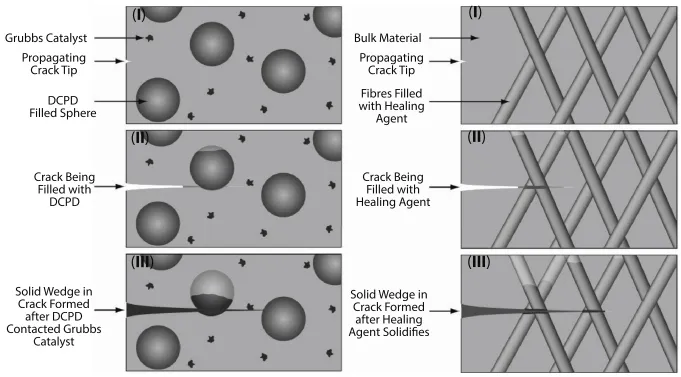
Figure 1.1 Concept of healing mechanisms in microcapsule- (left column) and hollow fiber- (right column) based self-healing composites. Extrinsic polymeric composites. Adapted from Ref. [14]; Copyright (2008) with permission from Elsevier.
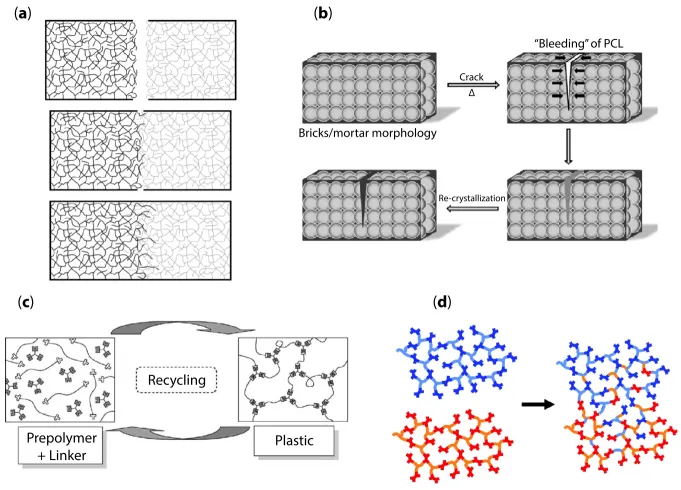
Figure 1.2 Intrinsic healing mechanisms for thermosetting polymers. (a) Homogeneous mixtures of thermosetting and thermoplastic polymers. Reprinted with permission from Ref. [14]. Copyright (2008) with permission from Elsevier. (b) Heterogeneous mixtures of thermosetting and thermoplastic polymers. Reprinted with permission from Ref. [15]; Copyright (2009) American Chemical Society. (c) Polymeric networks based on reversible covalent bonds. Reproduced with permission from Ref. [20]. Copyright (2008) John Wiley & Sons, Inc. (d) Polymeric networks based on dynamic covalent bonds. Adapted with permission from Ref. [21]. Copyright (2012) American Chemical Society.
Other characteristics of the self-healing coatings are also of critical relevance for their final applications. Perhaps the most important one regards the stimulus needed for the self-healing process to start, ranging from materials that need no stimulus to the cases where high temperatures or external stresses have to be applied. This would be another valid classification for self-healing materials, but as we will find out, very often the limit between them is somewhat blurred. In most cases extrinsic self-healing polymers are totally or nearly autonomous, and intrinsic ones need an external triggering. That is, most intrinsic self-healing coatings should not be regarded as self-healing, but instead just as healable materials. There are as well some notable exceptions to this statement that deserve to be considered.
Extrinsic self-healing polymers were developed several years before that intrinsic ones. However, nowadays intrinsic self-healing polymers are a much faster growing research field, led by polymeric networks based on dynamic covalent bonds (DCBs). We will devote the first part of this chapter to extrinsic self-healing thermosets, and a second part to intrinsic ones, with special emphasis on polymeric networks with DCBs. Finally, we will provide a perspective for futu...
Table of contents
- Cover
- Table of Contents
- Title Page
- Copyright
- Preface
- 1 Self-Healing Polymer Coatings
- 2 Smart Phenolics for Self-Healing and Shape Memory Applications
- 3 Self-Healable Elastomers
- 4 Self-Healable Tires
- 5 Self-Healing Bacterial Cementitious Composites
- 6 Self-Healable Solar Cells: Recent Insights and Challenges
- 7 Self-Healable Core–Shell Nanofibers
- 8 Intrinsic Self-Healing Materials
- 9 Self-Healable Catalysis
- 10 Self-Healing Materials in Corrosion Protection
- 11 Self-Healable Conductive Materials
- 12 Self-Healable Artificial Skin
- 13 Self-Healing Smart Composites
- 14 Stimuli-Responsive Self-Healable Materials
- 15 Mechanically-Induced Self-Healable Materials
- 16 Self-Healing Materials in Robotics
- 17 Self-Healing Materials in Aerospace Applications
- 18 Bio-Inspired Self-Healable Materials
- 19 Self-Healable Batteries
- 20 Self-Healing in Bleeding Composites
- 21 Self-Healing Polymers
- Index
- End User License Agreement
Trusted by 375,005 students
Access to over 1.5 million titles for a fair monthly price.
Study more efficiently using our study tools.
Frequently asked questions
Yes, you can cancel anytime from the Subscription tab in your account settings on the Perlego website. Your subscription will stay active until the end of your current billing period. Learn how to cancel your subscription
No, books cannot be downloaded as external files, such as PDFs, for use outside of Perlego. However, you can download books within the Perlego app for offline reading on mobile or tablet. Learn how to download books offline
Perlego offers two plans: Essential and Complete
- Essential is ideal for learners and professionals who enjoy exploring a wide range of subjects. Access the Essential Library with 800,000+ trusted titles and best-sellers across business, personal growth, and the humanities. Includes unlimited reading time and Standard Read Aloud voice.
- Complete: Perfect for advanced learners and researchers needing full, unrestricted access. Unlock 1.5M+ books across hundreds of subjects, including academic and specialized titles. The Complete Plan also includes advanced features like Premium Read Aloud and Research Assistant.
We are an online textbook subscription service, where you can get access to an entire online library for less than the price of a single book per month. With over 1.5 million books across 990+ topics, we’ve got you covered! Learn about our mission
Look out for the read-aloud symbol on your next book to see if you can listen to it. The read-aloud tool reads text aloud for you, highlighting the text as it is being read. You can pause it, speed it up and slow it down. Learn more about Read Aloud
Yes! You can use the Perlego app on both iOS and Android devices to read anytime, anywhere — even offline. Perfect for commutes or when you’re on the go.
Please note we cannot support devices running on iOS 13 and Android 7 or earlier. Learn more about using the app
Please note we cannot support devices running on iOS 13 and Android 7 or earlier. Learn more about using the app
Yes, you can access Self-Healing Smart Materials by Mohd Imran Ahamed, Rajender Boddula, Tariq Altalhi, Mohd Imran Ahamed,Rajender Boddula,Tariq A. Altalhi,Tariq Altalhi, Mohd Imran Ahamed, Rajender Boddula, Tariq A. Altalhi in PDF and/or ePUB format, as well as other popular books in Biological Sciences & Biotechnology. We have over 1.5 million books available in our catalogue for you to explore.