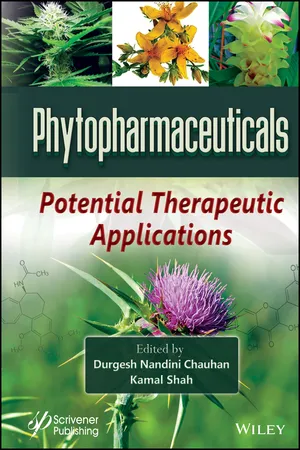
Medicinal plants contain a variety of bioactive compounds, (also referred to as phytochemicals). in the leaves, stems, flowers and fruits. This book covers these bioactive compounds, their available sources, how the bioactive molecules are isolated from the plants, the biochemistry, structural composition and potential biological activities. Also discussed are the pharmacological aspects of medicinal plants, phytochemistry and biological activities of different natural products, ethnobotany and medicinal properties, as well as a novel dietary approach for various disease management and therapeutic potential. The importance of phytopharmaceutical of plants and potential applications in the food and pharma industries is highlighted.
eBook - ePub
Phytopharmaceuticals
Potential Therapeutic Applications
- English
- ePUB (mobile friendly)
- Available on iOS & Android
eBook - ePub
Phytopharmaceuticals
Potential Therapeutic Applications
About this book
Information
1
A Great Challenge on the Reproducibility of Therapeutic Results of Phytopharmaceuticals
Idha Kusumawati
Pharmacognosy and Phytochemistry Department, Faculty of Pharmacy, Airlangga University, C Campus Jl, Surabaya, Indonesia
AbstractPhytopharmaceuticals contain a complex mixture of constituents from herbal medicine. It is important to understand that pytopharmaceutical therapeutic result and safety are built from all its constituents. Reproducibility of phytopharmaceutical quality must be guaranteed from raw material to end product and from batch to batch production. Determination of quality cannot only be based on one or a group of marker compounds because it will not be able to describe a complex mixture of ingredients. To represent the complexity of constituent in phytopharmaceuticals, chemical finger-prints have to be used which can be obtained by various chromatography and other methods.Keywords: Phytopharmaceuticals, complex mixture, marker constituent, chemical fingerprint, medicine, R&D investment
1.1 Introduction
For many centuries, herbal medicine has been used to prevent and cure various diseases. This relates to cultural popularity, ease of access, and relatively low prices. In ancient times, herbs use was based on instinct, taste, and experience so that people could distinguish plants that were beneficial to health, not useful or toxic. The public can also find out which processing method should be used to obtain optimal efficacy [1] Chinese, Unani, Homeopathy, and Siddha. Traditional medicine using herbal formulas is widely used to treat complex diseases for years. The herbal formula often consists of several herbs and contains various chemical compounds, making it possible to have several unknown targets and treatment functions [2]. Medicinal plants are also important sources of substances with biological activity. Approximately 25% of modern medicines are directly or indirectly derived from plants [1].
Herbal products have excellent potential in the pharmaceutical segment. There are three categories of herbal products; traditional herbal medicine, over-the-counter (OTC) herbal medicine, and phytopharmaceuticals. Traditional herbal medicines are based on empirical efficacy and supported by ancient beliefs, and are prescribed individually. The OTC herbal medicinal products do not yet have scientific clinical data and evidence but are already in pharmaceutical preparations. The phytopharmaceuticals made based on data, scientific evidence, and clinically tested [3]. The phytopharmaceuticals is a standardized herbal preparation containing active ingredients in a complex mixture of plant ingredients. This preparation does not have an immediate or strong pharmacological effect; therefore, it is not appropriate for emergency treatment [1, 4].
An herbal product, either in the form of plant parts (fresh or dried) or plant extracts, contains many constituents that often work together synergistically. The active ingredient in herbal medicine preparations is the entire chemical content. It can also be one of the compounds that have confirmed therapeutic activity or a group of compounds with the same core structure and are generally accepted that have a substantial contribution to the drug’s therapeutic activity. With varying chemical contents in a plant, no one plant is recommended for only one disease; and no one disease is related to only one plant [1, 4, 5].
Besides having tremendous potential, various reports show the side effects of herbal products. People always assume that herbal medicines are safe and there are no side effects compared to synthetic drugs due to their nature. This perception causes herbal medicines are often misused and consumed like food, not as medicine. Various studies have shown there are many interactions between herbs with herbs or herbs with drugs. The herbal medicines are considered complementary medicines that can be consumed together with synthetic medicines [6, 7].
Even though herbal medicines lately tend to increase, unfortunately, it is followed by an increase in various adverse effects of herbal use. One of the biggest causes of these cases is closely related to the poor quality of phytopharmaceuticals used. For this reason, the issue of phytopharmaceutical quality is crucial to consider [8].
Difficulties in quality control and lack of scientific evidence in terms of herbal medicines efficacy have resulted in their use being replaced by a synthetic drug. However, in alternative medicine, herbal medicine still exists in various parts of the world [4, 5]. For this reason, the chemical substance composition in phytopharmaceutical has to fulfill the quality because it will influence the effectiveness and safety’s reproducibility at the clinical level [5, 9].
1.2 Common Challenges in Phytopharmaceuticals
Herbal medicines usually consist of plant parts, either single or in combination in pharmaceutical dosage forms. Like synthetic drugs, herbal medicine also has therapeutic or prophylactic properties. The interaction of its multi-component ingredients causes poly-pharmacological effects or is known as a multi-target effect. The application of this concept in phytopharmaceuticals development requires comprehensive characterization of chemical content and bioactivity [10].
Phytopharmaceuticals can become part of the health care system if they can prove their quality to guarantee the safety and efficacy as expected. But until now, it is still challenging to ensure the quality, safety, and effectiveness of phytopharmaceuticals. Quality assurance must be applied at every production stage starting from cultivation, harvesting, post-harvest processing, manufacturing, packaging, and product distribution. Quality assurance at each step is intended to ensure the reproducibility of its effectiveness and safety [5, 9, 11, 12].

Figure 1.1 The great challenges in phytopharmaceuticals reproducibility.
In the following, we will discuss the three most significant challenges of developing phytopharmaceutical products not found in synthetic drugs as illustrated in Figure 1.1.
1.2.1 Authentication of Raw Material
Lately, the use of phytopharmaceuticals has increased so that medicinal plants have become an important agricultural commodity. Many medicinal plants are sold in various dosage forms such as fresh ingredients, dried ingredients, dry powdered materials, and extracts, making it impossible to authenticate morphology because such materials have lost their characteristics. Increased demand for medicinal plants has caused unethical commercial trade, such as replacing authentic raw materials with other materials that are similar but less effective. The act of counterfeiting or mixing herbs of low-quality herbs will affect consumer health and safety, so that authentication and determination of the quality of herbal raw materials is a critical point in guaranteeing the quality of pharmaceuticals [13, 14].
Authentication is a guarantee of compliance with the required specifications. Authentication covers various aspects, including identifying, quantifying of characteristic components, adulteration, contaminants, and verification of quality according to specifications. Specification of medicinal plant raw material is including botanical or geographical origin, manufacturing, or processing procedures of its preparation [15, 16].
Ancient healers have a very high ability to recognize the ingredients used in their medicinal herbs. However, with the development of modernization, the loss of contact with nature has reduced the ability to identify medicinal plants. Ancient texts about herbal medicine are often translated and interpreted differently, and as a result, there are the same names for more than one plant and different names for one plant. This condition is increasingly tricky with language diversity and local dialects [17, 18].
The morphological similarity of plant parts causes misidentification of herbal raw materials. Faulty raw materials can occur either intentionally or unintentionally. Adulteration usually occurs concerning the material’s economic value, for example, by replacing authentic raw material with other similar plant species. Accidental mistakes can happen mainly because workers’ carelessness collects wild plants as raw material [19–21].
Nomenclature problems cause misidentification that often occurs. Local names of plants are often referred to for their traditional use. The local name also often causes mistakes in raw materials and becomes dangerous, especially when replaced by poisonous plants. For example, in Traditional Chinese Medicine (TCM), the name “Fangji” is used for the root of Stephania tetrandra S. Moore (Menispermaceae). This species originated from the northern part of China. The official name in Chinese Pharmacopoeia is “Hanfangji”. The name “Fangji” is also used for the roots of Aristolochiafangchi YC Wu ex LD Chow & SM Hwang (Aristolochiaceae) originating from the southern region. In pharmacopeia, it is referred to as “Guangfangji”, and contains nephrotoxic and carcinogenic acid derivatives [11].
Misidentification also occurs in different species of plants that have the same local name. The two species have different pharmacological activities so that their use will not achieving therapeutic targets. In Indonesia, Mesua ferrea is called “Nagasari”, or in India, it is called “Nagakeshara”, an herb used for heart tonic, cardiotonic, emenagogue, hypotensive, antispasmodic, antianaphylactic, and antiasthmatic. However, Calophyllumino phylum is also sold under the local name “Nagasari” or “Nagakeshara”. This plant is usually used for antiinflammatory and treatment of psoriasis [22, 23].
Hypericum androsaemum is traditionally used for its diuretics and hepatoprotectives. Due to high demand bu...
Table of contents
- Cover
- Table of Contents
- Title Page
- Copyright
- Preface
- 1 A Great Challenge on the Reproducibility of Therapeutic Results of Phytopharmaceuticals
- 2 Ibero-American Network as a Collaborative Strategy to Provide Tools for the Development of Phytopharmaceuticals and Nutraceuticals
- 3 Use of Hydrodistillation as a Green Technology to Obtain Essential Oils From Several Medicinal Plants Belonging to Lamiaceae (Mint) Family
- 4 The Hidden Danger in Phytopharmaceuticals: Adulteration
- 5 Medicinal Plants from the Balkan Peninsula—From Traditional To Modern Pharmacy/Medicine
- 6 Plant-Based Peptides With Biological Properties
- 7 Potential of Flavonoids as Anticancer Drugs
- 8 Phytomedicine Against Infectious Diseases
- 9 Herbal Traditional Remedies for Male Infertility
- 10 The Therapeutic Applications of Phytopharmaceuticals in Dentistry
- 11 Prevention of Vascular Endothelial Dysfunction by Polyphenols: Role in Cardiovascular Disease Prevention
- 12 Quercetin-Rebuttal Behavior in Male Reproductive Potential
- 13 Traditional Uses and Bioactivities of Common Rubus Species With Reference to Cancer: A Mini-Review
- 14 Therapeutic Compounds From Brown Seaweeds: Antitumor Properties on Various Cancers and Their Mechanisms of Action
- 15 Medicinal Plants and Polycystic Ovary Syndrome
- 16 The Potential Role of Phytochemical in Establishing Prophylactic Measurements Against Neurological Diseases
- 17 Immunomodulatory Activity of Cannabinoids: From Abuse to Therapy
- 18 Botany, Geographical Distribution, Phytochemistry and Phytopharmaceutical Potential of Rheum emodi Wall. ex Meisn.: An Overview
- 19 Taxonomic Status, Phytochemical Constituents and Pharmaceutical Active Components of Genus Alseodaphne: A Literature Update
- 20 Bioactive Compounds From Schinus terebinthifolius Raddi and Their Potential Health Benefits
- 21 Composition and Biological Properties of Rambutan (Nephelium lappaceum)
- 22 Phytochemicals and Health: An Update
- Index
- Also Available by the Same Editors
- End User License Agreement
Trusted by 375,005 students
Access to over 1.5 million titles for a fair monthly price.
Study more efficiently using our study tools.
Frequently asked questions
Yes, you can cancel anytime from the Subscription tab in your account settings on the Perlego website. Your subscription will stay active until the end of your current billing period. Learn how to cancel your subscription
No, books cannot be downloaded as external files, such as PDFs, for use outside of Perlego. However, you can download books within the Perlego app for offline reading on mobile or tablet. Learn how to download books offline
Perlego offers two plans: Essential and Complete
- Essential is ideal for learners and professionals who enjoy exploring a wide range of subjects. Access the Essential Library with 800,000+ trusted titles and best-sellers across business, personal growth, and the humanities. Includes unlimited reading time and Standard Read Aloud voice.
- Complete: Perfect for advanced learners and researchers needing full, unrestricted access. Unlock 1.5M+ books across hundreds of subjects, including academic and specialized titles. The Complete Plan also includes advanced features like Premium Read Aloud and Research Assistant.
We are an online textbook subscription service, where you can get access to an entire online library for less than the price of a single book per month. With over 1.5 million books across 990+ topics, we’ve got you covered! Learn about our mission
Look out for the read-aloud symbol on your next book to see if you can listen to it. The read-aloud tool reads text aloud for you, highlighting the text as it is being read. You can pause it, speed it up and slow it down. Learn more about Read Aloud
Yes! You can use the Perlego app on both iOS and Android devices to read anytime, anywhere — even offline. Perfect for commutes or when you’re on the go.
Please note we cannot support devices running on iOS 13 and Android 7 or earlier. Learn more about using the app
Please note we cannot support devices running on iOS 13 and Android 7 or earlier. Learn more about using the app
Yes, you can access Phytopharmaceuticals by Durgesh Nandini Chauhan, Kamal Shah, Durgesh Nandini Chauhan,Kamal Shah in PDF and/or ePUB format, as well as other popular books in Physical Sciences & Organic Chemistry. We have over 1.5 million books available in our catalogue for you to explore.