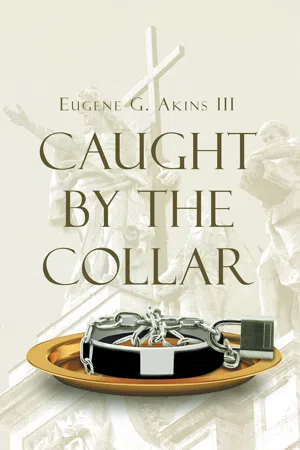
Caught by the Collar is an attempt to shed light on the inaccuracies and inefficiencies in the teachings and methodology of teaching in the Pentecostal church. In too many instances, sincere followers of Christ are lost in a quagmire of unanswered questions and errant doctrine. They end up with stunted or stagnant growth and sometimes turn away from Christ altogether. In many cases, these errors and confused teachings can be directly connected with the ideas that the Bible is confusing or contradictory. It is unfortunate that for so many years so many church leaders have either failed to recognize this issue or have intentionally chosen not to address it. In fact, holding on to and continuing to teach ideology and principles that are out of line with scriptures sounds suspiciously like teaching "another gospel, " which the Bible specifically speaks against. As a lifetime member of this denomination, Eugene Akins has personally experienced the confusion caused when scripture is misinterpreted, the failure that occurs when scripture is not implemented, and the heartbreak that is precipitated by clergymen who should be in some other line of work. Many of the members of these churches are caught in what they have been told versus what they know and understand. They are caught in traditions and hand-me-down word bites versus the truth of the scriptures, and when the clergy is primarily responsible for all this clutter, church members are caught by the collar.
- 228 pages
- English
- ePUB (mobile friendly)
- Available on iOS & Android
eBook - ePub
About this book
Information
To Serve Man
One of my favorite episodes of the classic TV series The Twilight Zone involved aliens coming to earth. The plot was that a race of beings presents themselves as good neighbors that just want to help the earth with some problems they have noticed from afar. They don’t seem to want anything but to be helpful and supply our planet with some technology that we just can’t say no to. The ambassador from afar happens to leave a book laying around that is written in this alien language. The US military employs a linguist/code specialist to decipher the language. After several weeks Mr. Chambers makes out the title of the book but that’s all. The title is To Serve Man, which seems to go along with all the beneficence the “Kanamits” have shown since arriving. After several months of “serving man,” stopping war, famine, and disease the earth’s governments decide the new friends are genuine and authorize trips to the alien planet for anyone who is interested. After giving up on decoding the book and not having anything to do since there is no more war, Mr. Chambers decides to visit the alien planet himself. Just as he is about to board the spaceship, his assistant runs into the launch site imploring Mr. Chambers not to get onto the craft. She has continued to work on the deciphering and has found that the book To Serve Man is a cookbook! If they had been able to unlock the language, they would have known what the book was all about. They would have been able to save the lives of thousands if they had only known not to get on the ships! Of course, The Twilight Zone is not real but this illustrates a similar issue that exist when reading the Bible. I believe there are several mistakes made when reading the Bible that lead to much of the confusion in understanding scripture and therefore errant principles and doctrines. The primary purpose of the Bible is “to serve man.” That is to serve, help, support, guide man in his efforts to serve God. If we don’t read the service manual or we don’t read it correctly or we don’t understand what we read, it’s like trying to put something together without reading the directions. It takes a lot more time and somehow it doesn’t feel sturdy. Then you notice there are things left over that you have no idea what to do with or where they were supposed to go. So let’s talk about the Bible.
Most people know that the Bible is a book of books. That is it is made up of several individual writings by many different authors. But many people don’t realize there were many other writings that were considered for inclusion into the sacred book. For example, the Gospel of Mary; Jesus’s Infancy Gospel 1, 2; the Gospel of Nicodemus; the Epistle of Christ, Laodecians; the Apocalypse of Peter; the Epistle of Barnabas; Shepherd of Hermas; 1 Clement; the Gospel of Thomas; the Lost Epistle to the Corinthians. These are just a few of the many writings that were not included in the final grouping. The sixty-six works that make up the Holy Bible are known as “the canon of scripture.” That phrase refers to the list of books recognized as worthy to be included in the sacred writings of a worshipping community. For Christians, it is the group of writings recognized as being of divine inspiration. The word canon is from a Greek word (kanon) that means rod as in a special ruler used for measuring. This led to the use of the word as a standard. So in the early church, the canon was the group of writings that were to be used as the basis of any doctrinal philosophy under a Christian heading. Thomas Aquinas said, “Canonical scripture alone is the rule of faith.” In 1647, after listing the sixty-six books of the Bible.
The Westminster Confession of Faith added, “All which are given by the inspiration of God to be the rule of faith and life.” So while the canon of scripture means the list of books accepted as holy scripture, it also has a sense of “the rule and standard by which belief and Christian life are gauged.” So the Bible is a book. It is a sacred and holy book to be revered and esteemed above all others. But it is in fact a book! I think when this fact is overlooked, there are many pitfalls waiting for the reader, so let’s look at the book.
So what do I mean it’s a book? Well, it has a front and a back, a beginning and an end. It has chapters, paragraphs, sentences, commas, and periods. No, I’m not trying to be funny. The point is these are very important parts of the construct of a book. Without all of these elements, all you have is a bunch of words strung together. In fact, without the spaces, they are just a bunch of letters one next to the other. “Ohwhatagooseiam” has no meaning until the spaces are added to reveal “Oh what a goose I am.” If the recipes in a cookbook are not followed accurately, you don’t know how your product will turn out. It may look like the picture displayed and taste terrible. It may taste wonderful but does not stand up as firmly as it should. If you don’t understand the recipe or measuring or any of the chemistry of cooking, you may do well with some things but with others not so much. Failing to understand the Bible can come from a lack of understanding or failure to recognize the constructs of its creation. So we have all the literary tools that have been employed along with all the different authors and all the different styles. To top it all, none of the contributors were actual writers. So just from a literary standpoint there are many ways that our quest to “rightly divide the word” can be derailed. From this perspective, it is not surprising that there are so many misunderstood concepts in the charismatic/Pentecostal churches, which have always focused on the spiritual/mystic rather than the scriptural aspect of the relationship with God. Because of this spiritual focus, charismatics put more emphasis on what is seen and felt versus what the written word is really trying to say. Because of the focus on the intangible, critical logical thinking often takes a backseat. The idea that Abel’s blood was actually speaking could be avoided simply by asking the logical question, does blood speak? Since it does not, this scripture must mean something else. Instead with a mystic focus we allow ourselves to take the leap that something spiritual happens to the blood that allowed it to have the power to do something that no other blood can do simply because God is involved. There is no one who is more logical than God and he would not want his words read without logic. God inspired the authors of the Bible and “God is not the author of confusion” (1 Cor. 14:33). It simply does not make sense that we cast logical analysis aside when trying to understand the Bible. I sometimes joke that when we finally see God, he will probably be shaking his head from side to side in disbelief at the things that some of us have gotten wrong. Logic has to be a part of “rightly dividing the word of truth.”
Not understanding what kind of book you are reading can diminish your ability to understand the meaning of the book. For example, there are three kinds of books in the Old Testament: historical, poetic, and prophetic. The history books are Genesis, Exodus, Leviticus, Numbers, Deuteronomy, Joshua, Judges, Ruth, 1 and 2 Samuel, 1 and 2 Kings, 1 and 2 Chronicles, Ezra, Nehemiah, and Esther. The poetry is Job, Psalms, Proverbs, Ecclesiastes, and Songs of Solomon. The prophetic are Isaiah, Jeremiah, Lamentations, Ezekiel, Daniel, Hosea, Joel, Amos, Obadiah, Jonah, Micah, Nahum, Habakkuk, Zephaniah, Haggai, Zechariah, and Malachi. To understand the Bible, there must be clarity between these books.
The history is that of the nation of Israel and her relationship to God. It is the history and foundation of the Jewish religion. It is a history of the law and the evidence of man’s inability to keep the law. It records the rituals of the worship and the remedies for the sin. These rituals and remedies do not, however, apply to us as Christians today. Quite frankly, there is not a lot of trouble in this area. We don’t have a lot of Christian churches advocating burnt offerings and animal sacrifice or observing the many festivals of the OT. That is very good because they don’t apply to Christians they apply to Jews. When we read the OT, it is important to understand we are not reading a book on how to be a Christian, we’re reading how to be a Jew. Of course there are exceptions. The Ten Commandments carry over into the NT because they are a part of the foundation of righteous living and a life that pleases God. They are fundamental to our understanding of God and what he expects from us. Since God does not change what he expects from us does not change whether Jew or Christian. Therefore all of the ideas in the commandments can be found in some form throughout the NT.
- Thou shalt have no other God before me. (Matt. 4:10, Lk. 4:8)
- Thou shalt not make any graven image. (Acts 15:20, 1 Cor. 10:7, 14)
- Thou shalt not take name of the Lord in vain. (Mk. 6:9, Lk. 11:12, Matt. 15:8, 9, 12:36)
- Remember the Sabbath day. (Matt. 12:8, 12; Mark 2:27, 27, 28; Lk. 6:5)
- Honor thy parents. (Matt. 19:19, Mk. 10:19, Eph. 6:1–3)
- Thou shalt not commit murder. (Matt. 5:21; Mk. 10:19; Ro. 13:9)
- Thou shalt not commit adultery. Matt. 5:27, 28, 32; Matt. 19)
- Thou shalt not steal. (Matt. 19:18, Ro. 13:9, Eph. 4:28)
- Thou shalt not bear false witness. (Matt. 15:19, 20, 19:18; Ro. 13:9)
- Thou shalt not covet. (Lk. 12:15, Ro. 7:7, Ro. 13:9)
These NT verses that parallel the commandments are just a few of the multitude of verses that can be found to do so. These foundational ideas occurring in both the old and new testaments illustrate a principle that should be recognized when studying the Bible and that is “recurring themes.”
The idea of recurrence is that anything of theological importance that should be observed by NT Christians will be found in the NT more than once or it will be stated as a command if found only once. If something from the OT should be observed by us, it will be found in the NT such as the scriptures above relating the ideas of the Ten Commandments. God’s grace, his love, mercy, and longsuffering are all prominent themes in the OT and all are very obvious in the NT. It is impossible to read the Bible with any intelligence and not recognize that God desires our growth toward him in righteousness. Both testaments make this clear over and over with many different writers and situations. We can get it wrong when we fail to realize that God will, more times than not, repeat the important stuff as exemplified in “verily, verily I say unto you.” I think he repeats it because he wants to be sure we get it, and he knows how prone we are to lean toward our own understanding. Some things are a little harder to identify as belonging to the old or new testaments or both.
The Sabbath is one of those things. Some denominations believe because the Sabbath was originally observed on the last day of the week that it should continue being observed on Saturday as do the Jews. Most Christian denominations observe Sunday as the day of rest based on Christ rising on that day. The Sabbath is first mentioned in Genesis 2:2–3 when God rested from his creation work on that day and blessed and sanctified that day. In Exodus 31:13–17 the Sabbath is noted as a sign between God and Israel. Exodus 20:8–11 explains that no work should be done on that day, but it says nothing about worship. In the NT, Christ observed the Sabbath in the synagogue (Lk. 4:16, 13:10; Mk. 6:2) but then defied the Pharisees gauge of Sabbath observance with an exorcism (Lk. 4:31–32, 33–36). In Mark 2:27, Jesus states, “The Sabbath is for man and not man for the Sabbath.” Nowhere in the Bible are the Gentiles taught to observe the Sabbath nor are they condemned for failing to do so. The disciples gathered in Acts 20:7 for what sounds like the first description of a “church service” because Paul was preaching and this was on the first day of the week. In 1 Corinthian 16:2, a collection was taken also on the first day. In Romans 14:5, Paul forbids observers of the Sabbath condemning nonobservers and he directs us not to be judged by keeping Sabbaths in Colossians 2:16. Jesus, being a Jew, would of course observe the Jewish tradition of worship on the Hebrew Sabbath. His visits to the synagogue were in keeping with what he had grown up with all his life. None of these visits record any of the disciples joining him. One would think that if this were of great importance, we would see at least a couple of instances when they were together at the synagogue. Knowing that his mission was to the whole world and not just the Jews, it seems he didn’t focus on something that was after all Jewish. In Matthew 12:8, Jesus declares himself Lord of the Sabbath.
He seems to be saying that he and what he is teaching supersede the Sabbath. He doesn’t condemn the Sabbath as evidenced by his own observance, but he refuses to make it a task master as the Pharisees have. He seems to take this thought a step further when he says, “The Sabbath is for man.” I believe that means for man’s good, for man’s benefit, to help man, “to serve man.” I believe the Sabbath is a tool that assists man in his endeavor to serve God. Sabbath day observance maintains a regular pattern of communication and interaction with God. Perhaps Christ is saying it’s more important that we choose a day than which day we choose. But being omniscient, Christ knew there would come a time and a culture where some men would not have the luxury of not working on Saturday or Sunday as is the case today. Some people pine for the day when they can come to worship services with the others in their church family but the constraints of their employ do not allow that pleasure at this time. What about professional athletes? Should they be deprived the blessings of a God-given physical talent because the games are on a traditional Sabbath? Or should we teach that you can’t be a professional athlete and be saved? If a person works on Saturday and Sunday and the Sabbath was made for man, it seems that man should be able to observe another day of the week. The point of the Sabbath is after all to honor and glorify God. If God knows my situation and I set aside Wednesday to keep it holy, wouldn’t God be as pleased with me as those who kept traditional worship days? When I was growing up, the answer would be no! And there are those I’m sure now who would agree, no! Quit that job and let God provide you with another. It’s more important to come to church on a specific day than to hold onto a good job. So where do you place being a good steward in this scenario? Then there are those pastors who would take the opposite stance and encourage that person to remain employed as long as they are sending their tithes and offering! Both cannot be correct! Christ came to us as a Jew demonstrating how to be a Jew and then taught us that just being a Jew wasn’t enough. So it amazes me that it is sometimes difficult to separate things Jewish from things Christian. Perhaps I shouldn’t be amazed. Perhaps it is not so much a matter of difficult but a matter of choice. Take tithes for example.
The modern dictionary defines tithing as paying or giving one-tenth of annual production or earnings as a tax for the support of the church and clergy. I grew up with this tradition as did many of today’s Christians. My mother often shared her first experiences paying tithes with great pride and joy. When she was a very small child, as young as under ten, whenever she received a gift of money for a birthday or made money doing a chore, she couldn’t wait to put her nickel or ten cents in an envelope on Sunday and place it in the tithing vessel. Over the years, I’ve come to the conclusion that there are basically three categories of tithe payers: The 100%ers, the Spocks, and the tippers.
My parents were 100%ers. This group believes in paying that 10 percent out of every check no matter what happens. They take the tithe off the top and figure out what else will get paid after that. No matter what the need or the emergency, the tithe was to be paid first. Now I have ten siblings, and my father struggled working three jobs most of my life so I know there must have been times when they missed payments. In those cases, there would be an additional amount owed much like a late payment on a loan! The extent to which you adhered to or deviated from timely payment was a reflection of your dedication to God. It was actually considered sinful if tithes weren’t paid. If a person aspired to a particular office or position and did not pay tithes, they could forget any such appointments. They could be qualified on a professional and academic level, but if they were not tithing, they were out. I once heard a discussion about tithing and heaven. There was a woman who was tragically killed by an automobile one Monday morning on the way to work. She had missed church the day before (Sunday) and so did not pay her tithes. She had the tithes at home, and they were set aside, but since she did not get them to the church, there was some question as to whether this kept her out of heaven. The woman was loving, kind, faithful, and honest. She was always sacrificing for others and trying to help any and everyone she found in need. I personally knew her and to this day have never heard anyone say anything negative about her but some thought missing one tithe payment might keep her from seeing God!
The next group I call the Spocks (Star Trek). These are the more logical tithers. They believe in paying the 10 percent but not at the expense of letting bills lapse or taking care of real necessities for home and family. These people would say they love God just as much as the first group but do not think it is sensible to pay tithes when there is a financial issue that needs attention. They would be more likely to pay a portion of what they owe in these cases. They would likely recognize that scripture admonishes us toward good stewardship (1 Tim. 5:8) and the wise use of the finances God has provides for us. When speaking to those in this group, you can sense the rec...
Table of contents
- Introduction
- In the Beginning
- Obedience (Weapon of Mass Destruction)
- To Serve Man
- Fractured Fairy Tales
- We Don't Need No Stinking Papers
- Follow the Leader
- Satan's Ace
- Prophets for Profit
- Tongues: A Small Part of a Big Problem
- For God's Sake Get Understanding
- About the Author
Trusted by 375,005 students
Access to over 1.5 million titles for a fair monthly price.
Study more efficiently using our study tools.
Frequently asked questions
Yes, you can cancel anytime from the Subscription tab in your account settings on the Perlego website. Your subscription will stay active until the end of your current billing period. Learn how to cancel your subscription
No, books cannot be downloaded as external files, such as PDFs, for use outside of Perlego. However, you can download books within the Perlego app for offline reading on mobile or tablet. Learn how to download books offline
Perlego offers two plans: Essential and Complete
- Essential is ideal for learners and professionals who enjoy exploring a wide range of subjects. Access the Essential Library with 800,000+ trusted titles and best-sellers across business, personal growth, and the humanities. Includes unlimited reading time and Standard Read Aloud voice.
- Complete: Perfect for advanced learners and researchers needing full, unrestricted access. Unlock 1.5M+ books across hundreds of subjects, including academic and specialized titles. The Complete Plan also includes advanced features like Premium Read Aloud and Research Assistant.
We are an online textbook subscription service, where you can get access to an entire online library for less than the price of a single book per month. With over 1.5 million books across 990+ topics, we’ve got you covered! Learn about our mission
Look out for the read-aloud symbol on your next book to see if you can listen to it. The read-aloud tool reads text aloud for you, highlighting the text as it is being read. You can pause it, speed it up and slow it down. Learn more about Read Aloud
Yes! You can use the Perlego app on both iOS and Android devices to read anytime, anywhere — even offline. Perfect for commutes or when you’re on the go.
Please note we cannot support devices running on iOS 13 and Android 7 or earlier. Learn more about using the app
Please note we cannot support devices running on iOS 13 and Android 7 or earlier. Learn more about using the app
Yes, you can access Caught by the Collar by Eugene Akins in PDF and/or ePUB format, as well as other popular books in Teologia e religione & Critica e interpretazione biblica. We have over 1.5 million books available in our catalogue for you to explore.