A comprehensive study of the thirty-five parables spoken by Jesus Christ, in chronological order.
eBook - ePub
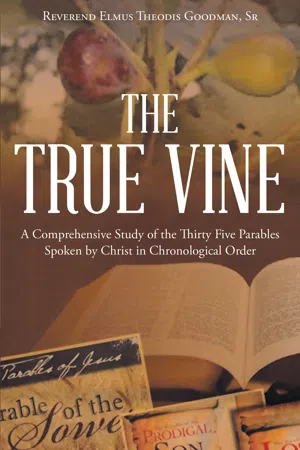
The True Vine
A Comprehensive Study of the Thirty Five Parables Spoken by Christ in Chronological Order
- 352 pages
- English
- ePUB (mobile friendly)
- Available on iOS & Android
eBook - ePub
The True Vine
A Comprehensive Study of the Thirty Five Parables Spoken by Christ in Chronological Order
About this book
Information
Topic
Theology & ReligionSubtopic
BiblesThe Lost Sheep and the Lost Coin
How think ye? If a man have an hundred sheep and one of them be gone astray, doth he not leave the ninety and nine, and goeth into the mountains, and seeketh that which is gone astray? And if so be that he find it, verily I say unto you, he rejoiceth more of that sheep, than of the ninety and nine which went not astray. Even so it is not the will of your Father which is in heaven, that one of these little ones should perish.
—Matthew 18:12-14
And he spake this parable unto them, saying, What man of you, having an hundred sheep, if he lose one of them, doth not leave the ninety and nine in the wilderness, and go after that which is lost, until he find it? And when he hath found it, he layeth it on his shoulders, rejoicing. And when he cometh home, he calleth together his friends and neighbours, saying unto them, Rejoice with me; for I have found my sheep which was lost. I say unto you, that likewise joy shall be in heaven over one sinner that repenteth, more than over ninety and nine just persons, which need no repentance. Either what woman having ten pieces of silver, if she lose one piece, doth not light a candle, and sweep the house, and seek diligently till she find it? And when she hath found it, she calleth her friends and her neighbours together, saying, Rejoice with me; for I have found the piece which I had lost. Likewise, I say unto you, there is joy in the presence of the angels of God over one sinner that repenteth.
—Luke 15:3-10
Jesus spoke only one parable in chapter 14 of Luke’s Gospel. As He continued to be a guest in the Pharisee’s home, Jesus spoke three other parables, which are found in chapter 15 of Luke’s Gospel. They are the Lost Sheep, the Lost Coin, and the Prodigal Son. In the parables of the “lost sheep” and the “lost coin,” emphasis is placed on that which is lost.
God’s Love Is Reflected through Christ
As Christ sat at meat in the Pharisee’s home, He began to eat without washing his hands. In the eyes of the Pharisee, this behavior reflected poor manners and went contrary to Mosaic teachings. The next thing Jesus did was to heal a man of dropsy, a heart and fluid condition. After healing the man, Jesus asked the Pharisee this question: “Is it lawful to heal on the Sabbath day?” The host, as well as the guests, couldn’t answer him. Would a farmer, having a calf bogged down in the mud and mire at the watering hole, not retrieve his calf on the Sabbath or wait until the Sabbath had passed and suffer loss? Jesus simply stated that in the case of this man who had dropsy, would it not be a good deed to heal him and let him go home rejoicing with a prayer in his heart and praises on his lips? They held their peace and pondered his sayings.
The Pharisees believed that rituals and ceremonies were of utmost importance. People who were not of their ranks were not important. Satan had impressed upon men’s hearts and minds that God was a firm, strict and harsh tyrant or despot who constantly frowns upon the entire human family and their activities, shortcomings, and human weaknesses. Having these thoughts of God, men tended to shun or ignore the name of God altogether. Jesus came to prove otherwise.
He came to show and demonstrate in His life that the Heavenly Father was just the opposite of these accusations, and that by Him and through Him men would have a bird’s eye view of our Heavenly Father and what His nature is like. Thus, He said, “If ye had known me, ye should have known my Father also” (John 14:7). For God is love, the foundation of His kingdom is built upon love. God’s love is the adhesive that binds and holds the universe together. Many songs have been written trying to explain God’s love. Many poets have written poems trying to express the joy and beauty to be found in God’s love. For many people, God’s love takes on different meanings and interpretations, but one thing we can all agree on is that it cannot be comprehended or explained. Divine love sheds sunshine in its passage through this cold, dark, and sinful world. One would be led to think that incarnate love would at once command the admiration of mankind. The divine love was incarnate, and the incarnation was treated with contempt.
Divine love was set forth for all to see, yet look how many of us are ignorant and blind to its excellence! Did not the prophet plainly tell us, “For unto us a child is born, unto us a son is given; and the government shall be upon his shoulder: and his name shall be called Wonderful Counselor, the mighty God, the everlasting Father, the Prince of Peace” (Isa. 9:6)?
No better gift could have been given, for while we were yet sinners, God commended His love toward us. In my opinion, love—that is, the love of God—cannot be explained. He has given us life. He has carpeted the earth with all kinds of trees, all sorts of green herbs, beautiful lakes, ponds, rivers, and waterways running over with marine life. The air pockets swell until they cannot hold any more moisture, and the moisture falls to the earth in the form of rain, watering the green vegetation, watering all life upon the earth, causing man’s crops to grow and yield food, fresh air to breathe, and an abundance of sunshine to warm the earth and to stimulate crop production.
Our Heavenly Father has promised to supply all of our needs. Many of us take His goodness and mercy for granted. We owe Him the highest praise and benevolence for His goodness and mercy. The flowers commend their beauty and fragrance in praise to Him, as they bob and weave in the gentle breezes. The birds sing their songs of praises as they go about building their little nests, bringing forth their young and preparing to pass the torch to oncoming generations. Our feathered friends neither work nor toil and yet the Heavenly Father feeds them. The pearls reveal their chastened luster. The sun reveals its brightness. The moon reveals its lemon-colored clearness. The stars reveal their brilliance. How slow men are to give God His adoration, admiration, and praise, which is His just due. In the councils of eternity, sin was clearly seen, and decisions and provisions were made to meet the terrible emergency.
There are no surprises with the Lord. The sacrificial lamb was slain from the foundation of the world (Rev. 13:8). The plan of salvation was put in place long before the humans appeared upon the earth. God demonstrated His love for fallen humanity by giving His only begotten son. Why? Because He gave His choicest gift. “For God so loved the world, that He gave His only begotten Son, that whosoever believeth in Him should not perish but have everlasting life” (John 3:16).
Is there any love greater than this love, of a man laying down his life so that his friends and family might live? God chooses the unworthy and loves the ungodly. The objects of God are the “unworthy” and the “ungodly”—the impious, who have no love for him, no reverence for him, and try to shed the very thought of him. God does not wait until we come to a better state of mind. He loves when “without strength” we are unable to leave our deplorable state, our miserable condition. He loves us in our misery, and while we were yet sinners, He commended His love toward us. We are the most contrary, disobedient, and undeserving of all His creatures. Yet He commended His love.
The scriptures tell us very plainly, “in that, while we were yet sinners, Christ died for us” (Rom. 5:8). He tasted death for every man. He came to seek and save that which was lost. While we were at our worst, He did His best for us—the best thing, commended by our Heavenly Father in the best way possible, and for the best purpose, that we might be “justified by His Blood,” saved from wrath, reconciled to God by the death of His Son, and saved by His Life. Yes, we have joy in God through our Lord and Savior Jesus Christ. We have become heirs of eternal life. Man is saved by the shed blood of Christ, and his justification is based on the merits of Christ. In other words, when God looks at Christ, he sees righteousness. Therefore, Christ is our Mediator, High Priest, and Intercessor. Our human weaknesses are covered by His precious blood. Therefore, we cry, “Father.”
Our Heavenly Father is not sheer intellect. He has a heart and His heart is not maligned or evil, but benevolent. He has love, not merely an attribute, but in essence. Love is not a mere element in His nature. It is His nature. God is love. The moral code by which God governs and rules the universe is love, speaking in the imperative frame or mood. His anger or wrath or displeasure is but love uprooting and consuming whatever hinders our present, itself an obstacle to peace, joy, and the well-being and happiness of His creation.
The love of God is the universal sea in which all created existences rise up, riding upon the waves, breaking upon the shores of eternity. While we were sinners, God sent His Son not to condemn the world, but to save it. God’s love is not written in the book of nature, stating His love for sinners. The book of nature was written long before sinners existed. Love is not puffed up. Love isn’t self-righteous, trying to condemn others while at the same time trying to make ourselves look righteous. Love doesn’t give with the intent of receiving something in return. Love will win the day. Love is measured by the sacrifices it makes; this is its strength. Again, its brings us to the doctrine of the Bible: “For God so loved the world, that He gave His only begotten Son, and whosoever believeth on Him shall have everlasting life” (John 3:16).
God’s love is not the love of moral esteem, for He cannot love the sinful character and the sinful things the sinner does. Then it must be the love of compassion—compassion deep, tender, and boundless. The question is asked, just how is God’s love exemplified or demonstrated? The love of God is exemplified in the death of Christ, for He died for us. Throughout the four Gospels, Christ constantly stated His reason for coming to planet earth: I come to seek out and save that which is lost. He used metaphors in symbolizing people as sheep, coins, and wayward sons.
The shepherd was concerned about the lost or missing sheep, and so was the housewife’s concern about the lost coin. No emphasis is placed on the sheep that are secure, neither is there emphasis placed on the coins that are not lost. These two parables can be called the two twin parables because their points of emphasis are the same. These parables illustrate the fact that a more active interest in any possession is aroused by the very circumstance that it is lost, as I have previously stated. The sheep that is lost is not on the account disregarded by the shepherd, but receives for the time greater attention than those that remain in the fold. The piece of money that has gone missing becomes on that very account of greater immediate importance to the woman than all the other accounted for coins.
The mother goes shopping in the mall and her small child turns up missing. The mother becomes extremely frightened and searches high and low for her missing child. She isn’t worried about the ones she left at home, for she knows they are safe and secure. She searches high and low in an attempt to find the missing child. She even calls in law enforcement to aid her in the search. Finally, they find the child wandering in the mall. What a relief! Joy now fills her heart.
The farmer loses an attachment which is a part of his equipment. He stops the tractor and searches the field over, trying to find this missing particular attachment. It is most important to him. The other equipment doesn’t concern him. It’s the piece that is lost which concern him the most. After walking the field over, he finally finds the missing piece. What a relief the farmer now...
Table of contents
- Preface: Divine Revelation
- The Wise and Foolish Builders
- The Two Debtors
- The Rich Fool
- The Servants Waiting and Watching for Their Lord
- The Barren Fig Tree
- The Sower
- The Tares
- Seeds Growing Secretly
- The Mustard Seed
- The Leaven
- The Hidden Treasure
- The Pearl of Great Price
- The Net
- The Unmerciful Servant
- The Good Samaritan
- A Friend at Midnight
- The Good Shepherd
- The Great Supper
- The Lost Sheep and the Lost Coin
- The Prodigal Son and His Brother
- The Unjust Steward
- The Rich Man and Lazarus
- The Importunate Widow
- The Pharisee and the Publican
- Laborers in the Vineyard
- The Pounds
- The Two Sons
- The Wicked Husbandmen
- The Marriage of the King’s Son
- The Fig Tree Leafing
- The Man Taking a Far Journey
- The Ten Virgins
- The Talents
- The True Vine
- References
Trusted by 375,005 students
Access to over 1.5 million titles for a fair monthly price.
Study more efficiently using our study tools.
Frequently asked questions
Yes, you can cancel anytime from the Subscription tab in your account settings on the Perlego website. Your subscription will stay active until the end of your current billing period. Learn how to cancel your subscription
No, books cannot be downloaded as external files, such as PDFs, for use outside of Perlego. However, you can download books within the Perlego app for offline reading on mobile or tablet. Learn how to download books offline
Perlego offers two plans: Essential and Complete
- Essential is ideal for learners and professionals who enjoy exploring a wide range of subjects. Access the Essential Library with 800,000+ trusted titles and best-sellers across business, personal growth, and the humanities. Includes unlimited reading time and Standard Read Aloud voice.
- Complete: Perfect for advanced learners and researchers needing full, unrestricted access. Unlock 1.5M+ books across hundreds of subjects, including academic and specialized titles. The Complete Plan also includes advanced features like Premium Read Aloud and Research Assistant.
We are an online textbook subscription service, where you can get access to an entire online library for less than the price of a single book per month. With over 1.5 million books across 990+ topics, we’ve got you covered! Learn about our mission
Look out for the read-aloud symbol on your next book to see if you can listen to it. The read-aloud tool reads text aloud for you, highlighting the text as it is being read. You can pause it, speed it up and slow it down. Learn more about Read Aloud
Yes! You can use the Perlego app on both iOS and Android devices to read anytime, anywhere — even offline. Perfect for commutes or when you’re on the go.
Please note we cannot support devices running on iOS 13 and Android 7 or earlier. Learn more about using the app
Please note we cannot support devices running on iOS 13 and Android 7 or earlier. Learn more about using the app
Yes, you can access The True Vine by Reverend Elmus Theodis Goodman Sr in PDF and/or ePUB format, as well as other popular books in Theology & Religion & Bibles. We have over 1.5 million books available in our catalogue for you to explore.