Have you ever read the parables in the Bible and wondered, "What is this all about?" Parables can be hard to understand, but this book will help as you read it and the parable alongside of the chapters. The book examines not just the parable itself but the context it was given in, both historical and scriptural, as well as giving some crucial keys to understanding the text itself. The author is confident you will be blessed in your understanding of God's heavenly stories and their earthly meanings.
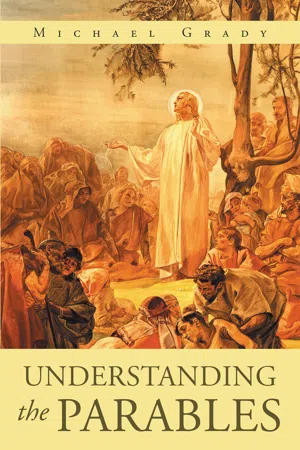
- 140 pages
- English
- ePUB (mobile friendly)
- Available on iOS & Android
eBook - ePub
Understanding The Parables
About this book
Information
Topic
Theology & ReligionSubtopic
Biblical StudiesUnderstanding
the Parables
the Parables
ISBN 978-1-64114-281-6 (Paperback)
ISBN 978-1-64114-282-3 (Digital)
Copyright © 2017 by Michael Grady
All rights reserved. No part of this publication may be reproduced, distributed, or transmitted in any form or by any means, including photocopying, recording, or other electronic or mechanical methods without the prior written permission of the publisher. For permission requests, solicit the publisher via the address below.
Christian Faith Publishing, Inc.
296 Chestnut Street
Meadville, PA 16335
www.christianfaithpublishing.com
Printed in the United States of America
Dedication
I dedicate this book to the following two people:
My wife, Yolanda, who has given me more patience and encouragement than I deserve throughout our forty-seven plus years of marriage. You definitely qualify for sainthood.
My good friend and faithful servant, Johnnie Mullendore, whom we lost way too early but will see again in Heaven: love you dearly, friend.
Foreword
This book is based on a series of sermons I was privileged to preach while an associate pastor at Fellowship Bible Church in Harrah, Oklahoma. It was the most rewarding Bible study I have ever done, and I hope you will be as blessed by reading it as I was having the opportunity to preach it. The primary sources I used in my research include the following: J. Vernon McGee’s Commentary (Volume 4) on the Bible, Willmington’s Guide to the Bible (Willmington), and Barclay’s Commentary on the Bible. I also used one of the notes in Scofield’s Bible (Scofield). All verses are quoted from the King James Bible.
I want to thank the members of FBC for the patience and encouragement they gave me throughout the series, and I also would like to thank then Pastor Randall Slack for giving me the opportunity to preach on a regular basis so I could stay sharp and grounded in the Word. May God be glorified and honored through this book.
The Purposes and Principles of Parables
Matthew 13:10–17
Jesus was a master teacher, and the more one reads the gospels, it is clearly seen that his favorite teaching method was by the use of parables. Some of you may have the same questions the disciples had as you read these same parables. After one particularly intriguing parable, they asked, “Why speakest thou unto them in parables?” The disciples found the parables hard to understand and had noticed that others were having difficulty understanding as well. In his answer, Jesus revealed two specific purposes for using parables. The question is why Christians today have trouble understanding the parables when we have so much more light than even the disciples? Let’s look at Jesus’ explanation in Matthew 13:10–17 and glean the truths of what the purposes and principles of parables might be.
In verses 11–15, we see the two purposes for Christ using parables. First, he used parables so that those who were determined to reject Christ would continue in their darkness. In I Corinthians 2:14, we learn that the natural man, the unregenerate man, does not receive the things of God. Paul further states that the eyes of the natural man are so blinded that the things of God are foolishness to him; as long as he refuses to accept Christ, he will never know the truth because the truth of God’s word is spiritually discerned. Thus, the unregenerate man who refuses to believe will never believe because he refuses to believe, so his heart gets harder and harder. It is the vicious circle of a hardened heart.
However, even more exciting, the second purpose for Christ to use parables is found in the Old Testament passage he quoted from Isaiah 6:9–10: “And he said, Go, and tell this people, ‘Hear ye indeed, but understand not; and see ye indeed, but perceive not. Make the heart of this people fat, and make their ears heavy, and shut their eyes; lest they see with their eyes, and hear with their ears, and understand with their hearts, and convert and be healed.’” Since Jesus himself used these words, it is evident that this is one of the signs of Jesus’ Messiahship; he identified with the man and his message.
While the purposes of the parables are clear, we need to understand what principles need to be applied in studying parables. First, remember that the parables are a tool used for teaching. Many have said that the definition of a parable is an earthly story with a heavenly meaning, a tool used to teach you (V 11). They give a broad overview of God’s plan. There are three keys to understanding the parables. The first key is to rely on the Holy Spirit to teach you. After all, he inspired holy men of old to write the book, so technically, he is the author. Secondly, we need to understand the terminology that is used. For instance, there are two terms used, which appear to be synonymous but are not in reality: The Kingdom of Heaven versus the Kingdom of God.
There are two meanings to the phrase “Kingdom of Heaven.” First, it refers to the general rule of the Father from heaven over the affairs of men from the creation to the millennium; both the saved and unsaved belong to this kingdom, and this is what Jesus had in mind at this point. The second meaning deals with that specific rule of the Son from Jerusalem over the affairs of men during the millennium; only saved people will enter this kingdom. There are two meanings to the phrase “Kingdom of God.” On rare occasions, it is used interchangeably with millennial meaning of Kingdom of Heaven; however, the most common meaning is referring to the new birth...
Table of contents
- The Purposes and Principles of Parables
- What Foundation Are You Building On?
- How Much Have You Been Forgiven? How Much Do You Love Him?
- How Do We Bind the Strongman?
- Four Responses to the Gospel
- Are You a Wheat or a Tare?
- The Kingdom of God: The Growth Process and the End Result
- The Corruption of the Church
- The Two Great Loves of Jesus
- The Tools of Evangelism
- Mixing Legalism with Grace
- A Generation of Gripers
- The Forgiven Who Won’t Forgive
- How to Recognize Your Neighbor
- The Foolishness of Reformation without Regeneration
- A Fool in a Fix
- Ready or Not, Here He Comes
- A Fruitless Fig Tree
- Choosing the Least at a Wedding Feast
- Two Fools and a Hen-Pecked Husband
- A Lost Sheep
- A Missing Coin
- The Love of the Father
- The Prodigal Returns
- The Prodigal That Stayed Home
- The Stewing of a Steward
- When Our Best Is but the Least
- A Widow and a Weary Judge
- Are You a Humble Publican or a Haughty Pharisee
- God’s Generosity toward Us
- Proper Investment of God’s Resources
- Two Sons Who Changed Their Minds
- The Vicious Vinedressers
- The Proper Dress at a Wedding Feast
- A Fig Tree That Foretold the Future
- Are You a Wise or Foolish Virgin?
- Are You a Sheep or a Goat?
- The Parable That Is Not a Parable
- Review and a Challenge to the Reader
Trusted by 375,005 students
Access to over 1.5 million titles for a fair monthly price.
Study more efficiently using our study tools.
Frequently asked questions
Yes, you can cancel anytime from the Subscription tab in your account settings on the Perlego website. Your subscription will stay active until the end of your current billing period. Learn how to cancel your subscription
No, books cannot be downloaded as external files, such as PDFs, for use outside of Perlego. However, you can download books within the Perlego app for offline reading on mobile or tablet. Learn how to download books offline
Perlego offers two plans: Essential and Complete
- Essential is ideal for learners and professionals who enjoy exploring a wide range of subjects. Access the Essential Library with 800,000+ trusted titles and best-sellers across business, personal growth, and the humanities. Includes unlimited reading time and Standard Read Aloud voice.
- Complete: Perfect for advanced learners and researchers needing full, unrestricted access. Unlock 1.5M+ books across hundreds of subjects, including academic and specialized titles. The Complete Plan also includes advanced features like Premium Read Aloud and Research Assistant.
We are an online textbook subscription service, where you can get access to an entire online library for less than the price of a single book per month. With over 1.5 million books across 990+ topics, we’ve got you covered! Learn about our mission
Look out for the read-aloud symbol on your next book to see if you can listen to it. The read-aloud tool reads text aloud for you, highlighting the text as it is being read. You can pause it, speed it up and slow it down. Learn more about Read Aloud
Yes! You can use the Perlego app on both iOS and Android devices to read anytime, anywhere — even offline. Perfect for commutes or when you’re on the go.
Please note we cannot support devices running on iOS 13 and Android 7 or earlier. Learn more about using the app
Please note we cannot support devices running on iOS 13 and Android 7 or earlier. Learn more about using the app
Yes, you can access Understanding The Parables by Michael Grady in PDF and/or ePUB format, as well as other popular books in Theology & Religion & Biblical Studies. We have over 1.5 million books available in our catalogue for you to explore.