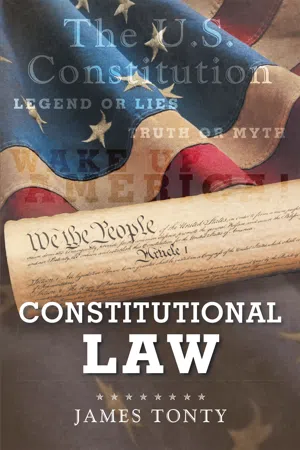
The Development of the United States ConstitutionThis book is an overview of the development of the United States Constitution, starting from the beginning of its founding documents of the first settlements through the war for independence from Great Britain through the establishing of the republic. This dissertation will examine the writings, statements, and proclamations of the founders of this great nation and their meaning of government as the first rule of law for America. It will also examine the forming of these documents into articles of law that were first written by the settlers, incorporating their heritage and beliefs into principles of rights integrated into the legal process of law for the final development of our Constitution. It will go on to scrutinize the historical development of the Constitution by briefly reviewing the character and motivations of the founding fathers before, during, and after the ratification process in determining the true intentions of these great men. It will evaluate the idea of Christianity in Colonial America and scholars' ongoing debate that this nation was founded on Christian principles or, as some claim, were men of deist, having a belief in God based on reason rather than revelation. This book will explore this avenue from the prospective of their writings, statements, legislation, and articles that helped form the original Constitution of the United States of America.
- 102 pages
- English
- ePUB (mobile friendly)
- Available on iOS & Android
eBook - ePub
Constitutional Law
About this book
Information
Conclusion
In conclusion, the methodology and research of data collected was developed from history itself and is indisputable as historical events. The documentation provided from precepts, writings, charters, legislation, and case law itself attests to the facts and conclusion established in this academic paper. The writing of the Constitution of the United States of America itself was incontestably the single most important political event in the history of the United States and a notable event in the political history of the modern world. Historians believe that the writings in this great document are the most profound and important legal document ever produced. The Constitution, the Supreme Law of the land, dictates to the executive, legislative, and judicial branches of government the rights and freedoms of its citizens under all terms and conditions of a self-sustaining government. The authors created a superb instrument of government that has withstood many tests of wars, political corruption, international disputes, and domestic challenges. The framers diligently placed freedom and that of the people’s rights far above any political agenda, clearly portrayed by their declarations, charters, speeches, and writings. The founding fathers were farsighted enough to create a document and system of government that was both firm in its basic foundation, though flexible in its execution, to continue to protect the rights of its citizens. As incontestably confirmed by the colonist’s proclamations, legislation, statutes and even the Declaration of Independence itself, established the very principles in which the Constitution was developed. The document declares it to be a self-evident truth that all men are created equal and endowed by their Creator with all their inevitable rights. It closes with an appeal “to the Supreme Judge of the World.”
The value of these expressions in the declaration attests that the nation owes her allegiance to God. It vindicates her right, now being strenuously denied, to acknowledge God in public documents. The writings of the Declaration of Independence prove beyond disparagement that what was so valuably proposed is consistent with the spirit and example of our founding fathers and their true beliefs in the noblest passages of our history. The Constitution, being developed from the will of our nation past, should be stringently and distinctly defined in the present and future so that the intent of the founders does not become distorted but is instead dearly preserved.
The argument, which is now drawn by some that rest their defense against the Christianity of the United States, is found in the writings of Article 11 of the Treaty of Tripoli written in 1797. This treaty between the United States of America and the Bay and Subjects of Tripoli of Barbary, ratified by the US Congress and signed by President John Adams, stated in Article 11: “As the government of the United States of America is not in any sense founded on the Christian Religion,-as it has in itself no character of enmity against the laws, religion or tranquility of Musselmen.”
However, this translation that includes Article 11 of the Treaty of Tripoli by Joel Barlow has been found not without fault, and there is some doubt whether Article 11 in the version of the treaty ratified by Congress corresponds to anything of the same purpose in the Arabic version. There are no records of the negotiations that took place that developed into the treaty, and comparison to other treaties negotiated at the same time with Algiers and Tunis contain no such clause. It is speculated that Article 11 was placed into the document at the insistence of Tripoli officials looking for assurance that the United States would not use religion as a pretext for future hostilities against them, knowing that the Muslim regions of North Africa had century-long conflicts between Islam and Christianity, where Tripoli’s leaders, viewing the United States as a mere extension of Christianity and expecting future tensions over religion, insisted of the adding of this clause. Further questions arose concerning Article 11 of the Treaty by Hunter Miller in 1931 as he completed a commission by the United States government to analyze US treaties and to explain what function they had to the United States’ legal position in relationship with the rest of the world. Miller’s notes stated, “The Barlow translation is at best a poor attempt at a paraphrase or summary of the sense of the Arabic” and “Article 11 … does not exist at all.” After comparing the United States’ version by Barlow with the Arabic and the Italian version, Miller continues by claiming “that the Arabic text which is between Articles 10 and 12 is in the form of a letter, crude and flamboyant and withal quite unimportant, from the Dey of Algiers to the Pasha of Tripoli.”
Article 11 of the treaty remains a mystery and seemingly must remain so for the diplomatic correspondence of the time sheds no light whatsoever on this article, yet evidence of the erroneous character of the Barlow translation has been in the archives of the Department of State since perhaps 1800, where the Arabic and English texts remain different. Thus, to rely on one such questionable writing is an inadequate defense.
However, this debate continues through Article VI, Section 3, of the US Constitution, which states, “No religious test shall ever be required as a qualification to any office or public trust under the United States.” The key founders—Adams, Jefferson, Madison, Franklin, and even Washington—not only knew the term religion meant all religions but believed all religions were equally protected under the unalienable rights of conscience. Jefferson and Madison’s own words through debates discussing the exact intent of “Religious Freedom” stated, “Where the preamble declares, that coercion is a departure from the plan of the holy author of our religion, an amendment was proposed, by inserting the word “Jesus Christ,” so that it should read, “a departure from the plan of Jesus Christ, the holy author of our religion.”
This insertion, although rejected by the majority, knowing there were numerous sectors of religions that worshiped God in their own manner, further attests to the intent that God was thought of by the founders as a religious belief that cannot be disputed.
Article VII of the US Constitution ends with the words “Seventeenth Day of September in the Year of our Lord one thousand seven hundred and Eighty seven,” which can certainly be argued as setting up the United States under “our Lord” as God. This sentence is in the last section of the fourth and final page of the Constitution and was a common way of referencing the Christian calendar.
From the very beginning of the Constitution, the founding fathers declared that its development was “little short of a miracle,” as stated by George Washington as he witnessed the signing of the Constitution. Washington was also responsible for initiating the custom of taking the presidential oath of office using the Bible as a testament.
Benjamin Franklin, finding it remarkable that the delegates were able to agree on such a strong central government, said,
“To conclude, I beg I may not be understood to infer, that our General Convention was divinely inspired when it formed the new Federal Constitution … yet I must own I have so much faith in the general government of world by Providence, that I can hardly conceive a transaction of such momentous importance to the welfare of millions now existing, and to exist in the posterity of a great nation should be suffered to pass without being in some degree influenced, guided, and governed by that omnipotent, omnipresent, and beneficent Ruler, in whom all inferior spirits live and move and have their being.”
Likewise, another of the framers, Charles Pinckney, stated, “Nothing less than a superintending hand of Providence, that so miraculously carried us through the war, in my humble opinion, could have brought it (the Constitution) about so complete, upon the whole.”
Alexander Hamilton, at the Constitutional Convention, expressed a similar view, stating, “For my own part, I sincerely esteem it a system, which, without the finger of God, never could have been suggested and agreed upon by such a diversity of interests.”
This state of mind continued through the United States Congress in 1782 as it voted the following resolution into law: “The Congress of the United States recommends and approves the Holy Bible for use in all schools.”
On February 2, 1813, President James Madison sponsored an act that Congress passed, giving authority to Dr. Benjamin Rush’s Bible Society to mass-produce Bibles. This was America’s congressional decision for mass printing and distribution of the Bible published by the Bible Society of Philadelphia, which remains in existence today. How can one deny, from the very acts of Congress and numerous statements of faith made by both government and legislators that have been incorporated into both political and public resolutions, that not having a Christian or godly belief is a fundamental factor of issue?
William Holmes McGuffey is the author of the McGuffey Reader, which was used for over one hundred years in our public schools, with over 120 million copies sold since 1836 until it was stopped in 1963 due to a Supreme Court decision in Abington v. Schempp, where the court eliminated Bible reading in American schools under the pretense of separation of church and state. The McGuffey Readers contained religious messages and sought to instill morality in its readers. Practically every American who attended public schools during the second half of the nineteenth century learned moral and ethical lessons from these McGuffey’s Reader series. President Lincoln referred to McGuffey as the “schoolmaster of the nation.” McGuffey’s very words promoting these textbooks were so profoundly stated:
“The Christian religion is the religion of our country. From it are derived our notions on the character of God, on the great moral Governor of the universe. On its doctrines are founded the peculiarities of our free institutions. From no source has the author drawn more conspicuously than from the sacred Scriptures. From all these extracts from the Bible I make no apology.”
McGuffey, William. McGuffey’s Electric First Reader. 1836. Reprinted by Mott Media. 1982.
Dickinson Press, Inc. 2014.
In spite of the Supreme Court decisions in Abington v. Schempp and Engle v. Vitale, where prayer was removed from United States schools, the legacy of Christianity continued with President Jefferson worshiping in church services that were held in the nation’s Capitol. Jefferson also approved the Northwest Ordinance encouraging religion in education and in the federal government, recommending church services in the military.
President Lincoln acknowledged God’s hand in his Gettysburg Address, which was the origin of the words “Under God” in the Pledge of Allegiance. Lincoln’s own words attested to his dedication to God for this nation, “It is the duty of nations as well of men to own their dependence upon the overruling power of God … and to recognize the sublime truth announced in the Holy Scriptures ...
Table of contents
- Dedication
- Abstract
- Introduction
- Magna Carta
- The Fundamental Purpose of the Constitution
- The Origin of the Constitution
- The First Charter of Virginia
- Virginia Bill of Rights
- The Mayflower Compact
- New Hampshire Exeter Compact
- New England Articles of Confederation
- The First Charter of Maryland
- The Portsmouth Compact
- Fundamental Orders of Connecticut
- Massachusetts Body of Liberties
- Old Deluder Act
- New England Primer
- Rhode Island Charter
- Charter of Carolina
- The First Charter of New Jersey
- The Pennsylvania Charter of Privileges
- British Intolerable Acts
- The Declaration of Independence
- The Philosophies and Intent of the Framers
- The Articles of Confederation
- The Development of the Constitution
- The Establishment Clause
- Conclusion
- References
- About the Author
Trusted by 375,005 students
Access to over 1.5 million titles for a fair monthly price.
Study more efficiently using our study tools.
Frequently asked questions
Yes, you can cancel anytime from the Subscription tab in your account settings on the Perlego website. Your subscription will stay active until the end of your current billing period. Learn how to cancel your subscription
No, books cannot be downloaded as external files, such as PDFs, for use outside of Perlego. However, you can download books within the Perlego app for offline reading on mobile or tablet. Learn how to download books offline
Perlego offers two plans: Essential and Complete
- Essential is ideal for learners and professionals who enjoy exploring a wide range of subjects. Access the Essential Library with 800,000+ trusted titles and best-sellers across business, personal growth, and the humanities. Includes unlimited reading time and Standard Read Aloud voice.
- Complete: Perfect for advanced learners and researchers needing full, unrestricted access. Unlock 1.5M+ books across hundreds of subjects, including academic and specialized titles. The Complete Plan also includes advanced features like Premium Read Aloud and Research Assistant.
We are an online textbook subscription service, where you can get access to an entire online library for less than the price of a single book per month. With over 1.5 million books across 990+ topics, we’ve got you covered! Learn about our mission
Look out for the read-aloud symbol on your next book to see if you can listen to it. The read-aloud tool reads text aloud for you, highlighting the text as it is being read. You can pause it, speed it up and slow it down. Learn more about Read Aloud
Yes! You can use the Perlego app on both iOS and Android devices to read anytime, anywhere — even offline. Perfect for commutes or when you’re on the go.
Please note we cannot support devices running on iOS 13 and Android 7 or earlier. Learn more about using the app
Please note we cannot support devices running on iOS 13 and Android 7 or earlier. Learn more about using the app
Yes, you can access Constitutional Law by James Tonty in PDF and/or ePUB format, as well as other popular books in History & World History. We have over 1.5 million books available in our catalogue for you to explore.