When asking someone why they hold a political or social justice belief, they often are at a loss to defend it. We need articulate defenders of the biblical justice agenda. As people of faith, more of us should be able to explain why we reach out to others to assist during times of need or at times when they cannot speak up for themselves. This is the example set for us through the ministry of our Old Testament prophets and New Testament Jesus. Lay people often want to get right to the point and not always have to wade through the academic jargon of the various religious disciplines. My volume gives them some examples of how certain scripture, once it is employed, was and is used to support the mandate to "feed the hungry, clothe the naked, heal the sick, and set free the captives" and that the nations will be judged by the way they treat the "least of those among us." The volume has real world applications. Justice can be done through direct service; education about the issues; or systemic advocacy as shown here.
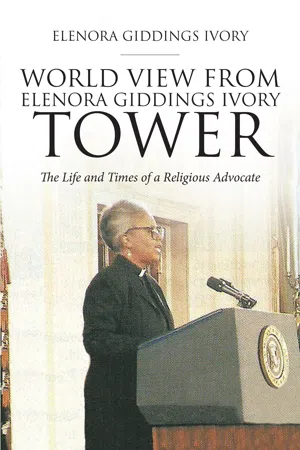
eBook - ePub
World View From Elenora Giddings Ivory Tower
The Life and Times of a Religious Advocate
- 176 pages
- English
- ePUB (mobile friendly)
- Available on iOS & Android
eBook - ePub
World View From Elenora Giddings Ivory Tower
The Life and Times of a Religious Advocate
About this book
Information
Topic
Teologia e religioneSubtopic
Fede e pratica religiosa1953: First Brush with Political Advocacy: Manalapan and Water for Housing
Presidency of Harry S. Truman and Dwight David Eisenhower
“I was thirsty and you gave me something to drink.”
—Matthew 35:25
My first awareness of a time of church activism happened when I was a very young member of Westminster Presbyterian Church of Manalapan, New Jersey. We referred to it simply as Manalapan Church. It was located off Highway 33 on Conover Road just outside of Freehold, New Jersey.
Across the street from Manalapan Church was migrant labor housing. It was one of the places where some African American families lived year round. In 1953, my family moved there from Philadelphia where I was born. I was about eight years old. The family was my father Edward Littleton Giddings Sr. (1903–1958) and my mother Phoebe Hill Giddings (1915–1987), along with my younger brothers, Edward Jr., Nathaniel, and Tyrone. Younger sisters Phoebe Janet and Ella had not yet been born.
We lived there for just one year, while my father builds from the ground up himself a three-bedroom, one-bath house in nearby Clarksburg. We were happy to move into our new house with its unfinished interior walls, even though it was only completed on the outside as a way to stave off the pending winter of 1954.
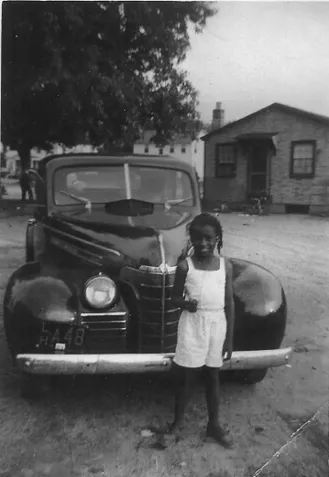
Unlike the Manalapan migrant house, our new house had an indoor toilet and not an outhouse. (A picture of me standing in front of one of the track houses is below.) Our new house had running water from a sink and not a farm-type pump in the kitchen of this two-room cabin. And there was a real bathtub instead of a metal tub.
When we lived at Manalapan, this was the time I became involved with the Manalapan Church. My father would gather us all up, his children and some nieces, nephews and neighbors, and drive us the little ways across and down the road to the Church on Easter Sunday. He must have thought it was a long service Baptist Church, because we had to wait outside for him to pick us up for what seemed like a long, long time after the service. I cannot remember if it was Rev. Echelberger or Rev. James Aaron Mitcham Jr. who waited patiently with us.
Manalapan Church allowed me to feel that I was worthy of being a human being. My Millstone Township Elementary School classes where not segregated in the way you would see in the south. But the black and white students played together in an impersonal way. This was not unfriendly, but not close and buddy-buddy either. I had the feeling of just being there. This was a small community. The Rev. Patricia Budd Kepler, one of the very early women to be ordained in the Presbyterian Church, became the pastor during my teenage years. It was she who challenged me to apply to Harvard Divinity School. I am most grateful for this and am eternally thankful.
This Church was a Revolutionary War–era structure that was built on large tree basis. As is often the case, the small African American congregation could not afford the upkeep that was probably maintained when the congregation was more grand, wealthy, and white.
The state highway department approached the Presbytery of Monmouth, where the church was owned, with an offer to buy it as the State wanted to build one of the now infamous turnoff-jug handles as Highway 33 was being widened. We were politically and financially powerless in our efforts to stop the sale and be allowed to keep worshipping as a congregation.
The state also tore down the migrant labor housing when the residents ask to get running water installed in the military barrack style housing. The answer was no. We thought, that is what happens sometimes, when you ask for water.
With the church and the housing gone, the families of the congregation were scattered. It was probably seen, by the authorities, to be easier to tear down the housing than it would have been to put running water into them.
I sympathize with the people of Flint, Michigan. The people of Flint, Michigan, are still asking for clean water years after their supply had been found to be contaminated with lead. In 2017, weeks after Hurricane Maria devastated Puerto Rico, the people were still in need of clean water. We have to ask if this delay is due to the fact that they are people of color. The cry goes out that we are all Americans, yet some of us have to beg for clean, life-sustaining water.
Our family had already moved out of the Manalapan housing years before it reached that point of demolition. As bad as it was, it was seen as the best of the housing camps where many of the African Americans lived. Pergola Ville, another camp not too far away, had dirt floors within cabins that looked like the old time slave cabins. This was the 1960s!
During my early elementary school day, the interior walls of our home were eventually covered in sheet rock as my father, Edward Littleton Giddings Sr. (1903–1958), labored to put on the finishing touches. He was a skilled construction worker, who did the roofing, plumbing, carpentry, electrical, and almost anything that needed to be done on our home as well as his sister’s and nieces’ homes that were being built next door. By day, he worked in the growing construction industry. It was the need for labor that brought the family to New Jersey from Philadelphia when I was eight years old.
Edward Littleton Giddings Sr. would often be asked to step in when someone else was not able to finish out a task on a construction job. He gladly stepped in. On March 29, 1958, he climbed down into a newly dug foundation ditch to figure something out as the construction company built the Kendall Park Division. They did not stop the moving bulldozer equipment above and the ditch caved in on him, and he was gone instantly.
That day, I saw three cars travel down the driveway to give my mother this unbelievable news. I was twelve years old at this time. Your uncles were ten, eight, and six years old. Your aunts were two and one. His trait of stepping in when someone else cannot seem to complete a task seems to have been handed down to me and my siblings. He described himself as a jack of all trades and master of none and that he worked from “kin to can’t”—meaning, that you worked from the time you can see by the sun until you can’t see by it in the evening. Therefore, in justice ministry, we advocate for safe labor laws. Had the ditch been fortified with barriers along its sides, your grandfather might have lived a longer life.
What I remember most about him is that he was so proud of the fact that the older of his children could all read. He was denied an education in his segregated Cape Charles, Virginia school system and only completed the third grade. He made a mark. He did not write a signature. He was so proud that his children could read that he once handed me the New Jersey driver’s manual and asked me to read a little of it to him and his friends to brag that I could read. He and his friends had to study the illustrative parts of the manual.
In the fifties, sixties, and seventies we fought for integrated schools as way to bring education to our community so that we had fewer of those who could not read. We now focus on quality education, because integration, if it happened, did not always bring with it a quality education. We also wanted to be treated fairly.
When a local news report told a story of a young white girl who scored very high on an IQ test aired on TV, the next day my teacher entered the classroom and asked if we had all seen that story. He said it was a big deal, but that someone in his class scored just as high, but he could not say who. Then he glanced at me, and as he turned his head, he muttered, “What a waste.” That was how I learned that I was “intelligent.” So incidents like this were part of my early formative years.
August 1971: The Ku Klux Klan “Visit”
and Historic Monuments
and Historic Monuments
Presidency of Richard M. Nixon
He said to him, “‘you shall love the Lord your God with all your heart, and with all your soul, and with all your mind.’ This is the greatest and first commandment. And a second is like it: ‘You shall love your neighbor as yourself.’ On these two commandments hang all the law and the prophets.”
—Matthew 22:37–40
Sometimes I just want to ask people what is it about these two commandments from Jesus that you do not understand, especially if you profess to be a Christian, or even more broadly, a person of faith in the God of us all?
I type this as I watch the events of the Charlottesville, VA, unfold on this August 12, 2017, day. There is violence erupting over the possible removal of a statute in commemoration of Confederate General Robert E. Lee in a public park. Groups representing the Ku Klux Klan (KKK), Alt-Right, Nazi sympathizers, and others are there to protest this removal. To some of them, it simply marks a historic event and has nothing to do with racism. They fail to accept that the historic event the statue represents is one where racist views of enslavement were being protected.
As I watch these events, I am reminded of the time when the Federal Bureau of Investigation (FBI) came knocking at our door in the middle of the day. At the time, your grandfather Tommie Ivory Sr., your mother Cynthia, and your Uncle “T” (Tom) and I lived on Fort Plains Road, in Howell Township, NJ.
I was alone at home and in the kitchen at the sink while cutting up a chicken for dinner when I heard the knock. Since I was...
Table of contents
- Introduction
- Part 1
- Part 2
- Part 3
- Part 4
- Part 5
- Part 6
- Part 7
- Part 8
- Part 9
- Part 10
- About the Author
Trusted by 375,005 students
Access to over 1.5 million titles for a fair monthly price.
Study more efficiently using our study tools.
Frequently asked questions
Yes, you can cancel anytime from the Subscription tab in your account settings on the Perlego website. Your subscription will stay active until the end of your current billing period. Learn how to cancel your subscription
No, books cannot be downloaded as external files, such as PDFs, for use outside of Perlego. However, you can download books within the Perlego app for offline reading on mobile or tablet. Learn how to download books offline
Perlego offers two plans: Essential and Complete
- Essential is ideal for learners and professionals who enjoy exploring a wide range of subjects. Access the Essential Library with 800,000+ trusted titles and best-sellers across business, personal growth, and the humanities. Includes unlimited reading time and Standard Read Aloud voice.
- Complete: Perfect for advanced learners and researchers needing full, unrestricted access. Unlock 1.5M+ books across hundreds of subjects, including academic and specialized titles. The Complete Plan also includes advanced features like Premium Read Aloud and Research Assistant.
We are an online textbook subscription service, where you can get access to an entire online library for less than the price of a single book per month. With over 1.5 million books across 990+ topics, we’ve got you covered! Learn about our mission
Look out for the read-aloud symbol on your next book to see if you can listen to it. The read-aloud tool reads text aloud for you, highlighting the text as it is being read. You can pause it, speed it up and slow it down. Learn more about Read Aloud
Yes! You can use the Perlego app on both iOS and Android devices to read anytime, anywhere — even offline. Perfect for commutes or when you’re on the go.
Please note we cannot support devices running on iOS 13 and Android 7 or earlier. Learn more about using the app
Please note we cannot support devices running on iOS 13 and Android 7 or earlier. Learn more about using the app
Yes, you can access World View From Elenora Giddings Ivory Tower by Elenora Giddings Ivory in PDF and/or ePUB format, as well as other popular books in Teologia e religione & Fede e pratica religiosa. We have over 1.5 million books available in our catalogue for you to explore.