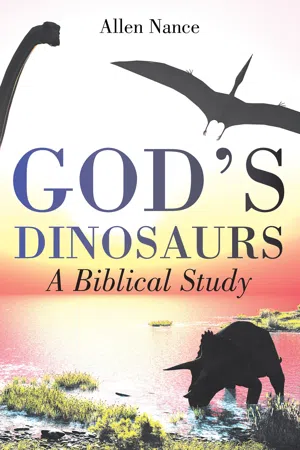
At one time, there was a public debate about which was true, creationism or evolution. The debate is no longer being waged publicly but a single answer, acceptable to both sides, has not been found. Evolution stays in the lane of public education. Creation stays in the lane of religious education. The problem we face as Christians in the debate is the lack of an explanations for the existence of the dinosaurs. The entire argument on behalf of evolution is made up but does include a very creative explanation for the dinosaurs' existence. We know God created all life on Earth, yet the traditional creation stories do not include the dinosaurs. This book will guide you to read the creation story in God's Word as it is actually written. The true story is surprising, intriguing, and does include the dinosaurs. The Bible has had the answer the whole time.
- 108 pages
- English
- ePUB (mobile friendly)
- Available on iOS & Android
eBook - ePub
About this book
Information
Print ISBN
9781098029579
What Does the Bible Say?
Different Creations: The Chronologies of Genesis 1 and 2
This section is what this work is all about. The previous sections were necessary in order to establish a proper perspective. Before we can recognize what is really truth, it is important to see what is being taught from various viewpoints. It is then possible to compare and critique the various explanations. This comparison is necessary to be able to filter out the bits of truth (Bible-based) from the bits of creative thinking (unsubstantiated scientific theory). If an idea is to be taken as biblical truth, we should be able to read the verse used to support the idea in context. If verses have to be chosen at random throughout the Bible, you should be suspicious of how they are being used. Remember, even Satan quoted scripture out of context (Matthew 4:6). Any discussion that incorporates a component of evolution would be in the creative thinking category. Here we are going to focus on the truth.
In order to have a biblical explanation of anything, we absolutely must read the Bible. This is especially true on this subject of the dinosaurs. Many people have given what they claim to be a biblical explanation of the dinosaurs without actually going back and reading anew the verses that would address the topic. They simply take what they have been taught by others, in both religious and secular education, and try to reconcile it in favor of religion by regurgitating commonly used verses. Carefully reading what the Bible actually says is the most important component in finding the truth. Because of this, I have quoted the verses that absolutely must be read when discussing this topic. You will also notice I repeat myself often for the purpose of stressing important points. Emphasis of particular words and their in-context meanings are also important. I recommend you have your Bible present as you read this section so that you may check the accuracy of what I have written.
All verses that are quoted are from the King James translation. I would suggest you be sure to use a Bible that is a translation and not simply an interpretation. The King James Version was translated from the original text for the expressed purpose of having an accurate English translation. A lot of the modem Bible versions have been written for ease of reading or understanding. In doing so, the writers have interpreted certain verses to have a single meaning. Usually that meaning is what they have been taught the verse to have. They accomplish this by changing key words in the verses to establish the wanted meaning. Some interpret entire passages to create the learned Bible stories. Please choose a version that would truly be considered a translation. Individual words can make a huge difference when discussing the truth of God’s Word.
I have been taught that when the Bible was originally written, the books were not separated into chapters and verses as are currently numbered. The chapter and verse numbers were added by the various translators during the transition period of going from the scroll format to the book. Some may have been added as the translations into various languages were made. I believe some were placed for the purpose of supporting the biblical stories as they were commonly taught. Although the King James translation was translated from the original language for accuracy of the text, the organization was influenced by other translations that existed at the time. The numbering of the first two chapters of Genesis, I believe, was based on supporting the traditional creation, Adam and Eve first, teaching. I do not hold to that teaching. With that in mind, it is my contention that the first three verses of chapter 2 should have been placed at the end of chapter 1 with chapter 2 beginning at what we now read as verse 4. This change helps to explain what I believe is different than I have ever heard taught.
Chapter 2 is traditionally taught to be a restatement and further explanation of chapter 1. I believe that not to be the case. I believe chapter 2, beginning at verse 4, stands alone as a description of God forming living creatures that would be different from His first living creations—those created in chapter 1. Most will reject this idea primarily because it doesn’t allow for Adam and Eve to be the first humans. We want them to be the first for a primarily egotistic reason. We are their descendants through Noah. If they were made in God’s image, then we can make the claim we are the image of God. Such a major change in theological teaching would be almost impossible for the religious community to accept after thousands of years of the Adam and Eve first teaching. It may be considered by some to be heretical. However, this is where we must begin if we are going to discuss the dinosaurs from a biblical perspective. We must break from traditional religious teaching. Most importantly, we must read the Bible as it is written.
The primary thing that will make this concept difficult for most people to accept is our human ego. The Bible states in chapter 1 that God created man (male and female) in his own image and likeness (Genesis 1:26–27):
And God said, Let us make man in our image, after our likeness;… So God created man in His own image, in the image of God created He him; male and female created He them.
We are traditionally taught, exclusively, that Adam and Eve were this first man and woman. We also know that we are all offspring of that couple, by way of the ancestral line of Seth through Noah’s family. These three statements coupled together allow us to boast that we are made to look like God. Of course, the assumption here is that the words image and likeness mean to look like. Our ego will not allow us to think that either Cro-Magnon or Neanderthal men looked more like God than we do. They would have, after all, been created first if Adam and Eve were not.
Scientists and their artists tell us prehistoric men and modern men have different appearances. Of course, that requires our accepting the assertion that the bones being found are in fact prehistoric. More importantly, it also depends on our accepting that the drawings we have been shown of prehistoric man for all these years are accurate. Some scientists today admit the artist’s renderings of prehistoric men are not accurate but are nothing more than the images of the artist’s imagination. Despite evolutionary scientist’s assertions that some bones being found are of humans (prehistoric man) who lived before us (modem man), the religious community feels we must be the ones to look like God. Religious leaders will say, based on the Adam and Eve explanation, that the scientists must be wrong. I say they are both wrong, at least in part. The first humans were spoken into existence (Genesis chapter 1) before Adam and Eve were formed (Genesis chapter 2). Although Adam and Eve were formed differently (not spoken into existence) than the first man, they had the same appearance. This is confirmed in Genesis 5:1: “This is the book of the generations of Adam. In the day that God created man, in the likeness of God made He him.” Even with that said, I do not mean to infer that we necessarily look like God, only that we look the same as the first humans. When God created man in chapter 1, He saw that it was good (Genesis 1:31). Why would he have changed His original design of man?
The word image does not necessarily have to mean to look like. It could mean to be personally designed according to an idea in the mind of the creator. One of the definitions of the word image is “a mental picture of something.” We have seen often where an artist renders an image on canvas or out of clay of an idea he has in his own mind. That would be the artist’s own image of that idea. This very concept and ability could have been passed on to us from God. We were, after all, given life (consciousness and cognitive ability) by God’s own breath. At least some of our patterns of thought would have come from Him also. God could have been saying (in verse 1:26) He was going to design man how He had predetermined man to look. The Bible teaches us that those who would be saved were chosen before the foundation of the earth (Ephesians 1:4). That would indicate God had an image of the man He would create before He ever created the earth. When God said in verse 1:26 He was going to make man in His image, He was simply being careful to follow His own predesigned image of what man would be. Besides, even if the word does mean to look like, who is to say scientists’ and artists’ renderings of prehistoric man are correct? We could look just like them and Him.
The question would then be asked, “Why do all of the bones of prehistoric man seem to indicate they did not walk in an upright position?” The question that should be asked is, “Why are there so few sets of human bones being found?” The Bible does not tell us the medium God used to create the male and female of the species man in chapter 1 of Genesis. It does tell us, however, in chapter 2 that both Adam and the animals were formed from the “dust of the ground” (Genesis 2:7, 2:19). It stands to reason that just as the animals in chapter 1 were brought forth from the ground that the humans, of that chapter, may have been also. We are also told that after we die, our bodies become the ground materials again. “All (man and beast) go unto one place, all are of the dust and all turn to dust again” (Ecclesiast 3:20). The few sets of bones the evolutionists find and use to try to explain the history of all of mankind, are those few who that physical abnormalities that would keep their bones from returning to dust. Those abnormalities also explain their posture. These are the ones we do not necessarily look like. The measure of the age of these bones using radiometric dating (discussed later) would be affected as well. If returning to dust was not the norm, many more sets of bones should have been found.
The word likeness has been interpreted in various ways. The importance of this is that it could mean “to be like,” not necessarily “to look like.” I contend that “to be like” is the correct interpretation. For us to be made in the likeness of God means we have some of the characteristics of God. This is supported by God’s statement in verse 3:22:
And the Lord God said, “Behold, the man is become as one of us, to know good and evil: and now, lest he put forth his hand, and take also of the tree of life, and eat, and live for ever.”
This verse tells us that Adam and Eve were already somewhat like God in that they had some godly characteristics. They were lacking only the ability to distinguish between good and evil. They were even immortal. Only after consuming the forbidden fruit was immortality taken from them. That is why they had been told if they ate of the fruit, they would surely die (Genesis 2:17, 3:3). If they had not eaten of the fruit, they would not have become mortal.
Since the forbidden fruit gave Adam and Eve only the ability to know good and evil and took from them only immortality, if we have any other godly characteristics, they must have already possessed them. The fact we have some of the characteristics of God is why He felt it was good to give us dominion over all of the other animals on the Earth. When God said man would be made in his likeness, He was saying we would be made to be like Him, not necessarily to look like Him. As already mentioned, it could mean the latter also.
God had told Adam not to eat of the fruit of a certain tree and warned him that if he did, he would surely die. It was at the point of consuming the forbidden fruit that death entered the bodies of Adam and Eve. This death had nothing to do with the humans I believe were created before. It had only to do with Adam and those who would follow. The fruit of the tree of life would have served as an antidote for death. God could not allow a physical man who had the knowledge of evil to be also immortal. That is why he protected the tree of life from man by evicting the couple from the Garden of Eden. He had already gone through the trouble it could cause with Lucifer (Satan) in Heaven.
Since I believe the male and female created in chapter 1 are not Adam and Eve, it bears the question of whether the first humans were immortal. No, I do not believe the beings of the chapter 1 creation were immortal. Neither do I believe the animals of chapter 1 were immortal. They both lived and died in a normal life cycle. I think immortality is one way God made Adam and Eve different from the first man. The fact Adam was different from the other humans is the reason God planted a special garden for him and placed him in it. Adam was being isolated from the “lesser” humans. That could be another entire discussion. Since the dinosaurs are the primary focus of this work, I will not spend too much time explaining that statement. I will admit I have not read a biblical passage to support it. Of course, most traditionalists teach there was absolutely no death on the earth before Adam’s sin. If non-traditionalists believe death began with Adam, then the first humans would also have been immortal. However, since they were not descendants of Adam, they would not have been affected by his sin. All of them would have lived until the time of the flood. They may even have survived the flood. If that were true, the commercials with the caveman may be reality T V.
We are made to resemble the image God had preplanned for us, and to have His characteristics, or to be like Him. That is how we were made in His image and likeness. Though we are not the descendants of the first humans, God still made us in His image and likeness when he formed Adam from the ground and Eve from Adam. The thing that made Adam different was that God decided to withhold from Adam the knowledge of good and evil and give him immortality. Also, since God was simply forming a new man, He did make us to look like the first humans He created that He felt were very good.
Support of this explanation of image and likeness can be found in the book of Philippians. Chapter 2, verses 5 through 8 read…
Let this mind be in you, which was also in Christ Jesus: Who, being in the form of God, thought it not robbery to be equal with God: But ma...
Table of contents
- Why Is the Study Needed?
- What Do Traditionalists Teach?
- What about Non-Traditionalists?
- What Does the Bible Say?
- The Coexistence of Man and Dinosaur
- What about What Science Teaches?
- What Does Modern Scientific Research Show?
- Bringing It All Together
Trusted by 375,005 students
Access to over 1.5 million titles for a fair monthly price.
Study more efficiently using our study tools.