Leaving the Shadowland of Stress, Depression, and Anxiety
eBook - ePub
Available until 23 Dec |Learn more

Leaving the Shadowland of Stress, Depression, and Anxiety

  1. 348 pages
  2. English
  3. ePUB (mobile friendly)
  4. Available on iOS & Android
eBook - ePub
Available until 23 Dec |Learn more

Leaving the Shadowland of Stress, Depression, and Anxiety

About this book

We all experience two types of stress: (1) the stress we seek and (2) the stress that seeks us. We bring the first type on ourselves through poor lifestyle choices or poor thinking habits. The second type comes to us through life circumstances: accidents, abuse, and trauma. The first type is more common and contributes to chronic stress. The second type, though less common, can hit much harder. Both are dangerous because both are capable of throwing us into an emotional shadowland-a dark place filled with fear, deep sadness, and despair. The emotional aftershocks of stress can include: - depression, - anxiety, - post-traumatic stress disorder, - substance abuse, and- self-harm.Written by a neuroscientist (and trauma survivor), this book explains exactly how stress leads to mind-brain disorders like depression and anxiety. Using up-to-date clinical research and biblical principles, it then describes the best ways to leave the shadowland.

Frequently asked questions

Yes, you can cancel anytime from the Subscription tab in your account settings on the Perlego website. Your subscription will stay active until the end of your current billing period. Learn how to cancel your subscription.
At the moment all of our mobile-responsive ePub books are available to download via the app. Most of our PDFs are also available to download and we're working on making the final remaining ones downloadable now. Learn more here.
Perlego offers two plans: Essential and Complete
  • Essential is ideal for learners and professionals who enjoy exploring a wide range of subjects. Access the Essential Library with 800,000+ trusted titles and best-sellers across business, personal growth, and the humanities. Includes unlimited reading time and Standard Read Aloud voice.
  • Complete: Perfect for advanced learners and researchers needing full, unrestricted access. Unlock 1.4M+ books across hundreds of subjects, including academic and specialized titles. The Complete Plan also includes advanced features like Premium Read Aloud and Research Assistant.
Both plans are available with monthly, semester, or annual billing cycles.
We are an online textbook subscription service, where you can get access to an entire online library for less than the price of a single book per month. With over 1 million books across 1000+ topics, we’ve got you covered! Learn more here.
Look out for the read-aloud symbol on your next book to see if you can listen to it. The read-aloud tool reads text aloud for you, highlighting the text as it is being read. You can pause it, speed it up and slow it down. Learn more here.
Yes! You can use the Perlego app on both iOS or Android devices to read anytime, anywhere — even offline. Perfect for commutes or when you’re on the go.
Please note we cannot support devices running on iOS 13 and Android 7 or earlier. Learn more about using the app.
Yes, you can access Leaving the Shadowland of Stress, Depression, and Anxiety by Pamela Coburn-Litvak, Ph.D. in PDF and/or ePUB format, as well as other popular books in Personal Development & Mental Health & Wellbeing. We have over one million books available in our catalogue for you to explore.
Chapter 5
Four Roads out of the Shadowland
No matter what happens, it is within my power to turn it to my advantage.
—Epictetus
If you are following the action steps in this book, you have now started journaling your thoughts and resulting feelings. The goal of a thought journal is to identify and then dispute any distortions that you see popping up over time. The question is, how exactly do you do dispute your distortions?
Great question. We will spend the rest of the book answering it.
I did not invent any of these techniques. Most were developed over many decades by professionally trained psychotherapists. The pioneers in this group include Drs. Aaron Beck, Albert Ellis, David Burns, Robert Leahy, and others.
If you suffer with depression and/or anxiety, I strongly suggest that you read their fine books and meet regularly with a qualified therapist. You will find, as I did, that there is a wealth of specific techniques to deal with each of the ten main types of distortions. Which means that there are literally hundreds of techniques that we could talk about.
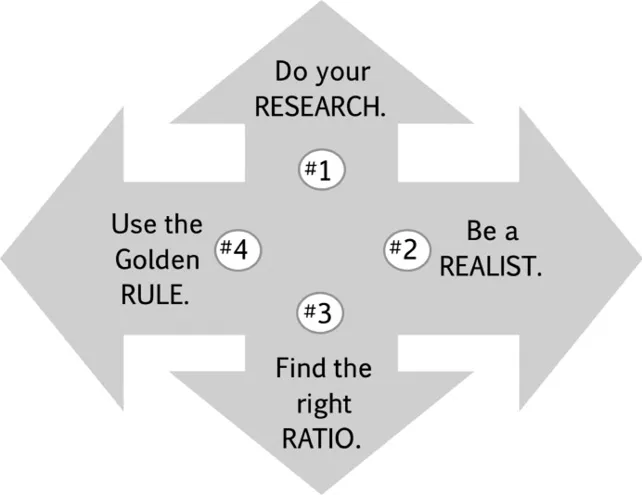
What I would like to doing this chapter is provide a general overview, a framework if you like, of all these techniques. In my own study of them, I have found that most fit into one of four core categories of disputation techniques. I call these categories the four roads out of the shadowland, or the Four Rs for short.
  1. Do your research.
  2. Be a realist.
  3. Find the right ratio.
  4. Use the golden rule.
These four techniques will be used in subsequent chapters to dispute each major type of distortion.
Road #1. Do your research.
Even if you are not a scientist, you probably learned back in elementary school about the scientific method: (1) we observe something happening; (2) we form a hypothesis about how or why we think it happened that way; (3) we collect more data under as unbiased and controlled conditions as possible; (4) we analyze the data to test our hypothesis; and (5) based on our analysis, we form a working theory that either accepts or rejects our hypothesis.
Cognitive distortions are a decidedly nonscientific way to think about life. They generally skip the middle part of the scientific method altogether, jumping directly from a single observation to a working theory.
We have known for a long time that depression darkens our perceptions of our past, present, and future. Compared to nondepressed individuals, depressed individuals are more likely to recall negative memories from their past. In the present, depressed individuals tend to pay more attention to the clouds in the sky than the sunshine. They also tend to fear the future, believing it will be every bit as gloomy as the present. Anxious individuals also fear the future and are constantly on the lookout for potential threats. In fact, they have a hard time paying attention to anything else.
The end result is, those who suffer from depression and anxiety notice only the information in their environment that confirms their view of things. They simply ignore the rest. There’s a technical name for this, confirmation bias. And once they have confirmed their negative beliefs, they stop looking for additional information. This is technically called limited search. To those who have never suffered from depression or anxiety, these may be among the most confusing and seemingly irrational aspects of these mind-brain disorders.
The science nerd in me can easily understand why this is so annoying to others. Imagine what would happen if one tried to do this in a real scientific study:
“Why didn’t you include all this other data?”
“Oh, well, none of it fit my theory, so I left it out.”
Really? This would never fly in the research world. The first thing the director of the study would say is, “Go back and review all your data. Then rework your theory.”
But it’s important to realize that those who suffer from depression and/or anxiety are usually unaware of these biases until others point them out. It’s just an odd quirk of these mind-brain disorders.
My main point is this. Any rational and logically sound theory must, by definition, be based on all available data, not just the data that happens to support the theory. The fact that depressed or anxious individuals tend to cherry-pick data points in their heads, either from past memories or current events, means they are not that great at developing sound theories.
So achieving this R requires us to analyze both the quantity and quality of our evidence.
You and I can ask questions like
  • What is the evidence for and against my belief or prediction?
  • Am I using all the evidence available, or am I limiting my search to only evidence that supports my belief/prediction?
  • What is the quality of my evidence? Is it so good that almost everyone would agree with me?
  • How could I prove that my belief or prediction is right or wrong? Is it even testable?
  • How often have I seen this situation before? Did I interpret it correctly then? Why or why not?
  • How often have my beliefs or predictions been wrong?
Some may think that analyzing our thoughts like this is just too nitpicky. Or even worse, that critiquing our thoughts means we are criticizing ourselves. But this is not true. The idea is simply to weigh the evidence for and against the thought, given all the evidence available to us right now. And like all good scientists, we will be duty-bound to go where the evidence leads us.
Which means we may find that our negative thought is true or partly true. This happens, right? Sometimes we fail at something that was really important to us; sometimes, people do in fact reject us or things don’t turn out the...

Table of contents

  1. Medical Disclaimer
  2. Introduction
  3. The Shadowland of Depression
  4. Entering the Shadowland
  5. Entering the Shadowland
  6. Leaving the Shadowland: Cognitive Behavioral Therapy
  7. Four Roads out of the Shadowland
  8. Dancing on the Gray
  9. Leaving the Exaggerated Life
  10. Seeing Light Behind the Clouds
  11. The Difference Between What You Know and What You Think You Know
  12. How Not to Major in Minors
  13. How Not to Minor in Majors
  14. Ending the Blame Game
  15. Embracing Emotion
  16. No More Monsters
  17. The Acceptance Paradox
  18. Conclusion
  19. Image Credits
  20. Endnotes
  21. Suggested Reading List
  22. About the Author