The author describes the history of industrial safety and the emergence of process safety as an engineering discipline in the 20th century. The book sheds light on the difference between: employers and workers.
- 362 pages
- English
- ePUB (mobile friendly)
- Available on iOS & Android
eBook - ePub
About this book
Information
1 Introduction
Occupational health and safety at work and process safety are very closely connected and at the same time very different. Because both subjects are closely connected, people tend to bring them together under the heading of “safety.” In many companies, experts in both subjects are part of the HSE department (HSE = Health, Safety and Environment). However, the two subjects are very different:
-
The historical motivation to avoid personal or process-related accidents is different.
-
The underlying thought process is different.
-
The approach is different: preventing person-related accidents requires mainly leadership and knowledge about legislation while preventing technologically related accidents requires mainly scientific competency.
Occupational health and safety at work is a common quest for social justice in the relationship between employers and workers irrespective of the type of industry. The basic premise in occupational health and safety is:
-
Workers contribute to their industry by “investing” time, physical capabilities and intellectual capabilities.
-
Workers are compensated financially.
-
The work undertaken has a potential impact on workers’ well-being including their health (positive or negative, real or potential).
-
The compensation received by the worker has to balance the worker’s investment.
This quest for justice is not new. The code of Hammurabi, a code of law of ancient Mesopotamia dating back to about 1754 BC made reference to “the duty of workers.”
Occupational health and safety is part of labor law which regulates the relationship between workers, employing entities, trade unions and the government. The Code of Federal Regulations (CFR) of the United States of America for instance, contains in Title 29, the principal set of rules and regulations issued by federal agencies regarding labor laws. Chapter XVII of CFR Title 29 (version 2014) comprises all the rules and regulations governing occupational health and safety.
The concepts of occupational health and safety (and associated legislation) evolved over time and, in particular, through the first and second industrial revolutions.
The early industries (textile, railroads and mining) that got off to a good start in Europe in the eighteenth century, involved hazardous working conditions. During the first industrial revolution, it was not clear for the society, at least at the beginning, how best to deal with accidents. In many cases, the employer was of the opinion that the worker didn’t take enough precautions and that it was somehow the worker’s fault that an accident occurred.
But the industrialization also introduced new technologies. Every time a new technology was put to practice, new types of accidents were “discovered.” On 10 August 1909, about 85 people were killed in a fire in the Paris Metro. The material used in the construction of the wagons was adapted accordingly but “the occurrence of the accident and the lessons learned from the investigation were needed” to improve the design of the wagons. This type of engineering “learn and improve” is different from “occupational health and safety at work” because new technologies bring about unknowns and inherent uncertainties.
Uncertainties due to complicated technologies should not be confused with unknowns that can occur at a certain moment in time, in the field of Occupational Health and Safety (e.g., the uncertainties for exposure to certain products such as asbestos, benzene, etc.). After some time when more knowledge is available, the unknowns are removed and the measures to be taken to avoid any risk are known. Uncertainties associated with complicated technologies can simply not be removed because they are inherent to the fact that technologies can be complex and complicated.
Of course, in both cases (i.e., occupational health and safety at work and industrial safety associated with new technologies), the ultimate goal is to avoid accidents and improve safety. However, “occupational health and safety” and “industrial safety” have different origins and different driving forces.
“Process safety” is an engineering discipline that was developed in the process industries. Its purpose is to avoid losses and to improve reliability and availability of process installations. The use of new technologies and new processes gave rise to accidents that were not known hitherto. Engineers and scientists worked hand in hand to better understand the physics and chemistry behind these accidents. Despite all efforts, uncertainties continue to be an inherent part of the occurrence of these accidents. To deal with these uncertainties, the notion of “risk” was introduced. A broad set of methods and tools were developed to analyze and to assess the risks. Acceptance or rejection of the exposure to hazards is based on risk assessment criteria.
2 The run-up to the Industrial Revolution
2.1 Purpose of this chapter
Occupational health and safety or well-being at work is a subject that arose with the industrialization. The industrialization created the need for a clear defined relationship between the employer and the workers on how to avoid potential negative impacts of the work on the health of the workers. So, why were the rules (legislation) not introduced at the beginning of industrialization? One of the explanations is that this relationship was a new social concept and there was no experience with an industrialized society in which the relationship “employer–workers” was a foundation. The society before the industrialization was built on different beliefs and social structures. The purpose of this chapter is to give some insights on the evolution of the society toward the industrialization.
2.2 The importance of the First and Second Industrial Revolutions
Evolution of European and American societies since around 1700 has provided the basis for the current approach to Occupational Health and Safety worldwide. The First Industrial Revolution saw the transition to new manufacturing processes in Europe and the USA in the period from about 1760 to sometime between 1820 and 1840. This revolution is characterized by such developments as the transition from manual production to machine production, the discovery and introduction of new chemicals, the development of new iron production processes.
The First Industrial Revolution marks a turning point in human history because of its influence on every aspect of daily life. It was driven by a combination of demographics, urbanization and living conditions in towns. The changing needs in Great Britain and a little later in the rest of Europe and the USA, and demographic and societal changes created the seeds for an Industrial Revolution, which in turn changed society in such a way that further industrialization was inevitable. I will focus on Great Britain because of its dominance at that time. During the nineteenth century, the economy of Europe and the rest of the world was dominated by Great Britain. It acted as the workplace of the world. Halfway through the nineteenth century, a quarter of all international trade went through British ports (Evans, 2016). However, the causes and consequences of the First Industrial Revolution became entangled in a vicious circle in which one reinforced the other.
The First Industrial Revolution was followed by a period of rapid industrial development, primarily in Great Britain, Germany and the USA. It was characterized by the construction of railroads, large-scale iron and steel production, widespread use of machinery in manufacturing, greatly increased use of steam power, widespread use of the telegraph, and increased use of energy sources (coal, petroleum and electricity). It also was the period during which modern organizational methods for operating large-scale businesses over vast areas came into existence. The Second Industrial Revolution is generally dated between 1870 and 1914 (the beginning WWI).
The main drivers for the First and Second Industrial Revolutions are:
- Population growth
- People’s way of living and in particular:
- Housing
- Food
- Clothing
-
The evolution of these drivers let to modifications in:
- Societal structure
- Warfare
- Manufacturing of goods and industry in general
- Transportation
- Banking
To make the First and Second Industrial Revolutions possible, science and engineering went through a fundamental transformation.
2.3 Population growth
At the end of the sixteenth century, the world population was estimated around 550 million from which about 110 million lived in Europe. Farmers leased land from the rich while poor people were on the lookout for jobs as wage laborers. The population of Europe grew from about 110 million in 1600 to 742 million in 2000. Figure 2.1 shows the growth (%) of the population in each century. In the seventeenth century for instance, the growth was 13% (number of people in Europe at the end of the seventeenth century compared to the number of people at the beginning of the seventeenth century) while in the eighteenth century, the population in Europe grew by 76% and in the nineteenth century by 122%.
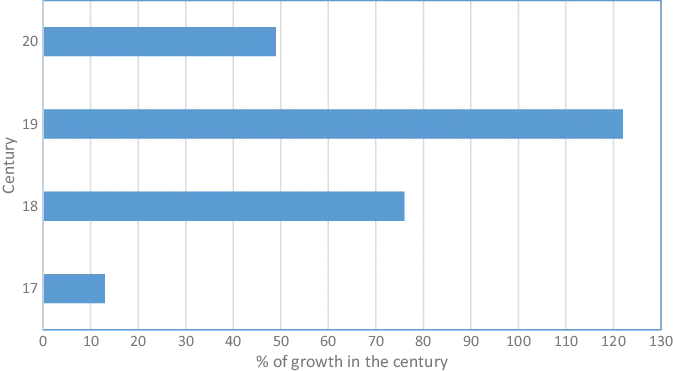
Figure 2.1: European population growth in different centuries.
The population growth was not at the same pace in different regions of Europe. The number of people living in (greater) London increased from about 60,000 in 1500 to 600,000 in 1700 and to about 1,000,000 in 1800. The population in London grew, in other words, with a factor of 16.7 between 1500 and 1800. This growth was much faster than in other European cities. In Paris for instance, of the same period the population grew with a factor of 2.8. It was also much faster than in the rest of England, where the overall population growth between 1500 and 1800 was about 3.1 (in France it was 1.6).
This rapid urbanization of a number of cities (and in particular, London) combined with the change in living standards probably explains why industrialization started in England.
After 1800, the population of many cities increased rapidly. The population of Glasgow, for example, which was around 77,000 in 1800, grew to 742,000 in 1900. The population of Berlin grew from 172,000 in 1800 to 1,122,000 in 1880. The population of Lisbon, which remained virtually unchanged until well into the nineteenth century, suddenly rose from 232,000 in 1880 to 435,000 just before World War I.
The rapid population growth in major European cities was accompanied by a wave of emigration. It is thought that in the period from 1815 to 1914, a total of around 60 million citizens left Europe (Evans, 2016). More than half (34 million) fled to the USA. All in all, more than a quarter of the natural population growth in Western Europe between 1841 and 1915 was swallowed up by emigration, with a net population decrease of 35 million citizens.
As a result, the population balance in the world began to change and parts of the world became more connected. Halfway through the nineteenth century, the population in the USA was not much larger than that of Great Britain while on the eve of World War I, it had grown to 92 million.
In the nineteenth century, the population of Italy and Spain grew twice as fast as in France while in Great Britain the population grew eight times faster than in France.
The rapid population growth which started in Great Britain and caused industrialization, continued in other parts of Europe. Population growth in Germany was accompanied by turbulent industrialization and lightning-fast urbanization. As a result, the demand for electricity, street lighting, chemically dyed clothing, canned food, etc. increased in turn accelerating industrialization.
2.4 Living conditions
In the sixteenth century, people lived predominantly in small villages and relied on farming. Poor people lived in simple huts of 1 to 3 rooms. Furniture...
Table of contents
- Title Page
- Copyright
- Contents
- Preface
- 1 Introduction
- 2 The run-up to the Industrial Revolution
- 3 Historical evolution of occupational health and safety in the nineteenth century
- 4 Technological risks
- 5 Process safety: an engineering discipline
- 6 Process safety risk-based management
- 7 Conclusion
- Index
Trusted by 375,005 students
Access to over 1.5 million titles for a fair monthly price.
Study more efficiently using our study tools.
Frequently asked questions
Yes, you can cancel anytime from the Subscription tab in your account settings on the Perlego website. Your subscription will stay active until the end of your current billing period. Learn how to cancel your subscription
No, books cannot be downloaded as external files, such as PDFs, for use outside of Perlego. However, you can download books within the Perlego app for offline reading on mobile or tablet. Learn how to download books offline
Perlego offers two plans: Essential and Complete
- Essential is ideal for learners and professionals who enjoy exploring a wide range of subjects. Access the Essential Library with 800,000+ trusted titles and best-sellers across business, personal growth, and the humanities. Includes unlimited reading time and Standard Read Aloud voice.
- Complete: Perfect for advanced learners and researchers needing full, unrestricted access. Unlock 1.5M+ books across hundreds of subjects, including academic and specialized titles. The Complete Plan also includes advanced features like Premium Read Aloud and Research Assistant.
We are an online textbook subscription service, where you can get access to an entire online library for less than the price of a single book per month. With over 1.5 million books across 990+ topics, we’ve got you covered! Learn about our mission
Look out for the read-aloud symbol on your next book to see if you can listen to it. The read-aloud tool reads text aloud for you, highlighting the text as it is being read. You can pause it, speed it up and slow it down. Learn more about Read Aloud
Yes! You can use the Perlego app on both iOS and Android devices to read anytime, anywhere — even offline. Perfect for commutes or when you’re on the go.
Please note we cannot support devices running on iOS 13 and Android 7 or earlier. Learn more about using the app
Please note we cannot support devices running on iOS 13 and Android 7 or earlier. Learn more about using the app
Yes, you can access Process Safety by Pol Hoorelbeke in PDF and/or ePUB format, as well as other popular books in Technology & Engineering & Industrial & Technical Chemistry. We have over 1.5 million books available in our catalogue for you to explore.