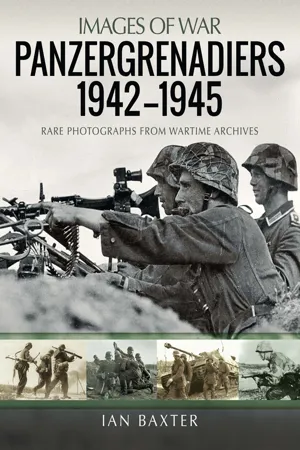
Using 250 photographs, this addition to the Images of War series examines Hitler's elite armored infantry: the Panzergrenadiers.
The term Panzergrenadier was introduced in 1942 and applied equally to the infantry component of Wehrmacht, Luftwaffe and later Waffen-SS Panzergrenadiere divisions. As this classic new Images of War book describes, these elite divisions fought as mechanized infantry and escort for and in close cooperation with panzers and other armoured fighting vehicles. Trained to fight both mounted and on foot, their priority was to maintain the fast momentum of armoured troops on the battlefield. Using a wealth of rare, often unpublished, photographs with detailed captions and text, the author charts the fighting record of the Wehrmacht and Luftwaffe Panzergrenadiertruppe units. This includes their initial successes on the Eastern Front. But as defeat approached, they were forced on the defensive on all fronts including the bitter fighting in Italy and the Western Front. As well as describing their many actions, the book details the vehicles and weapons used and main personalities.
- 176 pages
- English
- ePUB (mobile friendly)
- Available on iOS & Android
eBook - ePub
Panzergrenadiers 1942–1945
About this book
Information
Chapter One
Birth of the Panzergrenadiers
The German army was made up of heavy infantry, light (Schützen) units, security (Sicherung) or police units, and various types of Jäger formations. Although the standard infantry formation was paramount to the conduct of operations, often advancing in the wake of the Panzer divisions, by 1942 it was considered that techniques had to change in fighting against the Red Army on the eastern front.
As early as the Blitzkrieg years of 1939–41 it was realised how vital motorized infantry was. While the bulk of German infantry remained on foot, still using animals for its main form of transport, the armoured divisions were mechanized, using wheeled and tracked vehicles against their enemy. The integration of mobile units, equipment and tactics saw considerable success in the first half of the war. But as the time went on, it was necessary to adapt the motorized infantry into special independent mechanized infantry divisions. These new divisions would be ready to rush to the front lines at speed using trucks and halftracks as their main forms of transportation. Motorization provided no particular tactical advantage in small-unit combat, as trucks were vulnerable to both artillery and small arms fire. But in larger battles, motorized infantry provided the capability of moving units to critical sectors of the battlefield, allowing better response to enemy movements and the ability to outmanoeuvre the enemy. So in 1942 infantry and armour were combined as a single entity bringing Panzer and soldier together – the Panzergrenadier had been born.
In military history it had long been considered that a grenadier was a specialized soldier, first established with a distinct role in special assault operations. They were chosen for being physically the strongest soldiers, often riding into battle on horses, often leading the storming of breached fortifications.
In 1914 the Imperial German armies included a number of grenadier regiments. Five regiments of the Prussian Guard were designated as Garde-Grenadiers and there were an additional fourteen regiments of grenadiers amongst the infantry of the German Empire. They were considered elite troops and wore plumed helmets and braided uniforms in full dress.
But when the term Panzergrenadier was adopted in the Wehrmacht in 1942, it was purely to describe mechanized heavy infantry working in tandem with armoured formations. They operated as highly mobile elite shock troops, adapting between mounted and dismounted combat to maintain the momentum of armoured troops. Their versatility and reactivity enabled them to gain and maintain the initiative and quickly bring about successes.
One of the earliest Panzergrenadier divisions to see action derived from the 16th Motorized Infantry Division, nicknamed ‘Windhund’ (Greyhound). The division participated in the Balkans campaign in 1941 along with the 16th Panzer Division. It took part in operations in Army Group South in Russia a year later, and was also sent to fight in Stalingrad. In November 1942 it was formed from the 16th Motorized Infantry Division into the 16th Panzergrenadier Division. It continued to see extensive action on the southern front but sustained serious losses. What remained of its badly depleted units were reorganized into the 116th Panzer Division in March 1944.
Another early Panzergrenadier Division was the 233rd. It was derived from Division 233 (mot) in July 1942. The division only operated for nine months before it was incorporated into the 233rd Reserve Panzer Division on 8 August 1943 and was posted to central Jutland from 18 November. It remained in Denmark where it trained Panzer crews and motorized troops at Horsens. It took no part in combat.
Though the Panzergrenadiers were few in late 1942, their techniques were very successful. Soldiers accompanied the armoured spearheads, often mounted aboard tanks in the first wave. A second wave followed immediately, of Panzergrenadiers in trucks, armoured halftracks, or mounted on tanks. They would overcome the enemy positions that had survived the first wave. Because they were mounted on vehicles, the tanks did not have to slow their advance for the infantry to keep pace with them. When they arrived on the battlefield the tank riders dismounted to let the tanks attack and flush out Soviet infantry. When a tank company went into action with infantry, there were normally two platoons on the line, one at the rear, and a fourth in reserve. The interval between tanks was usually 300–360 feet.
The steppes of southern Russia were regarded as good tank country; there were few roads but the ground was usually firm enough for wheeled or tracked vehicles, and the Panzergrenadiers often excelled against Russian fire. In urban areas, such as Stalingrad, where the 16th Pa...
Table of contents
- Cover
- Title
- Copyright
- Contents
- About the author
- Introduction
- Chapter One Birth of the Panzergrenadiers
- Chapter Two 1943
- Chapter Three 1944
- Chapter Four 1945 – The Last Months
- Appendix 1 Heer and Luftwaffe Panzergrenadiers
- Appendix 2 Reorganization of Panzergrenadier Divisions, 1944
- Appendix 3 Panzergrenadier Battalion, 1945
Trusted by 375,005 students
Access to over 1.5 million titles for a fair monthly price.
Study more efficiently using our study tools.
Frequently asked questions
Yes, you can cancel anytime from the Subscription tab in your account settings on the Perlego website. Your subscription will stay active until the end of your current billing period. Learn how to cancel your subscription
No, books cannot be downloaded as external files, such as PDFs, for use outside of Perlego. However, you can download books within the Perlego app for offline reading on mobile or tablet. Learn how to download books offline
Perlego offers two plans: Essential and Complete
- Essential is ideal for learners and professionals who enjoy exploring a wide range of subjects. Access the Essential Library with 800,000+ trusted titles and best-sellers across business, personal growth, and the humanities. Includes unlimited reading time and Standard Read Aloud voice.
- Complete: Perfect for advanced learners and researchers needing full, unrestricted access. Unlock 1.5M+ books across hundreds of subjects, including academic and specialized titles. The Complete Plan also includes advanced features like Premium Read Aloud and Research Assistant.
We are an online textbook subscription service, where you can get access to an entire online library for less than the price of a single book per month. With over 1.5 million books across 990+ topics, we’ve got you covered! Learn about our mission
Look out for the read-aloud symbol on your next book to see if you can listen to it. The read-aloud tool reads text aloud for you, highlighting the text as it is being read. You can pause it, speed it up and slow it down. Learn more about Read Aloud
Yes! You can use the Perlego app on both iOS and Android devices to read anytime, anywhere — even offline. Perfect for commutes or when you’re on the go.
Please note we cannot support devices running on iOS 13 and Android 7 or earlier. Learn more about using the app
Please note we cannot support devices running on iOS 13 and Android 7 or earlier. Learn more about using the app
Yes, you can access Panzergrenadiers 1942–1945 by Ian Baxter in PDF and/or ePUB format, as well as other popular books in History & German History. We have over 1.5 million books available in our catalogue for you to explore.