How many times have you thought about your own baptism? If you are one of the many who have been brought up in a church that includes infants, you probably don't even remember the waters running down. In our hurried world, not many stop to question a sacrament performed so long ago. Yet biblically, the sign was meant to signify your personal relationship with the God of the universe. What could be more important than this?At present, we face the reality that the way baptism is practiced has no choice but to portray crucial elements of the cross-covenant. Does this arrangement merely offer us salvation, or does it signify our actual participation in the redemptive work of Christ? Down through the centuries, whole denominations have divided sharply over the issue, a situation that still remains with us. But for those caught under the waters, a burning question lingers-where in all of this do I stand with God?On a personal level, if you were unaware of the proceedings on that special day, one might be very surprised to learn how Old Testament circumcision answers this most important question. From its historical origins, spiritual realities, and harsh consequences, the practice of infant baptism must be revealed for what it is--and is not.This book serves as a powerful resource for both layman and clergy to take a much deeper glimpse into the nature of covenant relationships. Once inside, the reader will come to understand all that has happened to both the Church and the Gospel message ever since infant membership became a cultural norm. A comprehensive effort in returning jurisdiction over the baptismal waters back to the priesthood of Christ, this works will possess lasting value for anyone who wants to stand upright and true before the King.
eBook - ePub
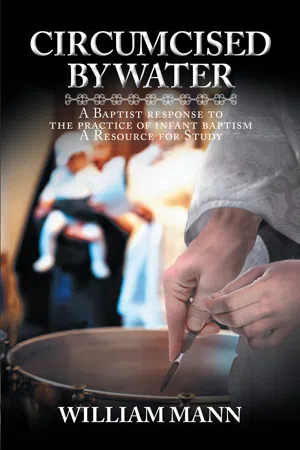
Circumcised by Water
A Baptist Response to the Practice of Infant Baptism: A Resource for Study
- 546 pages
- English
- ePUB (mobile friendly)
- Available on iOS & Android
eBook - ePub
Circumcised by Water
A Baptist Response to the Practice of Infant Baptism: A Resource for Study
About this book
Information
chapter i
A Little Trip
Well, there I was, in our truck and running her a little bit faster than the local speed limit (and good judgment) would normally allow. Taking the turns with a hint of squeal from the tires, the whine of the engine just barely overpowered the sounds of labored breathing and the occasional whimper coming from the passenger side of the cabin. With clenched teeth and eyes that at times narrowed into slits, she was having a hard time controlling the contractions that came with increasing frequency as we made our way to the hospital.
As with any set of parents who go through the difficult experience of childbirth for the first time, I wondered what truly lay ahead for us. Would my wife be in labor for hours upon hours? Will she treat me differently now that her affections will be focused on our new addition to the family? More importantly, will the little girl we knew was coming be a healthy strong baby? All these things and more I was to find out in the course of the next few hours. As it turned out, they would be tense ones.
The labor progressed normally at the hospital until the monitor of the baby indicated that the heartbeat was faster than it should have been: a clear sign of distress. At that point, the doctor suggested that we needed to have this baby, and he meant right now. Coached into pushing with the contractions instead of riding them out, my wife began the final stages of childbirth that would allow us to become a family for the first time. With one final push, our daughter came into the world to bless us with her presence.
But all was not well. No sound came from her lips as she seemed to gasp for air, her chest rising and falling rhythmically in a labored attempt to get the oxygen she so desperately needed. The room suddenly seemed to grow very small as we all waited for the characteristic wail of the healthy newborn—a sound that never came. Rushed to another room where pure oxygen was pumped through her nose, it was all she could do just to stay alive.
The hospital recommended an emergency flight to the nearest major facility in the city, and placement within the neonatal center there. She was flown immediately. Over the span of the next few days, in an environment of pure oxygen, our daughter would eventually come to improve. But those first tense days were a nightmare for us. In due course, we found that a genetic anomaly was the cause for her condition and that it was a condition that would affect her physical and cognitive ability the rest of her life.
Naturally, we were devastated. As both of us were strong Christians, we knew that somehow all of this was in God’s plan for us, but we questioned aloud how all of this could possibly come together for anyone’s good. For me personally, the curse God overlaid upon the earth for the sin of man could not have come any closer to my heart. The frequent trips between both hospitals—one that my wife was in and the other for my little girl—gave me plenty of time to reflect on all of this, and I remember wondering if our new baby would ever have the mental capacity to come to know Christ in any meaningful way. It was a question that would haunt me for months afterward.
As the days turned into weeks, she slowly improved to the point of being discharged from the hospital, but with the clear expectation that she would develop much differently than a normal child. My mind floated from one thought to the next, until eventually it came to rest on the issue of baptism. This was not by chance, for traditionally, this meant it would have to happen fairly soon, as early as the next month after she was stable enough to be brought to church. The mixture of her future mental state and everything I knew about what it meant to be Christian coalesced into a jumbled mass of questions. Questions that had to do with the nature and meaning of baptism as a sign of Church membership. Was she still eligible for baptism at all? What was it that made even a healthy “normal” child fit for baptism? I too had been baptized as an infant and traced my early years through Sunday school and youth groups until as a late teenager, personal faith in the living God had washed over me. But thinking along these lines, another question came slowly to mind. At what point had I become a true member of the Church? Was it at baptism as an infant or when faith came later?
Intuitively, almost without thinking, my first response was to affirm that faith and Church membership went hand in hand. But hadn’t the pastor always proclaimed that the newly baptized infant was now a “member” of the Church? I racked my memory to confirm that these were the actual words spoken during the baptismal ceremony. After some time sifting through the many baptisms witnessed in the past, my conclusion was that, yes, those were the exact words. Puzzled and more than a bit curious, I began to reference texts that were lying about the house concerning Church doctrine. After all, she was my little girl and no matter what state she was in, she was loved dearly. It was my responsibility to ensure she received every spiritual benefit the Church offered. To my surprise, the scanty bits concerning what baptism meant in the literature I had found affirmed what my memory had told me. Infants were indeed made members of the Body of Christ at baptism. But my thoughts were anything but settled. Wasn’t the whole assembly naturally made up of believers only? Just what kind of church was I a part of anyway?
Even though raised as an active member since childhood, it was kind of embarrassing to think that I hadn’t the faintest clue as to why infants were baptized. So, starting with some of the more well-known books on baptism, I began to read everything that was available on the subject. My search for the meaning of infant baptism soon grew into a passion of sorts, and I became deeply concerned at what was found. All that was needed was a solid scriptural answer to the question of how infants became legitimate members of the Church! For such a simple question you would think there would be a simple answer. But there wasn’t. Each new material referenced on the subject seemed to be increasingly confusing and attempted to drive me further away from my own Christian beliefs. Sure, these academic theologians quoted from an impressive list of passages from the Bible, yet each and every interpretation had problems being compatible with other sections of scripture. Sections that were fundamental to everything I had learned about Christianity.
Eventually, as the reasons behind infant baptism became somewhat familiar, patterns became to emerge from the texts. Things that were common within each approach were written down and compared to the next idea some theologian would offer on the subject. It was only after reading the fifth or sixth author that I realized something was seriously wrong with the doctrine, and that my search for meaning within this practice was a story that needed to be told. It was quite apparent at this point that if there had been a sound biblical reason to baptize an infant, it would have come to light by now. After all, some of these authors had lived up to five centuries ago, and their contemporaries in this day and age had come up with nothing really new.
Perhaps you have never really wondered why anyone would grant covenant status to a newborn little baby. On the other hand, you may have entered the local church in the exact same fashion, who knows? To be quite honest, it is probably an accurate statement to say that most of us never really question why infants are baptized, much less looked into all the theological reasons behind it. This is largely a reflection on the power of tradition, whereby forms and practices are so deeply embedded within an institution that their basic meaning and justifications are simply taken for granted. To stop and question them almost seems almost redundant, unthinkable.
Therein lies the danger however, for traditions are fine if they are rooted in scripture, but poison to the soul and the life of the Church if they are not. It is the responsibility of every churchgoing generation to make that determination. To a large extent this was the driving force that brought about the Protestant Reformation, whereby the worship of God was stripped of man’s authority represented in the classic Roman Catholic claim of “sacred tradition.” Within the new order of Protestant Churches, this authority was rightly returned to the authenticity of God’s Word.
The break was not as clean as it might have first appeared to be, however. Remnants of the old Church still move and breathe within the walls of many houses of worship, and one of them is clearly represented within the doctrine of infant baptism. Perhaps few pastors would claim that we still celebrate a Catholic sacrament today, yet the truth remains that the practice itself was inherited directly from the Roman Church. The only thing that has changed is the justifications for its practice, and it is to this that we must now turn.
This works was fashioned from the outset to explore many of the theological aspects that lie behind the rite. In so doing, we will come to answer the questions posed here and many others that plague this practice. However, it must be fully understood from the outset that so much more is at stake here than simply sprinkling a little water over some adorable little babies. As baptism is given us in Scripture as the premier sign of our covenant relationship with God, any misstep with the way it is administered belies an underlying distortion of the ways and means of the covenant itself. In this respect nothing could be more important in the life of the Christian than the fundamental identity and workings of the arrangement that brings us into communion with God. Indeed, from the initial call of servanthood to the final act in receiving us into His presence at death, the covenant wrought at the cross both defines and affirms who we are at each station in life.
As such, the need for His people to engage in this conversation remains very real and pressing. Many might instinctively think that the authority of the Bible as it describes the event of baptism would be all-sufficient to set its meaning throughout the various expressions of church found all over the globe. Then again, mankind was never really that good at sticking to the scriptural testimony, were we? As a result, in that our witness amid the hostile and unbelieving world was always interwoven through the person of Jesus Christ, this practice today stands perfectly suited to hinder the central message of the Gospel like no other rite found within the modern church. We would do well to take note of it.
chapter ii
The Eventful Day
Before the service even started, a gathering met outside to greet one another, some having not seen each other for quite some years. Dressed in their finest attire, many haven’t darkened a church doorway in years. Yet today is obligatory, for an important family function is going to take place. Unlike other social gatherings such as weddings, reunions, and funerals that are self-evident as to their importance and meaning, this one is different, shrouded deeply within the mysteries of tradition.
“Hey, Walter, how’s it going?”
“Good, good, doing just fine. How’s everything your way? Are you still with that firm in Towson?”
“Yup. I got put on their assessment team a while back though, so I get to write the reports from the manufacturing end of things now.”
“That’s great. Hey, what’s the little one’s full name?”
“Donald Sebastian Miller, I think.”
“That’s what I thought, but where on earth did the Sebastian come from? Is it a family name on their side or something?”
“I don’t know. Aunt Cathy might know. She’s sort of tight with the Millers after Amy had trouble with the false labor and all.”
“I heard about that. What was it, three different trips to the hospital?”
“Something like that, but everything turned out okay, thank God.”
“Hey, there they are now. Are we all supposed to sit together inside?”
“I think so, I’m just going to follow Cathy in and see where they put us.”
“Are we allowed to take any pictures?”
“I sure am. Sharon wanted to get a few and besides, you only get to have this thing done once, you know.”
Walking inside as a unified group, they take their place within the sanctuary, usually in a roped-off or designated section close to the pulpit and, more importantly, in plain view of a strange- looking furnishing that is placed nearby. As the service begins and continues toward the anticipated moment, they will forbear the pastor’s sermon, stand for a creed and spiritual song or two, and nervously await to capture the magic moment that is about to occur. But what is happening here? What is the reason for all this effort and pageantry? Yes, an infant is going to be baptized today.
The parents will eventually take a stance in front of the congregation, and after proclamations of faith and vows of Christian upbringing, the pastor takes the little one from the parents arms and softly recites the familiar words that has become entrenched in our collective experience within the modern Church of Christ: “Donald Sebastian Miller, child of the covenant, I baptize you in the name of the Father, Son, and Holy Spirit.” Water from the font is applied on the head as the words are spoken, running down on the fine linen of the outfit purchased specifically for the occasion. Clicks and flashes from the audience mark the event, and even from...
Table of contents
- Preface
- chapter i
- chapter ii
- chapter iii
- chapter iv
- chapter v
- chapter vi
- chapter vii
- chapter viii
- chapter ix
- chapter x
- chapter xi
- chapter xii
- chapter xiii
- chapter xiv
- chapter xv
- chapter xvi
- chapter xvii
- chapter xviii
- chapter xix
- chapter xx
- chapter xxi
- chapter xxii
- chapter xxiii
- chapter xxiv
- Appendix
Trusted by 375,005 students
Access to over 1.5 million titles for a fair monthly price.
Study more efficiently using our study tools.
Frequently asked questions
Yes, you can cancel anytime from the Subscription tab in your account settings on the Perlego website. Your subscription will stay active until the end of your current billing period. Learn how to cancel your subscription
No, books cannot be downloaded as external files, such as PDFs, for use outside of Perlego. However, you can download books within the Perlego app for offline reading on mobile or tablet. Learn how to download books offline
Perlego offers two plans: Essential and Complete
- Essential is ideal for learners and professionals who enjoy exploring a wide range of subjects. Access the Essential Library with 800,000+ trusted titles and best-sellers across business, personal growth, and the humanities. Includes unlimited reading time and Standard Read Aloud voice.
- Complete: Perfect for advanced learners and researchers needing full, unrestricted access. Unlock 1.5M+ books across hundreds of subjects, including academic and specialized titles. The Complete Plan also includes advanced features like Premium Read Aloud and Research Assistant.
We are an online textbook subscription service, where you can get access to an entire online library for less than the price of a single book per month. With over 1.5 million books across 990+ topics, we’ve got you covered! Learn about our mission
Look out for the read-aloud symbol on your next book to see if you can listen to it. The read-aloud tool reads text aloud for you, highlighting the text as it is being read. You can pause it, speed it up and slow it down. Learn more about Read Aloud
Yes! You can use the Perlego app on both iOS and Android devices to read anytime, anywhere — even offline. Perfect for commutes or when you’re on the go.
Please note we cannot support devices running on iOS 13 and Android 7 or earlier. Learn more about using the app
Please note we cannot support devices running on iOS 13 and Android 7 or earlier. Learn more about using the app
Yes, you can access Circumcised by Water by William Mann in PDF and/or ePUB format, as well as other popular books in Theology & Religion & Biblical Criticism & Interpretation. We have over 1.5 million books available in our catalogue for you to explore.