The massacre of Igbos/Biafrans across the Northern Nigeria started way back in 1945 in Jos, where more than 150 Igbos/Biafrans were brutally slaughtered for no reason. That is about thirty-one years after the fraudulent amalgamation of Islamic north and Christian south by the British. Prior to the Civil War in 1966 pogrom, over sixty thousand civilians were brutally murdered because they were Igbos/Biafrans and Christians living in the north. "One by one, the Igbo people who were sheltered in the Emir's Palace were dragged out with hands and feet tied. An unsharpened knife was used on purpose in cutting the neck to ensure a slow and painful death. Goats do not receive such wicked treatment during slaughter; neither does a chicken. Tired and in pain, the victim gave up the ghost while asking for water in Igbo language: 'Nye m Mmiri,' literally expressing 'Give me water.' Families watched as they each gave up the ghost. Since then, the Hausa-Fulani people have adulterated the expression into 'nyamiri' as a form of mockery to the Igbos." The Indigenous People of Biafra (IPOB) are the remnants of people that survived the genocide of 1967""70, where more than 3.5 million Biafrans were brutally slaughtered by the Nigerian State. These remnants of Biafran people have not only resided in every nook and corner of the said Nigeria but also have scattered all over the planet earth in quest for green pasture. Those who understand the true meaning of freedom fighting know that IPOB is here to get Biafra and nothing more. Those who read history know that every successful freedom fighting have always started from outside. The method, strategy, and mode of its execution have never been seen anywhere on this planet earth, and that is why Biafra is going to be restored. Buhari remains the last standing samurai/pharaoh of the uneducated northern oligarchy with the boldness to attempt to implement the Hausa-Fulani Islamic agenda to the shores of Atlantic Ocean, but he must fail. The leader of Indigenous People of Biafra, Nnamdi Kanu, has always said, "They would kill us, we will kill them, and then Biafra will come."
- 204 pages
- English
- ePUB (mobile friendly)
- Available on iOS & Android
eBook - ePub
The Case For Biafra Restoration
About this book
Trusted by 375,005 students
Access to over 1.5 million titles for a fair monthly price.
Study more efficiently using our study tools.
Information
Chapter 1
The Original Sinner
“The leadership of Indigenous People of Biafra (IPOB) has agreed that we must step up and intensify an all-out attack on the British Government (not the British People) on social media so that they will stop supporting Nigeria to hold down Biafra. We must force the British Government to capitulate from their stranglehold on Biafra” (IPOB, January 5, 2017).
Around the world in retrospect, five of the worst atrocities carried out by the British Empire in the last 150 years include the following:
- The Boer concentration camps of 1899–1902, where British Army rounded up around a sixth of the Boer population, mainly women and children, detained them in overcrowded camps prone to outbreaks of disease and little food. “Of the 107,000 people interned in the camps, 27,927 Boers died, along with an unknown number of black Africans.”
- Amritsar massacre: “When peaceful protesters defied a government order and demonstrated peacefully against British colonial rule in Amritsar, India on 13th April 1919, they were blocked inside the walled Jallianwala Gardens and fired upon by Gurkha soldiers. The soldiers, under the orders of Brigadier Reginald Dyer, kept firing until they ran out of ammunition, killing between 379 and 1,000 Protestants and injuring another 1,100 within ten minutes.”
- Partitioning of India: “In 1947, Cyril Radcliffe was tasked with drawing the border between India and the newly created state of Pakistan over the course of a single lunch. After Cyril Radcliffe split the subcontinent along religious lines, uprooting over 10 million people, Hindus in Pakistan and Muslim in India were forced to escape their homes as the situation quickly descended into violence. Some estimates suggest up to one million people lost their lives in the sectarian killings.”
- Mau Mau Uprising: “During the Mau Mau uprising (1951–1960), thousands of elderly Kenyans claimed that British colonial forces mistreated, raped and tortured them. As a result, they launched a 200 million pound damage claim against the UK Government. Estimates of death in the camps ranged from 20,000–100,000, mainly of members from the Kikuyu tribe.”
- Famines in India: “Between 12 and 29 million Indians died of starvation while under the control of British Empire. Millions of tons of wheat were exported to Britain as famine raged in India. In 1943, up to 4 million Bengalis starved to death when Churchill diverted food to British soldiers and countries such as Greece while deadly famine swept through Bengal. Talking about the Bengal famine in 1943, Churchill said: ‘I hate Indians. They are a beastly people with a beastly religion. The famine was their own fault for breeding like rabbits.’”(Source: www.independent.co.uk/news/uk/home-news/worst-arocities-british-empire-amritsar-boer-war-concentration-camp-mau-mau-a6821756.html.)
The British quest to conquer and colonize have affected about half of the world’s countries whom they have come in contact with, leaving all of them in the most negative state, politically and economically. In the 1885 map of Africa, Biafra could be seen clearly existing on its own. The formation of southern and northern protectorates and joining them together was what constitute today as the paradox of Nigeria false marriage. In essence, both the north and south of Nigeria eventually became victims of these evil British colonial experiments. Before the emergence of both protectorates, both regions differ in languages, religion, and value systems. Protectorates of the south and north were joined together in 1914 by Lugard and called the country Nigeria. The Southern Nigeria protectorate, chartered by Royal Niger Company, lies below Lokoja, parallel on the Niger River. On the other hand, the northern protectorate included Sokoto Caliphate and parts of the former Bornu Empire, which was conquered in 1912. Flora Shaw, the mistress who later became the wife of Lugard, was the person that coined the name Nigeria by applying River Niger to the area of the land surrounding it.
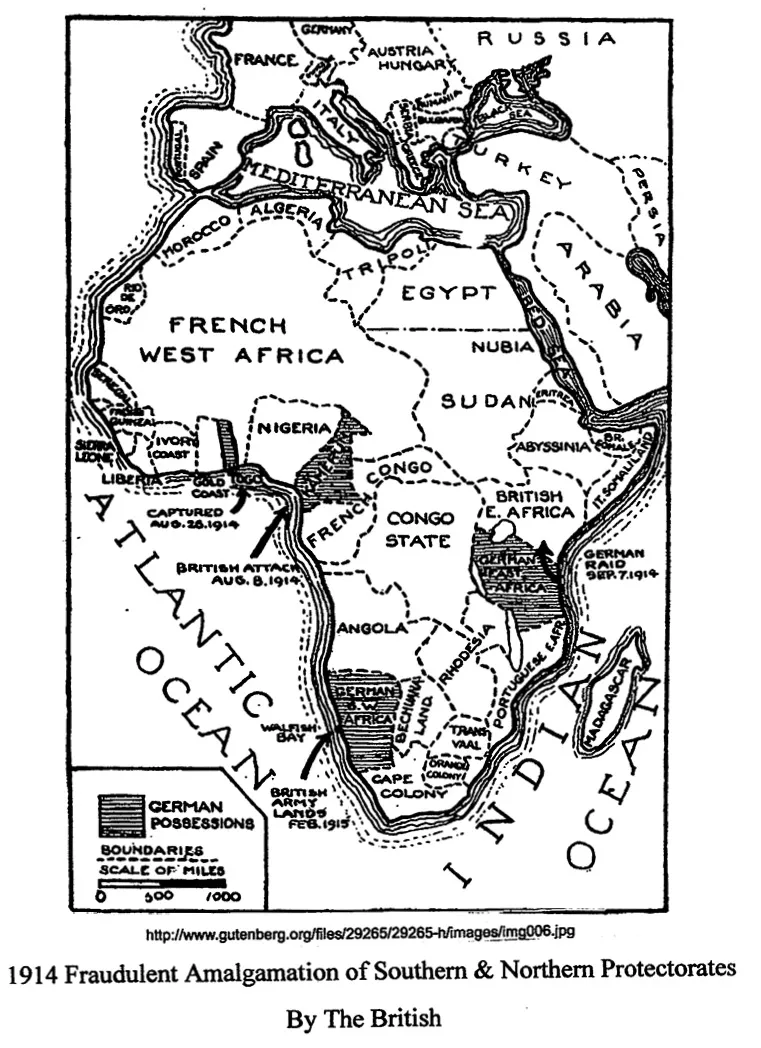
The success of Lugard’s indirect rule policy was as a result of administration through local chief under the close supervision of British colonial officers. The indirect rule system worked best in the northern areas, but in the southeast, for example, the use of warrant chiefs were adopted. In Dual Mandate, Lugard outlines the reasons and methods for the colonization of Africa by Britain, and these included in it the spread of Christianity to end barbarism. Writing in the book Dual Mandate on page 70 in 1920, Lugard belittled and dehumanized the inhabitants thus:
In character and temperament, the typical African of this race-type is a happy, thriftless, excitable person. Lacking in self-control, discipline, and foresight. Naturally courageous, and naturally courteous and polite, full of personal vanity, with little sense of veracity, fond of music and loving weapons as an oriental loves jewelry. His thoughts are concentrated on the events of the moment, and he suffers little from the apprehension for the future, or grief for the past. His mind is far nearer to the animal world than that of the European of Asiatic, and exhibits something of the animals’ placidity and want of desire to rise beyond the State he has reached. Through the ages the African appears to have evolved no organized religious creed, and though some tribes appear to believe in deity, the religious sense seldom rises above pantheistic animalism and seems more often to take the form of a vague dread of the supernatural.
He lacks the power of organization, and is conspicuously deficient in the management and control alike of men or business. He loves the display of power, but fails to realize its responsibility . . . he will work hard with a less incentive than most races. He has the courage of the fighting animal, an instinct rather than a moral virtue. In brief, the virtues and defects of this race-type are those of attractive children, whose confidence when it is won is given ungrudgingly as to an older and wiser superior and without envy. Perhaps the two traits which have impressed me as most characteristic of the African native are LACK OF APPREHENSION AND HIS LACK OF ABILITY TO VISUALISE THE FUTURE.
Frederick John Dealtry Lugard probably had some points. We may be angry on what he said about the Africans he met, but the facts remain that up till today, many of the so-called African leaders still lack self-control, discipline and foresight. Isn’t it a fact that up till today, African heads of state, presidents, governors, and other political parastatals still loot the public treasury and most sadly send those loots abroad to benefit foreign countries? Now tell me why any African leader in his right mind, with no good roads, no running water, no electricity and no adequate medical delivery will not use public funds to build and service infrastructures for his people? Why is it that for the most part Africans seem to concentrate on the events and feelings of the moment and lacking in the ability to visualize the future? Could it have been as a result of cultural difference between Europeans and Africans? In my analysis, I would say that Lugard concentrated his findings in the north, where people were least educated, coupled with their Islamic tendencies of submission, rooted in the Sokoto Caliphate. In contrast, in the south especially the southeast, advanced system of democratic process had existed many thousands of years before British invasion. That’s why Lugard and his British subjugators called the Igbos “great” people.
Yet Frederick Lugard, who was a soldier of fortune for the British, long dead now, had the audacity to insult the people of Africa by saying that “the Africa appears to have evolved no organized religious creed.” That’s the one I have the greatest problem with. Before the white man came to Africa, Africans had their own religious practices. This insult from Lugard came about because many Africans left their traditional religion and followed that of foreign land. That was when the culture and souls of many Africans were lost because experiences of foreign lands and spirits of their ancestors were invoked rather than ours. My belief is that our ancestors should have allowed African religion to evolve, refine, and strictly hold on to it. They should not have abandoned it to follow that of foreigners. When Lugard wrote that “the Nigerian loves the display of power,” I agree with him, unfortunately. An example of this arrogance is when they—the president, governors, senators, and other politicians—will brag and say “You no know me?” And this has become their character trait. Again, Lugard wrote that the Nigerian “lacks the power of organization.” Lack of education, insightfulness, coupled with culture of corruption have contributed as to why roads, traffic, and electricity are lacking till date! Why is it such a big deal to establish and maintain durable and credible structures for the growth and sustenance of local, state, and federal government economic infrastructures? From all accounts, Lugard somehow came to believe that the southeastern people were more advanced in culture and knowledge than those of the northern elements. That notwithstanding, he went ahead with the amalgamation of 1914 while referring the two regions as oil and water that cannot mix. He, however, gave the two amalgamated regions one-hundred-year trial period, after which each party involved may find their own ways. According to this report, the one-hundred-year time period ended in December 2014.
The fact of the matter is that Lugard created the contraption, Nigeria, for the economic interests of British government. It was the same British that came with their Bible, after which they handed the Christian south over to the Muslim north because they envisioned that the southeasterners were highly advanced in knowledge and cannot be easily be manipulated. What the British did in 1914 was against the law of man as well as the law of God. It was against the law of man in that our forefathers were neither consulted in the execution of the ill-conceived amalgamation nor were they asked for a referendum. It was also against the law of God because it was stated in the Bible that “cursed be he who moves his neighbor’s landmarks” (Deuteronomy 27:17).
Prior to Nigeria-Biafra war of 1967–70, the north actually planned to secede from Nigeria; it was the British that talked to them for war instead of secession. The then British high commissioner, Sir Cumming Bruce, persuaded the Emirs and told them that secession would be an economic disaster to them the northerners. “It wasn’t on the face of it easy to get them (the North) to change, but I managed to do it overnight. I drafted letters to the British Prime Minister, to send to Gowon as Nigerian head of state, and for my Secretary of State, (Michael Stewart) to send letters to each of the Emirs. I wrote an accompanying letter to each of them because I know the personally. I drafted all these and they came back to me duly authorized to push at once. The whole thing was done overnight and it did the trick of stopping (the North) from dividing Nigeria up” (Nwobu 2013, http://www.irishdemocrat.co.uk/features/biafra)
That was a classic British treachery in manipulating the north in the interest of the British government to use the north as a willing tool to control the mineral resources that came from the southeast.
In December 1968, Auberon Waugh, an English journalist, writing in Britain and Biafra, The Case for Genocide Examined narrated the eyewitness events of 1967–70 war of genocide against the people of Biafra thus:
For as long as any Christian, liberal or humanitarian tradition survives, the year 1968 will be remembered as the one in which a British Government, for the first time in its history, was prepared to condone the mass starvation to the death of innocent civilians as a means of implementation one aspect of its peacetime foreign policy. Very few people in England have any awareness of the fact—like most Germans said after the war, they will be able to say that they did not know what was being done in their name. Few Englishmen have even bothered to think out their attitudes to the war as far as this. Because the fact has never been presented to the British public except in these pages and in a few hastily contradicted letters to the quality newspapers, nobody has had to think further. If they did, and if they accepted the doubtful proposition that the mass starvation civilians including children is permissible act of war (Article IV of the Geneva Convention on the conduct of war, 1949, expressly states that civilians may not be deliberately used as war targets for the purpose of winning a war) then they would still have to decide what purpose is served by the present siege.
When I visited Biafra in July, I was told by Red Cross officials, by Dr Herman Middlekoop of the World Council of Churches, by the Catholic Missionaries there and by secular relief workers that the most accurate estimate of current mortality would be 3,000 a day. Needless to say, I was not able to see anything like that number. When I visited Queen Elizabeth Hospital, Umuahia, I saw about a hundred children who were beyond recovery, according to Dr Shephered, the medical officer in charge. He said that if I had come on an out-patient day I would have seen nearer to a thousand. That is the only contribution I can personally make to the evaluation of statistics, since everything else was hearsay—a missionary who said that he had buried ten children that day; Mr M. N. Nwaubani, in charge of the Orie Amaenyi refugee camp of 550 inmates, who said that twenty-eight of his charges had died, a fact of which he was not at all proud. It was only one of forty-two camps around Aba, and one shudders to think what happened to them now?
But however unreliable the figures may be, and however reluctant one may be to believe them, they are the best available, and it is no defense merely to assert that they are exaggerated. Those who have the task of tending to the dying and burying the dead are in a far better position to make an estimate than any one in Lagos, or than any mandarin in the Foreign and Commonwealth Office. After I left Biafra, the figure, according to the responsible relief organizations, quickly rose to 5,000 a day until it has now reached the appalling level of 10,000 deaths a day inside unoccupied Biafra and 4,000 a day in the so-called “liberated” territory. When existing stocks of seed-yams and cassava have been eaten, starvation will presumably be total. But even if one The Biafra Ministry of Information posters reproduced on this and succeeding pages were taken from the walls of Aba, Owerri and Umuahia earlier this year, decides, as nobody who has spoken to those responsible for collating the figures reasonably could decide that they are propaganda-inspired, even then if we divide the figures by ten, we are still left with the most hideous crime against humanity in which England has ever been involved.
If the original purpose of the siege was to make Biafra surrender, then the August’s final push was an admission that this strategy had failed. The notion of “quick kill” so enthusiastically endorsed by Nigel Fisher and others ended in bloody and atrocious failure, as anybody who had ever spoken to a Biafran—even a Biafran Nurse in an English Hospital—could have told him it would. At no stage of the last twelve months in the present war have the Nigerians enjoyed an arms superiority of less than ten to one, but if there is a single lesson to be learned from the decade and a half since Korea, it is surely that arms superiority is no effective guarantee against a determined enough, intelligent enough or desperate enough enemy.
However, since the failure of the “quick kill,” Nigeria has returned to a siege strategy. Possibly this siege is intended to last only as long as is necessary for the Nigerians to secure another arms build-up, but the indications are...
Table of contents
- Introduction
- Chapter 1
- Chapter 2
- Chapter 3
- Chapter 4
- Chapter 5
- Chapter 6
- Chapter 7
- Chapter 8
- Chapter 9
- Chapter 10
- About the Author
Frequently asked questions
Yes, you can cancel anytime from the Subscription tab in your account settings on the Perlego website. Your subscription will stay active until the end of your current billing period. Learn how to cancel your subscription
No, books cannot be downloaded as external files, such as PDFs, for use outside of Perlego. However, you can download books within the Perlego app for offline reading on mobile or tablet. Learn how to download books offline
Perlego offers two plans: Essential and Complete
- Essential is ideal for learners and professionals who enjoy exploring a wide range of subjects. Access the Essential Library with 800,000+ trusted titles and best-sellers across business, personal growth, and the humanities. Includes unlimited reading time and Standard Read Aloud voice.
- Complete: Perfect for advanced learners and researchers needing full, unrestricted access. Unlock 1.5M+ books across hundreds of subjects, including academic and specialized titles. The Complete Plan also includes advanced features like Premium Read Aloud and Research Assistant.
We are an online textbook subscription service, where you can get access to an entire online library for less than the price of a single book per month. With over 1.5 million books across 990+ topics, we’ve got you covered! Learn about our mission
Look out for the read-aloud symbol on your next book to see if you can listen to it. The read-aloud tool reads text aloud for you, highlighting the text as it is being read. You can pause it, speed it up and slow it down. Learn more about Read Aloud
Yes! You can use the Perlego app on both iOS and Android devices to read anytime, anywhere — even offline. Perfect for commutes or when you’re on the go.
Please note we cannot support devices running on iOS 13 and Android 7 or earlier. Learn more about using the app
Please note we cannot support devices running on iOS 13 and Android 7 or earlier. Learn more about using the app
Yes, you can access The Case For Biafra Restoration by Obi Ukwuoma in PDF and/or ePUB format, as well as other popular books in History & African History. We have over 1.5 million books available in our catalogue for you to explore.