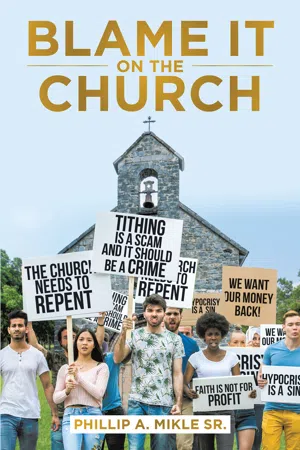
The church has become one of the most hated organizations in the world. Almost every day, Christians are walking away from the church because its teachings have become more about money and materialism rather than God. We can clearly see that the heart of the church is leaning more toward prosperity than toward God. Preaching the Word of God has also become nothing more than another way of making a living, and the pulpits are full of false preachers who are taking full advantage of this. And because of the false doctrines of "tithing" and "seed, sow, and harvest, " families are being ripped apart. Husbands are leaving their wives because they're giving their last dollar to the preachers and vice versa. This has been a strategy for a long time that the enemy has been using against Christians by teaching them false doctrines while concealing the truth. In Phillip A. Mikle Sr.'s eye-opening book Blame It on the Church, it uncovers God's most kept secret from mankind "THE MYSTERY ABOUT THE TRINITY, " God is not three persons but one. This book unmasks the world's biggest scams which are "Tithing and seed, sow, and harvest." You will be informed about false preachers who the author calls "smooth criminals." This book uncovers the truth about "once saved, always saved, God will not allow his son to simply be an escape route on judgment day. And you will learn the truth about what is really going to happen when Christ returns to Earth. Like it or not, these are facts and this book is a must-read. The author makes it plain and simple for anyone who desperately want to know the truth. And, don't get upset when you discover why many are pointing their fingers at the church and blaming it.Also, in this book the author addresses the #TIMESUP #METOO MOVEMENT, and including EVERY WOMAN that EXISTS on the face of this earth.
- 104 pages
- English
- ePUB (mobile friendly)
- Available on iOS & Android
eBook - ePub
Blame It on the Church
About this book
Information
Topic
Teología y religiónSubtopic
Iglesia cristianaThe Mystery about the Trinity
The Father, the Son, and the Holy Spirit
The doctrine about the Trinity of God is a very complex situation to explain because the natural mind of man will never be able to understand how three entities, or three persons, can come together and be one God. For hundreds of years, man has been trying to figure out the connection between the Father, the Son, and the Holy Spirit but despite the best of their ability, they have failed trying to solve the puzzle. Although no one was successful with connecting the dots between the Father, the Son, and the Holy Spirit, personally, I still don’t think that it is appropriate for man to just settle with calling God a Trinity just because there are three different characters of God in the Bible. God is great—greater than we can grasp that of him. That’s why we need the Holy Spirit to reveal to us who God really is. In Jeremiah 33:3 (ESV), God said, Call to me and I will show you great and hidden things that you do not know. And in John 16:13 (ESV), Jesus said that the Holy Spirit will lead you into all truth. We (Christians) call ourselves serving God, but we really don’t know who he is—well, at least some of us. Church is great, and it was ordained by God that we should attend it to learn about godly things, and we need preachers to teach us things in the Bible that we know nothing about but we have to get to know the Lord for ourselves. God himself even said in Jeremiah 31:34 (ESV), No longer shall each one teach his neighbor to know the Lord, for they shall all know me. So let’s stop depending on others to teach us things about God and start asking God to teach us all things through the Holy Spirit (1 John 2:27, ESV). And fellowshipping with God is also a part of having a personal relationship with him. The existence of God, his power, and his might is so great that finite human minds are unable to fully comprehend them. People can have a true understanding of God, but never a complete or exhaustive one; for example, the Bible speaks of God dwelling in thick and impenetrable darkness (Ps. 97:2, ESV). And the Bible also speaks of God dwelling in unapproachable light (1 Tim. 6:16, ESV). How can God dwell in light and darkness at the same time?
Or how can God dwell (in) light and darkness when the Bible describes him as being everywhere at the same time? (Jer. 23:24, ESV). And if God is everywhere, how can he be sitting on a throne (1 Kings 22:19, ESV), having a face (Exod. 33:11, ESV), or having eyes and ears (Neh. 1:6, ESV), or as having feet (Nah. 1:3, ESV), for example, in Exodus 33:19–23 (ESV) it speaks about God covering the face of Moses with his hands and not allowing Moses to see his face, only his back, as he passes by. These are not descriptions of what God is in himself but of what he is to us.
God Almighty relates to his people as a father and a friend (Matt. 6:9 and Ps. 25:14, ESV). He comes to us in this way to draw us to him in love and trust. God is infinite, and we are finite. God is far above and beyond us, and it is beyond our power to take his measure. No one has physically seen God in his pure, natural, and spiritual existence. But only in his manifestations people have seen God, because the light radiating from his divine presence is overwhelming. Like the prophet Ezekiel who did not dare to try to describe God (Ezek. 1:4–28, ESV). Ezekiel describes only the appearance of the likeness of the glory of God (v. 28).
As human beings, we are unable to comprehend the being and actions of God. And this study will not give you a complete understanding of God’s existence, but it will give you a better understanding of God than what you already think of him as the Father, the Son, and the Holy Spirit. Some Christians and/or people in general believe that Jesus Christ is not God because, they say, that they never read in the Bible that Jesus confessed out of his own mouth and said that he is God. People believe that Jesus Christ is only the son of God. They also believe that the Holy Spirit is God’s helper and/or power. Other Christians believe that Jesus is God and that the Holy Spirit is God’s power and/or helper. Why is this so?
The Old Testament continually states in several scriptures that there is only One God—the self-revealed Creator whom we must obey and worship.
Deuteronomy 6:4 (ESV)
Hear, O is real, the Lord our God (the Lord is one).
Isaiah 44:6 (ESV)
I am the first and I am the last, (besides me there is no God.)
The New Testament agrees with the Old Testament that there is only one God.
Mark 12:29 (ESV)
Jesus answered, the most important is hear O isreal the Lord our God, (the Lord is one.)
Galatians 3:20 (ESV)
Now an intermediary implies more than one, but (God is one).
The New Testament also speaks of three different beings or entities—the Father, the Son, and the Holy Spirit—working together.
Thessalonians 2:13 (ESV)
But we ought always to give thanks to God for you brothers beloved by the Lord, because (God) chose you as the first fruits to be saved, through sanctification by the (spirit) and belief in the truth. To this he called you through our gospel, so that you may obtain the glory of our (Lord Jesus Christ).
1 Peter 1:2 (ESV)
According to the foreknowledge of (God the father) in the sanctification of (the Spirit) for obedience to (Jesus Christ) and for sprinkling with His blood.
Reading the scriptures and trying to combine them to try to understand the wholeness or completeness of God with our natural minds is impossible. So let’s follow the Holy Spirit as he uncovers the mystery about the Trinity.
Deuteronomy 4:15–19 (ESV) says that God has no form. So if I ask you to draw a house, a tree, a car, or a woman, those images would be easy for anyone to draw because we know how these images look; but God has no image. He is a transcendent spirit (John 4:24, ESV), which rules out any idolatrous representation of God in the form of animated objects (Deut. 4:15–18, ESV) and any worship of the created order (Deut. 4:19, ESV); but even though God is spirit, he has the power to transform himself into any object or anything that he wishes. For example, through history in the Bible, God’s transfiguration is seen in the manifestations, such as the burning bush (Exod. 3:4, ESV), the pillar of clouds (Exod. 14:21, ESV), the man that wrestled against Jacob (Gen. 32:24–30, ESV), the fourth man in the burning furnace (Dan. 3:25, ESV), Jesus Christ’s transfiguration on the mountain (Matt. 17:2, ESV), and the talking donkey (Num. 22:28, ESV).
God is everywhere, as he explains in Jeremiah 22:23–24 (ESV). Am I a God at hand, declares the Lord, and not a God far away? Can a man hide himself in secret places so that I cannot see him? Declares the Lord. Do I not fill heaven and earth?”
It is often spoken that in heaven is where God dwells with all his angels around him, but strictly speaking, God’s infinite and transcendent spirit is such that not even the heavens are unable to contain him (1 Kings 8:27, ESV). God is present in all places; however, we should not think of him as filling space, for he has no physical dimensions. God does not live in and through a body as we do, and he is not subject to the limits of space and time. All created things are limited by time, but for God, there are no present moments into which he is locked as we are. It is as spirit that he is everywhere, although it surpasses the understanding of our human minds, God himself is present everywhere in his majesty and power.
King David said in Psalm 139:7–10 (ESV), “Where shall I go from your spirit? Or where shall I flee from your presence? (v. 8). If I ascend to heaven, you are there! If I make my bed in Sheol, you are there (v. 9). If I take the wings of the morning and dwell in the uttermost parts of the sea (v. 10) even there your hand shall lead me and your right hand shall hold me.”
First, we understand that God has no form; there is no image in this world or in heaven and hell that we can compare God to. Second, we understand that there is no place in this world or in the universe that we can’t go and God is not there. God is everywhere.
Now we have to find out what happened to God, who is one, and who has no image, and who is everywhere.
In Genesis 22:2 (ESV), God told Abraham to sacrifice his only son, Isaac, whom he loved so much. This is history, but this is also an example of what God was about to do in the future. God demonstrated with this event what he was only about to do to save man and redeem us back to himself by the way of sacrificing his only son Jesus Christ. This was God’s way of revealing his plan to his people (Amos 3:7, ESV).
In John 1:1–14 (ESV), starting with verse 1, it says, in the beginning was the word, and the word was with God, and the word was God. The first thing that we have to do now is to identify who is the word.” In verse 14, it says, the word became flesh and dwelt among us, and we have seen his glory, glory as of the only son from the father. So far, we understand that the (word) is the (only son) from the father. Now we have to figure out who is the only son from the Father because some believe that the prophet Mohammad is the only son from the Father and others believe that Ben-Yahweh is God’s only begotten son, but according to the Holy Bible, when Jesus Christ was getting baptized by John the Baptist, God spoke from heaven and said that Jesus is his beloved son (Matt. 3:13–17, ESV). We have established that the “word” is the “son,” and the son is “Jesus Christ.”
So if we were to rewrite John 1:1–3 (ESV), it would read like this: In the beginning was Jesus Christ and Jesus Christ was with God and (Jesus Christ was God) (v. 1). Jesus Christ was in the beginning with God (v.2). All things were made through Jesus Christ, and without him there was not anything made that was made (v.3). We have now established that Jesus Christ, who is the word and the only son from the Father, was also God Almighty in the beginning.
In the modern world, a person’s name can be simply a name with no meaning. But the names of the people in the Bible gives significant meaning, it gives significant ...
Table of contents
- The Mystery about the Trinity
- Tithing: The Biggest Scam in the World
- The Truth about “Once Saved, Always Saved”
- The Truth about Christ’s Millennium Reign on Earth
- You Were Made for God’s Glory
- Smooth Criminals
- The Church and the Civil Authorities
- Unsolved Murders
- God Is Your Sufficiency
- What Is a Christian?
- Blame It on the Church
Trusted by 375,005 students
Access to over 1.5 million titles for a fair monthly price.
Study more efficiently using our study tools.
Frequently asked questions
Yes, you can cancel anytime from the Subscription tab in your account settings on the Perlego website. Your subscription will stay active until the end of your current billing period. Learn how to cancel your subscription
No, books cannot be downloaded as external files, such as PDFs, for use outside of Perlego. However, you can download books within the Perlego app for offline reading on mobile or tablet. Learn how to download books offline
Perlego offers two plans: Essential and Complete
- Essential is ideal for learners and professionals who enjoy exploring a wide range of subjects. Access the Essential Library with 800,000+ trusted titles and best-sellers across business, personal growth, and the humanities. Includes unlimited reading time and Standard Read Aloud voice.
- Complete: Perfect for advanced learners and researchers needing full, unrestricted access. Unlock 1.5M+ books across hundreds of subjects, including academic and specialized titles. The Complete Plan also includes advanced features like Premium Read Aloud and Research Assistant.
We are an online textbook subscription service, where you can get access to an entire online library for less than the price of a single book per month. With over 1.5 million books across 990+ topics, we’ve got you covered! Learn about our mission
Look out for the read-aloud symbol on your next book to see if you can listen to it. The read-aloud tool reads text aloud for you, highlighting the text as it is being read. You can pause it, speed it up and slow it down. Learn more about Read Aloud
Yes! You can use the Perlego app on both iOS and Android devices to read anytime, anywhere — even offline. Perfect for commutes or when you’re on the go.
Please note we cannot support devices running on iOS 13 and Android 7 or earlier. Learn more about using the app
Please note we cannot support devices running on iOS 13 and Android 7 or earlier. Learn more about using the app
Yes, you can access Blame It on the Church by Phillip Mikle in PDF and/or ePUB format, as well as other popular books in Teología y religión & Iglesia cristiana. We have over 1.5 million books available in our catalogue for you to explore.