![]()
Chapter 1
How’d They Get There
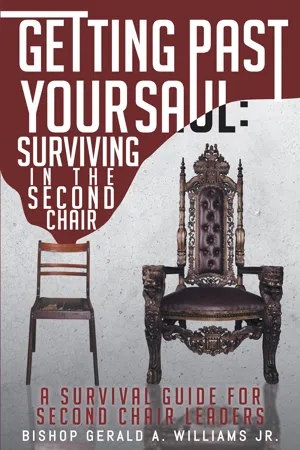
I want to make two bold statements. One, not every first chair leader got there by being a good leader. We have some bad leaders serving in first chair capacities in many local churches. This is a truth that we don’t want to admit in the church. I will leave it to your imagination what a bad leader is at this point in the book. Two, God does not simply connect us to senior leaders; he connects us to senior leaders to do a “work.” When I use the word “work,” I mean anything a leader feels God has called or directed them to do, whether it be a church, mission, community center, church fellowship, etc. Anything that is designed to reach out to people and connect them with the body of Christ is considered work for the purposes of this book. In Warren Wiersbe’s book Integrity Crisis, he states, “Saying the right words, carrying the right credentials, giving sermons from the right texts, helping people with their problems, and even performing miracles can never take the place of doing the will of God” (25). The work of any senior leader is irrelevant if it is not surely rooted in what God has directed him/her to do.
This is not something that should surprise us as we were warned. Paul made it clear in his letter to Timothy, “For the time will come when they will not endure sound doctrine; but after their own lusts shall they heap to themselves teachers, having itching ears” (2 Timothy 4:3). Many first chair leaders are there not because they are carrying out a God-mandated work, but because they are what made us feel comfortable. They looked the part, but as Paul also told Timothy, they have the “form of godliness, but denying the power thereof” (2 Timothy 3:5).
Before we go on, let me define certain terms I will repeatedly use interchangeably:
- first chair leader: anyone who is positioned at the top of the organization chart (bishop or pastor).
- second chair leader: anyone who directly serves a first chair leader (overseer, associate pastor, adjutant, etc.).
- work: any task that a senior leader has professed God has given them charge to do.
- office: the position one holds in an organization.
Let me also say that throughout this book I will at times refer to myself as a first chair and second chair leader. This is because although I serve in a first chair leadership role, I also serve as a second chair in various ecclesiastical and secular settings. I further suggest that any good first chair should be a second chair to someone else. The principles in this book can also be used to navigate the pitfalls of secular leadership. However, most of this book is focused on the local church dynamic. Paul makes it clear to Timothy when he stated, “This is a true saying, If a man desire the office of a bishop, he desireth a good work” (1 Timothy 3:1, KJV). Oftentimes we put the emphasis on the “office of the bishop” (elder, pastor, overseer, etc.) and totally neglect that what makes the bishop/elder/pastor/overseer necessary is the work. I have observed a significant number of people who desire to sit in the number one seat do not really have a clear vision for a work inspired by God. Without the work, there is no need for the senior leader or leadership in general. The “office” is simply how the work is manifested or carried out. If you think of the “office” as a water hose and the water the work, there are a lot of disconnected water hoses. So important is the work that Jesus expresses in John 9:4, “I must work the works of him that sent me, while it is day: the night cometh, when no man can work.” Not only is the work important but Jesus puts emphasis on the importance of time.
Seemingly the most sought-after first chair position in recent years (particularly in the African American church) is that of bishop. There are seemingly some among us that possess the skill of optimistic oratory and hermetical hyping who simply purchase the purple shirt, gold chain, gold cross, and gold ring with the amethyst stone, and hocus pocus, they are a bishop. Historically these individuals are referred to as Episcopi vagantes, which is Latin for “wandering bishop.” Their sole intent is to persuade pastors or clergy to connect with them to give themselves a sense of purpose or credibility. Oftentimes there is no credible work being accomplished other than inviting each other to preach various conferences and revivals. However, the work of a church leader should not be measured by how many preaching engagements one gets, but in how many churches are planted, disciples sent out, pastors counseled, and programs developed to help those in need.
The issue is oftentimes those on the outside become so enamored with the social media images one puts out not realizing it’s a smoke screen. Often what is presented on Facebook, Instagram, and Twitter is how certain leaders see their future. More to my point, we should stop putting pictures on a web page with the background of a church that sits ten thousand when in reality you’re in a storefront. It’s like they should put on their Facebook, Instagram, and web pages the disclaimer of “Objects on this page are FARTHER AWAY than they appear.” There is nothing wrong with a storefront church. I started a church in a rented space and then met in members’ homes. What is important is that you take pride in where you are in your ministry journey. If God rejoices at the beginning of a work (according to Zechariah 4:10), then you should rejoice whether you have five members or fifty members. It is not the quantitative measurement of the work that God gets excited about, but the simple fact the work has begun.
It is the work God gives to a senior leader that makes that leader relevant. To o often we put the senior leader above the work. This is easy to do as the work is embedded in the personality of the leader as he/she is the voice of God in that instance. But we must never forget that it is the Providence behind the personality that draws any leader to willingly serve. As second chair leaders, it is imperative that we always remember it is the worthiness of the work that God has assigned us to assist in more so than the worth we give to the personality of the senior leader. Even Jesus had to set the record straight after he healed the man at the pool of Bethesda as the Jews sought to persecute him as the Bible reads, “But Jesus answered them, My Father worketh hitherto, and I work” (John 5:17 ). So committed was Jesus to ensuring that the work always took priority that when a ruler addressed him as “good teacher” in Luke 18:18–19, the Bible reveals that he didn’t even answer the rulers’ question but was quick to ask him a question and answer, ‘Why callest thou me good? None is good, save one, that is, God.’”
To be clear, I’m not saying we should not honor our leaders as Paul instructed in 1 Timothy 5:17. So do not go canceling the pastor’s anniversary. I am saying that what makes the senior leader worthy is the work entrusted to him/her by God. What has to always be remembered is that God calls every leader to do a work. If there is a work to do, then God finds a leader to do the work. Just like in Isaiah 6:8, God said, “Also I heard the voice of the Lord, saying, Whom shall I send, and who will go for us? Then said I, Here am I; send me.” Isaiah was volunteering to do a work that God already had in mind. As a second chair leader, we can become so enamored with personhood of the one entrusted with the work that we elevate the person over the work. Now, I can hear my fellow first chair leaders saying, “Well, preacher, there is no work without me.” It is true that the work and the leader cannot be separated. What some first chair leaders forget is that just because God gives us a perfect work to accomplish, it does not make us perfect, neither does it make us superior. I know I’m right about it because every first chair leader was not God’s first choice. Therefore, it is important for those of us who serve as senior leaders to always be mindful that our elevation to pastor/bishop/overseer, etc., should be rooted in our ability to accomplish his work. Consider 1 Samuel 8:1–9 (KJV):
And it came to pass, when Samuel was old, that he made his sons judges over Israel. Now the name of his firstborn was Joel; and the name of his second, Abiah: they were judges in Beersheba. And his sons walked not in his ways, but turned aside after lucre, and took bribes, and perverted judgment. Then all the elders of Israel gathered themselves together, and came to Samuel unto Ramah, And said unto him, Behold, thou art old, and thy sons walk not in thy ways: now make us a king to judge us like all the nations. But the thing displeased Samuel, when they said, Give us a king to judge us. And Samuel prayed unto the LORD. And the LORD said unto Samuel, Hearken unto the voice of the people in all that they say unto thee: for they have not rejected thee, but they have rejected me, that I should not reign over them. According to all the works which they have done since the day that I brought them up out of Egypt even unto this day, wherewith they have forsaken me, and served other gods, so do they also unto thee. Now therefore hearken unto their voice: howbeit yet protest solemnly unto them, and shew them the manner of the king that shall reign over them.
First let’s deal with the reality that although God permitted the people to have a king, God did not want Saul. Saul’s kingship, pastorate, bishopric, etc., was birthed out of frustration with Samuel’s sons. The issues that the elders in the aforementioned text had with Samuel’s sons were valid. Joel and Abijah took bribes and tainted the priestly office. But note, the elders did not ask that two more priests be appointed, they asked for a king. They requested an entirely different form of leadership/government. What is often disturbing is that many local churches will demand a leader and/or governmental structure not based on God’s design but on who has the largest church on the block. Let me pause here and answer the question that is presented in the title of this chapter. Leadership opportunity often arises when people are frustrated with the current leaders.
How can a person not desired by God find themselves in first chair leadership? In this case, Saul’s rise to the first chair starts with the people being frustrated with the current leaders. So much did Samuel’s son discredit their leadership roles, they were not replaced but a whole new form of government was desired. This may be the worst time to look for new leadership because people may also start to deviate from a pattern of leadership that God has established for the ministry/local church to be effective. What I have learned is that God will answer prayer, even if it is not what he would want for us. Consider the rest of the story in 1 Samuel 8:9–22 (KJV):
And Samuel told all the words of the LORD unto the people that asked of him a king. And he said, This will be the manner of the king that shall reign over you: He will take your sons, and appoint them for himself, for his chariots, and to be his horsemen; and some shall run before his chariots. And he will appoint him captains over thousands, and captains over fifties; and will set them to ear his ground, and to reap his harvest, and to make his instruments of war, and instruments of his chariots. And he will take your daughters to be confectionaries, and to be cooks, and to be bakers. And he will take your fields, and your vineyards, and your olive yards, even the best of them, and give them to his servants. And he will take the tenth of your seed, and of your vineyards, and give to his officers, and to his servants. And he will take your menservants, and your maidservants, and your goodliest young men, and your asses, and put them to his work. He will take the tenth of your sheep: and ye shall be his servants. And ye shall cry out in that day because of your king which ye shall have chosen you; and the LORD will not hear you in that day. Nevertheless the people refused to obey the voice of Samuel; and they said, Nay; but we will have a king over us; That we also may be like all the nations; and that our king may judge us, and go out before us, and fight our battles. And Samuel heard all the words of the people, and he rehearsed them in the ears of the LORD. And the LORD said to Samuel, Hearken unto their voice, and make them a king. And Samuel said unto the men of Israel, Go ye every man unto his city.
So committed were they to fitting in with other nations they were willing to become slaves, lose property, lose resources, and risk God not responding to their prayers. Notice God tells Samuel to give them a king. God is in essence saying, I’m simply going to endorse what they want as opposed to giving you what I know you need. It may be a hard thing to accept that some of the leaders we serve may not have as much of a godly endorsement as we proclaim they have.
I have been in the pastoral pool for three churches over the years. During each of those interviewing processes, they seemed to only be concerned about my ability to preach, raise money, my wife’s role in ministry, and would I be like the last guy. There was no question about having a criminal record, do I have mistresses, bad credit score, experience with strategic plans, or anything that would give them a clue as to the character or anointing on my life. In many cases the most charismatic people get chosen to fill first chair positons in the church. But what is charisma without character? What is charisma without compassion? What is charisma without charity? What is charisma without courage? Charisma alone is not enough to be a good leader. How many people are serving in pulpits all because their mama said, “You got the head of a preacher.” We forget about 1 Samuel 16:7 which states, “For the LORD se...