REFORMATION SERIES VOLUME 2THE PRIMARY AGENTS OF REFORMATION ARE THEMSELVES BEING REFORMED!The prophetic ministry, as we have known and practiced it, is in a season ofsignificant upgrade and radical revision from heaven. In the midst of thisdivine activity and heavenly initiative, a new (third) prophetic dimension hasemerged, signaling a clear break and divergence from the old prophetic order.In Prophetic Divergence: Distinguishing Characteristics of the Third PropheticDimension, Robert insightfully tracks the progression and development of theprophetic dimension through three key significant stages recorded in Scripture.As the author-with the Holy Spirit as his guide-takes us on this remarkableprophetic journey, many inaccurate assumptions and ungodly beliefs relative tothe prophetic are biblically challenged. In addition, many key prophetic principlesand paradigms are expounded upon, bringing new revelation and definitionregarding the greatest prophetic dimension mankind has ever seen.Robert G. Paul is the president and founder of Kingdom AmbassadorsInternational, an embassy dedicated to the promotion and proclamationof God's Kingdom agenda in the earth, as well as the establishing of newreformation positions and patterns throughout the global community ofKingdom citizens otherwise known as the Church.Robert is a born native of the beautiful twin island republic of Trinidadand Tobago, where he faithfully served for more than a decade as a musician, worship leader, Bible teacher, and coordinator of a successful outreachprogram to the public schools before migrating to the United States duringthe turn of the new millennium.
The Church has once again entered into a season of major reformation, and God is once again upgrading and refining our current beliefs and practices to a much higher standard than we have known or experienced before. Greater accuracy and Kingdom conformity are being demanded in this hour by the heavenly Architect—the Holy Spirit—and a new divergence is beginning to emerge amongst the prophetic. God’s primary agents of reformation are themselves being reformed and personally transformed in obedience to these new heavenly requirements.
The prophetic ministry itself, or what we have usually defined as being prophetic, is being radically redefined to accommodate these new standards and requirements, creating a difference of opinion and estrangement from the old prophetic order.
One of the issues that has really grieved my heart of late is the tendency for many to make the word prophetic something common and mundane. It is often used trivially, with very little thought given to its true meaning or definition. Like the term Christian, it has almost lost its honor and validity in the minds of men. While this “profanation” of the prophetic can be attributed largely to a misapplication of the term by many who have used it ignorantly and erroneously, a lot has to do with poor definition. The former practice or tendency of applying the adjective “prophetic” to those operating or prophesying solely by gifting or to the ability to accurately predict or forecast future events or even to the spectacular ability to disclose detailed or secret information about an individual by word of knowledge is no longer valid. This may come as a shock to many of you, but your ability to prophesy accurate details or foretell future events does not necessarily make you prophetic. Neither does your ability to interpret dreams nor your tendency to experience visions. While these may all be valid aspects of prophetic ministry, neither one of them, in and of themselves, constitutes what it really means to be genuinely prophetic. Instead of misusing the term prophetic to describe such people, we should prefer the term gifted.
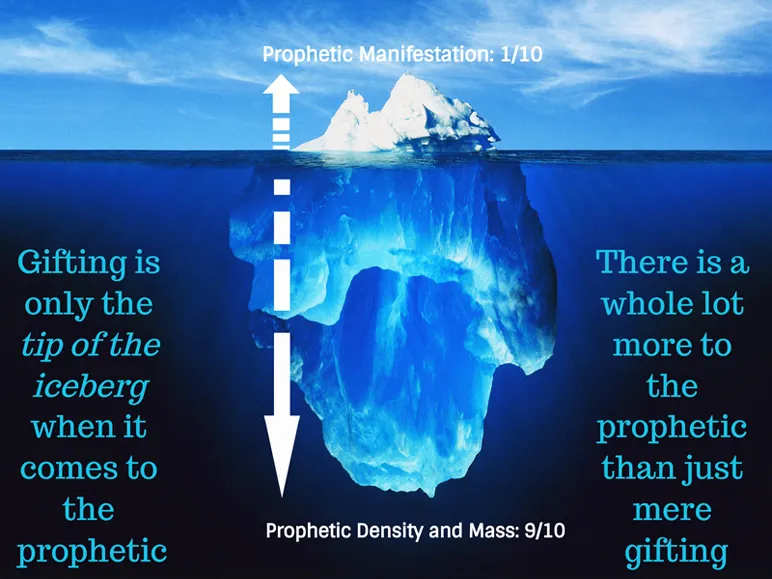
The true prophetic dimension is much deeper than gifting. Some psychics are very gifted, but that doesn’t make them prophetic. Judging ministry by gifting or supernatural manifestations alone is a very poor way to determine if someone is genuinely prophetic. For instance, supernatural signs and wonders are stated by Paul as being one of the qualifying or validating marks of an apostle, but almost everyone knows that manifesting signs and wonders does not necessarily mean you’re an apostle (2 Cor. 12:12).1 The same could be said of planting churches or being “sent” as a missionary in global missions. While these are all credible aspects of apostolic ministry, being a church planter does not necessarily make you an apostle or apostolic. Neither does being sent as a missionary. Giftings can be counterfeited, and activities can be copied. Or your gifting may be genuine, but you’re still lacking in other more important areas. These are mere surface issues, and there is much more to the apostolic or prophetic than what can be seen on the surface, much like an iceberg.
The Iceberg Principle
Icebergs are very fascinating, at least to me. According to Wikipedia, “An iceberg is a large piece of freshwater ice that has broken off a glacier or an ice shelf and is floating freely in open water.”2 Interesting, right? But hardly fascinating. After all, what can be so fascinating about a floating mass of ice in the ocean? I will tell you. The fascinating part about icebergs is in how much of their mass is actually exposed above the surface of the water. Because of the density of ice, which is less than that of sea water, typically only a small fraction of the iceberg—less than one-tenth of its total mass or volume—is ever visible above the surface of the water.3 In other words, there is far greater mass and substance beneath the surface than what is exposed above the surface. This communicates a very profound principle and provides a very powerful and accurate image or example of what it means to be prophetic.
The gifts, manifestations, and activities that are normally ascribed to prophetic ministry such as prophecy, visions, supernatural knowledge, etc., are only the “tip of the iceberg” (pun intended) with regard to what it means to be genuinely prophetic. This is only a small fraction. There is much more to being prophetic than meets the eye. The true identity, reality, character, and substance of the prophetic lie much deeper—hidden from view.
This brings us to another fascinating discovery about icebergs: the true shape or architecture of the underwater portion of an iceberg can be difficult to determine by looking solely at the portion above the surface.4 An iceberg can take on a completely different shape or form underneath. In other words, you can’t define an iceberg based upon what you see on the surface because nine out of ten times, you will be wrong! What you see on the surface usually doesn’t provide enough data for you to formulate a clear or accurate picture. Therefore, in order to judge correctly, you must look past the surface. This, again, is a very important principle. If we are to make an accurate judgment on what is truly prophetic, we can’t depend on surface manifestations of gifting or accuracy of content. We must go beyond the surface in order to ascertain the true architecture of the ministry. This is called the iceberg principle.
Prophetic Terminology
Depending on the particular version of the Bible you are using, performing a basic word search in order to ascertain how many times the word prophetic is used in the Bible would come up empty (e.g. the KJV and CEV) or with varied results (compare NKJV, ESV, and AMP). The reason for this is simple: people choose to translate certain words and phrases differently from others. From a technical standpoint, the adjective prophetic is only found twice in Scripture, and only in the New Testament (Rom. 16:26; 2 Pet. 1:19).
But now has been made manifest, and by the prophetic Scriptures has been made known to all nations, according to the commandment of the everlasting God, for obedience to the faith. (Emphasis mine)
And so we have the prophetic word confirmed, which you do well to heed as a light that shines in a dark place, until the day dawns and the morning star rises in your hearts. (Emphasis mine)
The word translated prophetic above is the Greek word prophētikós, an adjective formed from another Greek word, proph
tēs, meaning prophet. It is used to describe the ministry of the prophet and, more specifically, their inspired utterance (or writing) of what has since become scripture, as evident from its usage above.5 You will note that the root of this word is prophet, and it is applied narrowly to the prophet and/or his inspired ministry of revealing the divine will and purposes of God. It is never used in a general sense for all prophecy or those who are merely gifted to prophesy.
While the word prophetic is used only but a couple of times in Scripture, the terminology most often used is prophet (Gen. 20:7), prophetess (Ex. 15:20), company of prophets (1 Sam. 10:5), sons of the prophets (2 Kings 2:3), and those who prophesy (Acts 21:9). But there is a significant difference in Scripture between someone who merely prophesies and the ministry of a prophet.
The word prophetic in our English usage adds the suffix ic to the noun prophet (prophet-ic), thus forming an adjective that also carries with it the connotation of having a similar character, form, or manner of a prophet. Note that the operative word here again is prophet and not prophecy or prophesy. This means that to fully understand or comprehend the term prophetic, one must first seek to understand the nature and character of a prophet and his ministry. This cannot be accomplished by simply doing a word study. Most biblical lexicons provide a very broad and somewhat obscure definition of what a prophet is, emphasizing mostly their ability to foretell events, speak or teach by inspiration, or bring exhortation and reproof, but there is more to their ministry than this.
Seven Distinct Characteristics of the Prophet’s Ministry
There are seven distinct characteristics of the prophet’s ministry that can be extrapolated from Scripture. These characteristics clearly distinguish it from one who merely prophesies by gifting or otherwise. This is by no means an exhaustive list, but for the purpose of this writing, we will focus on these seven.
1. Insight
One of the most distinguishing characteristics of a prophet is his divine insight. The word insight describes the ability to see or comprehend (by the Spirit) that which is otherwise hidden. To have insight means to have spiritual sight. By very definition, a prophet is one who sees (Heb. ro’eh). They’re not blinded by fleshly ambitions, carnal concerns, religious traditions, political or religious allegiances, patriotism, national pride, or popularity of opinion. They don’t stumble around in darkness, ignorant of the plans and purposes of God on a personal or corporate level. This type of sightedness does not come by gifting alone; it comes through intimate relationship.
I have known many gifted prophesiers (claiming to be prophets or prophetic) who were able to give impressive words of knowledge and personal prophecies to individuals yet were totally blind and clueless regarding issues in their own lives. I’m not just talking about having blind spots—that can happen to any one of us, including prophets. They were internally blind. There was no capacity to accurately hear and respond to the voice of God in their own personal spheres of existence. These same prophesiers were often in need of prayer and personal prophecy for dealing with issues in their own lives or in making major decisions. When you’re operating solely by gifting, it is easy to hear God for others but much harder for yourself. There’s a reason for this. The gifts of God were given to us but not necessarily for us; they were given for the benefit of others (1 Cor. 12:7). The only gift that was given for our own personal benefit is the gift of speaking in tongues (1 Cor. 14:4). Therefore, people prophesying by gifting alone may be able to give incredible prophecies yet in their own personal lives be stumbling along in blindness or be spiritually deficient. I have seen it all too often.
Please don’t misunderstand. This doesn’t mean that prophets always know everything or are never in need of personal direction or guidance because that simply isn’t true. But what it does mean is that true prophets and prophetic people are not shallow one-dimensional prophesiers, able to hear God for others but hardly ever for themselves. Abraham was called a prophet of God before ever uttering one single word of prophecy (Gen. 20:7). It was his ability to accurately hear and respond to the voice of God in his own personal life and sphere of relationships that truly qualified him to be prophetic, not his ability to declare what God was saying to others.
Abraham demonstrated divine insight from the moment he was commanded by God to leave his country and his father’s house and migrate to a place that he had never known or seen before (Gen. 12:1). This didn’t just require great faith; it required great spiritual sight because the only information he would have to go on would be what God would show him.
Abraham expressed insight into the hearts and culture of the Egyptians when he had Sarah (Sarai) pretend to be his sister. By having both insight and foresight, Abraham was able to hatch a plan (even if it was a deceptive one) in order to navigate the life-threatening pitfalls that lay ahead (Gen...
Table of contents
Introduction
1
2
3
4
5
6
7
About the Author
Trusted by 375,005 students
Access to over 1.5 million titles for a fair monthly price.
Study more efficiently using our study tools.
Frequently asked questions
Yes, you can cancel anytime from the Subscription tab in your account settings on the Perlego website. Your subscription will stay active until the end of your current billing period. Learn how to cancel your subscription
No, books cannot be downloaded as external files, such as PDFs, for use outside of Perlego. However, you can download books within the Perlego app for offline reading on mobile or tablet. Learn how to download books offline
Perlego offers two plans: Essential and Complete
Essential is ideal for learners and professionals who enjoy exploring a wide range of subjects. Access the Essential Library with 800,000+ trusted titles and best-sellers across business, personal growth, and the humanities. Includes unlimited reading time and Standard Read Aloud voice.
Complete: Perfect for advanced learners and researchers needing full, unrestricted access. Unlock 1.5M+ books across hundreds of subjects, including academic and specialized titles. The Complete Plan also includes advanced features like Premium Read Aloud and Research Assistant.
Both plans are available with monthly, semester, or annual billing cycles.
We are an online textbook subscription service, where you can get access to an entire online library for less than the price of a single book per month. With over 1.5 million books across 990+ topics, we’ve got you covered! Learn about our mission
Look out for the read-aloud symbol on your next book to see if you can listen to it. The read-aloud tool reads text aloud for you, highlighting the text as it is being read. You can pause it, speed it up and slow it down. Learn more about Read Aloud
Yes! You can use the Perlego app on both iOS and Android devices to read anytime, anywhere — even offline. Perfect for commutes or when you’re on the go. Please note we cannot support devices running on iOS 13 and Android 7 or earlier. Learn more about using the app
Yes, you can access Prophetic Divergence by Robert Paul in PDF and/or ePUB format, as well as other popular books in Theology & Religion & Biblical Studies. We have over 1.5 million books available in our catalogue for you to explore.