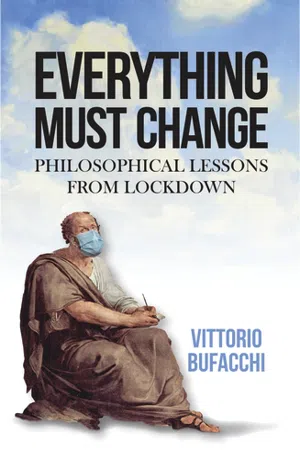
The philosopher Michel de Montaigne said that facing our mortality is the only way to learn the 'art of living'. This book asks what we can learn from COVID-19, both as individuals and collectively as a society.Written during the first and second lockdowns, Everything must change offers philosophical perspectives on some of the most pressing issues raised by the pandemic. It argues that the pandemic is not a misfortune but an injustice; that it has exposed our society's inadequate treatment of its most vulnerable members; that populist ideologies of post-truth are dangerous and potentially disastrous. In considering these issues and more, the book draws on a diverse range of philosophers, from Cicero, Hobbes and Arendt to prominent contemporary thinkers.At the heart of the book is a simple argument: politics can be the difference between life and death. With careful reflection we can avoid knee-jerk decision making and ensure that the right lessons are learned, so that this crisis ultimately changes our lives for the better, ushering in a society that is both more compassionate and more just.
- 184 pages
- English
- ePUB (mobile friendly)
- Available on iOS & Android
eBook - ePub
About this book
Information
Topic
PhilosophySubtopic
Ethics & Moral Philosophy1
Coronavirus and philosophy
There have been as many plagues as wars in history; yet always plagues and wars take people equally by surprise.
Albert Camus, The Plague
The Roman philosopher Marcus Tullius Cicero famously said that ‘to study philosophy is nothing but to prepare one’s self to die’.1 Cicero wrote this in 45 BCE in a text of philosophical ruminations known as Tusculan Disputations. In the first book of this philosophical treatise Cicero challenges the widely held belief that death is an evil, and thus to be feared.
As I write this introduction, death is inescapably on my mind, and probably on the mind of many readers. The reason, needless to say, is COVID-19, caused by the SARS-CoV-2 virus or more colloquially coronavirus; whatever its name, this highly infectious disease caused by a severe acute respiratory syndrome is the most devastating and lethal pandemic in living memory. At present, 47 million cases of the virus have been reported, causing the deaths of more than 1.2 million people worldwide.2 By the time you read these pages these numbers will be even more frightening, and the pain and fear left in the virus’s wake unspeakable. Eight times more people have died in New York City from COVID-19 than from the terrorist attack on 9/11. More people have died in the UK from COVID-19 than were killed in the Blitz during the Second World War. COVID-19 has made the fear of death tangible to everyone, everywhere in the world.
Cicero had a very specific reason for wanting to apply his considerable philosophical skills to the subject of death. A few months before he wrote Tusculan Disputations his beloved daughter Tullia died, at the age of 34, during childbirth. Cicero never recovered from the grief, and the pain he endured shattered his personal life. Soon after the death of Tullia he divorced his second wife Publilia, whom he had married only the previous year, allegedly because she couldn’t comprehend the agony he was suffering. Cicero was himself assassinated two years later.3
To ease the pain Cicero turned to philosophy. In the first book of Tusculan Disputations he uses logical reasoning to convince the reader that death is not to be feared: if death brings nothingness, there is literally ‘nothing’ to fear, and if death takes us to an eternal afterlife, then far from fearing death, we should welcome it. For Cicero what is much more difficult to accept, and to come to terms with, is not our own death but the loss of those we love. Thus, the second and third books of Tusculan Disputations are respectively on the subject of bearing pain and grief. Ultimately, Tusculan Disputations is Cicero’s love letter to his departed daughter.
Similarly, the unfolding global tragedy of COVID-19 is something we cannot escape. The numbers of the deceased are so great as to become mere statistics, and it is all too easy to forget that behind each and every death there are many who despair, like Cicero, for the loss of a friend, a father or a mother, a wife or a husband, or indeed a son or a daughter. This is why we need philosophy. Like Cicero more than 2,000 years ago, we look to philosophy to conquer the fear of death. And as we make our way through a new reality that many of us have never experienced, we turn to philosophy to help us make (some) sense of the absurdity that is around us.
Cicero was an immense influence on many philosophers over many centuries, especially during the period of humanism, or to be precise Renaissance humanism, an intellectual movement in Europe of the later Middle Ages and the Early Modern period. One of the most significant thinkers in the humanist tradition was the French philosopher Michel de Montaigne (1533–92), the author of a famous essay entitled ‘That to Study Philosophy is to Learn to Die’.4 The influence of Cicero on Montaigne is undeniable. But Montaigne takes his analysis of death in a totally different direction to Cicero. According to Montaigne, it is not just the case that we need to understand death before we can hope to make sense of life, but that comprehending death is the key to the very art of living. Montaigne captures this idea in typically exuberant style: ‘He who has learned how to die has unlearned how to be a slave.’5
Montaigne is not making a banal assertion that portrays the Grim Reaper as our master and we, mere mortals, as its slaves. Instead, what Montaigne is telling us is that what keeps us enslaved is the fear of death, the terror of our annihilation. Liberty is the opposite of domination, and as long as we live our lives under the dominion of the anxiety of death, we are never truly free. It is only when we learn to welcome death’s approach that we become free. But to achieve this freedom will take time, and effort, and a great deal of philosophy.
In the most abrupt and unexpected way, coronavirus has forced us to reflect on this most basic aspect of the human condition: our mortality. The fear of catching the virus, and of the unknown repercussions this may have on our lives, has made us reflect on our mortality in a way that no one had anticipated or expected.
For many months now, starting in February 2020, death and COVID-19 have been ever-present on every television channel and radio station when the news comes on. Death, or the fear of death, is still on the front pages of all the newspapers. In learning to live with coronavirus we are trapped in a catch-22: we want to escape this state of anxiety, but in staying responsibly informed we cannot get away from it. Perhaps Montaigne had the right solution: we cannot run away from death, we cannot pretend that death doesn’t concern us, therefore we have no choice but to face death head-on:
We must learn to stand firm and to fight it. To begin depriving death of its greatest advantage over us, let us adopt a way clean contrary to that common one; let us deprive death of its strangeness; let us frequent it, let us get used to it; let us have nothing more often in mind than death. At every instant let us evoke it in our imagination under all its aspects. Whenever a horse stumbles, a tile falls or a pin pricks however lightly, let us at once chew over this thought: ‘Supposing that was death itself?’ With that, let us brace ourselves and make an effort. In the midst of joy and feasting let our refrain be one which recalls our human condition.6
Montaigne was right: facing our mortality is the only way to properly learn the ‘art of living’. This is something we can take from the present crisis. Coronavirus has given us an opportunity that may not come again. Trapped in the relentless hectic rhythm of modern life, always multi-tasking, forever chasing the evanescent gold standard of productivity, we have forgotten about the art of living.
And so, while death will be a recurring theme, this book is not about death but about the art of living.7 More specifically, it is about the politics and the ethics of the art of living. The focus of this book will be on what we can learn from the experience of living with COVID-19, as individuals but also collectively as a society. More specifically, this book starts from the premise that this deadly crisis could potentially change our lives for the better, ushering in a more just society.
I will be looking at eight coronavirus-related themes through philosophical lenses, one in each of the chapters that follow. Chapter 2 will ask the question whether coronavirus is a misfortune or an injustice. It is tempting, and oddly reassuring, to think of this virus-induced crisis as a global misfortune, something that could not have been predicted, or anticipated, and that no one can be blamed for. Like an earthquake or a hurricane, this virus is merely an act of nature, and the only thing we can do is defend ourselves from the whims of misfortune as best we can. But there is another way to look at this crisis: it has fully exposed the chronic social injustice that pervades our modern society. The response to this crisis is also imbued with serious issues of global social injustice.
Chapter 3 will focus on the largest cohort of victims of coronavirus: people living in old age. This crisis has forced us to rethink the way society sees people over the age of 65, and the often inadequate and disrespectful way in which our productivity-obsessed modern world shows contempt for its more senior members, to a great extent because of their perceived waning autonomy.
Chapter 4 will attempt to answer the question whether life under coronavirus is comparable to life in the so-called ‘state of nature’. The state of nature is a term of art for political philosophers, and the reference here is specifically to the work of Thomas Hobbes, an English philosopher who wrote his masterpiece Leviathan towards the end of the Civil War in 1651. For Hobbes, the state of nature is a place of abysmal anarchy, where we live in incessant fear of oblivion, and where life is ‘solitary, poor, nasty, brutish, and short’. We are not in a state of nature, not yet anyway, but there are elements of Hobbes’s state of nature that resemble certain aspects of our lives under enforced lockdown, marked by uncertainty as they are. The chapter will also evaluate ways to leave, or avoid, a full-scale state of nature.
Chapter 5 will explore the impact of coronavirus on the global phenomenon of populism, which had become the dominant ideology up to the outbreak of the pandemic. The question we need to ask ourselves is whether populism will come out of this crisis weaker or stronger than it was before. While the jury is still out on this question, and only time will tell, the chapter suggests that populism could be one of the major victims of this pandemic.
Populism, especially of its right-wing variety, is never far from propelling fake news, and its political leaders tend to be enthusiastic champions of post-truth. One of the features of the present crisis has been the extent to which all sorts of half-truths and outright lies have been allowed to spread. Chapter 6 will explore the relationship between post-truth and coronavirus, and it will suggest things that we can learn from this crisis in the fight against post-truth.
Chapter 7 will focus on the role of arguably the most important players in the response to the coronavirus pandemic: the experts. The World Health Organization (WHO) has been at the forefront of the fight against the virus, and every country has its own team of scientific experts: epidemiologists, virologists, microbiologists, and the mathematicians with their sophisticated models. The problem is that experts don’t always agree with each other, there isn’t always one, unanimous, uncontested scientific truth. This raises a set of important questions. Who do we trust? And what do we base our trust on?
Chapter 8 will look at one of the most disturbing aspects of the lockdown experience: worldwide there has been a 25 per cent increase in recorded incidents of domestic violence. The issue of domestic violence will be addressed via an analysis of Sally Rooney’s award-winning novel Normal People, which was turned into a successful television adaptation by the BBC and aired during lockdown in April 2020 in Ireland and the UK.
Finally, the concluding chapter will argue that there is one principal lesson to be learned from this pandemic: that politics is not only important, but essential, and often the main difference between life and death. In politics, mixing incompetence with hubris can be lethal, not for the politicians but for the general public. More specifically, this pandemic has reminded us of three key political certainties: the necessity of the state to coordinate social efforts; the requirement to raise taxes to facilitate the essential work that only the state can carry out; and the imperative to introduce new radical social and economic reforms, including a universal basic income.
2
COVID-19: injustice or misfortune?
Yes, there was an element of abstraction and unreality in misfortune. But when an abstraction starts to kill you, you have to get to work on it.
Albert Camus, The Plague
There are two ways to think of a human tragedy: as a (social) injustice or as a misfortune. A misfortune is usually associated with inescapable external forces of nature, and as such the desolation it leaves in its wake is blameless. The devastating impact of a hurricane, or the trauma of a brain tumour, are dreadful, awful realities, but as acts of nature they can be deemed mere misfortunes. An injustice, on the other hand, is caused by fellow humans, not nature. An injustice, unlike a misfortune, is intentional, controllable, and therefore not blameless. Poverty is an injustice, not a misfortune. The impact of COVID-19 has a lot more to do with injustice than misfortune.
At an intuitive level this distinction between an injustice and a misfortune makes sense, and yet actually distinguishing between the two can be profoundly problematic.1 In her still relevant book The Faces of Injustice, first published thirty years ago, Judith Shklar reminds us that what is a misfortune to one is an injustice to another, and the perception of what is an injustice as opposed to a misfortune will often differ if it is described by the victim or the bystander.2
Perceptions of injustice are a powerful tool in our effort to make sense of the world we live in. To those not directly affected, the destruction of a school by an earthquake might seem like a quintessential case of misfortune; but to the families of the victims who were told the school was built to withstand an earthquake, this is a case of injustice. Flooding in Bangladesh or the ris...
Table of contents
- Cover
- Half Title
- Title Page
- Copyright
- Dedication
- Contents
- Preface
- 1 Coronavirus and philosophy
- 2 COVID-19: injustice or misfortune?
- 3 Old age in the time of coronavirus
- 4 Life under lockdown: nasty, brutish, and short?
- 5 Is COVID-19 bad for populism?
- 6 COVID-19, fake news, and post-truth
- 7 COVID-19, experts, and trust
- 8 Normal People, normalized violence
- 9 Justice after COVID-19
- Epilogue: a year of COVID-19
- Notes
- Index
Trusted by 375,005 students
Access to over 1.5 million titles for a fair monthly price.
Study more efficiently using our study tools.
Frequently asked questions
Yes, you can cancel anytime from the Subscription tab in your account settings on the Perlego website. Your subscription will stay active until the end of your current billing period. Learn how to cancel your subscription
No, books cannot be downloaded as external files, such as PDFs, for use outside of Perlego. However, you can download books within the Perlego app for offline reading on mobile or tablet. Learn how to download books offline
Perlego offers two plans: Essential and Complete
- Essential is ideal for learners and professionals who enjoy exploring a wide range of subjects. Access the Essential Library with 800,000+ trusted titles and best-sellers across business, personal growth, and the humanities. Includes unlimited reading time and Standard Read Aloud voice.
- Complete: Perfect for advanced learners and researchers needing full, unrestricted access. Unlock 1.5M+ books across hundreds of subjects, including academic and specialized titles. The Complete Plan also includes advanced features like Premium Read Aloud and Research Assistant.
We are an online textbook subscription service, where you can get access to an entire online library for less than the price of a single book per month. With over 1.5 million books across 990+ topics, we’ve got you covered! Learn about our mission
Look out for the read-aloud symbol on your next book to see if you can listen to it. The read-aloud tool reads text aloud for you, highlighting the text as it is being read. You can pause it, speed it up and slow it down. Learn more about Read Aloud
Yes! You can use the Perlego app on both iOS and Android devices to read anytime, anywhere — even offline. Perfect for commutes or when you’re on the go.
Please note we cannot support devices running on iOS 13 and Android 7 or earlier. Learn more about using the app
Please note we cannot support devices running on iOS 13 and Android 7 or earlier. Learn more about using the app
Yes, you can access Everything must change by Vittorio Bufacchi in PDF and/or ePUB format, as well as other popular books in Philosophy & Ethics & Moral Philosophy. We have over 1.5 million books available in our catalogue for you to explore.