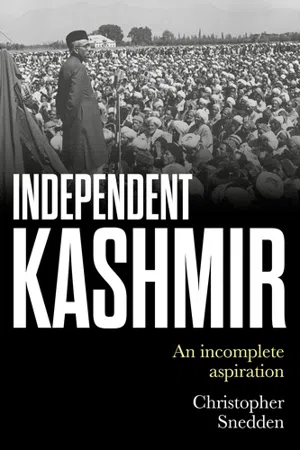
Many disenchanted Kashmiris continue to demand independence or freedom from India. Written by a leading authority on Kashmir's troubled past, this book revisits the topic of independence for the region (also known as Jammu and Kashmir, or J&K), and explores exactly why this aspiration has never been fulfilled. In a rare India-Pakistan agreement, they concur that neither J&K, nor any part of it, can be independent.Charting a complex history and intense geo-political rivalry from Maharaja Hari Singh's leadership in the mid-1920s to the present, this book offers an essential insight into the disputes that have shaped the region. As tensions continue to rise following government-imposed COVID-19 lockdowns, Snedden asks a vital question: what might independence look like and just how realistic is this aspiration?
- 456 pages
- English
- ePUB (mobile friendly)
- Available on iOS & Android
eBook - ePub
About this book
Information
1
Decolonisation and the departure of the British from India
1947 was a tumultuous year on the Indian subcontinent. Thoughts of independence were everywhere. On 20 February, the British Government announced that it ‘would grant Indian independence no later than June 1948’.1 This was significant. The British had been the only people ever to unify the entire Indian subcontinent into a single political entity – ‘their’ Indian Empire, or Raj. By 1947, however, these dispirited foreigners were ‘scuttling’. They wanted to decolonise their vast, disparate and increasingly unruly ‘possession’ – rapidly.2 At the time of its announcement, the British Government had not resolved how it would fully and finally disengage from India. Ultimately, this ‘savage disentanglement’ would involve the clinical partitioning, or dividing, of the parts of their Indian Empire that the British directly administered (‘British India’) into two new political entities.3 The larger of these two entities, (post-British) India, would consist of territory that made up the bulk of British India. The other entity, (Muslim) Pakistan, would comprise two wings, East and West Pakistan, located on either side of the subcontinent. Almost unbelievably, certainly in retrospect, these two Pakistani portions would be separated by a thousand miles of Indian territory. This circumstance would eventually prove to be untenable.
In 1947, the British imperialists also left behind many confused, uncertain and equally dispirited princely protégés, some of whom also had been thinking about independence. The British, in their role as the paramount power and guarantor of the Indian princes’ autocratic regimes, had maintained superiority and power over some 562 rulers for nearly ninety years via various treaties and other arrangements. These would end, or lapse, after the British departure. Thereafter, some princely rulers, along with the leaders of the soon-to-be-created political entity of Pakistan, believed that the princely states (‘Princely India’) would be independent. That is, they would not have to join either India or Pakistan. Maharaja Hari Singh, the ruler of the princely state of Jammu and Kashmir, was one such ‘believer’. He had enjoyed British support and, as some saw it, ‘power without responsibility’ since securing the J&K gaddi (throne) in 1925 following the death of his childless uncle, Maharaja Pratap Singh.4 How these supposed future independent princely entities, many of which were landlocked and/or physically separated from each other, would survive was unclear. More realistically, therefore, the British, along with the new leaders of India – but not, initially, of Pakistan – encouraged, and expected, each legally empowered major ruler to take a decision to join his state with either India or Pakistan. Formally, this decision was called an accession. Each ruler was supposed to make an accession before 15 August 1947, the date that the British would depart India and bring the new dominions of (post-British) India and Pakistan into being. In 1947, some 140 princes, including Maharaja Hari Singh, were legally empowered to make an accession to either dominion.5
This chapter examines the British Indian Empire, relevant aspects of its administrative structure, and the positions of India's politicians and princes in the hasty and purgative – for the British, at least – decolonisation processes of 1947. It explains that, during 1947, there were differing ideas about the Indian princes’ legal positions and post-British options, including in relation to independence or otherwise, considerable politicking by politicians – all of whom were Indians until 15 August 1947 – and much uncertainty and upheaval for many subcontinentals, including J&K-ites. One of the most significant of these J&K-ites was Maharaja Hari Singh, the person charged, and empowered, to decide J&K's post-British future by making an accession. As this chapter explains, the British decolonisation of their substantial Indian Empire in 1947 enabled him to seriously contemplate and envisage independence for J&K.
The paramount power's empire
In 1947, the British directly and indirectly controlled all of India. The areas under their direct control and administration were referred to as British India; the areas under their indirect control were referred to as Princely India6 or the ‘Indian States’.7 British India comprised roughly two-thirds of the Indian Empire divided into eleven provinces and with a population in 1941 of 296 million.8 In this directly controlled section of their empire, the departing colonial rulers were leaving behind two new dominions: Pakistan, which would comprise almost all of the subcontinent's Muslim-majority areas, but, significantly, not all of the subcontinent's Muslims; and India, which would comprise the remaining non-Muslim-majority areas. The basis for the establishment of these two new legal entities was the rapidly enacted Indian Independence Act of 18 July 1947. It stated that ‘As from the fifteenth day of August, nineteen hundred and forty-seven, two independent Dominions shall be set up in India, to be known respectively as India and Pakistan’.9 So, even though Pakistanis actually celebrate 14 August as their nation's independence day, Pakistan did not legally come into being until 15 August 1947. While self-governing and essentially independent, the two new dominions of India and Pakistan would become fully independent of the United Kingdom after each instituted their respective constitution: in 1950 for India; in 1956 for Pakistan.
Reflecting the fact that the major religious group in (post-British) India was Hindus, some people, chiefly Pakistanis, referred to the new Dominion of India as ‘Hindustan’ (the land of Hindus). They may have used this name to emphasise the Hindu character of India.10 Conversely, some Indians called their nation ‘Bharat’, an ancient term for India. Members of the Indian National Congress (‘Congress’), such as Jawaharlal Nehru,11 whose political party had long fought for Indian independence, and (post-British) Indians considered their state to be the post-partition/post-British and residual Indian entity. It was the successor state to British India, not the seceding state, which was Pakistan.12 For these Indians, Bharat inherited the ‘international personality of India’ that previously had been under British control, including many of this entity's offshore assets, responsibilities, and membership of international bodies.13 This was an important distinction. Due to this ‘inheritance’, India already belonged to the United Nations in 1947, as British India had been admitted as a member on 30 October 1945. Newly created Pakistan, however, had to apply for membership of the United Nations. It was admitted on 30 September 1947.14 Some Indians also considered that Congress, which would form the new Indian Government, was ‘the de facto successor to [British] paramountcy’.15 Congress did not accept that, after the British had left India, paramountcy would revert, or be retroceded, to India's princely rulers,16 or that each prince would then become ‘an autocratic and independent sovereign’.17 Rather, most rulers necessarily would need to have a subordinate relationship with India, which essentially would act as the post-British paramount power. Invariably, India's princes disagreed with this position. Few hereditary rulers were keen to submit themselves to being controlled by elected politicians, a position the princes had enunciated as early as 1929, as the Indian States Committee's report had noted. The issue of paramountcy therefore was an ‘old vexed question’.18
Paramountcy was the ‘vague and undefined’ feudatory system whereby the British, as the suzerain power, dominated and controlled India's princely rulers.19 Collectively, these Indian rulers and their lands under British suzerainty comprised Princely India. British dominance and control was achieved in two ways. First, by direct ‘treaty relationships’ with 40 larger Indian states, whose total population amounted to about two-thirds of Princely India's total population. Second, by ‘engagements and Sanads’ with the smaller princely states that bound them to the paramount power.20 (A sanad was a legal instruction or decision, an ‘acknowledgement of concession or authority or privileges generally coupled with conditions proceeding from the Paramount Power’.)21 These ‘loyal collaborators of the Raj’ were ‘afforded [British] protection in exchange for helpful behavior in a relationship of tutelage, called paramountcy’.22 This arrangement enabled British control of India's princely states in three areas or ways: ‘(1) external affairs; (2) defence and ...
Table of contents
- Cover
- Half-title page
- Title page
- Copyright page
- Dedication
- Contents
- Tables
- Acknowledgements
- Abbreviations
- Glossary
- Maps
- Introduction
- 1 Decolonisation and the departure of the British from India
- 2 Maharaja Hari Singh and his accession issue
- 3 The significance of Kashmir and Kashmiri identity in J&K
- 4 The rise of Kashmiri aspirations, 1924–47
- 5 Sheikh Abdullah’s pursuit of independence for ‘Kashmir’, 1946–53
- 6 Sheikh Abdullah’s pursuit of independence for ‘Kashmir’, post-1953
- 7 Kashmiris and independence since 1988
- Conclusion: to be independent, or not to be independent? That is the question1
- Appendix I: Comparison of Jammu and Kashmir with other entities
- Appendix II: Kashmir Valley Muslims in J&K and their numerical dominance
- Appendix III: Border or territorial changes, actual or attempted, in South Asia since 15 August 1947
- Notes
- Bibliography
- Index
Trusted by 375,005 students
Access to over 1.5 million titles for a fair monthly price.
Study more efficiently using our study tools.
Frequently asked questions
Yes, you can cancel anytime from the Subscription tab in your account settings on the Perlego website. Your subscription will stay active until the end of your current billing period. Learn how to cancel your subscription
No, books cannot be downloaded as external files, such as PDFs, for use outside of Perlego. However, you can download books within the Perlego app for offline reading on mobile or tablet. Learn how to download books offline
Perlego offers two plans: Essential and Complete
- Essential is ideal for learners and professionals who enjoy exploring a wide range of subjects. Access the Essential Library with 800,000+ trusted titles and best-sellers across business, personal growth, and the humanities. Includes unlimited reading time and Standard Read Aloud voice.
- Complete: Perfect for advanced learners and researchers needing full, unrestricted access. Unlock 1.5M+ books across hundreds of subjects, including academic and specialized titles. The Complete Plan also includes advanced features like Premium Read Aloud and Research Assistant.
We are an online textbook subscription service, where you can get access to an entire online library for less than the price of a single book per month. With over 1.5 million books across 990+ topics, we’ve got you covered! Learn about our mission
Look out for the read-aloud symbol on your next book to see if you can listen to it. The read-aloud tool reads text aloud for you, highlighting the text as it is being read. You can pause it, speed it up and slow it down. Learn more about Read Aloud
Yes! You can use the Perlego app on both iOS and Android devices to read anytime, anywhere — even offline. Perfect for commutes or when you’re on the go.
Please note we cannot support devices running on iOS 13 and Android 7 or earlier. Learn more about using the app
Please note we cannot support devices running on iOS 13 and Android 7 or earlier. Learn more about using the app
Yes, you can access Independent Kashmir by Christopher Snedden in PDF and/or ePUB format, as well as other popular books in History & Indian & South Asian History. We have over 1.5 million books available in our catalogue for you to explore.