This collection follows the extraordinary careers of nine colonial subjects who won seats in high-level parliamentary institutions of the imperial powers that ruled over them. Revealing an unexplored dimension of the complex political organisation of modern empires, the essays show how early imperial constitutions allowed for the emergence of these unexpected members of parliament, asks how their presence was possible, and unveils the reactions across metropolitan circles, local communities and the voters who brought them to office.
Unearthing the entanglements between political life in metropolitan and non-European societies, it illuminates the ambiguous zones, the margins for negotiation, and the emerging forms of leadership in colonial societies. From a Hispanicised Inca nobleman, to recently emancipated slaves and African colonial subjects, in linking these individuals and their political careers together, Unexpected Voices in Imperial Parliaments argues that the political organisation of modern empires incorporated the voices of the colonised and the non-European, in an ambiguous relationship that led to a widening of political participation and action throughout the imperial world. In doing so, this book offers a comprehensive but nuanced reassessment of the making and unmaking of modern empires.
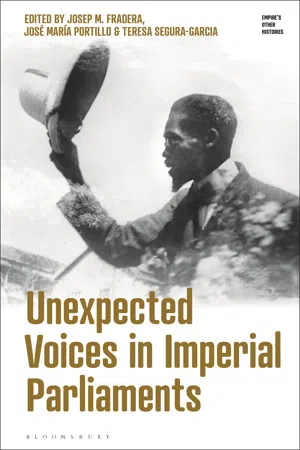
eBook - ePub
Unexpected Voices in Imperial Parliaments
- 304 pages
- English
- ePUB (mobile friendly)
- Available on iOS & Android
eBook - ePub
Unexpected Voices in Imperial Parliaments
About this book
Information
1
The value of political representation in modern empires
Already during the period of Old Regime monarchies in Europe, representative assemblies were venerable, inherited institutions. It is true that royal authoritarianism limited their reach, capacities and projection, with notable differences among countries. But growing financial and military demands arising from conflicts among monarchies both in Europe and in colonial dominions on various continents in the eighteenth century modified the perception of these ancient institutions’ attributes and their representative foundations. Concepts such as liberty, democracy, universality and political equality took many years to acquire their shape in political debates that would end up defining their complete transformation during the nineteenth and twentieth centuries. Demands placed upon what we today refer to as the fiscal-military state triggered those political debates and the institutional transformations that defined the late-eighteenth-century revolutionary cycle. Patrician debates with classical trappings were suddenly interrupted with demands from consumers squeezed by new taxes, monopolies and by new forms of debt aimed at the disposable savings of the Creole elites in America and Asia, the scene of inter-imperial warfare. Taxes and representation, militia and civil status, personal freedom and servitude or slavery: these were the poles of modern politics starting from the last third of the eighteenth century.
One of the results of all this was that representative capacity and its value were no longer concepts belonging to aristocratic political culture. Rather, they became the very essence of the cause championed by the rising urban middle classes. Furthermore, discussions regarding the limits of worn-out aristocratic privileges and demands for greater political equality used the new language of mass politics – in the press, pamphlets, outdoor meetings and impassioned debates in beer halls and coffee houses – and they made evident the novel ability of these new groups to organize. The substance of these discussions, with their vital issues and new forms of propaganda, enabled the message to reach society at large, going beyond the limits of earlier eras in ways previously unseen (with the exception of the great religious and revolutionary upheavals). The margins of political participation broadened to an extraordinary degree, mixing social groups and classes: the Atlantic revolutions, with their enormous social reach, are a perfect example of this. If Paris in 1789 was the epitome of that transformation, it was due to its intensity and scope. In that revolutionary context, representative assemblies adapted to the new demands – they had no choice.
Parliaments, Cortes and other representative bodies, be they monarchical or republican, performed three crucial tasks in line with the complex and often opaque triad of power that Montesquieu delineated. The first was to ensure continuity of the legislative process, always with the initiative of the crown or the government in power. The second was to determine which factions represented in those bodies would gain the upper hand, either alone or with allies – in other words, who would win over the monarch or manage to form a new government. These two functions, described thus schematically, might give us an idea of the construction of the state and of liberal society were it not for the third factor, which was just as critical. Parliaments were the key location for the formation of public opinion, a rising force that overwhelmed readers of Hansard in England and similar publications elsewhere. The Journal de Débats, which not coincidentally appeared in 1789 Paris, would play a similar role, as would the official Diario de Sesiones de Cortes and the liberal publication of Manuel José Quintana, Semanario Patriótico, in liberal Spain in 1808. Publication of parliamentary debates was consolidated only in the last third of the eighteenth century and would become more stable through the 1820s. Before then it was not only difficult to read the debates, but in some places, such as in England until the 1770s, it was a risk. The combination of the printing revolution and an eager readership decimated the proverbial censorship ability of the modern Leviathan.1 Not coincidentally, these summaries of parliamentary debates appeared both in the metropolis and in colonial cities. They formed part of the process we are attempting to describe, that is, the inescapable relationship between political life in metropolitan society and in non-European societies. The circulation of parliamentary debates was a key constitutive element of the legitimacy of parliaments and among public opinion, parties, politicians, the electoral process and the constitution of governments. The monarch could no longer simply call upon the head of one of the constitutive factions. In other words, he or she could no longer be ignorant of the opinions being formed ever more freely in civil society. Edmund Burke was well aware of this, and his eloquence helped encourage decisions that sometimes undermined established interests. So too was Georg Wilhelm Friedrich Hegel, the heart of whose early political theory was inspired, in the Scottish tradition, by the distinction between civil and political society. For Hegel, the state must be the keystone in a civil war to be fought according to new rules that still no one in the mid-nineteenth century was familiar with.
The sudden appearance in representative political bodies of people from colonial worlds was the outcome not just of the complexity of colonial relations and the impossibility of the metropolis exercising absolute control, an option viable only in social scientific models that exist far, far away from worlds in which people must fight for their welfare and dignity. It was also owed to the ability of certain individuals and social groups to make their presence known in given moments and circumstances. Clearly, joining an imperial representative body such as the French National Assembly, the Cortes of Cádiz in September 1810 or Westminster was not the same as joining assemblies of lesser rank or reduced territorial reach, be they in a Colombian province, the French Antilles or South Africa. In the former cases, the message of representation reached far and wide around the globe. In the latter, what was most important was close proximity to local or regional interests.
As we will see in the following pages, the appearance of figures such as Jean-Baptiste Belley and Inca Yupanqui in the French National Assembly and the Spanish Cortes of Cadiz, respectively, was linked to their and others’ ability to negotiate the complexities of new political spaces opened up by the Atlantic revolutions. Finding themselves in spaces that bestowed upon them the utmost legitimacy, their worlds of origin suddenly became visible for the first time. It was one thing for religious figures, enlightened humanitarians or writers to criticize slavery or the condition of the Indians – it was quite another for the criticism to come from the mere presence of such capable and articulate personages. To make things more critical, many of those elected representatives had neither European origin nor white skin, a detail that made quite remarkable – to say the least – the role they suddenly embodied, immortalized by Belley’s famous portrait. That presence, which was both unexpected and generally unwelcome, constituted a direct challenge to elaborately drawn hierarchical orders. The challenge was indeed so great that a major part of colonial and imperial politics in the nineteenth century consisted of an attempt to close off or deliberately distort constitutional possibilities that had opened up as a result of these men’s disturbing arrival.2 One way of doing this was to assign seats by ethnicity, thus building a sort of golden cage for minority representatives in parliament. This was the case with four Māori representatives in the New Zealand parliament from 1867, when the war over the North Island was still being fought. This model – derived from that of the Irish minority in Westminster – was hugely influential later on in other parts of the great liberal empire, from Fiji to Lord Curzon’s British Raj. Minority representation based on ethnicity also existed in contemporary empires with very different parliamentary traditions.3 Paradoxically, only in exceptional moments, such as in 1848 France or when European imperial territorial expansion was such that it had to pull back and co-opt groups – in India, in the French vielles colonies in the Antilles, in Senegal – do we find colonists becoming involved again in metropolitan politics. Their appearance was never incidental or episodic – on the contrary, it was a key part of colonial reforms and the rise of the Creoles and Pan-Africanism as European imperialism waned during the inter-war years of the twentieth century. Therefore, it is important to correctly identify and interpret the place of these unexpected voices in imperial and colonial history, their weight and importance in the larger arena of colonial and metropolitan relations.
I
The task of the historian is to understand the contexts in which historical change takes place without ever losing sight of the protagonists who actually make those changes happen, be they individuals or social groups common interests, ideas, religion or ethnicity. In 1993, the great American historian Eric Foner published Freedom’s Lawmakers: A Directory of Black Officeholders during Reconstruction, a documented and exhaustive repertoire of biographies of public figures who, better than anyone else, symbolized the changes in the United States after the Civil War and passage of the Fourteenth and Fifteenth Amendments.4 Each entry contains information about the individual’s origin, if they had been a slave, their racial category in the hierarchy of the times, profession, place of residence and subsequent posts – no easy feat for the author given the enormous instability and mobility in the United States during those years. The figures in Foner’s book were not the only ones who played a decisive role in their country’s transformation, as alongside them stood the radical Republicans. But while the latter have always figured prominently in history books, the same cannot be said of Foner’s parliamentarians and administrators. A few years after his book came out, another historian, the Frenchman Michel Winock, published Les voix de la liberté, a massive portrait of leading French political figures, a global narrative featuring the great protagonists of France’s post-Revolutionary epic struggle for political liberty during both the republic and the monarchy.5 Both are excellent books, and they are complementary in some ways. The difference in content and focus, however, is obvious. In the centre of Winock’s analytical perspective stand the figures of classical liberalism along with those from other settings who challenged them, either from the right or from the left. This broad focus allowed him to create an ensemble with a common thread. He gathered the men who moulded French political culture, which had such great influence on the nineteenth-century world – men such as Benjamin Constant and Alexis de Tocqueville, but also others who spoke in different voices, such as the socialist François Proudhon and the German exile Karl Marx.
Both books are essentially group portraits during times of great change. Winock’s wide view allowed him to also include leading figures in literature and culture, such as Jules Michelet, Charles Baudelaire and Victor Hugo, all of whom were also caught up in the endless political manoeuvrings between republicanism and Bonapartist or monarchical legitimism. But with the exception of those whom E. H. Carr called the ‘romantic exiles’, Winock’s daguerreotype does not include anyone from outside France itself. There was no one from the faraway places that nonetheless flew the French flag. This absence becomes even more stark when the book is placed alongside Foner’s. In the decade that followed the end of the Civil War, Reconstruction was marked by, among other things, a massive influx of African Americans into US administrative positions and, to a lesser degree, into legislative posts. This was the epitome of an obviously monumental transformation: the end of slavery and the rise of those whose lives changed with the Emancipation Proclamation of 1863 and the passage of the Thirteenth Amendment in 1865. Even before then, there were those who had managed to obtain marginal positions, but what occurred from 1865 had no historical equivalent anywhere.6 However, ten years after the end of the Civil War, their progress in obtaining this modest political space was cut short and would undergo ceaseless regression in the face of the relentless political reaction of rising white supremacists.
What is the prima facie difference between the case studies chosen by Foner and Winock? The first and most obvious one is that the American republic since the War of Independence was a nation under construction, forged with the implicit inclusion of slavery so as to attain a geographic balance of power among the new states that would survive until the war broke out. France, Britain, Holland, Portugal and Spain, on the other hand, all maintained empires that depended upon slavery – empires that obviously lay beyond their own metropolitan territory in Europe. The US Republic, by contrast, encouraged slavery within its own borders, which in theory were characterized by republican equality.7
That was of course not the only colonial situation within US borders: there were key Supreme Court rulings regarding the Cherokee and the other ‘civilized’ tribes, with the subsequent establishment of Indian Territory. The crisis between the North and the South almost inevitably, thus, turned into a civil war, an open national crisis. France, meanwhile, had colonial possessions both with and without slavery. Among the former, the Antilles, Senegal and Réunion were in 1848 sites of a great emancipatory experiment along the lines of Britain’s in 1833, the latter being too close to ignore. The continuity of the old slave colonies after the republican catharsis brought about an experiment in assimilation and political representation made possible by the ‘voices of liberty’ in 1848, as well as by the republican restoration of 1870 and the establishment of a Third Republic that would prove lasting. The division of the French empire into two sorts of colonies, ‘old’ and ‘new’, explains the coexistence of places where it was impossible to undo the revolutionary legacies of 1793 and 1848 and places where that legacy was denied. That contrast, with all the necessary caveats for nuance, is one of the reasons why the French empire looms so large in this volume.
Many of the pages that follow address the complex events of an incipient democracy, institutions in the process of formation and social principles that appeared to announce neither expanded suffrage nor political representation for certain groups. And yet this is the history of the late eighteenth century that would continue through the following century and beyond. If the two republics par excellence marked such a contrast, other countries with colonies and an imperial vocation can perfectly enter into a larger-scale comparison. The chapters in Unexpected Voices in Imperial Parliaments add new elements to the historiography and debate surrounding empires and the struggle for political representation by colonial subjects. The case studies we present concern both the US model of internal colonialism and the more general case of countries with traditions of both colonialism abroad and liberalism at home, such as France, Spain and Great Britain. In all these cases, during the revolutionary era that began with the Declaration of Independence in the United States, and lasted through the Napoleonic Wars, the importance and weight of political representation underwent modifications. Old traditions and institutions were destroyed or reformed everywhere, though in some cases certain formulas and rhetoric would endure well into the nineteenth century. The period beginning with the Atlantic revolutions saw a notable expansion of subjects’ civic life (for one is always a subject before becoming a citizen) in countries that had felt the flicker of the revolutionary and liberal flame. One of these modifications was the universalization of the very idea of representation and citizenship even for colonial subjects who were not intended to enjoy such benefits.
A clarification is due at this point: if European worlds were internally divided, so too were the colonies. Everywhere, extra-European societies were a complex superimposition of white colonists, Creoles and indigenous peoples, free and unfree, the outcome of the gigantic movement of Africans and the infinite variation in their offspring. Initially and emphatically, the possibility of representation was conceived as a way of coopting dominant groups in those faraway places. Predictably enough, amid the dynamics of the revolutionary era the ideas of extending citizenship, voting rights local representation, and access to imperial parliaments were interpreted as excessive concessions that were the result of circumstances. Such options could be eliminated by metropolitan fiat or by the more perverse option of lois spéciales – an invention of Napoleon that would be followed in spirit or in fact by other empires. What is beyond question is that that ambiguous political space opened up by the first generation of colonial parliamentarians was projected onto and sustained by societies that were intimately acquainted with slavery and forced labour. In the pages that follow, readers will find individuals who emerged out of those divided worlds, individuals who reached the apex of parliamentary representation through perilous circumstances, hard work and sophisticated skills – sometimes even including a reinvention of their own lineage and biography. Before continuing to speak of the larger context, let us now see how these people managed to stand out, and let us name them.
The chapter by David Geggus is about the near-mythical figure of Jean-Baptiste Belley, the first black parliamentarian (‘black’ to distinguish him from mulattos or pardos, the phenotypes obsessively used by contemporaries) to take a seat in a European chamber of deputies. The importance of this representative of Saint-Domingue has never been explored in all its breadth and ambiguity, though the famous oil portrait of him by Anne-Louis Girodet Trioson has immortalized him. He is less heroic and less consistent than previously thought (his mythology owes a great deal to C. L. R. James’s The Black Jacobins, written in 1938). Geggus’s chapter shows how free and enslaved blacks and mulattos in French colonies in the Caribbean and the Indian Ocean viewed the possibility of taking a seat in the National Convention in Paris as something both important and dangerous. Those who aspired to preserve slavery and keep things the way they were in the Sugar Islands, the key piece of French commercial prosperity, thought exactly the same. Geggus explores the complex relationship between colonies and metropolis during the revolutionary per...
Table of contents
- Cover
- Halftitle page
- Title Page
- Contents
- List of Figures
- Notes on Contributors
- Introduction
- 1 The value of political representation in modern empires
- 2 Jean-Baptiste Belley: France’s first black legislator
- 3 Dionisio Inca Yupanqui: A ‘lord’ in Spain’s Cortes de Cádiz
- 4 Pedro José de Ibarra: A mulatto senator in Colombia’s Antioquia
- 5 Cyrille Bissette: A singular voice in France
- 6 Robert Smalls: In majority and in minority in Washington
- 7 Dadabhai Naoroji: Indian Member of Parliament in Westminster, 1892–5
- 8 Mpilo Walter Benson Rubusana: South Africa’s first black parliamentarian
- 9 Gratien Candace: In the name of the French Empire
- 10 Blaise Diagne: French parliamentarian from Senegal
- Conclusion
- Select Bibliography
- Index
- Imprint
Trusted by 375,005 students
Access to over 1.5 million titles for a fair monthly price.
Study more efficiently using our study tools.
Frequently asked questions
Yes, you can cancel anytime from the Subscription tab in your account settings on the Perlego website. Your subscription will stay active until the end of your current billing period. Learn how to cancel your subscription
No, books cannot be downloaded as external files, such as PDFs, for use outside of Perlego. However, you can download books within the Perlego app for offline reading on mobile or tablet. Learn how to download books offline
Perlego offers two plans: Essential and Complete
- Essential is ideal for learners and professionals who enjoy exploring a wide range of subjects. Access the Essential Library with 800,000+ trusted titles and best-sellers across business, personal growth, and the humanities. Includes unlimited reading time and Standard Read Aloud voice.
- Complete: Perfect for advanced learners and researchers needing full, unrestricted access. Unlock 1.5M+ books across hundreds of subjects, including academic and specialized titles. The Complete Plan also includes advanced features like Premium Read Aloud and Research Assistant.
We are an online textbook subscription service, where you can get access to an entire online library for less than the price of a single book per month. With over 1.5 million books across 990+ topics, we’ve got you covered! Learn about our mission
Look out for the read-aloud symbol on your next book to see if you can listen to it. The read-aloud tool reads text aloud for you, highlighting the text as it is being read. You can pause it, speed it up and slow it down. Learn more about Read Aloud
Yes! You can use the Perlego app on both iOS and Android devices to read anytime, anywhere — even offline. Perfect for commutes or when you’re on the go.
Please note we cannot support devices running on iOS 13 and Android 7 or earlier. Learn more about using the app
Please note we cannot support devices running on iOS 13 and Android 7 or earlier. Learn more about using the app
Yes, you can access Unexpected Voices in Imperial Parliaments by Josep M. Fradera, José María Portillo, Teresa Segura-Garcia, Josep M. Fradera,José María Portillo,Teresa Segura-Garcia in PDF and/or ePUB format, as well as other popular books in Historia & Historia social. We have over 1.5 million books available in our catalogue for you to explore.