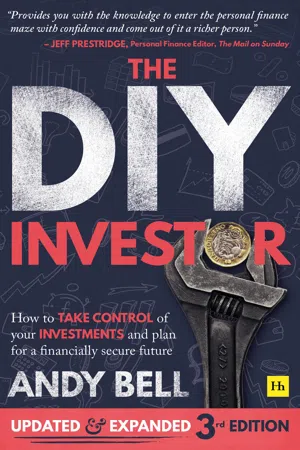
eBook - ePub
The DIY Investor 3rd edition
How to take control of your investments and plan for a financially secure future
- English
- ePUB (mobile friendly)
- Available on iOS & Android
eBook - ePub
The DIY Investor 3rd edition
How to take control of your investments and plan for a financially secure future
About this book
FULLY REVISED AND UPDATED THIRD EDITION
Investing expert Andy Bell shows you how to plan your financial future in this updated edition of his bestselling guide to do-it-yourself investing.
Andy shows you how to build a long-term investment portfolio using a range of low-cost, tax-efficient strategies. He provides expert guidance and industry insights suitable for first-time investors and those who are more experienced. The DIY Investor teaches you the skills and strategies you need to take control of your investments and manage your money in the years ahead.
PART ONE
WHAT BEING A DIY INVESTOR
IS ALL ABOUT
1
INTRODUCING DIY INVESTING
Why be a DIY investor?
“Because nobody cares as much about my money as I do.” This quote came out of a survey that AJ Bell commissioned to understand why people had chosen to become a DIY investor. It is all well and good thinking or saying it, but action is required.
A life event can often be the trigger for someone reviewing and taking control of their investments. The life event may be a new job, redundancy, retirement, marriage, divorce, inheritance, having a child, a child going to university and the list goes on. It is clear that the COVID-19 pandemic has been one such life event, which has driven a noticeable increase in the number of DIY customers.
The lack of engagement many people have with their investments never ceases to amaze me. Many of us spend hours scouring the internet to save a few quid on a new phone, eat at restaurants we otherwise wouldn’t be seen dead in to take advantage of a coupon discount scheme, or buy three items for the price of two when we only need one.
That is human nature – everyone likes a bargain. But translate that into far bigger financial decisions and most people simply haven’t got a clue. Ask someone how much they have in their ISA (individual savings account) or pension, what charges they pay, what they are invested in, how much they need to retire, or even what interest rate they’re getting on their cash savings account and a look of quizzical bemusement takes over.
The fact that you are reading this book means you probably don’t fit into this category or, if you do, you are desperate to break free. Learning how to become a DIY investor enables you to set basic goals and implement a simple strategy to achieve them. You will strip out a whole layer of charges that will free up your investments to grow quicker and hit your desired targets sooner than would otherwise be the case.
I am often asked, “What is the minimum amount of money I need to become a DIY investor?” My reply is always the same, after checking for eavesdroppers to avoid embarrassment. “It is not about size, it is about your state of mind.” There is a DIY solution for everyone, irrespective of how much you want to invest. But you do need a willingness to take control of your investments and the ability to dedicate at least a small amount of time.
Follow the strategies, ideas and tips set out in this book and you will learn how to create the sort of portfolio that you would get from a professional adviser, without paying the charges.
What you won’t get from this book are share tips, instructions on how to spot good or bad companies, or a guide to equity valuation metrics. There is plenty of other material available out there that goes into these specific areas.
Why everyone should invest – DIY or otherwise
However you choose to invest for your future, the necessity of doing so is an imperative for us all. The government has made no secret of the fact that it expects us to provide for ourselves, both before and during retirement.
For instance, the government has made changes to the system so that employees are automatically enrolled in pension schemes. What’s more, the age at which we’ll all get our state pension is steadily increasing and there’s even been talk of the government considering the possibility of raising the age to 70 years old. Therefore, it seems inevitable that everyone must do more to save for their future, as the government will not provide enough to provide you with a comfortable retirement.
Providing for your children could be one of your investment objectives, and this could be for a number of reasons: to pay for their school fees, university fees, help with their first house or just buy them their first car. Providing for private school fees is expensive enough, but we have also seen university fees triple in recent years, and with graduates coming out of university with an average debt of £50,000, it is understandable parents might want to help out with that.
Or your primary goal may be more focused around your own retirement.
Retirement ages are increasing and anyone in their early thirties today will not get their state pension until the age of 68 at the earliest. State pension age is being linked to how long we live and as life spans increase, so the day you will get your pension recedes further into the future.
I attended an actuarial conference a few years ago and the heading of one session was, ‘Immortality is no longer a pipe dream’. While the speaker may have been stretching the point, the heading succinctly highlights the direction of travel. Increasing longevity means longer in retirement, which may sound great but it also makes saving for your retirement a real uphill battle.
Just how much longer everyone is living can be hard to digest – the statistics are phenomenal. Back in 1952, only 300 people in the UK had made it to the age of 100. By 2018, the number of centenarians living in the UK had risen to 13,170, according to the Office for National Statistics (ONS).
And every new generation seems to be living longer than the last. A baby boy born in 2018 is expected to live until 88; and a baby girl to 90. These are average figures, so many could live longer. Particularly because they include those who will become overweight, smokers, heavy drinkers and those with long-term health conditions, which brings the average down. You may not believe it, and you may not even want to believe it, but these days if you are of above-average health you are in with a decent shot of making it to 100.
This means if you want to retire aged 60 then unless you have got a final salary, or defined benefit pension, you will have to put away a small fortune to pay the bills for a retirement that could run into three, four or even five decades.
It is clear doing nothing is not an option, so everyone needs to invest for the future in some way.
But that doesn’t mean you have to take on absolutely everything yourself. If you don’t understand something, or you are involved in a complicated situation, don’t be afraid to ask for help. Being a DIY investor means making your own financial decisions, but it doesn’t mean you are an expert at everything.
There are times in your life when you have to accept that someone else could provide the best solution to a problem. This applies to calling in a tradesman to fix a botched home repair job or getting a mechanic to overhaul your car after your quick fix turned into a big mess.
It also applies to managing your money, particularly in the complicated world of tax. Inheritance tax is a classic example of where it can pay to seek advice from an expert. Divorce is another situation where you may need the help of a financial adviser in trying to separate your assets.
What does being a DIY investor entail?
Being a DIY investor can involve as much or as little effort on your part as you want it to. You could set up a well-researched, low-maintenance investment portfolio from scratch in less than an hour, which only needs an hour or two every six months or so to review it. Or you can create a more complex portfolio that may require daily or weekly monitoring.
The choice is yours, but please don’t dive in at the deep end. Read this book and then ask yourself the question, “Am I a DIY investor?” If the answer is yes, you will likely be particularly interested in one or more investment styles and strategies highlighted in later chapters and you are ready to go. If the answer is no, then you need to seriously consider appointing a financial adviser.
You may have accumulated one or more old pensions or savings policies. The policy documents may be getting dusty in your filing cabinet and at some stage, as part of this process, you will have to dust these down and consider consolidating them all into one pension you can manage. This will give your portfolio a decent kick-start, but more on this later.
Being a DIY investor does require some commitment on your part. Because you are not paying for advice, you are buying on a caveat emptor, or buyer beware, basis. This means that you will be the person responsible if things go wrong. For example, if you make a mistake and buy a share or fund that you thought was something entirely different, or if you misunderstand a tax planning strategy, then you will have no one to blame but yourself. That might seem scary to start with, but over time you will build more confidence with this – and you’ll learn from any small mistakes you make along the way.
The extent to which you should engage as a DIY investor should reflect the person you are. If you are someone who finds numbers particularly difficult to grasp then don’t worry, just keep it simple. Buy a few different multi-asset funds and you will get the hang of it.
You also need to have the discipline to review your investments at least once a year and preferably twice a year, to make sure they are performing as they should. A few carefully considered Google alerts can keep you abreast of any key changes to your investments in the interim.
The skills and commitment you need will also depend on the type of investor that you intend to be. If you are going to adopt a long-term buy-and-hold strategy, you may need no more than a couple of hours a year to review your portfolio.
That said, once everything is set up, checking your investments online is so straightforward that most people find themselves regularly looking to see how their investments are faring anyway. Most investment platforms now have mobile phone applications, which you may find compulsive. There’s a careful balance here, as you don’t want to be too hands-off but you also don’t want to be checking it so often you become obsessed with every small rise and fall in your portfolio. When we listed AJ Bell on the London Stock Exchange in December 2018, I made a commitment to myself that I wouldn’t obsess over the share price. ‘A sneaky peak, once a week’ at the share price is all I allow myself. This is a sensible rule of thumb for how often you should look at your portfolio in between more detailed reviews.
Investment platforms
An investment platform is an internet-based service that offers the DIY investor at least three types of account:
1. self-invested personal pension, or SIPP
2. individual savings account, or ISA
3. dealing account
These are offered through an overarching account, accessed by a single login.
The platform you choose will be where you carry out all your investing, so choosing the right one with the most suitable charging structure, appropriate choice of investments and useful investor tools is very important.
The functionality that today’s investment platforms offer means it has never been easier to be a DIY investor. It is no exaggeration to say that the internet has genuinely revolutionised the process of investing, in particular DIY investing.
Investment platforms today give you online access to real-time dealing, along with data and information that only a decade or so ago were exclusive to professional advisers and fund managers. There’s lots more detail on what to look for when picking your platform in Chapter 19.
Different types of investment accounts
Efficient DIY investing involves using the right type of account – sometimes referred to as a product, tax wrapper or savings vehicle – at the right time.
The two main tax-efficient products you will see in this book are a SIPP, which stands for self-invested personal pension, and an ISA, which stands for individual savings account. There are now various different types of ISA, which I highlight below and explain in more detail in later chapters.
As well as a SIPP and an ISA, you will most likely need a dealing account for any investments that fall outside these two accounts.
The SIPP is a personal pension with the flexibi...
Table of contents
- Cover
- Title
- About the author
- Preface
- PART ONE. WHAT BEING A DIY INVESTOR IS ALL ABOUT
- PART TWO. THE DIY INVESTOR’S TOOLKIT – THE PRODUCTS
- PART THREE. THE DIY INVESTOR’S TOOLKIT – THE INVESTMENTS
- PART FOUR. PUTTING IT ALL TOGETHER
- A Final Word
- Index
Trusted by 375,005 students
Access to over 1.5 million titles for a fair monthly price.
Study more efficiently using our study tools.
Frequently asked questions
Yes, you can cancel anytime from the Subscription tab in your account settings on the Perlego website. Your subscription will stay active until the end of your current billing period. Learn how to cancel your subscription
No, books cannot be downloaded as external files, such as PDFs, for use outside of Perlego. However, you can download books within the Perlego app for offline reading on mobile or tablet. Learn how to download books offline
Perlego offers two plans: Essential and Complete
- Essential is ideal for learners and professionals who enjoy exploring a wide range of subjects. Access the Essential Library with 800,000+ trusted titles and best-sellers across business, personal growth, and the humanities. Includes unlimited reading time and Standard Read Aloud voice.
- Complete: Perfect for advanced learners and researchers needing full, unrestricted access. Unlock 1.5M+ books across hundreds of subjects, including academic and specialized titles. The Complete Plan also includes advanced features like Premium Read Aloud and Research Assistant.
We are an online textbook subscription service, where you can get access to an entire online library for less than the price of a single book per month. With over 1.5 million books across 990+ topics, we’ve got you covered! Learn about our mission
Look out for the read-aloud symbol on your next book to see if you can listen to it. The read-aloud tool reads text aloud for you, highlighting the text as it is being read. You can pause it, speed it up and slow it down. Learn more about Read Aloud
Yes! You can use the Perlego app on both iOS and Android devices to read anytime, anywhere — even offline. Perfect for commutes or when you’re on the go.
Please note we cannot support devices running on iOS 13 and Android 7 or earlier. Learn more about using the app
Please note we cannot support devices running on iOS 13 and Android 7 or earlier. Learn more about using the app
Yes, you can access The DIY Investor 3rd edition by Andy Bell in PDF and/or ePUB format, as well as other popular books in Business & Stocks. We have over 1.5 million books available in our catalogue for you to explore.