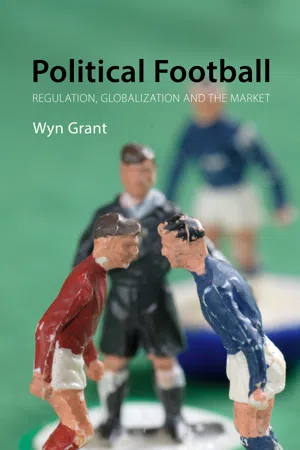
Political Football
eBook - ePub

Political Football

Regulation, Globalization and the Market

  1. English
  2. ePUB (mobile friendly)
  3. Available on iOS & Android
eBook - ePub

Political Football

Regulation, Globalization and the Market

About this book

Football has been largely exempt from the development of the regulatory state and has been left to govern itself. However, new media have raised the profile of the game and globalization has created new pressures as football clubs become pawns in the ambitions of states, consortia and wealthy individuals. Clubs offer an important sense of identity for fans, but the impersonality and distance of ownership can set up new tensions. In addition, corruption in the international governing body has been a significant problem and the sport's symbiotic relationship with gambling continues to be a concern.

Wyn Grant examines the political economy of football and its uneasy relationship with the market. There are no off-the-shelf solutions for regulation, he argues, but the complexities of the game and its economic size demand more attention from government.

Frequently asked questions

Yes, you can cancel anytime from the Subscription tab in your account settings on the Perlego website. Your subscription will stay active until the end of your current billing period. Learn how to cancel your subscription.
At the moment all of our mobile-responsive ePub books are available to download via the app. Most of our PDFs are also available to download and we're working on making the final remaining ones downloadable now. Learn more here.
Perlego offers two plans: Essential and Complete
  • Essential is ideal for learners and professionals who enjoy exploring a wide range of subjects. Access the Essential Library with 800,000+ trusted titles and best-sellers across business, personal growth, and the humanities. Includes unlimited reading time and Standard Read Aloud voice.
  • Complete: Perfect for advanced learners and researchers needing full, unrestricted access. Unlock 1.4M+ books across hundreds of subjects, including academic and specialized titles. The Complete Plan also includes advanced features like Premium Read Aloud and Research Assistant.
Both plans are available with monthly, semester, or annual billing cycles.
We are an online textbook subscription service, where you can get access to an entire online library for less than the price of a single book per month. With over 1 million books across 1000+ topics, we’ve got you covered! Learn more here.
Look out for the read-aloud symbol on your next book to see if you can listen to it. The read-aloud tool reads text aloud for you, highlighting the text as it is being read. You can pause it, speed it up and slow it down. Learn more here.
Yes! You can use the Perlego app on both iOS or Android devices to read anytime, anywhere — even offline. Perfect for commutes or when you’re on the go.
Please note we cannot support devices running on iOS 13 and Android 7 or earlier. Learn more about using the app.
Yes, you can access Political Football by Wyn Grant in PDF and/or ePUB format, as well as other popular books in Economics & Political Economy. We have over one million books available in our catalogue for you to explore.
1
THE POLITICAL ECONOMY OF FOOTBALL
The excitement of attending a first football match is ingrained in the memory of many fans. They can recall the details of the journey to the ground, who they were with, the merchandise and food being sold outside and the feeling they had on entering the ground for the first time. They can remember the match itself, the emotional involvement of the other spectators around them, the singing and the chanting. I recall catching the number 53 bus from Plumstead Common at the age of six with my parents, walking with the crowds through Maryon Park and standing on the huge East Terrace at The Valley, the home of Charlton Athletic.
For many fans, that first experience begins a lifelong commitment that becomes an important part of their identity. Going to a match is not simply a release from the pressures of everyday life, important though that is, it also represents an opportunity to connect with an extended football family. This may include generations of the same family and old school friends. However, it may also involve “football friends” with whom the only contact is at the game, for a drink beforehand or afterwards. I frequently make the two-hour journey to attend Charlton home games to meet football friends in my birthplace of Greenwich for brunch and a pre-match pint.
Even if after moving away from the club’s location, a fan’s continuing support for their team can be a means of maintaining and reviving their connection with an area familiar to them. Topophilia, a love of place, and the cultural identity associated with a place, can be a powerful force. Of course, in some ways this is a nostalgic and sentimental interpretation, or at least a constructed version of the experience of football. Many fans never visit the ground of the team they support and simply follow their progress on television and social media. Football is now a global game with supporters of leading teams located all over the world. Inevitably this leads to a tension between a club as a global business, perhaps with foreign owners, and the idea of a club as an expression and embodiment of a particular community. Some fans have become alienated from football as a result, as the business and finances of the sport distance and diminish the importance of the local supporters to the team’s success. The need to temper and regulate the globalizing market forces at work in the beautiful game is a central theme of this book.
The challenge of global football
To help understand and explain the forces at work in global football, I draw on the analytical framework provided by the concept of political economy, which is all about the relationship between the market and the state and the governance of that relationship. Unrestrained market forces can damage the functioning of both economy and society so that competition cannot deliver its benefits, and the structure and cohesion of society is undermined. One response to prevent these harmful outcomes by governments has been the increase of regulation to ensure that the market operates within a framework of rules. Football has operated largely outside this “regulatory state” and has relied on self-regulation, which has often been found wanting. The absence of effective regulation has been criticized as football has been transformed by globalization, foreign investment and new technology. The need for regulation cannot, however, be satisfied simply by importing established forms of regulation from areas such as utility company competition and pricing. It requires a more responsive and innovative form of regulation that takes account of the variety of stakeholders in football, not least the fans.
There is widespread discontent about the state of football at a time when it is followed more extensively and intensively across the world than ever before, even making headway in the United States with its own long-established and distinctive sports. It is important to be cautious about falling into the trap of believing in a sepia-tinged golden age of football. There have always been dominant clubs with more resources than others. Players were ruthlessly exploited in the past by owners. Games were played in stadiums that were at best uncomfortable and at worst dangerous, leading to a number of incidents in which spectators were killed. The state of pitches certainly did not encourage the development of silky skills; training was often limited to physical fitness with a belief that keeping players away from the ball would make them hungry for it at the next match; and there was little understanding of diet and nutrition and its relationship with performance: “Objectively, the football of the 1970s was markedly inferior to the tactics, fitness and skill levels of today” (Everitt 2019: 19). In the twenty-first century players are athletes with much higher work rates and better technical skills.
Given that there have been improvements in the standard of player fitness and of playing tactics along with the facilities in which the game is watched, why is there so much discontent? There are many grievances, and some real cause for concern, but among the most prominent is a widely held opinion that players are paid too much, and agents extract too much from the game. Owners are often considered to have little emotional investment in their clubs and to be pursuing agendas that have little to do with football. A small number of top clubs dominate the game such as the “big six” in the Premier League (Arsenal, Chelsea, Liverpool, Manchester City, Manchester United and Tottenham Hotspur), Paris Saint-Germain (PSG) in France, Juventus in Italy and Barcelona and Real Madrid in Spain. This domination is regarded as anti-competitive with top clubs ruthlessly pursuing their own interests and evading rules designed to keep their conduct in check. There is also a troubling symbiotic relationship between football and gambling, which is a theme I explore in Chapter 5.
All these concerns can be summarized as the feeling of alienation that many fans experience from the game they love. Clubs are an important source of identity for fans and their communities. However, they feel powerless in the face of owners who may run a club into the ground and even destroy it, as exemplified by what happened at Bury in 2019. Players are tradeable commodities and may have little real loyalty to their clubs, however much they kiss the badge. The price of attending games has often soared beyond what can be afforded by those on below average or even median incomes. Of course, it should be acknowledged that fans often have unrealistic expectations and are one of the forces leading to overspending on players.
What is evident is that at a time when economic and political resistance to globalization is growing, it remains a strengthening force in football. Leading clubs often have foreign owners and they continued to be active in acquiring clubs during the Covid-19 pandemic. Overseas television revenue is becoming more important to the Premier League while domestic revenues actually diminished in the last settlement. Footballers migrate from Africa and Latin America to play in the European leagues. Football is celebrated as a global game, its appeal resting in part in its simplicity, which means that it can be played for fun with very basic equipment. Yet in many respects it remains highly conservative. This reluctance to embrace change can stand in the way of needed reforms.
Forces for change
Football is not dissimilar to any other economic sector or industry. In assessing what drives the evolution and development of an industry, important considerations would be the role of technology, patterns of ownership, market structure and consumer demand, and how these are changing. To understand what is going on in football, each of these aspects needs to be considered in turn in relation to what has become a global game.
Technology
The adoption of technology has always been mediated by culture, and this is particularly true of the subculture of “the world of football”. Football has not undergone many technological changes and those that have come along have often been strongly resisted. Floodlights were initially treated as a novelty with their own special competitions. They were met with resistance from administrators, and it took some time to realize their potential in terms of evening matches and later kick-off times in winter. The concern being that “evening football would keep working men from the family home” (The Away Section 2019). They were not, of course, the only spectators, but their presence at the match was seen as a potential social harm.
Laced leather balls, which were heavy and easily became waterlogged, were replaced with a resultant improvement in performance and a reduced risk of injury to players, in particular the long-run risk of developing dementia. Artificial pitches have been controversial in part because they are seen as giving an advantage to teams used to playing on them, but also because they offend traditionalists. Any non-league team with an artificial pitch promoted to the Football League would have to replace it, as happened to Harrogate Town in 2020. The introduction of video-assisted refereeing (VAR) has been opposed by many fans who believe it spoils the spontaneity of the game. Although some of the problems may have arisen from associated and subsequent rule changes, particularly on handball, and the way in which decisions have been communicated, VAR has also revealed that many refereeing decisions are genuinely borderline.
However, the technological changes that have had a profound impact on football have been external to the game itself. The really transformative technology has been satellite broadcasting. The competition between terrestrial television channels was insufficient to drive up the price paid for coverage to clubs. They were also not very innovative in the way in which they covered football, in terms of utilizing new technology to interpret the game, camera positions and angles, and the range and diversity of commentators used. The involvement of satellite broadcasting in televising matches all over the world has created a new financial dynamic and created a situation in which “followers” become more important than “fans”. Satellite broadcasters constantly need new and fresh content that attracts and retains subscribers, and football is ideal for that purpose. Live sport sells subscriptions, particularly to key demographics for advertisers, such as young males. In 1992, “[f]earing stagnation from earlier losses of £14m a week, Sky needed to secure live Premier League football to survive” (Bower 2003: 105). It is satellite broadcasting that has created the riches of the English Premier League. By the end of the second decade of the twenty-first century, however, there were signs that growth in the subscriber numbers was slowing or even going into reverse. In turn this meant that broadcasters were reluctant to increase their bids for exclusive coverage of league games.
The Covid-19 pandemic was an additional complicating factor. The Premier League, the Bundesliga, La Liga and the Champions League all granted rebates to the broadcasters to compensate for spring lockdowns. The Bundesliga was the first major league to conclude a television deal, and it had to take a €200 million – 5 per cent – reduction on a €4.4 billion deal over four years. In retrospect this could be seen as a good outcome. A warning of possible future trends came in the autumn of 2020 when Mediapro skipped one of its payments to France’s Ligue 1 and stated that it wanted to renegotiate the deal, arguing that the absence of fans from grounds changed what was on offer. They subsequently withdrew from the agreement and Ligue 1 had to replace it with a much less lucrative deal. The dispute was seen as “the first indicator of a painful correction in the multibillion-euro market for European football’s media rights” (Abboud & Ahmed 2020). There had already been indications that peak television revenues for football had been reached, but the pandemic was a final blow to the free-spending era for television executives and football clubs alike.
Patterns of ownership
From the mid-1990s “a new breed of club owner” has emerged in European football, “members of the super rich with little or no connection to the club they had bought … By the end of 2016 foreign owners had bought, or held significant shares in, 15 of the 20 Premier League teams” (Montague 2017: 6). The motivations for buying clubs range from the commercial to the political and the personal. As a consequence, there is considerable variation in ownership strategies and styles. On the whole, fans are not too concerned about ...

Table of contents

  1. Cover
  2. Title Page
  3. Copyright Page
  4. Contents
  5. Preface
  6. 1. The political economy of football
  7. 2. Globalization
  8. 3. Not business as usual
  9. 4. The players
  10. 5. Football and gambling
  11. 6. Women’s football
  12. 7. Regulating football
  13. 8. Finding solutions: a new regulatory framework
  14. References
  15. Index