Water is one of the most precious and basic needs of life for all living beings, and a precious national asset. Without it, the existence of life cannot be imagined. Availability of pure water is decreasing day by day, and water scarcity has become a major problem that is faced by our society for the past few years. Hence, it is essential to find and disseminate the key solutions for water quality and scarcity issues. The inaccessibility and poor water quality continue to pose a major threat to human health worldwide. Around billions of people lacking to access drinkable water. The water contains the pathogenic impurities; which are responsible for water-borne diseases. The concept of water quality mainly depends on the chemical, physical, biological, and radiological measurement standards to evaluate the water quality and determine the concentration of all components, then compare the results of this concentration with the purpose for which this water is used. Therefore, awareness and a firm grounding in water science are the primary needs of readers, professionals, and researchers working in this research area.
This book explores the basic concepts and applications of water science. It provides an in-depth look at water pollutants' classification, water recycling, qualitative and quantitative analysis, and efficient wastewater treatment methodologies. It also provides occurrence, human health risk assessment, strategies for removal of radionuclides and pharmaceuticals in aquatic systems. The book chapters are written by leading researchers throughout the world. This book is an invaluable guide to students, professors, scientists and R&D industrial specialists working in the field of environmental science, geoscience, water science, physics and chemistry.
1 Sorbent-Based Microextraction Techniques for the Analysis of Phthalic Acid Esters in Water Samples
Miguel Ángel González-Curbelo1, Javier González-Sálamo2,3, Diana A. Varela-Martínez1,2 and Javier Hernández-Borges2,3*
1Departamento de Ciencias Básicas, Facultad de Ingeniería, Universidad EAN, Bogotá D.C., Colombia
2Departamento de Química, Unidad Departamental de Química Analítica, Facultad de Ciencias, Universidad de La Laguna (ULL). Avda. Astrofísico Fco. Sánchez, San Cristóbal de La Laguna, España
3Instituto Universitario de Enfermedades Tropicales y Salud Pública de Canarias, Universidad de La Laguna (ULL). Avda. Astrofísico Fco. Sánchez, San Cristóbal de La Laguna, España
Abstract
Current society is living in a world in which it is exposed to a broad spectrum of contaminants that can pose different risks for health. In this sense, we are daily bombarded with news related to pollution by plastic residues (especially in the oceans), being one of the main issues that humans must face today, not only because of the direct effects of plastics but also because of the variety of contaminants they can release to the environment. Probably, the most important ones are phthalic acid esters (PAEs), since they easily migrate from the polymeric matrix to the surrounding media, acting as endocrine disruptors in human organisms and resulting in multiple diseases. Their occurrence in water matrices is of especial importance, since it is essential for life, and the presence of PAEs, even at very low levels, can cause serious health problems. This book chapter aims at providing a general and critical overview of the different analytical methodologies that have been developed for the analysis of PAEs in water samples and which are based on the application of sorbent-based microextraction techniques, which is one of the current trends in the Analytical Chemistry field.
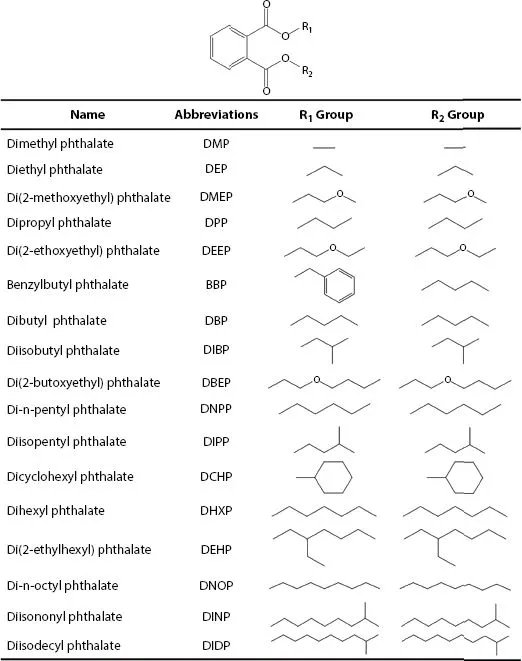
Phthalic acid esters (PAEs) are a group of dialkyl or alkylaryl esters of phthalic acid (see Figure 1.1), commonly known as phthalates, which are widely used as additives in the polymer industry but also added to paints, adhesives, lubricants, and cosmetics, among others [2]. As an example, low-molecular PAEs such as butyl benzyl phthalate (BBP), dibutyl phthalate (DBP), and diethyl phthalate (DEP) are widely used as solvents and emulsifiers to maintain color and fragrance mainly in beauty products and pharmaceuticals, while high-molecular PAEs such as di(2-ethylhexyl) phthalate (DEHP) are highly used as plasticizers to make polymeric materials more workable and flexible. As a result of the extremely high production of such products, especially plastics, PAEs are exorbitantly present in the daily life. Among them, DEHP is the most currently used. In fact, its production as plasticizer is estimated to be a quarter of the total [3, 4]. Due to these widespread applications and intensive production, together with the fact that they are only retained in the polymer structure through weak secondary molecular interactions and not covalently, PAEs can easily migrate to the environment. As a result, PAEs have become ubiquitous contaminants in the environment, in particular, they can be found in natural waters such as lake, river, sea, and ground waters [5, 6], especially those adjacent or downstream from industrial locations [5]. In addition, their possible migration to drinking waters that are in contact with plastic materials like mineral and tap waters must also be taken into account, as well as their final presence in waste waters [5, 7].
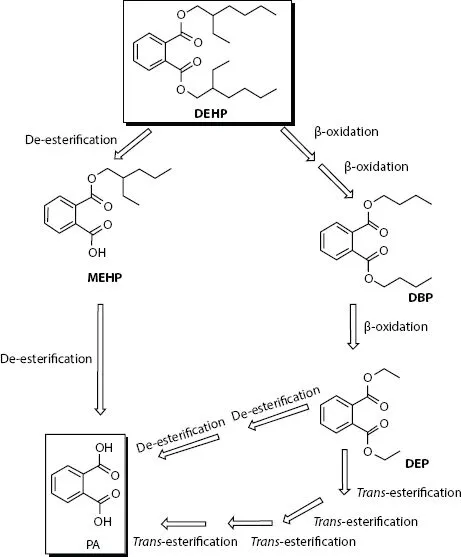
It has already been demonstrated that many PAEs act as endocrine disruptors and that they can be toxic for reproduction, even at extremely low concentrations [8–11]. Even more worrying is the fact that certain PAEs can be easily degraded in the environment by bacteria and fungi and their degradation products can also have an important toxicity. Such is the case of DEHP that can be degraded to DBP, DEP, and especially to mono-2-ethylhexyl phthalate (MEHP), which has shown to be more toxic than DEHP [12, 13] (see Figure 1.2). As a result of the high human exposure to PAEs and their metabolites, their potential risks for health and their persistence, several organizations have established an increasingly broad and restrictive legislation. As examples, the European Union has listed several PAEs as compounds suspected to produce endocrine abnormalities [15] and the International Agency for Research on Cancer has classified DEHP in the group 2B (possibly carcinogenic to humans) [16]. Moreover, the US Environmental Protection Agency (EPA) has included several PAEs (BBP, DBP, DEHP, DEP, dimethyl phthalate (DMP), and di-n-octyl phthalate (DNOP)) in its priority list of pollutants and has established limits of 6 μg/L and 400 μg/L for DEHP and di(2-ethylhexyl) adipate (DEHA) in drinking water, respectively [17], while this maximum allowed concentration has been established in 8 μg/L for DEHP by the World Health Organization [18] and in 1.3 μg/L in surface waters by the European Union [19]. Considering all the above mentioned, it is clear that there is an increasing need to develop highly sensitive and reliable analytical methods for monitoring trace amounts of PAEs in different samples and, especially, in water.
Figure 1.1 The chemical structures of PAEs. Adapted from [1]. PAEs, phthalic acid esters.
Figure 1.2 DEHP biodegradation pathways to obtain MEHP, DBP, and DEP. Reprinted from [14] with permission from Elsevier. DBP, dibutyl phthalate; DEHP, di-2-ethylhexyl phthalate; DEP, diethyl phthalate; MEHP, mono-2-ethylhexyl phthalate; PA, polyacrylate.
PAEs have been analyzed in water samples using gas chromatography (GC) coupled to flame ionization detectors (FIDs) [20], mass spectrometry (MS) [21] and tandem MS (MS/MS) [22], or highperformance liquid chromatography (HPLC) coupled to diode array detectors (DADs) [23], ultraviolet (UV) [24], and MS [25]. Among them, GC is normally the preferred technique since most PAEs are nonpolar and thermostable. It is important to notice that, in all these analytical methods, it has been necessary to include previous sample preparation steps before instrumental analysis to achieve accurate and sensitive results. These steps consist on the isolation and pre-concentration of PAEs since they can be found in water samples at extremely low concentrations. However, since PAEs are not ionizable in water, these samples are normally analyzed directly or after a simple filtration without pH adjustment regardless of the sample preparation technique used in each ca...
Table of contents
Cover
Table of Contents
Title Page
Copyright
Preface: Applied Water Science I-Fundamentals and Applications
1 Sorbent-Based Microextraction Techniques for the Analysis of Phthalic Acid Esters in Water Samples
2 Occurrence, Human Health Risks, and Removal of Pharmaceuticals in Aqueous Systems: Current Knowledge and Future Perspectives
3 Oil-Water Separations
4 Microplastics Pollution
5 Chloramines Formation, Toxicity, and Monitoring Methods in Aqueous Environments
6 Clay-Based Adsorbents for the Analysis of Dye Pollutants
7 Biochar-Supported Materials for Wastewater Treatment
8 Biological Swine Wastewater Treatment
9 Determination of Heavy Metal Ions From Water
10 The Production and Role of Hydrogen-Rich Water in Medical Applications
11 Hydrosulphide Treatment
12 Radionuclides: Availability, Effect, and Removal Techniques
13 Applications of Membrane Contactors for Water Treatment
14 Removal of Sulfates From Wastewater
15 Risk Assessment on Human Health With Effect of Heavy Metals
16 Water Quality Monitoring and Management: Importance, Applications, and Analysis
17 Water Quality Standards
18 Qualitative and Quantitative Analysis of Water
19 Nanofluids for Water Treatment
Index
End User License Agreement
Trusted by 375,005 students
Access to over 1.5 million titles for a fair monthly price.
Study more efficiently using our study tools.
Frequently asked questions
Yes, you can cancel anytime from the Subscription tab in your account settings on the Perlego website. Your subscription will stay active until the end of your current billing period. Learn how to cancel your subscription
No, books cannot be downloaded as external files, such as PDFs, for use outside of Perlego. However, you can download books within the Perlego app for offline reading on mobile or tablet. Learn how to download books offline
We are an online textbook subscription service, where you can get access to an entire online library for less than the price of a single book per month. With over 1.5 million books across 990+ topics, we’ve got you covered! Learn about our mission
Look out for the read-aloud symbol on your next book to see if you can listen to it. The read-aloud tool reads text aloud for you, highlighting the text as it is being read. You can pause it, speed it up and slow it down. Learn more about Read Aloud
Yes! You can use the Perlego app on both iOS and Android devices to read anytime, anywhere — even offline. Perfect for commutes or when you’re on the go. Please note we cannot support devices running on iOS 13 and Android 7 or earlier. Learn more about using the app
Yes, you can access Applied Water Science, Volume 1 by Mohd Imran Ahamed, Rajender Boddula, Tauseef Ahmad Rangreez, Mohd Imran Ahamed,Rajender Boddula,Tauseef Ahmad Rangreez in PDF and/or ePUB format, as well as other popular books in Technology & Engineering & Mechanical Engineering. We have over 1.5 million books available in our catalogue for you to explore.