- 144 pages
- English
- ePUB (mobile friendly)
- Available on iOS & Android
eBook - ePub
Planning and Real Estate
About this book
Real-estate development is a highly regulated, high-value industry: this book examines its efficiency, its role in shaping the built environment and its relationship with planning and planners. It considers issues such as the role of the government and property markets and whether it is valid to blame the planning systems for dysfunctional housing markets. It also provides a useful grounding in development companies' decision-making and how the property-development process, financing and pricing systems operate in a market economy. It explains the UK's Development Led system and Development Appraisals, before comparing various alternative international systems to see how they treat, or prioritise, real estate and development interests. It questions which policies might lead to high levels of speculative activity and if so, whether this is sustainable, in political, economic or environmental terms. It looks to the future to see whether the planning system can prevent future property bubbles and identifies key lessons and implications for planning and property markets.
Information
Topic
ArchitectureSubtopic
Urban Planning & LandscapingChapter 1
Public Policy, Planning and the Property Market
Making places and spaces
The outcomes of planning and real estate development decisions are of fundamental importance to all the inhabitants of a city or a region, since the making of places and spaces impacts on everyday life and the future wellbeing of communities. Planners have a dual role in helping set out aspirations for an area and providing a regulatory framework that helps guide future development. Planning systems can attract support and criticism from multiple political and public policy perspectives – a healthy sign of a functioning democratic system. Planning policies can be viewed by supporters as an essential framework for the creation of the physical structures within which society operates, while others criticise them as an unnecessary constraint on the property development market, delaying and blocking supply processes. Alternatively, planning systems may be viewed as a necessary democratic control of the real estate development process or, by some detractors, as uncritically supporting real estate and business-led development coalitions operating at the expense of local communities.
The importance of land-use planning rests in its leading role in providing the physical framework within which we live and work. The use of planning policy decision-making within competitive property markets is examined in this chapter, along with the role of regulation or interventions aimed at achieving equity and/or efficiency. The chapter will explore the evolving role of the state in the context of property markets in a market economy. This discussion will include recognition of the growing importance of environmental policy frameworks for property development. Specific issues of importance include: availability of zoned and serviced lands, infrastructure requirements, access to services and utilities, industry capacity and constraints and general policy environment, taxation, and regulation. The discussion will include examples of public policy influences on property markets through regulation and state intervention.
In land-use planning approaches the focus is on achieving an efficient use of resources, including land resources. By providing a framework for future infrastructure to support future development, planning can also improve the efficiency in the use of the financial resources of both public sector and private investors. The scope of the planning and public policy system has historically addressed broader social problems and issues of economic development and equality in an integrated manner. Planning systems based on a land-use control approach, as have evolved in the UK and Ireland, place a heavy reliance on market processes to achieve desired development objectives. The exploration of the key features of such systems and the relationships that exist between planning, public policy, real estate and finance interests is a key task of this book.
Comparing this land-use control planning model with other approaches can reveal differences in scope of powers, resources and administrative structures, as outlined in Chapter 2. It also highlights that evidence of improved planning and development outcomes can be identified based on alternative approaches and resourcing models. At opposite ends of the spectrum might be the historically integrated approach to social housing as the policy approach adopted in Vienna, Austria, as against the housing of lower socio-economic groups or ethnic groups in problem estates in separated public provision and market provision in a neo-liberal context. Social inclusion from the inception of development policies along with market support may produce a more socially balanced outcome than either state centrally planned models such as the pre-1990s command economy approach, or a development-led free market approach, as in the recent property development booms and collapses in Spain and Ireland.
In general, this exploration views planning of land markets and governance structures in relation to real estate development as part of a wider public policy debate. The role of government can be both supportive and negative towards all sectors in communities and impact upon community and sustainability and economic development prospects in both the short and long term. Relevant issues include the role that planning, policy and development interest’s play and the power or control each can exert over the development process. It is also critical to explore policy instruments related to planning, including development control at local and regional level, public financing and investments, property taxes and legal remedies to development problems.
Relevant real estate issues include economic issues, such as elasticity of supply, which is the capacity of the property industry to respond to increases in demand, market cycles, market controls, vacancies, abandonment of lands and sites, and issues of impacts on neighbouring occupiers. Costs, decision-making and the role of subsidies and growth controls all shape market-driven planning and development processes. From such theoretical considerations emerge major planning challenges such as achieving social equity in the city. The economics of residential location and the self-reinforcing nature of positive externalities or impacts of development in good neighbourhoods and of negative externalities, or blight, in depressed inner-city areas, make progress in achieving social equity difficult and complex. This demonstrates the importance of the spatial development dimensions of investment, disinvestment, and employment and education, and their critical importance to planning. The persistent focus on competing individual interests through an economic exchange market with values or rents distributing uses undervalues political, social, resource issues and other factors.
The descriptive nature of the land-use market models as presented in Figure 1 shows the Bid Rent Process by which the varieties of alternative land uses compete for the best locations for their land use. The various sector bids produce a pattern of dominant land uses within urban areas. We can see – represented on the vertical axis – that commercial high-rent retail and offices become dominant in prime central business districts with the significant pull factors of central areas, while lower pricing patterns in standard housing and industrial sectors push these uses from such areas towards the suburbs on the horizontal axis.
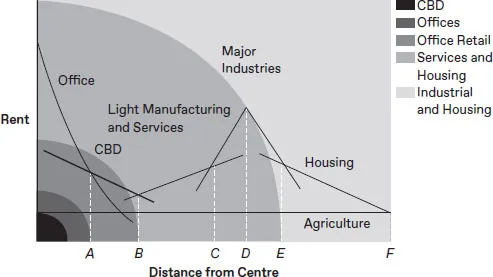
Figure 1
Urban land bid rent models
A constant evolution in such market approaches, based on observed analyses of patterns of land uses and linkages within urban areas, have seen developments in key concepts including central place theories, agglomeration and concepts relating to land markets evolution.
The land market in an open market economy has the aim of optimising land use and profits and does not focus on the provision of equitable outcomes. Decades of planning and urban policy have sought to balance these market processes to achieve social and public improvements by influencing real estate outcomes. This policy approach to equity was traditionally focused on affordable housing and public amenities, and in modern times has included achieving lower energy consumption. In the modern period, the concept of equity and inequality has widened to include addressing socio-economic, ethnic opportunity and access issues, as illustrated in Figure 2.
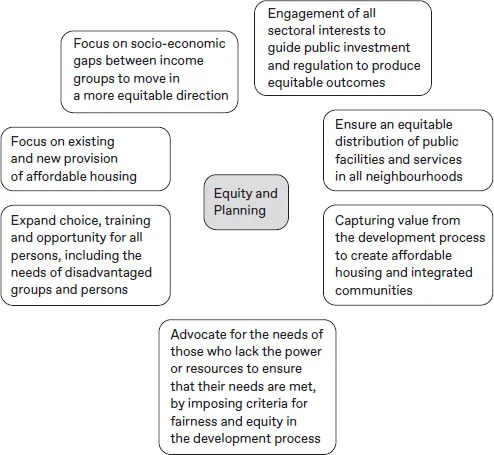
Figure 2
Equity and planning
Topics for critical evaluation include how we categorise planning and governance systems. Planning systems can be pluralistic and open to multiple local inputs, regime-orientated or controlled by elites. Communities and their elected representatives often claim that they are without power and resources to influence local development. For example, anti-austerity groups in European regions criticise urban policy-makers and processes as encouraging the financialisation of development processes in a neo-liberal economic context in ways that privilege elites and punish the undeserving, the poor and marginalised communities. This perspective sees the urban built environment as becoming a depository for investment capital, speculation and the commodification of housing and urban development, rather than providing essential housing, infrastructure and facilities.
A significant driver of modern planning policy internationally is the issue of environmental sustainability. Public awareness of environmental issues has led to a wide variety of UN, EU and international agreements on tackling major issues, including the long-term effects of climate change. Multiple programmes and planning policies attempt to put into effect such policies and become part of the mainstream of planning policy and practice. A problem for policy-makers in this area is that while the costs of such initiatives are often immediate and clearly identifiable, the savings in costs and times or revenues accruing are long term and less clear. Potential approaches to sustainability in planning are shown in Figure 3 and include the certification of new development which complies with prescribed standards, the introduction of energy coding for all buildings, and supports or grants for upgrading existing buildings. The provision of grants for the retrofitting of older buildings with modern insulation materials and renewable energy appliances is increasingly promoted. This form of intervention is politically popular and can be argued to support local business and employment.
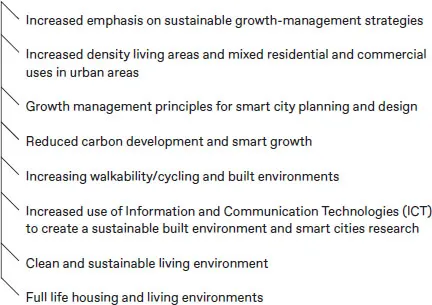
Figure 3
Sustainability and planning
The consensus in the developed world on the approaches to regulate the use of limited resources through effective public policy and planning has lessened. Conventional approaches to the planning and development of urban areas have been viewed as deficient and the search for new ideas and approaches has led to the development of more market-led policies. It is therefore necessary to examine the conventional assumptions upon which urban policy has been based and why such approaches are perceived to have failed. The choice of policy and consideration of alternatives therefore necessitates investigation of the key themes or issues which underline the operations of property markets. Taking the example of inner-city dereliction: if it is a function of market malfunctions, government policies to loosen the constraints preventing such operations might suffice. If, however, the market is simply a reflection of deep-seated political, social or economic strains, broader-based policies tackling more difficult issues are required. The issue subsequently arises as to whether the various interest groups involved are willing to accept policies, including land-use planning, which would contribute to solving such problems.
Development problems, land use planning and the regulation of development
Historically, the evolution of planning policies and regulation of development in western nations was a reaction to the negative consequences of rapid urban expansion following the industrial revolution of the nineteenth century. The massive shift from agricultural to industrial employment created boom towns with large-scale manufacturing industry which developed without adequate guidance or control. The living conditions of the working classes and the squalor of the environment led to frequent outbreaks of disease – exposing the limits of market self-regulation – and calls for a greater role for the state. The lack of state regulation of housing development was identified as a cause of the severe health problems experienced by the new urban populations living in unsanitary conditions.
Public Health Acts formed the initial basis of planning approaches and were enacted in many European countries, including the UK and Ireland, to regulate and improve living conditions. Powers involved in such measures involved the enacting of bye-laws governing drainage, sewage, closure of unfit buildings and widths of streets. While in general the powers enacted contributed to higher standards of urban construction and improved layout in residential construction, more extensive planning of development did not occur until the twentieth century. Parallel with the development of public legislation, private philanthropists often developed highly individualistic concepts as to idealised forms of planned urban development. Notable amongst such developments in Britain were towns such as Saltaire, founded by Titus Salt (1851), Bourneville, founded by the Cadbury family (1895), and Port Sunlight, founded by W.H. Lever (1888). For example, the development of the mill town, New Lanark, in 1813 incorporated the provision of educational, health and social amenities. Such movements recognised the linkage between social and environmental problems in the creation and perpetuation of the problems prevalent in urban tenements or slums. Industrialists, amongst such philanthropists, also made the obvious link between improved living conditions for their workers and improved profits. Such movements recognised the linkage between social and environmental problems in the creation and perpetuation of the problems prevalent in poorly managed urban areas.
The role of the state in market regulation and direct intervention (such as slum housing removal) was intended as a positive and progressive process of regulation of development for the public benefit. This outlook contributed to the development of modern planning as based upon the idealism of the innovators of better models of urban development, such as the garden city movement, attempting to plan new developments to offer residents the benefits of both town and countryside. Town planning, in its modern meaning, involves analysing the overall physical development of the entire urban structure, and planning to accommodate its growth and development has developed from both an idealistic and a scientific base.
However, this historic analysis was challenged by many who viewed the state in a capitalist economy as being dependent upon, rather than a neutral regulator of, capital flows, consequently disciplined by the needs and requirements of capital. From such a critical perspective, this dependency creates an alternative role for state intervention as an agent to ensure social stability, compensate for market failure and regulate capital markets. Also notable from such early origins are the seeds of the later structuralist criticisms of the market capital economies which created such conditions (Harvey, 2011).1
The divergence of such views can be understood in the changing role of planning in the urban property markets and development management in many European and international jurisdictions. The optimism of early planning theorists can be readily identified in the work of some of its major exponents. Abercrombie, in the preparation of his civic plan for Dublin (1922) and the Plan for Greater London in 1944 (see Figure 4), planned for the development needs of the entire city region, including precise details of road developments, green space requirements, housing and all ancillary development needs.
The methodical basis of scientific survey, analysis and the mapped development plan became the standard model for development planning. A complex set of development standards was envisaged to ensure development control. Laid down in the development plan were standard features which remain operative in the modern system. These features include zoned and serviced lands, infrastructure requirements, and access to services, amenities, utilities and provision for modern industry capacity.
Central to the development plan approach as it emerged in the UK, the US and Ireland is the segregation of various parcels of land ascribed to broad classifications of land use, known as zoning. Zoning, combined with density controls, aims to ensure maximisation of existing resources and segregation of incompatible uses, as outlined in Table 1. Densities are controlled, with ancillary guidelines covering the heights of buildings permitted, the amoun...
Table of contents
- Cover
- Title Page
- Copyright
- Contents
- Foreword by Graham Haughton
- Preface
- Acknowledgements
- Chapter 1: Public Policy, Planning and the Property Market
- Chapter 2: The Scope of Alternative Physical Planning Systems and their Relationships with Real Estate Markets Internationally
- Chapter 3: Development-led Systems and the Pivotal Role of Real Estate Interests
- Chapter 4: Property Development and Financing Development
- Chapter 5: Planning and Cyclical Property Market Processes, the Role of Market Prices and Property Market Analysis
- Chapter 6: Conclusions and Future Directions
- Notes
- References and Further Reading Index
Trusted by 375,005 students
Access to over 1.5 million titles for a fair monthly price.
Study more efficiently using our study tools.
Frequently asked questions
Yes, you can cancel anytime from the Subscription tab in your account settings on the Perlego website. Your subscription will stay active until the end of your current billing period. Learn how to cancel your subscription
No, books cannot be downloaded as external files, such as PDFs, for use outside of Perlego. However, you can download books within the Perlego app for offline reading on mobile or tablet. Learn how to download books offline
Perlego offers two plans: Essential and Complete
- Essential is ideal for learners and professionals who enjoy exploring a wide range of subjects. Access the Essential Library with 800,000+ trusted titles and best-sellers across business, personal growth, and the humanities. Includes unlimited reading time and Standard Read Aloud voice.
- Complete: Perfect for advanced learners and researchers needing full, unrestricted access. Unlock 1.5M+ books across hundreds of subjects, including academic and specialized titles. The Complete Plan also includes advanced features like Premium Read Aloud and Research Assistant.
We are an online textbook subscription service, where you can get access to an entire online library for less than the price of a single book per month. With over 1.5 million books across 990+ topics, we’ve got you covered! Learn about our mission
Look out for the read-aloud symbol on your next book to see if you can listen to it. The read-aloud tool reads text aloud for you, highlighting the text as it is being read. You can pause it, speed it up and slow it down. Learn more about Read Aloud
Yes! You can use the Perlego app on both iOS and Android devices to read anytime, anywhere — even offline. Perfect for commutes or when you’re on the go.
Please note we cannot support devices running on iOS 13 and Android 7 or earlier. Learn more about using the app
Please note we cannot support devices running on iOS 13 and Android 7 or earlier. Learn more about using the app
Yes, you can access Planning and Real Estate by Brendan Williams in PDF and/or ePUB format, as well as other popular books in Architecture & Urban Planning & Landscaping. We have over 1.5 million books available in our catalogue for you to explore.