![]()
Chapter 1 Introduction: Children and Planners
Children as a legitimate planning concern
In 1989, the United Nations Convention on the Rights of the Child (UNCRC or CRC) was adopted and is now ratified by 196 countries. The Convention requires planners to consider children in matters affecting them and affirms that children have the right to be heard on such matters. This global policy context is helpful as it focuses attention on three critical areas of wellbeing: protecting children from harm and discrimination, ensuring their universal human rights and promoting their agency, as citizens, in issues affecting them. There can be few aspects of planners’ work that do not directly impact on issues affecting children from designing city centres, to implementing policies that minimise the environmental effects of industrial practices. Children as a population group are, therefore, directly influenced by the work that planners do and the decisions planners take. Further, children occupy a unique place in contemporary cities and towns. They are the beneficiaries of the strategic planning decisions made by planners, politicians and communities and are also ‘the canaries in the mines’ with respect to our cities’ current liveability, health and amenity (Malone 2006, p.29). Children are critical consumers of urban places with specific needs and aspirations for their city and they are also the adults of the future cities we are envisioning for in today’s planning practice. More broadly, children are a shared concern for very diverse groups of people and ‘The benefits of a child-friendly city go beyond children to add value to all citizens’ lives’ (Arup, 2017, p.7). Responding to the needs of children, then, can act to incentivise the adults participating in the shaping of cities and the places we live to build better.
Some 20 years ago, Simpson recognised that it was incumbent on planners to be cognisant of the needs and contributions of children, arguing that they ‘cannot be left out of planning simply because they have not yet learned the intricacies of the planning system’ (Simpson, 1997, p.923). This was followed in 1999 by one of the early books directed at bringing children to planners’ attention, Planning with Children for Better Communities (Freeman, Henderson and Kettle, 1999). The book was a response to the imperatives of the Rio Conference on Environment and Development (1992), where it was recognised that children and young people needed to be a central concern in local government if better environments were to be achieved for current and future generations. In particular, the book developed out of Manchester City Council’s desire to formulate a child-centred local government response as part of its Local Agenda 21. In this respect Manchester Council was an early responder to creating planning policy and practice that acknowledged the impact of the planning profession on children’s lives and in doing so, acknowledged the responsibility of planning to be child aware and informed. It is worth quoting from the original Local Agenda 21 document as it encapsulates the challenge that Manchester was responding to:
Agenda 21 – Chapter 25 – Children and Youth in
Sustainable Development: Advancing the role of youth and actively involving them in the protection of the environment and the promotion of economic and social development.
Basis for action
25.2 It is imperative that youth from all parts of the world participate actively in all relevant levels of decision-making processes because it affects their lives today and has implications for their futures. In addition to their intellectual contribution and their ability to mobilize support, they bring unique perspectives that need to be taken into account.
25.3 Numerous actions and recommendations within the international community have been proposed to ensure that youth are provided a secure and healthy future, including an environment of quality, improved standards of living and access to education and employment. These issues need to be addressed in development planning.
These extracts send a clear message to planners that children and young people are a relevant planning concern and need to be the focus of direct and targeted action. To date, we would argue this action has still to occur. The challenge for planners to recognise and work with children continues to be applicable today and is one that forms the catalyst for this book.
The professional planning ethos and structures
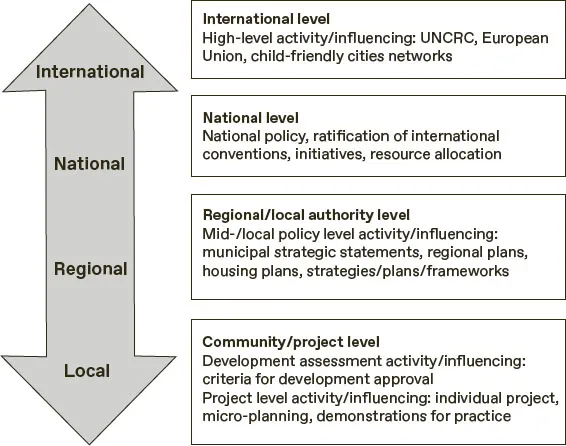
Planners, together with a wide range of agencies, professionals and individuals act as ‘space shapers’, whose practices ‘shape’ the lives of children and their communities. Planners work in a wide range of organisations and take on an extensive variety of roles, depending on their place of work and their remit within the workplace. Planners work in consultancies, councils, governments (at all levels national to agency), organisations from national parks to housing agencies and urban design, in business, corporations, conservation agencies, Indigenous organisations, voluntary and charitable sectors to name a few. Among others they can work as service providers, development facilitators, financial providers, arbiters, community representatives, advisors on governance and data management, or regeneration consultants. In these roles a hierarchy of planning can be observed (Figure 1.1).
The highest level is the global level: UNCRC, child-friendly cities networks, international organisations such as UNICEF and other multi-national initiatives. These provide global direction and support for national to local governments right down to the project level. Information and guidance emanating at the international level provides not only support (in the case of UNCRC international support), for planners but also examples of ways planners can respond to children’s concerns through exemplars on project design and implementation.
Figure 1.1
The planning hierarchy
Planners feed into these development levels and initiatives by sifting, extending, coordinating and mediating the vast range of actions, agencies, professions, organisations and individuals whose actions both enable and obstruct the creation of child supportive environments. For planners it is especially important that there are also supportive national and local policies and the resources necessary to respond effectively. Good planning cannot be done without resources (including staffing, finance, expertise, and time).
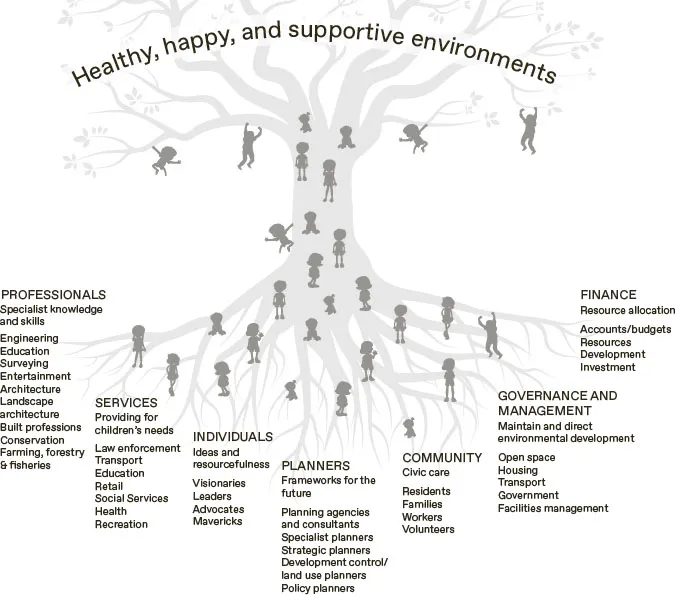
Children, and indeed society’s, development requires coordinated action from all and this coordination is perhaps the planner’s greatest contribution. The planners’ tree (Figure 1.2) reflects the integrated roles of all those, including planners, whose actions influence and feed (through the roots) into children’s life spaces (the trunk and branches) allowing children and their communities in turn to experience and facilitate the development of happy, healthy societies (the treetop). The fundamental message from this ‘tree’ is that for planning to be in children’s best interests planners should not and cannot work alone. Planners may have the will but they often lack the knowledge, resources, skills and importantly the time to devote to children’s environments, the only way they can make things work is by working with and through the resources and expertise available in society.
Figure 1.2
The planners’ tree
Planning and planners matter
As key players in local government and as influential decision-makers, planners shape the environments in which children live. The quality of these environments will determine the health and wellbeing of children today and their futures. Children have never been a major concern of planners and ‘while there are examples of the inclusion of children in urban planning and design, these remain isolated cases’ (Simpson, 1997, p.923). There is some evidence that planners have since responded to the challenges identified by Simpson and to the requirements of the UNCRC but arguably at a low level and in an ad hoc manner.
Just as planning has embraced the need to plan for people with disabilities, for multi-cultural communities and to provide for ageing populations, so too do planners need to recognise children as a group for whom planners have special responsibility. The challenges facing planners seem to be universal. Even in Sweden, where children have a strong position in society, children’s planning needs remain unmet. Interviews with planning professionals attending the annual meeting of ‘Children, Young People and the Built Environment’,1 found that children in Sweden: ‘are excluded from planning processes due to the rigidity of the planning process, neoliberal influences and planners’ lack of competence’ (Cele and Van der Burgt, 2015, p.14). Inclusive planning for children continues to be challenging.
There are two main areas of work where planners can and should be involved with children. The first is in developing processes that reflect on and respond to children’s needs. To do so will mean at a minimum consulting children and, in an ideal scenario, working with children to co-produce and co-develop their communities and the worlds they live in. The second is to consider children’s needs in all areas of planner’s work. A prime advocate for better city planning is the UNICEF Child Friendly Cities Initiative (CFCI). The Child Friendly Cities Initiative is:
About supporting all children to flourish and helping them engage actively with their communities. It is about valuing children, here and now, and working in partnership with communities to support and protect the most vulnerable children.
(UNICEF, n.d.)
It identifies child-friendly cities and communities as places where children can:
- Influence decisions about their city or community.
- Express their opinions on their city or community.
- Participate in family, cultural, city or community and social life.
- Experience quality, inclusive and participatory services.
- Be safe and protected from exploitation, violence and abuse.
- Meet friends and have places and spaces to play and enjoy themselves.
- Have green spaces for plants and animals.
- Live in a clean, unpolluted environment.
The principles reflected in this initiative also indicate good planning practice for working not only with children, but the wider population as well, and for working not just in cities, but in all environments where children live. Similarly, the key principles identified elsewhere in the UNICEF initiative are again cornerstone principles for good planning, namely: dignity, interdependence and indivisibility, best interests, participation, non-discrimination, transparency and accountability, life, survival and development. An initiative such as UNICEF’s provides valuable support for local government and excellent exemplars of good practice in a myriad of cultural, geographic, political and economic circumstances. In 2018, UNICEF published a guide directly aimed at planners indicating recognition of the importance of planners in determining children’s wellbeing: Shaping Urbanization for Children: A Handbook on Child-Responsive Urban Planning (UNICEF, 2018b). A similarly planning oriented study was the Arup production Cities Alive: Designing for Urban Childhoods (2017). In opening the study the Director, Global Planning and Cities leader, Jerome Frost explains: ‘The choices we make in the built environment can help to ensure children are given respect, fair treatment, a healthy life and the best chances of tackling the challenges of tomorrow. By highlighting children’s needs, we will be helping to solve other urban challenges, leading to cities that are better for everyone’ (Arup, 2017, p.7). In the report they identify seven key messages for child-friendly urban planning. These are:
1The quality of life experienced by urban populations, and particularly by children, will determine our global future.
2Child-friendly urban planning is a vital part of creating inclusive cities that work better for everyone.
3Focusing on the needs of children can help act as a unifying theme for the promotion of progressive ideas and ambitious actions.
4Children’s infrastructure can help to enhance the economic value and long-term viability of the urban environment.
5Providing multi-functional, playable space – beyond the playground – can enable everyday freedoms and create a public realm for all ages to enjoy together.
6Interventions at the neighbourhood scale offer the greatest potential to create a children’s infrastructure network that allows safe and enjoyable journeys.
7Decision makers should be opportunistic and strategic, and integrate child-friendly thinking into all aspects of city making.
Planners are inevitably an integral contributor to the success and outcomes of these type of initiatives. This centrality in some ways makes it difficult to understand why it is that despite the many and significant strides that planners have made, especially in the field of public participation, planners still largely feel insufficiently skilled in dealing with children? Also why are there still only...