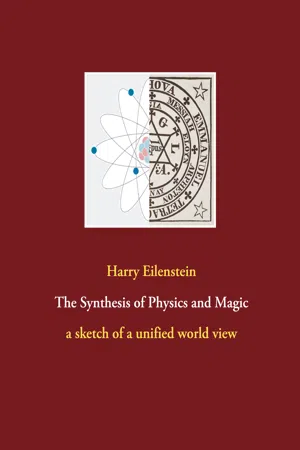
First of all, physics and magic are two completely different worldviews: - Physics looks at evolution along the time-ray and finds quantitative correlations - magic looks at simultaneities and finds qualitative correlations. - Physics considers quantity-equalities and finds formulas by it - magic considers quality-equalities and finds analogies by it. - Physics considers the multiplicity of the world and finds the perfect determinacy of all outer events - magic considers the unity of consciousness and finds therefore the freedom of all inner actions. You cannot explain one worldview with the other, but you can combine the two into a more comprehensive worldview. If one compares the structures in both worldviews, one finds a very broad correspondence: - Both the angles in physics and the angles in astrology have the same qualities. - Both the superstring and the zodiac are a twelve-divided circle. - Both the superstring theory and the Kabbalistic Tree of Life have eleven areas with the same quality. - Both the solar circumference and the chakra system have the same structure. From these and some other building blocks the detailed sketch of a unified magical-physical world view can be put together.
The previous considerations were mainly concerned with the relationship between consciousness and matter – simply because magic means, among other things, that physical effects can be triggered by consciousness. Moreover, the consciousness/ matter duality is one of the greatest mysteries in our world.
Next, in this chapter, the differences and equalities of consciousness and matter will now be examined and described in more detail. This will also make the transitional area between the two clearer.
III Analogy and Mathematics
The most important tool of physics is mathematics. The most important tool of magic is analogy.
These two tools are different – and also the point of view, under which they regard the world, is different. Therefore also the results of these two points of view should be different – even if the same world is regarded.
From this it follows, among other things, that one cannot explain magic with physics and likewise that one cannot explain physics with magic. But one can combine both views to a more complete picture, since they both describe the same world.
III 1. Quantity and Quality
The most important tool of physics and the natural sciences in general is mathematics. It compares quantities, that is, quantities of the same things.
The most important tool of magic and also of astrology and all other oracles and omens is analogy. By it qualities are compared.
Since magic stands between the completely free consciousness (inside) and the completely determined matter (outside), magic should be creative, thus have access at the same time to the freedom as well as to the impressed forms of the outer world.
To this it fits well that magic deals with qualities and not with determined quantities or with the completely unstructured and therefore free unity.
The qualities of magic contain both freedom and determination. These two things combined together yield creativity.
III 2. Quantity-equality and Quality-equality
Mathematics as the most important scientific tool considers quantity-equalities. Equations like "2+2=4" mean that there are equal quantities to the left and right of the equal sign. The symbol "=" indicates, like a scale, that there is the same quantity to the left and to the right of this sign.
It also means that there are the same units to the left and right of the "=". The equation "2apples + 2apples = 4apples" is correct; the equation "2apples + 2pears = 4apples", on the other hand, is incorrect; the equation "2apples + 2pears = 4fruits", on the other hand, is again correct. So in a mathematical equation, quantities are compared within the same thing – that thing is the quality of what is counted in that equation.
In a mathematical equation only one quality like "apples" is considered – but mostly these are only very general qualities like the weight or the length or the duration.
Of course there are also more complex equations like "2m · 2m = 4m2" or "force = mass · acceleration", so e.g. "8N = 2kg · 4m/sec2". In this kind of equation, the quality "N" (Newton) on the left side of the equation has been decomposed into "kg·m/sec2" on the right side. Nevertheless, there are forces on both sides – the force has only been broken down into the components that make it up on the right side of the equation.
This principle "in every equation there is the same unit/quality on the left side and on the right side" is also valid for very complex equations or for equations which show rather unexpected relations like e.g. "E = m·c2".
Mathematical equations thus always consider only one quality – but they describe precisely the quantity relations within this one quality.
The analogies used in magic and astrology describe qualities, but not quantities. For example, in astrology the following things correspond to Mars: in the body the muscles, in the psyche the aggression, in the objects the weapons, in the professions the soldier, in the state the military, in the chemical elements the iron and so on.
By analogies the element with the same quality can be found in different fields. It is also possible to represent this connection like an equation: "muscles
weapons".
In contrast to mathematics, where on the left side and on the right side of the "=" are equal quantities, on the left side and on the right side of the analogy sign "
" are equal qualities.
Since these "magic equations" refer in each case to a certain quality, one can furthermore attach the quality in this analogy to the "
" symbol. This looks then as follows: "muscles
Mars weapons".
This analogy equation can of course be even more complex and include several things: "muscles
Mars weapons
Mars iron
Mars warrior".
So it is obvious that both in natural sciences and in magic, equations are used to describe the world: In the natural sciences these are quantity equations – in magic these are quality equations.
III 3. The View of Analogy
Analogies have a great variety and many different possible applications.
III 3. a) The Analogy Grid
The analogy mostly uses a grid of qualities to determine in which place, in which "compartment", in which "drawer" in such a grid the thing under consideration belongs. Some of these grids can also be called "matrix" or "mandala".
Some of such quality systems are:
the 2 primordial opposites Yin and Yang (China),
the 2 primordial opposites fire and ice (Germanic),
the 2 primordial opposites water and earth (Mesopotamia, Egypt),
the 2 primordial opposites Sulphur and Mercurius (Alchemy),
the 4 elements (= fire, water, air, earth),
the 5 elements (= 4 elements plus the quintessence),
the 5 Chinese elements (= fire, water, wood, metal, earth)
the 7 main chakras,
the 8 trigrams (I Ching),
the 10 planets,
the 12 signs of the zodiac,
the 40 elements of the Kabbalistic Tree of Life,
the 64 hexagrams of the I Ching,
the 78 Tarot cards,
the 256 domains of the West African Ifa Oracle, etc.
Such systems have the advantage that one can practice to assign all things and events e.g. to one of the four elements or the quintessence. Thus, after a while, one is able to recognize the elemental affiliation and thus the quality of a thing quite quickly.
All these systems are complete pictures of the world – they represent the world as a complete group of qualities.
One can distinguish three types of analogy grids:
One can think of these kinds of grids as a complete matrix. Some of them are also ordered like a matrix, i.e. they can be represented as a square grid in which all things in the same column or in the same row have a common quality. Thus, the 64 hexagrams of the I Ching form a square of 8·8=64 squares. The Ifa oracle, on the other hand, forms a square of 16·16=256 squares.
Others of these grids are mandalas. Thus, the four elements form the four sides of a square or circle, in the center of which is the quintessence. In the zodiac, the twelve zodiac qualities form a circle, in the center of which is the sun, i.e. the quality of the center. In both cases, the center (quintessence, sun) is also a symbol of consciousness and of the soul, that is, of the next higher level and, therefore, of the origin ...
Table of contents
Table of Contents
A. Consciousness
B. Structures and Dynamics
C. A New View
List of Books
Copyright
Trusted by 375,005 students
Access to over 1.5 million titles for a fair monthly price.
Study more efficiently using our study tools.
Frequently asked questions
Yes, you can cancel anytime from the Subscription tab in your account settings on the Perlego website. Your subscription will stay active until the end of your current billing period. Learn how to cancel your subscription
No, books cannot be downloaded as external files, such as PDFs, for use outside of Perlego. However, you can download books within the Perlego app for offline reading on mobile or tablet. Learn how to download books offline
We are an online textbook subscription service, where you can get access to an entire online library for less than the price of a single book per month. With over 1.5 million books across 990+ topics, we’ve got you covered! Learn about our mission
Look out for the read-aloud symbol on your next book to see if you can listen to it. The read-aloud tool reads text aloud for you, highlighting the text as it is being read. You can pause it, speed it up and slow it down. Learn more about Read Aloud
Yes! You can use the Perlego app on both iOS and Android devices to read anytime, anywhere — even offline. Perfect for commutes or when you’re on the go. Please note we cannot support devices running on iOS 13 and Android 7 or earlier. Learn more about using the app
Yes, you can access The Synthesis of Physics and Magic by Harry Eilenstein in PDF and/or ePUB format, as well as other popular books in Philosophy & Philosophy History & Theory. We have over 1.5 million books available in our catalogue for you to explore.