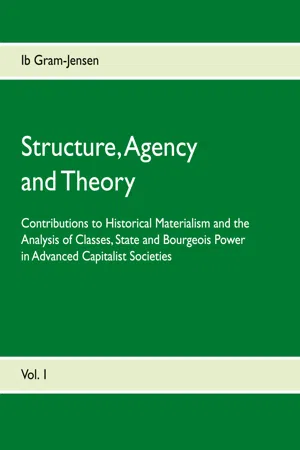
"Structure, Agency and Theory" challenges common readings of Marx' and Engels' historical materialism and argues the necessity of abandoning their conception of the dialectic of forces and relations of production as the motive power of historical development and transformations because of its doubtful validity and deterministic implications. Instead another fundamental conception in historical materialism, the interaction between social circumstances and agency as the motive power of history, is accentuated with an emphasis on agents' experiences as a causal factor, arguing its potential in terms of historical explanation, and attempting to spell out some of its strategic implications for revolutionary socialism.
eBook - ePub
Structure, Agency and Theory
Contributions to Historical Materialism and the Analysis of Classes, State and Bourgeois Power in Advanced Capitalist Societies
- 524 pages
- English
- ePUB (mobile friendly)
- Available on iOS & Android
eBook - ePub
Structure, Agency and Theory
Contributions to Historical Materialism and the Analysis of Classes, State and Bourgeois Power in Advanced Capitalist Societies
About this book
Information
Society.
1. The Marxist Debate on the State from the 60s to the
80s: Derivation and Structural Causality.
a. State Derivation.
The approach of state derivation [Staatsableitung] had a noticeable impact in the Federal Republic of Germany and Denmark during the 1970s. It never gained much ground in the Anglo-Saxon countries, but is still worth examining: the functionalist-teleological and formalist tendencies common to “Al-thusserian structuralism” and state derivation – different as they are in other respects – stand out with particular clarity in the latter, which is succinctly defined by Flatow & Huisken:
To satisfy the requirements of a “derivation” of the separate form of the bourgeois state from the concept of capital [der Besonderheiten des bürgerlichen Staates aus dem Begriff des Kapitals] (“Capital”, vols. 1-3) means to determine the systematic context from which this “political” sphere arises from the “economic” forms [.....], and to demonstrate the necessity of the development of that form of the bourgeois state which has hitherto been described as the particularisation [Besonderung] of the bourgeois state or as the doubling of bourgeois society into civil society and state [.....].50
Before going into the methodological implications of this, it is useful to examine the state derivation of Blanke, Jürgens & Kastendiek51 which explicitly deals with the problem of the relationship between such derivation and historical analysis. Here the state is derived “as a necessary form in the reproduction of society itself”52 from the analytical starting-point of simple commodity production.53 Arguing that a separate instance is necessary to guarantee the freedom and equality of commodity producers entering into exchange relations, Blanke, Jürgens & Kastendiek arrive at the general form of the state being an extra-economic force basing its actions on the specific monetary and/or legal form of social relations or creating such relations for the purpose of its interventions. Proceeding to a consideration of capitalist relations of production, where labour-power is exchanged as a commodity,54 they conclude that the state protects the rights of both capitalists and workers insofar as they exchange commodities, i.e. sell and buy labour-power, the labour-capital relation being upheld exactly by this “neutral” mode of intervention.55
Having derived the form of state, Blanke, Jürgens & Kastendiek address the problem of “system-limit” and “limit of activity”.56 The point is that while the “system-limit” to the range and modes of state action follows from the derivation, historical conditions – such as the struggles of the working class – for its concrete actions do not. Empirical analysis is, therefore, irreducible to derivation.57 However, their discussion of the “limit of activity” reveals contradictions that may be summed up as follows:
- As we shall see, the starting point of simple commodity production is legitimate on the methodological assumptions of the logic-of-capital trend in Marxism. But it involves a problem inasmuch as the form of state is derived before considering the capitalist mode of production. Thus Jürgens, Blanke & Kastendiek beg the question whether the specific nature of capitalism calls for a specific concept of the state rather than relating the state as derived from simple commodity production to it.
- According to the derivation state interventions must be based on the monetary and/or legal form. Consequently, the facts of extralegal interventions and state enterprises cannot be accounted for.58
- According to the derivation the state protects the rights of sellers of labour-power as well as those of capitalists.59 Turning to the analysis of “system-limit” and “limit of activity”, Blanke, Jürgens & Kastendiek nevertheless argue that the state does intervene in the sphere of private property, e.g. by suspending the right of workers to sell their-labour power at the best price obtainable.60 Whatever the merits of their discussion on the conditions for state interventions in this field it flatly contradicts the derivation of the supposedly necessary form of the state. In other words, the two components of the analysis, one derived one not, tend to fall apart.
- The idea of combining derivation and empirical analysis implies a paradox. For if derivation is the guarantee that concepts are valid, how can empirical analysis (involving concepts that are not derived) be methodologically legitimate? And if it is legitimate, why is derivation necessary in the first place?
To work out the implications of this paradox it is necessary to look into the methodological tenets underlying the maxim of state derivation. Ultimately this maxim rests on the conception of the logic of capital as no mere formal but rather a real logic [Reallogik]. That is, a logic that does not merely guide the analysis of social phenomena, but rules their very development. According to this notion the task of science is to reconstruct the stages of that movement of the real in theory and present them as produced by the logic, i.e. in their necessary sequence, in the Darstellung (exposition, representation). This is to be discerned from the process of research by means of which the conceptual point of departure of the Darstellung is found: significantly the exact nature of this research remains obscure.
The most prominent Danish protagonist of the logic-of-capital trend, Hans-Jørgen Schanz,61 explicitly endorses this idea, stating that if theory is to grasp the real political economy of society, it cannot be based on concepts that are not “the abstract determinations of and in the real object itself.”62 This distinction between real and formal abstractions63 obviously implies that the object of theory is moved by a logic pushing its development in a definite direction, the abstractions/concepts being actual forms brought into being in the course of this process because necessary to its progressive unfolding. Schanz argues that such a motive power of history is indeed established by the introduction of commodity exchange and the consequent establishment of exchange value as a functioning social determinant.64 He expounds the nature of the logic ruling history by analysing, among other things, the necessity of the appearance, as exchange value, of the abstract human labour embodied in a commodity.65
A single commodity, when seen in isolation, embodies value (abstract human labour), but only latently. The exchange of commodities, however, implies that they have something in common which makes them commensurable. This, identical quantities of which must be exchanged, cannot be use value (concrete human labour), as the exchange only makes sense if the use values concerned are dissimilar. What is common and regulates the proportions of use values exchanged must, therefore, be abstract human labour, value. “Thus, we have seen that the abstract contradiction which was implied by the commodity-producing labour and only allowed value to exist latently now, through reflection in another commodity, finds a form in which it can express itself”.66
What kind of real logic does this reasoning imply? It only makes sense on the assumption that the Reallogik is an intentional logic. One cannot argue that exchange value is explained by the fact that value needs it in order to appear, unless one takes it that the logic ruling the real development of the concept aims at this appearance (as a necessary stage in the development of capital). The words just quoted from Schanz might, as they stand, be read as a statement (put in somewhat metaphorical words) that value does “express itself”, or surface, if and when commodities are exchanged – and otherwise not. But such a statement would obviously not explain why commodity exchange, or any other social phenomenon, actually arises in history; it would merely describe one of its effects. Schanz does, indeed, state that the logic expounded in his analysis carries the direction of development latently within itself and is thus intentional in its form of development;67 this contention he supports with the argument that,
[.....]. The analysis of the commodity demonstrates – in the problematic of the value-form – that a logic bearing the hallmarks of the subject-form is in fact constituted here [.....] after which the (to be sure unconscious) form of intention can no longer be regarded as something external or alien.68
From this it is evident that the whole argument for the validity of the reconstruction of the logic of capital in the Darstellung is circular: the Darstellung is supposed to demonstrate that the logic is intentional, but only makes sense itself on the assumption that the logic is intentional, which hence forms the necessary basis of the argument for its own validity.69
On similar grounds the notion of real abstractions must be rejected. Schanz states that these abstractions do not appear in the Darstellung as the immediate products of the real movement itself: the Darstellung is a reconstruction, in the medium of thought, of the real movement, whereas the logic of the two is supposed to be the same.70 But this amounts to saying that these abstractions are real insofar as they correspond to determinants active in reality. As reality cannot be grasped except by way of reconstructing it in thought, the Darstellung cannot serve as an independent measure of the validity of the concepts it expounds, and by which it is ruled itself.71 Thus the distinction between real and formal abstractions collapses, as the special relationship of the former to reality turns out to be impossi...
Table of contents
- Dedication
- Table of Contents
- Preface
- Introduction
- Part One: Questioning the Capitalist State and Society
- Part Two: Agency, Structure and Classes in Advanced Capitalist Societies
- Copyright
Trusted by 375,005 students
Access to over 1.5 million titles for a fair monthly price.
Study more efficiently using our study tools.
Frequently asked questions
Yes, you can cancel anytime from the Subscription tab in your account settings on the Perlego website. Your subscription will stay active until the end of your current billing period. Learn how to cancel your subscription
No, books cannot be downloaded as external files, such as PDFs, for use outside of Perlego. However, you can download books within the Perlego app for offline reading on mobile or tablet. Learn how to download books offline
Perlego offers two plans: Essential and Complete
- Essential is ideal for learners and professionals who enjoy exploring a wide range of subjects. Access the Essential Library with 800,000+ trusted titles and best-sellers across business, personal growth, and the humanities. Includes unlimited reading time and Standard Read Aloud voice.
- Complete: Perfect for advanced learners and researchers needing full, unrestricted access. Unlock 1.5M+ books across hundreds of subjects, including academic and specialized titles. The Complete Plan also includes advanced features like Premium Read Aloud and Research Assistant.
We are an online textbook subscription service, where you can get access to an entire online library for less than the price of a single book per month. With over 1.5 million books across 990+ topics, we’ve got you covered! Learn about our mission
Look out for the read-aloud symbol on your next book to see if you can listen to it. The read-aloud tool reads text aloud for you, highlighting the text as it is being read. You can pause it, speed it up and slow it down. Learn more about Read Aloud
Yes! You can use the Perlego app on both iOS and Android devices to read anytime, anywhere — even offline. Perfect for commutes or when you’re on the go.
Please note we cannot support devices running on iOS 13 and Android 7 or earlier. Learn more about using the app
Please note we cannot support devices running on iOS 13 and Android 7 or earlier. Learn more about using the app
Yes, you can access Structure, Agency and Theory by Ib Gram-Jensen in PDF and/or ePUB format, as well as other popular books in Business & Business General. We have over 1.5 million books available in our catalogue for you to explore.