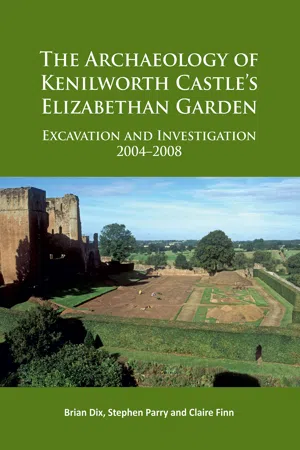
As part of the Property Development Programme for Kenilworth Castle in Warwickshire, English Heritage created an ambitious reconstruction of the Elizabethan garden which formerly stood on the north side of the castle keep. In order to achieve a reliable representation of the original garden, a programme of archaeological trenching, open area excavation and watching brief was carried out by Northamptonshire Archaeology (now MOLA) from 2004 to 2008.This report discusses the results of the excavations which uncovered for the first time the foundation and culverts of an octagonal fountain basin, described by Robert Langham in a contemporary letter relating to Queen Elizabeth I's visit in 1575. The results of the excavation also clarified to some extent the original dimensions of the garden and the foundation level upon which the fine surfacing detail would have been applied. Contributions to understanding the geometry of the garden's architectural features are made by the identification of a series of rubble-and-mortar-filled pits, which probably formed bases for plinths for structures or other structural elements. The terrace which formed a viewing promenade over the garden was shown to have undergone substantial alteration. The impact of Civil War defences and slighting on the north of the keep and outer bailey wall were investigated. Following this, the area was subsequently cultivated as a kitchen garden and orchard from at least the beginning of the eighteenth century. Twentieth-century activity included consolidation of the castle fabric, the construction of paths and the remodelling of the terrace, and the remains of an ornamental knotwork garden created in 1975. The archaeology of the garden and its surroundings are discussed from the remnants of medieval features through to the present day.
eBook - PDF
The Archaeology of Kenilworth Castle's Elizabethan Garden
Excavation and Investigation 2004–2008
- 90 pages
- English
- PDF
- Available on iOS & Android
eBook - PDF
The Archaeology of Kenilworth Castle's Elizabethan Garden
Excavation and Investigation 2004–2008
About this book
Information
Topic
Sciences socialesSubtopic
ArchéologieTable of contents
- Cover
- Title Page
- Copyright Page
- Contents
- List of Figures
- List of Tables
- Contributors
- Acknowledgements
- 1. Introduction
- Figure 1.1 Site location
- 2. Background
- Figure 2.1 Kenilworth Castle layout, with area of investigation marked
- Figure 2.2 View of Leicester’s gatehouse, converted to a residence after the Civil War, looking north-west
- Figure 2.3 Detail of 1817-engraving of the Newnham Paddox fresco (c1620)
- Figure 2.4 Plan made for Sir William Dugdale, published in 1656 as part of his Antiquities of Warwickshire Illustrated
- Figure 2.5 Detail of an undated engraving, c1820, of the keep with slighting debris spilling into the garden area at right
- Figure 2.6 Undated aerial view of Kenilworth Castle from the west, probably late 1960s
- 3. Aims, Objectives and Methodology
- Figure 3.1 2005 excavation looking west from the gatehouse roof
- Figure 3.2 2006 excavation looking west from the gatehouse roof
- Figure 3.4 View of the slighted north side of the keep overlooking the 1975-garden, taken in 2005.
- The Excavated Evidence
- 4. The medieval castle (1120-1563)
- Figure 4.1 General plan of excavated features
- Figure 4.2 Medieval features
- Figure 4.3 The north curtain wall
- Figure 4.4 Trench 9, plan and sections
- Figure 4.5 The north curtain wall and the postern tower, Trench 11
- Figure 4.6 Medieval drain
- Figure 4.7 Medieval cesspit, section
- Figure 4.8 Medieval cesspit, view looking west
- 5. The Elizabethan garden (1563-1605)
- Figure 5.1 Elizabethan and other early garden features
- Figure 5.2 Plan and section of the fountain foundation, culverts and adjoining pit
- Figure 5.3 The fountain foundations, looking west
- Figure 5.4 The fountain foundations, looking south to forebuilding
- Figure 5.5 Western culvert 562, looking east
- Figure 5.6 Elizabethan stone and tile-filled pits
- Figure 5.7 Tile-filled pit 5108
- Figure 5.8 Sandstone and mortar base 5362
- Figure 5.9 Trench 6, dogleg section of wall
- 6. Seventeenth-century developments and subsequent slighting (1605-1650)
- Figure 6.1 Sixteenth or seventeenth-century drain, plan and section
- Figure 6.2 Seventeenth-century and Civil War features
- Figure 6.3 Civil War ditch, Trench 1 sections
- Figure 6.4 Isometric view of the survival of the ditches and terraces
- 7. Late seventeenth-century abandonment and the later orchard and kitchen garden
- Figure 7.1 Post-Civil War features
- Figure 7.2 Copy of garden survey drawn by M. W. Thompson, c1968
- Figure 7.3 Nineteenth-century horse burial
- Figure 7.4 Trenches 8 and 10, sections
- Figure 7.5 Sandstone stairs and landings leading from the forebuilding arch
- Figure 7.6 The forebuilding stairs
- Figure 7.7 1975-garden layout features
- Figure 7.8 The 1975garden photographed in 2005, looking north from the forebuilding
- Figure 7.9 Bedding trenches for 1975 box hedging, scale rod in 50cm divisions
- The finds, faunal and environmental evidence
- 8. The pottery
- Table 8.1 Pottery fabrics
- Figure 8.1 North Italian Sgraffito Ware
- Table 8.2 Ceramic Phase (CP) chronology, with pottery occurrence by ceramic phase
- Figure 8.2 Jar rim, Warwick Sandy Ware (12th–13th centuries)
- Table 8.3 Pottery occurrence by fabric type (major wares) by ceramic phase
- Figure 8.3 Tankard body and upper part of the handle, White Stoneware
- 9. Other finds
- Table 9.1 Individual other finds quantified by material
- Table 9.2 Catalogue of coins (compiled by Dr Mark Curteis)
- Figure 9.1 Other finds
- Figure 9.2 Lead pipe fragment, found ex situ in the fountain foundations
- Figure 9.3 X-ray of armour plate, iron
- Figure 9.4 Plaster of Paris angel figurine
- Table 9.3 Catalogue of selected finds
- Table 9.4 Clay tobacco-pipes by context
- Figure 9.5 Fragment of leaded window
- Table 9.5 Glass by trench and weight (g)
- 10. Ceramic building materials
- Table 10.1 Ceramic roof tile by period
- 11. The worked stone
- Figure 11.1 T1001: base of three shafts, early fourteenth century
- Figure 11.2 Stone baluster T1002 (left), and upper baluster found previously (right)
- Figure 11.3 T1006: possible twelfth or thirteenth-century step
- Figure 11.4 Voussoir stone T1007 reused in wall 602; cf. Fig 5.9
- Figure 11.5 T1009: fourteenth-century fluted shaft
- Table 11.1 Worked stone
- 12. The animal bones
- Table 12.1 Total number of animal bone fragments per species
- Table 12.2 Ageing of species by tooth wear (Grant 1982)
- Table 12.3 Definitions of dental eruption and attrition stages used in analysis of age at death.
- 13. Environmental evidence
- 14. Conclusions
- Bibliography
Trusted by 375,005 students
Access to over 1.5 million titles for a fair monthly price.
Study more efficiently using our study tools.
Frequently asked questions
Yes, you can cancel anytime from the Subscription tab in your account settings on the Perlego website. Your subscription will stay active until the end of your current billing period. Learn how to cancel your subscription
No, books cannot be downloaded as external files, such as PDFs, for use outside of Perlego. However, you can download books within the Perlego app for offline reading on mobile or tablet. Learn how to download books offline
Perlego offers two plans: Essential and Complete
- Essential is ideal for learners and professionals who enjoy exploring a wide range of subjects. Access the Essential Library with 800,000+ trusted titles and best-sellers across business, personal growth, and the humanities. Includes unlimited reading time and Standard Read Aloud voice.
- Complete: Perfect for advanced learners and researchers needing full, unrestricted access. Unlock 1.5M+ books across hundreds of subjects, including academic and specialized titles. The Complete Plan also includes advanced features like Premium Read Aloud and Research Assistant.
We are an online textbook subscription service, where you can get access to an entire online library for less than the price of a single book per month. With over 1.5 million books across 990+ topics, we’ve got you covered! Learn about our mission
Look out for the read-aloud symbol on your next book to see if you can listen to it. The read-aloud tool reads text aloud for you, highlighting the text as it is being read. You can pause it, speed it up and slow it down. Learn more about Read Aloud
Yes! You can use the Perlego app on both iOS and Android devices to read anytime, anywhere — even offline. Perfect for commutes or when you’re on the go.
Please note we cannot support devices running on iOS 13 and Android 7 or earlier. Learn more about using the app
Please note we cannot support devices running on iOS 13 and Android 7 or earlier. Learn more about using the app
Yes, you can access The Archaeology of Kenilworth Castle's Elizabethan Garden by Brian Dix,Stephen Parry,Claire Finn in PDF and/or ePUB format, as well as other popular books in Sciences sociales & Archéologie. We have over 1.5 million books available in our catalogue for you to explore.