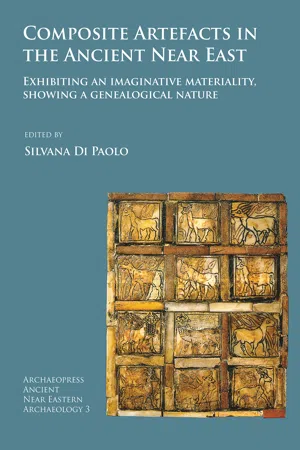
Composite Artefacts in the Ancient Near East: Exhibiting an imaginative materiality, showing a genealogical nature examines the complex relationship between environment, materials, society and materiality with particular reference to the composite artefacts in the ancient Near East. On the one hand are the objective and natural attributes of materials, possibly exalted from their transformation: a form of fascination immanent in all kind of technical activity which promotes the transition from the ordinary into an 'extra-ordinary' realm, imbuing the object with new meaning. On the other hand is the idea that properties of materials are not fixed attributes of 'matters', but are processual as well as relational: the qualities of artefacts are subjective and are included in the worldview of artisans making them, as well as in the mind of who observes who appreciate them. Thus, the craftsmanship is oriented towards the achievement of sophisticated products through assemblage techniques and the blending of contrasting properties and qualities of materials. The term 'composite' is a combination of the power of technology and the ability to form new images: the strict relationship between creativity, technology and manufacture produces novel interactions and solutions.
Although the primary concern of this volume is to provide specific case studies in which theoretical assumptions and hypotheses can be applied to the ancient evidence, most of the papers take not only the general perspective, such as the relationship between materials and humans, but also a defined body of evidence – material, textual and visual through which they address the issue. This volume represents a first attempt to conceptualise the construction and use of composite artefacts: the richness of approaches, the development of new issues depending on specific case studies, and the overturning of widely accepted ideas, show the interest towards this category of objects and the opportunity to enlarge this field study in the future.
eBook - PDF
Composite Artefacts in the Ancient Near East
Exhibiting an imaginative materiality, showing a genealogical nature
- 107 pages
- English
- PDF
- Available on iOS & Android
eBook - PDF
Composite Artefacts in the Ancient Near East
Exhibiting an imaginative materiality, showing a genealogical nature
About this book
Information
Table of contents
- Cover
- Copyright Page
- Content s Page
- List of Figures
- Contributors
- Introduction New Lines of Enquiry for Composite Artefacts?
- Section 1.
- The Planning: Materiality and Imagination
- From Hidden to Visible
- Figure 1. Remains of a wooden column decorated with bronze bands on the floor of the entrance to the Shamash Temple. (Loud 1936: 104, fig. 111).
- Figure 2. Gold applique probably intended for recycling from the Room R409, Stratum IIIc (Assyrian Trade Colonies) at Kaman-Kalehöyük (Omura 2015: 11, Fig. 1).
- Figure 3. The Creative Process: Materiality, Memory and Imagination.
- Figure 4. Fragment of a soapstone vessel from the Temple of Inanna, Nippur (Level VIIB). Iraq Museum 66071 (Land 1985: 365, no. 55, fig. a p. 306).
- Figure 5. Imagination and Imagery: Theories.
- Figure 6. Composite lion-headed aigle from Mari. ‘Treasure of Ur’. Palace P-0. Third Quarter of 3rd Millennium BC. (Margueron 2004: 537, pl. 70).
- Figure 7. Detail of a gaming board from Ur. Tomb PG 580. (Hansen 1998, 60, fig. 6 below).
- A Composite Look at the Composite Wall Decorations
- Figure 1. Early Finding by Loftus (Loftus 1857: 188).
- Figure 2. Left: Mosaics in situ at Tell ‘Uqayr (Lloyd et al. 1943: pl. 8); top-right: Mosaics in situ by the Staircase Podium of the Rundpfeilerhalle at Uruk (van Ess 2013: 128); bottom-right: Bieberschwänze and plaster of the Steinstiftgebäude (van Ess
- Figure 3. Digital Three-Dimensional Reconstruction of the Pfeilerhalle (Eichmann 2013: 124).
- Figure 4. Plan of the Northern Pillar of the Pfeilerhalle (Brandes 1966: pl. 27).
- Figure 5. Example of Analogic Sound Wave and its Digital Conversion (Curnow and Curran 1987: 100).
- Composite animals in Mesopotamia as cultural symbols
- Shining, Contrasting, Enchanting:
- Figure 1a-b. a) Two drop-shaped pendants with variscite inlays, lapis lazuli bead between suspension loops only preserved in one case; b) rectangular object with lapis lazuli and asbestos-mineral inlays (all courtesy of the Qaṭna-Project, University of Tü
- Figure 2. a) Rosette with carnelian and lapis lazuli inlays; b) small rosettes with carnelian inlays; c) reconstruction of rosette and gold-discs ensemble, all found in close distance (all courtesy of the Qaṭna-Project, University of Tübingen; photos: K.
- Figure 3. a) Banded agate ‘eye-stone’ set in gold; b) ‘double-eye’ banded agate set in gold; c) two ‘double-eye’ jewels with glass inlays, interior filling not preserved; d) three roundels with concentric rings of carnelian inlays, filling material not
- Figure 4. a) Eye-like artefacts consisting of amber, lapis lazuli, variscite and gold strips; b) cross sections of two of the artefacts (both courtesy of the Qaṭna-Project, University of Tübingen; photos: K. Wita); c) schematic diagram of the human eye (W
- Entangled Relations over Geographical and Gendered Space:
- Figure 1 Map showing location of Hasanlu (base map Wikimedia Commons).
- Figure 2. Site plan of the Hasanlu IVb Citadel, showing location of bead storage (Courtesy of the Penn Museum).
- Figure 3. Graph showing frequency of occurrence of artefact types in women’s and men’s and women’s burials during Period IVb, ranked from left to right using a z-score calculation (graph by Paul Sanchez).
- Figure 4. Excavation photograph of Burial SK481, adult female, Operation VIF Burial 10 (Courtesy of the Penn Museum).
- Figure 5. Composite photograph of HAS64-193 (UM 65-31-113), based on photographs of artefacts in situ (composite by author, Courtesy of the Penn Museum).
- Figure 6. Beads, including Arcularia, from Middle Bronze Age Burial SK45-7, Hasanlu VIb, HAS 58-134 (UM59-4-78) (Courtesy of the Penn Museum).
- Figure 7. Object biography of beaded dress ornaments (adapted from Jennings 2014, Fig. 1).
- Figure 8. Excavation photograph of Burial SK 448, adult female, Operation VIC Burial 4 (Courtesy of the Penn Museum).
- Figure 9. Excavation drawing of Burial SK481, showing location of armor scale and arrangements of bead groups that accompanied it (Courtesy of the Penn Museum).
- Figure 10. Object biography of beaded composite ornaments featuring armor scales.
- Composing Figural Traditions in the Mesopotamian Temple
- Figure 1. Early Dynastic bull man (George Ortiz collection; photo by author).
- Figure 2. Tell Agrab, Shara Temple, Early Dynastic sculpture fragment of a male figure (Ag. 35:999, by permission of the Oriental Institute).
- Figure 3. Nippur, Inanna Temple VIIB, Early Dynastic statue of a standing female figure (7N-190, by permission of the Nippur Publication Project).
- Figure 4. Nippur, Inanna Temple VIIB, Early Dynastic statue of a standing female figure (7N-162, by permission of the Nippur Publication Project).
- Figure 5. Tell Asmar, Abu Temple, Early Dynastic statue of a standing male figure (As. 33:439, by permission of the Oriental Institute).
- Figure 6. Khafajah, Small Temple, Early Dynastic pendant of a human head (Kh V 24, by permission of the Oriental Institute).
- Figure 7. Old Babylonian baked clay sculpture of a female head (by permission of the Boston Museum of Fine Arts).
- Figure 8. Tell Agrab, Shara Temple, Early Dynastic pendant of a human foot with scorpion incised on sole of the foot (Ag. 35:708, by permission of the Oriental Institute).
- Figure 10. Nippur, Area WA, Kassite clay figurine (19N-142, by permission of the Nippur Publication Project).
- Polymaterism in Early Syrian Ebla
- Figure 1. Ebla, schematic plan of the Royal Palace G (© Missione Archeologica Italiana in Siria).
- Figure 2. Ebla, arm-rest, probably from a throne, wood and shell, c. 2300 BC, from the Royal Palace G, L.2601 (© Missione Archeologica Italiana in Siria).
- Figure 3. Ebla, wooden plank with two carved male heads, probably from a cupboard door, wood, from the Royal Palace G, L.2764 (© Missione Archeologica Italiana in Siria).
- Figure 4. Ebla, revetment of a foot, gold, ca. 2300 BC, Royal Palace G (© Missione Archeologica Italiana in Siria).
- Figure 5a. Ebla, the steps of the Ceremonial Staircase, ca. 2300 BC, Royal Palace G (© Missione Archeologica Italiana in Siria).
- Figure 5b. Ebla, entrance to the Administrative Quarter, with limestone threshold and wood and shell decoration, ca. 2300 BC, Royal Palace G, L.2875 (© Missione Archeologica Italiana in Siria).
- Figure 6. Ebla, three views of a segment of female hair-dress, steatite, ca. 2300 BC, Royal Palace G, L.2752, on the last step of the Monumental Stairway (© Missione Archeologica Italiana in Siria).
- Figure 10a. Ebla, reconstruction of a procession of officials from an inlaid wall panel, limestone and lapis lazuli, ca. 2300 BC, Royal Palace G (© Missione Archeologica Italiana in Siria).
- Figure 10b. Ebla, reconstruction of three front facing kings’ figures from inlaid wall panels, limestone, ca. 2300 BC, Royal Palace G (© Missione Archeologica Italiana in Siria).
- Figure 7a. Ebla, figure of standing leopard from a wall inlaid panel, limestone with lost inlays of different materials, ca. 200, Royal Palace G, L.2913 (© Missione Archeologica Italiana in Siria).
- Figure 7b. Ebla, figure of passing human-headed bull from an inlaid wall panel, limestone with lost inlay for the beard, ca. 200 BC, Royal Palace G, L.2913 (© Missione Archeologica Italiana in Siria).
- Figure 9. Ebla, fragments of bridles from wall inlays, lapis lazuli, ca. 2300 BC, Royal Palace G (© Missione Archeologica Italiana in Siria).
- Figure 11. Ebla, three rosettes from the decoration of inlaid wall panels, limestone, ca. 2300 BC, Royal Palace G (© Missione Archeologica Italiana in Siria).
- Figure 12. Ebla, three views of a composite female hair-dress, steatite, ca. 2300 BC, Royal Palace G, L.2862, at one side of the entrance to the Throne Room L.2866 (© Missione Archeologica Italiana in Siria).
- Figure 13. Ebla, fragments of a textile, or of the decoration of a textile, gold, ca. 2300 BC, Royal Palace G. L.8778 (© Missione Archeologica Italiana in Siria).
- Figure 14. Ebla, miniature figure of human-headed bull, possible from a standard, gold and steatite, ca. 2300 BC, Royal Palace G, L.2764 (© Missione Archeologica Italiana in Siria).
- Figure 15. Ebla, miniature figure of veiled woman probably from a standard, limestone, steatite and jasper, ca. 2300 BC, Royal Palace G, L.3600 (© Missione Archeologica Italiana in Siria).
- Figure 16. Ebla, reconstructive drawing of the maliktum’s standard, wood, steatite, limestone, gold, silver and jasper, ca. 230 BC, Royal Palace G, L.9330 (© Missione Archeologica Italiana in Siria).
- Figure 17. Ebla, miniature head of lion on a mobile support, wood and gold, ca. 2300 BC, Royal Palace G, L.2984 (© Missione Archeologica Italiana in Siria).
- Figure 18a. Ebla, wooden core of Tabur-Damu’s figure from the maliktum’s standard, showing the complete modelling of the face, ca. 2300 BC, Royal Palace G, L.9330 (© Missione Archeologica Italiana in Siria).
- Figure 18b. Ebla, arm of Tabur-Damu’s figure from the maliktum’s standard, showing the modelled wooden core and the thick silver coating, ca. 2300 BC, Royal Palace G, L.9330 (© Missione Archeologica Italiana in Siria).
- Figure 19a. Ebla, back part of the hair-dress of Tabur-Damu’s figure from the maliktum’s standard, steatite, ca. 2300 BC, Royal Palace G, L.9330 (© Missione Archeologica Italiana in Siria).
- Figure 19b. Ebla, lower edge of the hair-dress of Tabur-Damu’s figure from the maliktum’s standard, steatite, ca. 2300 BC, Royal Palace G, L.9330 (© Missione Archeologica Italiana in Siria).
- Figure 20. Ebla, drawing of the separate pieces composing Tabur-Damu’s figure from the maliktum’s standard, wood, steatite, silver and jasper, ca. 2300 BC, Royal Palace G, L.9330 (© Missione Archeologica Italiana in Siria).
- Figure 21. Ebla, dress of Dusigu’s figure from the maliktum’s standard, gold, ca. 2300 BC, Royal Palace G, L.9330 (© Missione Archeologica Italiana in Siria).
- Figure 22. Ebla, drawing of the separate pieces composing Dusigu’s figure from the maliktum’s standard, wood, steatite, gold, marble and jasper, ca. 2300 BC, Royal Palace G, L.9330 (© Missione Archeologica Italiana in Siria).
- Figure 23. Ebla, proposal of reconstruction of the en’s standard, steatite, gold, limestone, red stone and shell, ca. 2300 BC, Royal Palace G, L.2982 (© Missione Archeologica Italiana in Siria).
- Near Eastern Materials, Near Eastern Techniques, Near Eastern Inspiration:
- Figure 1. Loop pin from Enkomi Br. T. 19. Image AN46789001001 © The Trustees of the British Museum.
- Figure 2. Loop pin from Enkomi Br. T. 19. Image AN81529001001 © The Trustees of the British Museum.
- Figure 3. Composite artefact (pin?) from Enkomi O.T. 74. Image AN107732001001 © The Trustees of the British Museum.
- Figure 4. Ivory pomegranate from Enkomi (uncertain tomb). Image AN95238001001 © The Trustees of the British Museum.
- Figure 5. Necklace from the sanctuary at Arsos (detail). Photo by the author.
- Figure 6. Broad collar (usekh collar) from Enkomi Br. T. 93. Image AN51096001001 © The Trustees of the British Museum.
- Figures 7−8. Finger ring from Kouklia-Evreti T. VIII (upper surface/profile). Photos by the author.
- _GoBack
Trusted by 375,005 students
Access to over 1.5 million titles for a fair monthly price.
Study more efficiently using our study tools.
Frequently asked questions
Yes, you can cancel anytime from the Subscription tab in your account settings on the Perlego website. Your subscription will stay active until the end of your current billing period. Learn how to cancel your subscription
No, books cannot be downloaded as external files, such as PDFs, for use outside of Perlego. However, you can download books within the Perlego app for offline reading on mobile or tablet. Learn how to download books offline
Perlego offers two plans: Essential and Complete
- Essential is ideal for learners and professionals who enjoy exploring a wide range of subjects. Access the Essential Library with 800,000+ trusted titles and best-sellers across business, personal growth, and the humanities. Includes unlimited reading time and Standard Read Aloud voice.
- Complete: Perfect for advanced learners and researchers needing full, unrestricted access. Unlock 1.5M+ books across hundreds of subjects, including academic and specialized titles. The Complete Plan also includes advanced features like Premium Read Aloud and Research Assistant.
We are an online textbook subscription service, where you can get access to an entire online library for less than the price of a single book per month. With over 1.5 million books across 990+ topics, we’ve got you covered! Learn about our mission
Look out for the read-aloud symbol on your next book to see if you can listen to it. The read-aloud tool reads text aloud for you, highlighting the text as it is being read. You can pause it, speed it up and slow it down. Learn more about Read Aloud
Yes! You can use the Perlego app on both iOS and Android devices to read anytime, anywhere — even offline. Perfect for commutes or when you’re on the go.
Please note we cannot support devices running on iOS 13 and Android 7 or earlier. Learn more about using the app
Please note we cannot support devices running on iOS 13 and Android 7 or earlier. Learn more about using the app
Yes, you can access Composite Artefacts in the Ancient Near East by Silvana Di Paolo in PDF and/or ePUB format, as well as other popular books in Social Sciences & Archaeology. We have over 1.5 million books available in our catalogue for you to explore.