The flourishing civilisations of Mesopotamia, nowadays Iraq and Syria, imported all kinds of materials from the surrounding regions. Iron oxide rock (hematite, goethite and magnetite) was very popular for weight stones and cylinder seals around 2000 BC. This research aims to determine the region of origin for the raw material, what made people start using iron oxide rock, and what led them to stop using it. To answer these questions, a multidisciplinary approach was applied. Geology and archaeology were combined to identify Northern Syria as the region of origin. Archaeometric research of the production process showed that technological change concurred with the start and end of the use of iron oxide rock. Cuneiform texts yielded, among other information, the earliest description of magnetism known to mankind. Furthermore, element and mineral composition of 50 artefacts from three Dutch collections were determined with modern, non-destructive analysis techniques.
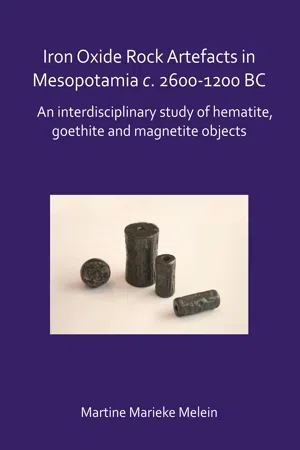
eBook - PDF
Iron Oxide Rock Artefacts in Mesopotamia c. 2600-1200 BC
An interdisciplinary study of hematite, goethite and magnetite objects
- 269 pages
- English
- PDF
- Available on iOS & Android
eBook - PDF
Iron Oxide Rock Artefacts in Mesopotamia c. 2600-1200 BC
An interdisciplinary study of hematite, goethite and magnetite objects
About this book
Information
Topic
Ciencias socialesSubtopic
ArqueologíaTable of contents
- Cover
- Title Page
- Copyright Page
- Contents
- List of Figures
- Figure 1.1: Area under study, with sites where iron oxide rock artefacts were found.
- Table 2.1: Terminology as used in the archaeological literature.
- Table 2.2: Iron oxides and oxide hydroxides. After Cornell and Schwertmann 1996, table 1.1.
- Table 2.3: Some mineralogical properties of hematite, goethite and magnetite. Based on Cornell and Schwertmann 1996.
- Figure 2.1: Example of clear carving: cylinder seal LB66 and its modern impression, height of the seal is 19mm.
- Figure 2.2: Colour variations in iron oxide rock artefacts; from left to right, top to bottom: half fabricate/ weight APM10960, goethite, 25*20mm; cylinder seal APM06370, hematite, 22*9mm; cylinder seal APM06361, hematite + calcite, 23*9mm; weight APM109
- Table 2.4: Comparison of streaks and neutron diffraction (ND) data. See Chapter 6.
- Figure 2.3: Iron oxide minerals compared to Mohs scale and tools to determine hardness.
- Table 2.5: Hardness of stones used for cylinder seals and beads before and during the 2nd mill. BC.
- Figure 2.4: Flowchart for recognizing iron oxide rock artefacts in the field.
- Table 2.6: Iron oxide rocks and ores containing hematite, goethite and/or magnetite, classified by origin. Based on Cornell and Schwertmann 1996, pp.348-393.
- Figure 2.5: Piece of iron oxide rock from the vicinity of Tell Bazi, Syria, where the iron precipitated in cavities in the limestone rock.
- Figure 2.6: Outcrops of iron oxide rock in horizontal layers in the limestone matrix (see arrows) near Tell Bazi.
- Figure 2.7: Areas with iron oxide rock deposits.
- Table 2.7: Areas with iron oxide rock deposits.
- Figure 3.1: Sites where raw iron oxide rock was found.
- Figure 3.2: Hematite cylinders from Selenkahiye. After Van Loon 1969, III.1.
- Figure 3.3: Roughly cylinder-shaped or horn-shaped piece of raw goethite from the Tell Bazi area.
- 3.3 Type of objects made out of iron oxide rocks
- Figure 3.4: Roughly duck weight-shaped piece of raw goethite from the vicinity of Tell Bazi.
- Table 3.1 Raw materials in excavations.
- Figure 3.5: Cylinder seal LB62 with its modern impression.
- Figure 3.6: Examples of sealing practices. From http://www.sabi-abyad.nl.
- Table 3.2: Recut seals in the database. See Appendix II.
- Table 3.3: Materials of seals in the British Museum and the Marcopoli Collection per period.
- Table 3.4: Chronology of cylinder seal materials from the Marcopoli Collection After Teissier 1984: 335.
- Figure 3.7: Materials of seals in the British Museum and the Marcopoli Collection per period. After Teissier 1984; Collon 1986; Sax et al. 1993; Collon 2001; Sax et al. 2005.
- Figure 3.8: Sasanian stamp seal LB118 and its modern sealing.
- Figure 3.9: Bronze balance pans (A, diam. 96 mm) and weight stones (iron oxide rock examples D, E) found in Ugarit. From Schaeffer 1937, fig. 12.
- Figure 3.10: Depiction on a cylinder seal of weighing with a balance weight in front of Shamash. After Boehmer 1965, no. 1105.
- Table 3.6: A selection of weights from the database to demonstrate occurring shapes.
- Figure 3.11: A duck weight, APM01768; size: 23 x 11 x 11 mm; weight: 5.82 grams.
- Table 3.7: Marked or inscribed weights in the database. See Appendix II.
- Figure 3.12: Pendant from Tell Billa, probably not iron oxide rock. Photo kindly provided by UPenn Museum of Archaeology.
- Table 3.8: Beads in the database. See Appendix II.
- Figure 3.13: Silver pendant inlaid with gold and hematite (Sb4884). Photo kindly provided by Deutsches Bergbaumuseum Bochum.⤀
- Figure 3.14: Lion statuette TM.79.Q.339 from Ebla/Tell Mardikh. From Mazzoni 1980, fig. 29a-c.
- Figure 3.15: Possible goldsmiths’ hammer from Ur, height 1.9 cm. From Ogden 1982, Pl.4.3.
- Figure 3.16: Not a touchstone, possibly a weight, from the Larsa hoard. From Arnaud et al. 1979, fig. 8.
- 3.4 Production of artefacts
- Figure 3.17: A cylindrical piece of iron oxide rock from the vicinity of Tell Bazi.
- Figure 3.18: Diagram of central perforation drilled from two sides. From Gwinnett and Gorelick 1981: 14.
- Figure 3.19: Diagram showing Larsen’s formula for conicity (‘Konizität’). From Larsen 1994: 53, Abb.7.
- Figure 3.20: Bead making in India: the abrasive is being collected (A) while drilling and re-used as grinding slurry (B). From Possehl 1981, fig. 11.
- Figure 3.21: Technical innovations and iron oxide rock cylinder seals.
- 3.5 Summary and conclusions
- 4. The archaeological evidence – a quantitative approach
- Table 4.1: Description of the labels of the database.
- Figure 4.1: Sites where iron oxide artefacts were found and their division into regions, see also Table 4.3.
- Table 4.2: Number of artefacts per type.
- Table 4.3: Sites per region, number of artefacts per site and per region, and grouping criteria per region.
- Table 4.4: Easily assignable date in years with period, including number of finds.
- Table 4.5: Date in years, not easily assigned to a period, with number of artefacts, to be divided over periods of 200 years.
- Table 4.6: Division of artefacts with a date in years 2000-1600.
- Table 4.7: Contexts of the artefacts with a date in years 1900 and 1600 BC.
- Table 4.8: Sites where the artefacts were found with a date in years 1900-1600 BC.
- Table 4.9: Division of artefacts with a date in years 1600-1300 BC.
- Figure 4.2: Percentages of provenanced and unprovenanced cylinder seals per period in the database.
- Figure 4.3: The number of finds before 2600 BC with the regions where they were found.
- Figure 4.4: The number of finds of 2600-2400 BC with the regions where they were found.
- Figure 4.5: The number of finds of 2400-2200 BC with the regions where they were found.
- Figure 4.6: The number of finds of 2200-2000 BC with the regions where they were found.
- Figure 4.7: The number of finds of 2000-1800 BC with the regions where they were found.
- Figure 4.8: The number of finds of 1800-1600 BC with the regions where they were found.
- Table 4.11: Iron oxide rock weights from the Larsa hoard.
- _GoBack
- Figure 4.9: The number of finds of 1600-1400 BC with the regions where they were found.
- Figure 4.10 The number of finds of 1400-1200 BC with the regions where they were found.
- Figure 4.11: The number of finds after 1200 BC with the regions where they were found.
- Table 4.12: Weights per period per context.
- Table 4.13: Artefacts per period per region.
- Table 4.14: Weights per period per region.
- Figure 4.12: Cylinder seals and weights per period.
- Table 4.15: Cylinders seals per period per region.
- Table 4.16: Overview of the descriptive statistics of length, width, height and weight of the artefacts.
- Table 4.17: Sizes of half-fabricates.
- 5. Hematite – the evidence from the cuneiform sources
- Figure 5.1: Kidney shaped seals/amulets from Tell Brak, late fourth millennium BC, different materials. From Mallowan 1947, Pl. XVII.
- Table 5.1: Šadānu mentioned in non-medical-magical texts.
- Table 5.2: ḪAR-ra=ḫubullu XVI (MSL 10 (1970) p.5).
- Figure 5.2: Astrological tablet TCL 6 12. From Jean 1926.
- 6. Material Analyses
- Table 6.1: Overview of the analysed artefacts with regard to the technique used.
- Table 6.2: Finds from Selenkahiye.
- Table 6.3: Finds (alledgedly) from Eshnunna.
- Table 6.4: Duck weights.
- Table 6.5: Barrel-shaped weights.
- Table 6.6: Long ovoid weights.
- Table 6.7: Cylinder seals.
- Table 6.8: The Sasanian stamp seal.
- Figure 6.1: Histogram of RMO B1982/5.1343. The density increases from left to right and is represented by different colours; the graph above the colour ribbon indicates the volume of the object with a specific density.
- Figure 6.2: Tomographic image of RMO B1982/5.1343, the piece added later has a notably lower density.
- Figure 6.3: Tomographic image of duck weight LB3502 showing damage near tail.
- Figure 6.4: Tomographical images showing the central perforation of (left to right) A1952/1.3, B1982/5.1324 and B1982/5.1343.
- Table 6.9: Overview of neutron diffraction results, sorted by material.
- Table 6.10: XRF results
- Table 6.11: XRF results sorted.
- Table 6.12: PGAA results of three pieces of raw material from Tell Bazi.
- Figure 6.5: The variables of the elements in relation to factors 1 and 2.
- Table 6.13: Artefact group 1.
- Figure 6.6: Dendrogram of the PGAA results.
- Table 6.14: Artefact group 2.
- Table 6.15: Artefact group 3.
- Table 6.16: Artefact group 4.
- Table 6.17: Artefact group 5.
- Table 6.18: Artefact group 6.
- 7. Conclusions and synthesis
- Summary
- Appendix I: Overview of Syrian and Mesopotamian history, and cylinder seal styles ca. 3000-1200 BC
- Appendix II: The Database
- _GoBack
- Appendix III: Reference numbers used in the database
- _GoBack
- Appendix IV: Concordance of artefacts from the De Liagre Böhl Collection
- Appendix V: Medical-magical texts mentioning iron oxide rock
- _GoBack
- Appendix VI: Material analyses per artefact
Trusted by 375,005 students
Access to over 1.5 million titles for a fair monthly price.
Study more efficiently using our study tools.
Frequently asked questions
Yes, you can cancel anytime from the Subscription tab in your account settings on the Perlego website. Your subscription will stay active until the end of your current billing period. Learn how to cancel your subscription
No, books cannot be downloaded as external files, such as PDFs, for use outside of Perlego. However, you can download books within the Perlego app for offline reading on mobile or tablet. Learn how to download books offline
Perlego offers two plans: Essential and Complete
- Essential is ideal for learners and professionals who enjoy exploring a wide range of subjects. Access the Essential Library with 800,000+ trusted titles and best-sellers across business, personal growth, and the humanities. Includes unlimited reading time and Standard Read Aloud voice.
- Complete: Perfect for advanced learners and researchers needing full, unrestricted access. Unlock 1.5M+ books across hundreds of subjects, including academic and specialized titles. The Complete Plan also includes advanced features like Premium Read Aloud and Research Assistant.
We are an online textbook subscription service, where you can get access to an entire online library for less than the price of a single book per month. With over 1.5 million books across 990+ topics, we’ve got you covered! Learn about our mission
Look out for the read-aloud symbol on your next book to see if you can listen to it. The read-aloud tool reads text aloud for you, highlighting the text as it is being read. You can pause it, speed it up and slow it down. Learn more about Read Aloud
Yes! You can use the Perlego app on both iOS and Android devices to read anytime, anywhere — even offline. Perfect for commutes or when you’re on the go.
Please note we cannot support devices running on iOS 13 and Android 7 or earlier. Learn more about using the app
Please note we cannot support devices running on iOS 13 and Android 7 or earlier. Learn more about using the app
Yes, you can access Iron Oxide Rock Artefacts in Mesopotamia c. 2600-1200 BC by Martine Marieke Melein in PDF and/or ePUB format, as well as other popular books in Ciencias sociales & Arqueología. We have over 1.5 million books available in our catalogue for you to explore.