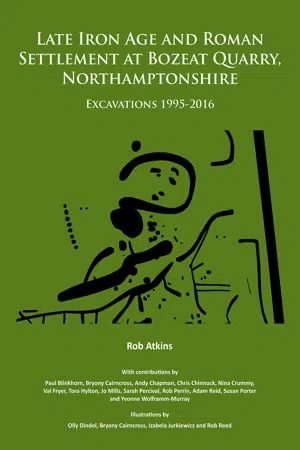
MOLA (formerly Northamptonshire Archaeology), has undertaken intermittent archaeological work within Bozeat Quarry over a twenty-year period from 1995-2016 covering an area of 59ha. The earliest archaeological features lay in the extreme northern area where a Bronze Age to Iron Age cremation burial was possibly contemporary with an adjacent late Bronze Age/early Iron Age pit alignment. In the middle to late Iron Age a settlement was established at the southern part of the site over a c170m by 150m area. It was a well organised farmstead, mostly open in plan with two roundhouses, routeway, enclosures, boundary ditches and pits. In the early 1st century AD, cAD 30, two separate settlements lay c0.5km apart. The former southern Iron Age farmstead had perhaps shifted location c150m to the north-west and a there was new farmstead to the north. Both settlements were located on a west facing slope of a valley side and were sited on sands and gravels at between 64m and 66m aOD. The Northern Settlement was only occupied for about 150 years and was involved in pastoral farming, but local coarseware pottery production was of some importance with a group of 12 pottery kilns dated to the middle to late 1st century AD. This is seemingly the largest number of pottery kilns from a single settlement of this period yet found in the regionally important Upper Nene Valley pottery producing area. The Southern Settlement was larger and continued to the end of the Roman period. In this area there was a notable scatter of 12 Iron Age and 1st century AD Roman coins as well as 24 contemporary brooches found over an area measuring c170m by c130m. This collection of finds may suggest the presence of a shrine or temple located in the area. It is perhaps significant that in 1964 directly to the west of the excavation, a middle Roman round stone building was found, perhaps an associated shrine. Within the excavation area in the latest Iron Age to early Roman period there was a possible roundhouse, a large oval enclosure and a field system. The latter largely related to pastoral farming including areas where paddocks were linked to routeways suggesting significant separation of livestock had occurred. Four cremation burials, including one deposited in a box, and an inhumation lay in three locations. Pastoral farming was a significant activity throughout the Roman period with enclosures, paddocks and linked routeways uncovered. In the late 2nd to 4th century there were two stone buildings and a stone malt oven at the extreme western extent of the site, within 50m to the east of the probably contemporary shrine recorded in 1964. There was minor evidence of early to middle Saxon occupation within the area of the former middle to late Iron Age settlement. No structures were found, although a few pits may date to this period and mark short stay visits. A small cemetery of five individuals respected the former Roman field system and probably dated to the late 6th to 7th centuries. The burials included a decapitation and a burial with a knife and a buckle. The site was then not re-occupied and became part of the fields of Bozeat medieval and post-medieval settlements.
eBook - PDF
Late Iron Age and Roman Settlement at Bozeat Quarry, Northamptonshire: Excavations 1995-2016
- 204 pages
- English
- PDF
- Available on iOS & Android
eBook - PDF
Late Iron Age and Roman Settlement at Bozeat Quarry, Northamptonshire: Excavations 1995-2016
About this book
Information
Table of contents
- Cover
- Title Page
- Copyright Page
- Contents
- List of Figures
- List of Tables
- Contributors
- Acknowledgements
- 1: Introduction
- Figure 1.1 Site location
- Figure 1.2 Contours, cropmarks, field boundaries and Historic Environment Record (HER) overlaid by the areas of greatest archaeological interest defined in the archaeological brief (Kidd 1997)
- Figure 1.3 Fieldwalking-Roman pottery distribution overlaying archaeological features (after Holmes 1996 fig 5)
- Figure 1.4 Fieldwalking early-middle Saxon pottery distribution overlaying archaeological features (after Holmes 1996 fig 6)⤀
- Figure 1.5 Geophysical survey
- Figure 1.6 Trial trenching and test pits 1997
- Figure 1.7 Archaeological work by area and year
- Figure 1.8 General site plan
- 2: The archaeological evidence
- Figure 2.1. Bronze Age to early Iron Age features in northern area (Field 2)
- Figure 2.2. Bronze Age to early Iron Age northern area cremation urn (50)
- Figure 2.3. Southern Settlement middle to late Iron Age settlement
- Figure 2.4 late Iron Age to early Roman Northern Settlement
- Figure 2.5 Late Iron Age to early Roman Northern Settlement kiln [89]
- Figure 2.6 Late Iron Age to early Roman Northern Settlement kilns [106 and 109]
- Figure 2.7 Late Iron Age to early Roman Northern Settlement kiln [127]
- Figure 2.8 Late Iron Age to early Roman Northern Settlement kiln [174]
- Figure 2.9 Late Iron Age to early Roman Northern Settlement kiln [175]
- Figure 2.10 Late Iron Age to early Roman Northern Settlement kiln [176]
- Figure 2.12. Early Roman Northern Settlement
- Figure 2.13. Early Roman Northern Settlement HB5 [171], looking north
- Figure 2.14. Early Roman Northern Settlement corn dryer [170]
- Figure 2.15. Late Iron Age to late Roman Southern Settlement
- Figure 2.16. Late Iron Age to early Roman Southern Settlement ‘domestic’ area
- Figure 2.17. Late Iron Age to early Roman Southern Settlement brooch and coin distribution map and human burials located
- Figure 2.18. Late Iron Age to early Roman Southern Settlement burial [263]
- Figure 2.19. Late Iron Age to early Roman Southern Settlement cremation burial [7124]
- Figure 2.20. Late Iron Age to early Roman Southern Settlement eastern part of the ‘domestic’ area
- Figure 2.21. Late Iron Age to early Roman Southern Settlement kiln [5068]
- Figure 2.22. Late Iron Age to early Roman Southern Settlement pit [5092]
- Figure 2.23. Late Iron Age to early Roman Southern Settlement field system in the south-eastern area
- Figure 2.24. Late Iron Age to early Roman Southern Settlement oven [534/536]
- Figure 2.25. Late Iron Age to early Roman Southern Settlement kiln [649]
- Figure 2.26. Late Iron Age to early Roman Southern Settlement field system in the northern area
- Figure 2.27. Early Roman Southern Settlement
- Figure 2.28. Early Roman Southern Settlement southern area
- Figure 2.29. Early Roman Southern Settlement southern area pit [89], looking south-east
- Figure 2.30. Early Roman Southern Settlement southern area pits [111 and 100]
- Figure 2.31. Early Roman Southern Settlement field system in the northern and eastern areas
- Figure 2.32. Middle to late Roman Southern Settlement southern area
- Figure 2.33. Middle to late Roman Southern Settlement southern area building wall (56)
- Figure 2.34. Middle to late Roman Southern Settlement southern area corn dryer or malting oven [73/84]
- Figure 2.35. Middle to late Roman Southern Settlement central area
- Figure 2.36. Early to middle Anglo-Saxon features
- Figure 2.37. Early to middle Saxon inhumation [741] (Cemetery 2)
- Figure 2.38. Early to middle Saxon inhumation [744] (Cemetery 2)
- Figure 2.39. Early to middle Saxon inhumation [747] (Cemetery 2)
- Figure 2.40. Early to middle Saxon inhumation [756] (Cemetery 2)
- 3: Finds
- Figure 3.1. Pottery LNVCC
- Figure 3.2a. Pottery illustration catalogue 1-4
- Figure 3.2b. Pottery illustration catalogue 7-12
- Figure 3.3a. Pottery illustration catalogue 13-19
- Figure 3.3b. Pottery illustration catalogue 20-25
- Figure 3.4a. Pottery illustration catalogue 26-35
- Figure 3.4b. Pottery illustration catalogue 36-42
- Figure 3.5a. Pottery illustration catalogue 43-47
- Figure 3.5b. Pottery illustration catalogue 48-54
- Figure 3.6a. Pottery illustration catalogue 55-63
- Figure 3.6b. Pottery illustration catalogue 64-67
- Figure 3.7a. Pottery illustration catalogue 68-79
- Figure 3.7b. Pottery illustration catalogue 80-88
- Figure 3.8a. Pottery illustration catalogue 89-98
- Figure 3.8b. Pottery illustration catalogue 99-108
- Figure 3.9. Kiln bars
- Figure 3.10. Illustrations
- Figure 3.12. Brooches
- Figure 3.13. Illustrations
- Figure 3.14. Illustrations
- Figure 3.15. Illustrations
- Figure 3.16. Fine textile on smaller main fragment of buckle (context 743)
- Figure 3.17. The plain weave of the fine textile marked in red on the detached piece of larger fragment
- Figure 3.18. Textile fibres on the smaller main fragment
- Figure 3.19. Insect lavae casings adhering to small fragment from buckle (context 743)
- 4: Human, faunal and environmental evidence
- Figure 4.1. Adult female (757), cleft neural arch (atlas) (scale 3cm)
- 5: Discussion
- Bibliography
Trusted by 375,005 students
Access to over 1.5 million titles for a fair monthly price.
Study more efficiently using our study tools.
Frequently asked questions
Yes, you can cancel anytime from the Subscription tab in your account settings on the Perlego website. Your subscription will stay active until the end of your current billing period. Learn how to cancel your subscription
No, books cannot be downloaded as external files, such as PDFs, for use outside of Perlego. However, you can download books within the Perlego app for offline reading on mobile or tablet. Learn how to download books offline
Perlego offers two plans: Essential and Complete
- Essential is ideal for learners and professionals who enjoy exploring a wide range of subjects. Access the Essential Library with 800,000+ trusted titles and best-sellers across business, personal growth, and the humanities. Includes unlimited reading time and Standard Read Aloud voice.
- Complete: Perfect for advanced learners and researchers needing full, unrestricted access. Unlock 1.5M+ books across hundreds of subjects, including academic and specialized titles. The Complete Plan also includes advanced features like Premium Read Aloud and Research Assistant.
We are an online textbook subscription service, where you can get access to an entire online library for less than the price of a single book per month. With over 1.5 million books across 990+ topics, we’ve got you covered! Learn about our mission
Look out for the read-aloud symbol on your next book to see if you can listen to it. The read-aloud tool reads text aloud for you, highlighting the text as it is being read. You can pause it, speed it up and slow it down. Learn more about Read Aloud
Yes! You can use the Perlego app on both iOS and Android devices to read anytime, anywhere — even offline. Perfect for commutes or when you’re on the go.
Please note we cannot support devices running on iOS 13 and Android 7 or earlier. Learn more about using the app
Please note we cannot support devices running on iOS 13 and Android 7 or earlier. Learn more about using the app
Yes, you can access Late Iron Age and Roman Settlement at Bozeat Quarry, Northamptonshire: Excavations 1995-2016 by Rob Atkins in PDF and/or ePUB format, as well as other popular books in Social Sciences & Archaeology. We have over 1.5 million books available in our catalogue for you to explore.