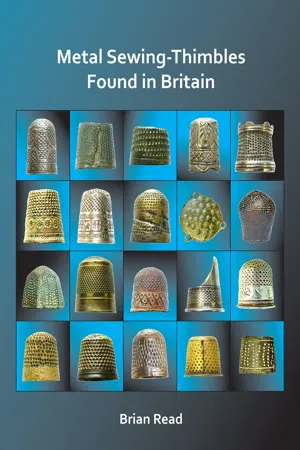
This is the first reference book that deals specifically with all types of sewing-thimble made from copper-alloy or silver, or either of these metals combined with iron or steel, and found in Britain: also included is a seemingly rare gold specimen. Domed, ring-type and open-top (here the latter classed as a new type) sewing-thimbles are described, among them unusual examples and others previously absent from the known record. From Britain the earliest reliable dating for these humble yet fascinating tools is between c.1270 – c.1350, and continues through the medieval and early post-medieval period and into the 18th and 19th centuries. Dating from at least the 17th century, subjected to detailed attention is the largely neglected sailmakers' and sailors' palm-iron, a heavy-duty tool made from either iron, steel or copper alloy. Also described are the two known types of silver or copper-alloy finger guard, an 18th – 19th century tool used in conjunction with finer sewing-thimbles. The majority of sewing-thimbles and other sewing-tools catalogued here are credited to metal-detectorists or members of The Society of Thames Mudlarks, who also use metal-detectors. To show constructional detail, each object is archaeologically drawn. This information is essential for metal-detectorists, archaeologists, museum curators, sewing-tool collectors and dealers, or anyone with an interest, seeking to gauge the type or age of any particular sewing-thimble or palm-iron.
- 104 pages
- English
- PDF
- Available on iOS & Android
eBook - PDF
Metal Sewing-Thimbles Found in Britain
About this book
Information
M
ETAL
S
EWING
-T
HIMBLES
FOUND
IN
B
RITAIN
6
The
palm-iron
–
aka
pusher,
palm
guard
–
is
probably
the
earliest
form
of
tool
to
push
needles,
initially
perhaps
being
a
rudimentary
piece
of
stone
or
organic
material
cupped
in
the
palm,
or
held
by
the
fingers.
Stone
pushers
ascribed
as
c
.10,000
BC
are
recorded,
and
copper-alloy
pushers,
called
acutrudia
,
dating
from
the
11th
to
the
15th
centuries
are
known
from
the
Middle
East
and
Turkey
(McConnel
1991).
Some
form
of
palm-iron
is
possibly
what
the
Romans
used,
but
paradoxically
such
tools
are
absent
from
the
Roman
period
archaeological
record.
In
Britain,
entirely
due
to
detectorists
and
Thames
Mudlarks,
substantial
cast
metal
tools
now
recognised
as
seemingly
post-medieval
palm-irons
are
becoming
more
apparent
in
the
known
record
(see
below).
Other
cast
leaden
objects
invariably
described
as
palm-guards/pushers
are
frequently
found
by
detectorists
though
this
function
is
unproven
(see
below).
Figure
1.
Composite
three-piece
sheet
silver
domed
thimble
c.19th
–
c.20th
century.
Note
longitudinal
soldered
butt
seam
and
925
fineness
stamp.
Private
collection.
Figure
2.
Hybrid
sheet
silver
domed
thimble
with
a
probable
replacement
flat
crown
c
.19th
–
c
.20th
century.
Dorset
.
Table of contents
- Cover
- Frontispiece
- Copyright Information
- Contents
- List of Figures
- Notes on Illustrations
- Abbreviations
- Acknowledgements
- Foreword
- Metal Sewing-Thimbles
- Figure 1. Composite three-piece sheet silver domed thimble c.19th – c.20th century. Note longitudinal soldered butt seam and 95 fineness stamp. Private collection.
- Figure 1. Composite three-piece sheet silver domed thimble c.19th – c.20th century. Note longitudinal soldered butt seam and 95 fineness stamp. Private collection.
- Figure 2. Hybrid sheet silver domed thimble with a probable replacement flat crown c.19th – c.20th century. Dorset.
- Figure 2. Hybrid sheet silver domed thimble with a probable replacement flat crown c.19th – c.20th century. Dorset.
- Metal Ring-Type Thimbles
- Figure 3. Ring-type copper-alloy thimbles c.9th – c.12th century, Corinth. (Note similarity with early ring-type thimbles found in Britain.) Top row: MF–7710, MF–7658, MF–7724, MF–8175, MF–7681, MF–5840, MF–6886 Bottom row: MF–4455, MF–7205, MF–6829, MF–4
- Figure 3. Ring-type copper-alloy thimbles c.9th – c.12th century, Corinth. (Note similarity with early ring-type thimbles found in Britain.) Top row: MF–7710, MF–7658, MF–7724, MF–8175, MF–7681, MF–5840, MF–6886 Bottom row: MF–4455, MF–7205, MF–6829, MF–4
- Figure 4. Soldered sheet copper-alloy ring-type thimble c.1350 – c.1400,
- Figure 5. Ring-type copper-alloy thimbles c. early 13th century – c. 1450.
- Figure 5. Ring-type copper-alloy thimbles c. early 13th century – c. 1450.
- Figure 6. Ring-type copper-alloy thimbles c. early 13th century – c. 1450.
- Figure 6. Ring-type copper-alloy thimbles c. early 13th century – c. 1450.
- Figure 7. Ring-type copper-alloy and silver thimbles c.1450 – c.1600
- Figure 7. Ring-type copper-alloy and silver thimbles c.1450 – c.1600.
- Figure 8. Dutch cast copper-alloy ring-type thimble from the Dutch East Indiaman De Liefde 18th century. Note mechanically knu led circular pits, upper circumferential groove and pronounced basal rim. Photo copyright © Lewis Murray and reproduced courtesy
- Figure 8. Dutch cast copper-alloy ring-type thimble from the Dutch East Indiaman De Liefde 18th century. Note mechanically knu led circular pits, upper circumferential groove and pronounced basal rim. Photo copyright © Lewis Murray and reproduced courtesy
- Figure 9. Ring-type copper-alloy and white-metal coated malleable iron/steel thimbles c.17th – c.18th century.
- Figure 9. Ring-type copper-alloy and white-metal coated malleable iron/steel thimbles c.17th – c.18th century.
- Metal Domed Thimbles
- Figure 10. Domed copper-alloy thimbles c.12th century – c.1400.
- Figure 11. Domed copper-alloy (aka acorn cup) thimbles c.12th century – c.1400.
- Figure 11. Possible unfinished domed sheet copper-alloy thimble c.1400 – c.1500, Lincolnshire. Note flatness, lack of trauma marks and left-hand spiral of drilled pits.
- Figure 12. Domed copper-alloy thimbles c.1400 – c.1500.
- Figure 12. Possible unfinished domed sheet copper-alloy thimble c.1400 – c.1500. Lincolnshire. Note flatness, lack of trauma marks and left-hand spiral of drilled pits. Photo copyright and reproduced courtesy of Adam Staples.
- Figure 13. Domed copper-alloy thimbles c.1400 – c.1500.
- Figure 13. Detached crown, from a possible c.mid-15th-century domed composite two-piece hammered sheet copper-alloy thimble wi h soldered seams, Wiltshire.
- Figure 14. Detached crown, from a possible c.mid-15th-century domed composite two-piece hammered sheet copper-alloy thimble wi h soldered seams. Wiltshire.
- Figure 14. Domed cast copper-alloy thimble with possible linen sleeve c.15th-century, South Lincolnshire. Photo copyright © and reproduced courtesy of Adam Staples.
- Figure 15. Domed cast copper-alloy thimble with possible linen sleeve c.15th-century. South Lincolnshire. Photo copyright © and reproduced courtesy of Adam Staples.
- Figure 15. Domed malleable iron/steel thimble with copper-alloy sleeve c. late post-medieval; private collection.
- Figure 16. Domed malleable iron/steel thimble with copper-alloy sleeve c. late post-medieval. Private collection.
- Figure 16. Domed malleable iron/steel thimble with copper-alloy sleeve c. late post-medieval; Buckinghamshire.
- Figure 17. Domed malleable iron/steel thimble c. late post-medieval, East Devon.
- Figure 18. Domed malleable iron/steel thimble c. late post-medieval. East Devon.
- Figure 18. Nuremberg thimble-maker brother Ving […] drilling pits in a domed thimble c.1414. Note domed and ring-type thimbles on bench. Mendelschen Institute Housebook 1. Stadtbibliothek Nürnberg Amb. 317.2 , f. 5 v. Reproduced courtesy of the City Libra
- Figure 19. Nuremberg thimble-maker’s workshop, after an engraving by Jost Amman (1539-91). First published 1564 and reproduced 1568 by Hans Sachsen in Eigentliche Beschreibung aller Stände auffErden. Note iron swaging block, and domed thimbles; some of wh
- Figure 20. Nuremberg thimble-maker’s workshop, after an engraving by Jost Amman (1539-91). First published 1564 and reproduced 1568 by Hans Sachsen in Eigentliche Beschreibung aller Stände auffErden. Note iron swaging block, and domed thimbles; some of wh
- Figure 20. Nuremberg thimble-maker brother Veit Schuster 7 January 1592 performing an indeterminate task with a hammer and punch. Mendelschen Institute Housebook II. Stadtbibliothek Nürnberg, Amb. 317b.2 , f. 52 r. Reproduced courtesy of the City Library
- Figure 21. Nuremberg thimble-maker brother Veit Schuster 7 January 1592 performing an indeterminate task with a hammer and punch. Mendelschen Institute Housebook II. Stadtbibliothek Nürnberg, Amb. 317b.2 , f. 52 r. Reproduced courtesy of the City Library
- Figure 21. Nuremberg thimble-maker brother Wolf Laim 6 July1621. Landauer Foundation Memorial Book I. Stadtbibliothek Nürnberg, Amb. 279.2 , f. 89. Reproduced courtesy of the City Library of Nuremberg.
- Figure 22. Nuremberg thimble-maker brother Wolf Laim 6 July1621. Landauer Foundation Memorial Book I. Stadtbibliothek Nürnberg, Amb. 279.2 , f. 89. Reproduced courtesy of the City Library of Nuremberg.
- Figure 22. Nuremberg thimble-maker brother Martin Winderlein 18 May 1627, punching pits in a domed thimble. Note two different colours of domed thimbles, which suggests both silver and copper-alloy forms. Mendelschen Institute Housebook II. Stadtbibliothe
- Figure 23. Nuremberg thimble-journeyman brother Nicolaus Zeittenberger 24 December 1667, punching pits in a domed thimble. Note two different colours of domed thimbles, which suggests both silver and copper-alloy forms. Mendelschen Institute Housebook II.
- Figure 23. Nuremberg thimble-maker brother Martin Winderlein 18 May 1627, punching pits in a domed thimble. Note two different colours of domed thimbles, which suggests both silver and copper-alloy forms. Mendelschen Institute Housebook II. Stadtbibliothe
- Figure 24. Nuremberg thimble-journeyman brother Nicolaus Zeittenberger 24 December 1667, punching pits in a domed thimble. Note two different colours of domed thimbles, which suggests both silver and copper-alloy forms. Mendelschen Institute Housebook II.
- Figure 24a. Nuremberg domed copper-alloy thimbles c.16th century.
- Figure 25a. Nuremberg domed copper-alloy thimbles c.16th century.
- Figure 24b. Nuremberg domed copper-alloy thimbles c.16th century.
- Figure 25a. Domed copper-alloy and silver thimbles c.16th century (one is perhaps 17th century).
- Figure 25b. Nuremberg domed copper-alloy thimbles c.16th century.
- Figure 26a. Domed copper-alloy and silver thimbles c.16th century (one is perhaps 17th century).
- Figure 25b. Domed copper-alloy and silver thimbles c.16th century (one is perhaps 17th century).
- Figure 26b. Domed copper-alloy and silver thimbles c.16th century (* one is perhaps 17th century).
- Figure 26. English domed composite silver and copper-alloy thimbles (some incomplete) c. mid- to c. late 17th century.
- Figure 27. English domed composite silver and copper-alloy thimbles (some incomplete) c. mid- to c. late 17th century.
- Figure 27. Probable English domed composite silver thimbles c. mid-17th to c. mid 18th century.
- Figure 28. Probable English domed composite silver and gold thimbles c. mid-17th to c. mid 18th century.
- Figure 28. Dutch Holmes’ Type I domed copper-alloy thimbles c.16th – c. mid-17th century.
- Figure 29. Dutch Holmes’ Type I domed copper-alloy thimbles c.16th – c. mid-17th century.
- Figure 29. Engraving of thimble-maker John Lofting by J Kip in the London Prospects Portfolio c.1690.
- Figure 30. Dutch Holmes’ Type II domed copper-alloy thimble 18th century, from the Dutch East Indiaman De Liefde (The Love). Note mechanically knurled circular pits, basal bands and deep grooves. Photo copyright © Lewis Murray and reproduced courtesy of
- Figure 31. Dutch or English Holmes’ Type II domed copper-alloy thimbles c. mid-17th – c. mid-18th century.
- Figure 32. Dutch or English Holmes’ Type II domed copper-alloy thimbles c. mid-17th – c. mid-18th century.
- Figure 33. Dutch or English (John Lofting) Holmes’ Type III domed copper-alloy thimbles c. mid-17th – c. mid-18th century.
- Figure 32. Dutch or English (John Lofting) Holmes’ Type III domed copper-alloy thimbles c. mid-17th – c. mid-18th century.
- Figure 33a. Miscellaneous domed copper-alloy, pewter and silver thimbles c. mid 18th – c. mid-19th century.
- Figure 34. Miscellaneous domed copper-alloy, pewter and silver thimbles c. mid 18th – c. mid-19th century. (*one is perhaps 7th century)
- Figure 34. Open-top copper-alloy thimbles c.14th century. After Mills 1999, NM.60, NM.61.
- Figure 35. Open-top copper-alloy thimbles c.14th century. After Mills 1999, NM.60, NM.61.
- Metal Open-Top Thimbles
- Metal Finger-Guards
- Metal Palm-Irons
- Figure 36. Read Type V cast copper-alloy palm-iron, from the c.1658 Wadden Sea shipwreck. Photo reproduced courtesy of the Rijksdienst voor Cultureel Erfgoed.
- Figure 37. Read Type V cast copper-alloy palm-iron, from the c.1658 Wadden Sea shipwreck. Photo reproduced courtesy of the Rijksdienst voor Cultureel Erfgoed.
- Figure 37. Sketch of a sailmaker’s palm fitted with a Read Type II palm-iron in Álbum del Marqués de la Victoria 1719-56. Afte Pawson 2010 pp 11.
- Figure 38. Sailmaker’s leather palm 19th century. Note angled section of rawhide and inset metal probable Read Type III wedge-shaped iron.Photo copyright © and reproduced courtesy of Penlee House Gallery and Museum, Penzance.
- Figure 38. Sketch of a sailmaker’s palm fitted with a Read Type II palm-iron in Álbum del Marqués de la Victoria 1719-56. Afte Pawson 2010 pp 11.
- Figure 39. Copper-alloy and malleable iron or steel palm-irons and copper-alloy possible palm-iron c.17th – c.20th century. Some photos copyright © and reproduced courtesy of the PAS.
- Figure 39. Sailmaker’s leather palm 19th century. Note angled section of rawhide and inset metal probable Read Type III wedge-shaped iron. Photo copyright © and reproduced courtesy of Penlee House Gallery and Museum, Penzance.
- Figure 40. Copper-alloy and malleable iron or steel palm-irons and copper-alloy possible palm-iron c.17th – c.20th century. Some photos copyright © and reproduced courtesy of the PAS.
- Figure 41. Leaden so-called palm-guards, possibly c. late post-medieval, Yorkshire, County Durham, Lincolnshire and Yorkshire. Note none, one or two circular impression in convex sides and absence of confirmed needle marks on either side. Photos copyrigh
- Metal So-called Palm Guards
- Bibliography
Trusted by 375,005 students
Access to over 1.5 million titles for a fair monthly price.
Study more efficiently using our study tools.
Frequently asked questions
Yes, you can cancel anytime from the Subscription tab in your account settings on the Perlego website. Your subscription will stay active until the end of your current billing period. Learn how to cancel your subscription
No, books cannot be downloaded as external files, such as PDFs, for use outside of Perlego. However, you can download books within the Perlego app for offline reading on mobile or tablet. Learn how to download books offline
Perlego offers two plans: Essential and Complete
- Essential is ideal for learners and professionals who enjoy exploring a wide range of subjects. Access the Essential Library with 800,000+ trusted titles and best-sellers across business, personal growth, and the humanities. Includes unlimited reading time and Standard Read Aloud voice.
- Complete: Perfect for advanced learners and researchers needing full, unrestricted access. Unlock 1.5M+ books across hundreds of subjects, including academic and specialized titles. The Complete Plan also includes advanced features like Premium Read Aloud and Research Assistant.
We are an online textbook subscription service, where you can get access to an entire online library for less than the price of a single book per month. With over 1.5 million books across 990+ topics, we’ve got you covered! Learn about our mission
Look out for the read-aloud symbol on your next book to see if you can listen to it. The read-aloud tool reads text aloud for you, highlighting the text as it is being read. You can pause it, speed it up and slow it down. Learn more about Read Aloud
Yes! You can use the Perlego app on both iOS and Android devices to read anytime, anywhere — even offline. Perfect for commutes or when you’re on the go.
Please note we cannot support devices running on iOS 13 and Android 7 or earlier. Learn more about using the app
Please note we cannot support devices running on iOS 13 and Android 7 or earlier. Learn more about using the app
Yes, you can access Metal Sewing-Thimbles Found in Britain by Brian Read in PDF and/or ePUB format, as well as other popular books in Social Sciences & Archaeology. We have over 1.5 million books available in our catalogue for you to explore.