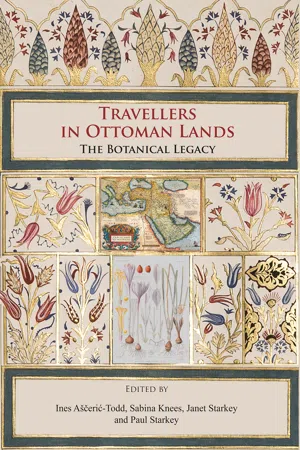
This collection of around twenty papers has its origins in a two-day seminar organised by the Association for the Study of Travel in Egypt and the Near East (ASTENE) in conjunction with the Centre for Middle Eastern Plants at the Royal Botanic Garden, Edinburgh (RBGE), with additional support from Cornucopia magazine and the Turkish Consulate General, Edinburgh. This multi-disciplinary event formed part of the Ottoman Horizons festival held in Edinburgh in 2017 and attracted a wide range of participants from around the world, including several from Turkey and other parts of the Middle East. This splendidly illustrated book focuses on the botanical legacy of many parts of the former Ottoman Empire — including present-day Turkey, the Levant, Egypt, the Balkans, and the Arabian Peninsula — as seen and described by travellers both from within and from outside the region. The papers cover a wide variety of subjects, including Ottoman garden design and architecture; the flora of the region, especially bulbs and their cultural significance; literary, pictorial and photographic depictions of the botany and horticulture of the Ottoman lands; floral and related motifs in Ottoman art; culinary and medicinal aspects of the botanical heritage; and efforts related to conservation.
eBook - PDF
Travellers in Ottoman Lands
The Botanical Legacy
- 409 pages
- English
- PDF
- Available on iOS & Android
eBook - PDF
Travellers in Ottoman Lands
The Botanical Legacy
About this book
Information
Table of contents
- Cover
- Previous volumes published from ASTENE Conferences
- Title Page
- Copyright Page
- In memory of Irene Linning
- Contents Page
- List of Figures
- Foreword
- Preface
- Introduction to Travellers in Ottoman Lands: The Botanical Legacy
- Acknowledgements
- Map 1. An engraved map of the Ottoman Empire and coloured by hand and engraved by Frans Hogenberg. It is map no. 50 in Theatrum Orbis Terrarum (Anvers, 1602, updated from the Antwerp 1570 edition), the atlas by Abraham Ortelius (1527-1598) called (Muzeul
- The Ottoman Empire: an introduction to its history and heritage
- The Ottoman Empire: an introduction to its history and heritage
- Presenting and re-presenting Ottoman imperial gardens in manuscript illustrations:
- Presenting and re-presenting Ottoman imperial gardens in manuscript illustrations:
- Gardens of Istanbul in Persian hajj travelogues
- Gardens of Istanbul in Persian hajj travelogues
- The public space of the Bakewell Ottoman Garden
- The public space of the Bakewell Ottoman Garden
- Dioscorides’ legacy: a classical precursor to travellers in Ottoman lands
- Dioscorides’ legacy: a classical precursor to travellers in Ottoman lands
- 7
- Botanical explorations by Frederik Hasselquist (1749–1752) and Pehr Forsskål (1761–1763):
- Linné’s apostles in the Holy Land
- Tobias Mörike
- From Ottoman Aleppo to Edinburgh:
- From Ottoman Aleppo to Edinburgh:
- Figure 1. A portrait of Carl Haussknecht, 1892 (archive of the Herbarium Haussknecht, Friedrich Schiller University Jena [FSU Jena]).
- 10
- In honour of Professor Asuman Baytop (1920–2015): a tribute
- On Georges Vincent Aznavour,
- On Georges Vincent Aznavour,
- Violet Dickson, Umm Saud, the last grande dame of Arabia
- Violet Dickson, Umm Saud, the last grande dame of Arabia
- Bulbs of the Holy Land: diversity, conservation, and cultivation
- Bulbs of the Holy Land: diversity, conservation, and cultivation
- George Maw (1832–1912):
- George Maw (1832–1912):
- Decline of the conifers in former Ottoman lands
- Decline of the conifers in former Ottoman lands
- The cedars of Lebanon in literature and art
- The cedars of Lebanon in literature and art
- Botanical art in Turkey from past to present
- Botanical art in Turkey from past to present
- The interpretation of Ottoman garden culture through miniatures
- The interpretation of Ottoman garden culture through miniatures
- Richly decorated textiles and Ottoman court dress
- Richly decorated textiles and Ottoman court dress
- Taking ‘stalk’ of Turkey red in Ottoman flora, fabric, and fibre
- Taking ‘stalk’ of Turkey red in Ottoman flora, fabric, and fibre
- Roses, carnations, and ‘Prophet’s eggs’:
- Roses, carnations, and ‘Prophet’s eggs’:
- Contributors
- Contributors to Travellers in Ottoman Lands:
Trusted by 375,005 students
Access to over 1.5 million titles for a fair monthly price.
Study more efficiently using our study tools.
Frequently asked questions
Yes, you can cancel anytime from the Subscription tab in your account settings on the Perlego website. Your subscription will stay active until the end of your current billing period. Learn how to cancel your subscription
No, books cannot be downloaded as external files, such as PDFs, for use outside of Perlego. However, you can download books within the Perlego app for offline reading on mobile or tablet. Learn how to download books offline
Perlego offers two plans: Essential and Complete
- Essential is ideal for learners and professionals who enjoy exploring a wide range of subjects. Access the Essential Library with 800,000+ trusted titles and best-sellers across business, personal growth, and the humanities. Includes unlimited reading time and Standard Read Aloud voice.
- Complete: Perfect for advanced learners and researchers needing full, unrestricted access. Unlock 1.5M+ books across hundreds of subjects, including academic and specialized titles. The Complete Plan also includes advanced features like Premium Read Aloud and Research Assistant.
We are an online textbook subscription service, where you can get access to an entire online library for less than the price of a single book per month. With over 1.5 million books across 990+ topics, we’ve got you covered! Learn about our mission
Look out for the read-aloud symbol on your next book to see if you can listen to it. The read-aloud tool reads text aloud for you, highlighting the text as it is being read. You can pause it, speed it up and slow it down. Learn more about Read Aloud
Yes! You can use the Perlego app on both iOS and Android devices to read anytime, anywhere — even offline. Perfect for commutes or when you’re on the go.
Please note we cannot support devices running on iOS 13 and Android 7 or earlier. Learn more about using the app
Please note we cannot support devices running on iOS 13 and Android 7 or earlier. Learn more about using the app
Yes, you can access Travellers in Ottoman Lands by Ines Asceric-Todd,Sabina Knees,Janet Starkey,Paul Starkey, Ines Asceric-Todd, Sabina Knees, Janet Starkey, Paul Starkey in PDF and/or ePUB format, as well as other popular books in Biological Sciences & Archaeology. We have over 1.5 million books available in our catalogue for you to explore.