The author of
The Coming of Neo-Feudalism and
The New Class Conflict challenges conventions of urban planning.
Around the globe, most new urban development has adhered to similar tenets: tall structures, small units, and high density. In
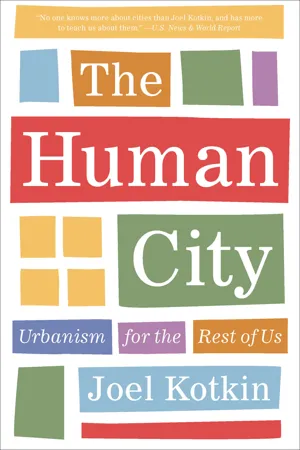
The Human City, Joel Kotkin?called "America's uber-geographer" by David Brooks of the
New York Times?questions these nearly ubiquitous practices, suggesting that they do not consider the needs and desires of the vast majority of people. Built environments, Kotkin argues, must reflect the preferences of most people?even if that means lower-density development.
The Human City ponders the purpose of the city and investigates the factors that drive most urban development today. Armed with his own astute research, a deep-seated knowledge of urban history, and a sound grasp of economic, political, and social trends, Kotkin pokes holes in what he calls the "retro-urbanist" ideology and offers a refreshing case for dispersion centered on human values. This book is not anti-urban, but it does advocate a greater range of options for people to live the way they want at all stages of their lives.
Praise for
The Human City
"Kotkin . . . presents the most cogent, evidence-based and clear-headed exposition of the pro-suburban argument . . . . In pithy, readable sections, each addressing a single issue, he debunks one attack on the suburbs after another. But he does more than that. He weaves an impressive array of original observations about cities into his arguments, enriching our understanding of what cities are about and what they can and must become." —Shlomo Angel,
Wall Street Journal
"The most eloquent expression of urbanism since Jane Jacobs's
The Death and Life of Great American Cities. Kotkin writes with a strong sense of place; he recognizes that the geography and traditions of a city create the contours of its urbanity." —Ronnie Wachter,
Chicago Tribune
- 320 pages
- English
- ePUB (mobile friendly)
- Available on iOS & Android
eBook - ePub
About this book
Information
Topic
Scienze socialiCHAPTER 1
What Is a City For?

WHAT IS A CITY FOR? In this urban age, it’s a question of crucial importance but one that is not often asked. Long ago, Aristotle reminded us that the city is a place where people come to live, and they remain there in order to live better: “A city comes into being for the sake of life but exists for the sake of living well.”1
But what does “living well” mean? Is it about accumulating as much wealth as possible? Is it about consuming amenities and collecting the most unique experiences? Is the city a way to reduce the impact of human beings on the environment? Is it about positioning the polis—the city—to serve primarily as an engine in the world economy? Is it about establishing the dominion of the powerful and well connected, those persons who can achieve a high quality of life near the urban core? These are the principles that often guide the thinking of most urbanists today.
I start at a different place. If we are to “live well” in the city, it should, first and foremost, address the needs of future generations, as sustainability advocates rightfully state. This starts with focusing on those areas where families—the new generations—are likely to be raised, rather than primarily focusing on the individual and places where relatively few youngsters grow into adolescence and maturity. We must not forget that without parents, children, and the neighborhoods that sustain them, it would be impossible to imagine how we, as a society, could “live well” or even survive as a species. This is the essence of what I call “the human city.”
This book is not primarily an argument for any particular urban form. Urban areas now account for 55 percent of the world’s population, up from 30 percent in 1950.2 These areas range from small towns to suburbs to megacities (cities with populations of over 10 million residents). Most have some unique qualities to offer their residents and provide solutions, economic or otherwise, for them.3 Ideally, urban areas should provide the widest range of living options—from exurbs and suburbs to a thriving urban core—that provide for different people at different stages of life. Living well should not be about where one should live but about how one wants to live and for whom.
Cities, in my definition, are more than what today’s planners and urban theorists insist they must be—dense and crowded places. To some advocates, these are the only places that matter because they express “superior” urban virtues pertaining to environmental or cultural values. A few years ago, for example, Seattle’s the Stranger outright scorned the periphery—where “people are fatter and slower and dumber”—and claimed cities own “a superior way of life” full of “sanity, liberalism and compassion”—although this compassion hardly seems to apply to those benighted non-urbanites.4
Rather than dismiss the expanding city, we need to include it as part of the contiguous region of settlement, what British authorities call the “built-up urban area.”5 As we’ll see, this dispersion is the common reality, more or less, for almost all large cities in the world. Cities are much more than places with arresting architecture or the most attractive places for culture or tourism. Instead, a city’s heart exists where its people choose to settle. “After all is said and done, he—the citizen—is really the city,” Frank Lloyd Wright suggested. “The city is going wherever he goes.”6
THE CULT OF DENSITY
Wright’s observation places emphasis in the right place—on those who live in the city. People love their places not for general reasons but for specific reasons that relate to their own needs and aspirations. In our contemporary setting, the desires of many citizens often conflict with those of urban planners and consultants. This centers largely on the dominant urbanist notion—what may be best called “retro-urbanism”—that cities, in order to be successful, must be made ever denser, much as they were in the late 19th and early 20th centuries. Some, including many New Urbanists, favor doing so on a somewhat human scale, with Paris-style levels of density. Others, influential perhaps more in the developing world, embrace a vision of urban density expressed boldly in high-rise apartment blocks and soaring office towers, which has defined the urban vision ever since high-rise steel frame construction began in late 1880s America.7
Perhaps the most powerful case for the high-rise city was first articulated by the brilliant architect Charles-Édouard Jeanneret-Gris, also known as Le Corbusier. He envisioned packed buildings surrounded by vast tracts of open land.8 A bold thinker, Le Corbusier was inspired by 1920s and 1930s Manhattan, the city that most approximated his ideal. But Gotham’s many poorer districts and its ramshackle appearance offended him. To him, New York City was not dense enough, its skyscrapers “too small.” His goal was to conjure the city as “a miracle of machine civilization” with “glass skyscrapers” that “rise like crystals” and serve as “a magnificent instrument for the concentration of population.”9 These cities, he believed, represented the urban future, an idea widely shared, at least broadly, by many urban thinkers today.
Le Corbusier’s work, much of which was written in the late 1920s, epitomized a kind of technological optimism, one that was centered on the application of geometry, mathematics, and mechanics to city building. “A town,” he wrote, “is a tool.” In his vision, cities required “order,” and that order was necessary if the city was not to “thwart” its ambitions. His theory was “a struggle against chance, against disorder, against a policy of drift.”
Le Corbusier detested the disorder of the traditional city, its mishmash of building types, its competing densities, and its street-level spontaneity. His was a city of order imposed from above, as had been the case in the earliest times; this order allowed Hellenistic cities to develop in a manner not seen in the cities of early Greece, which also tended to be somewhat haphazard in design.10 Le Corbusier, perhaps not too surprisingly, showed an unseemly admiration for dictators, be they Napoleon III, who rebuilt Paris, or Adolf Hitler, a failed artist who relished massive urban building projects. Like many of today’s planners, Le Corbusier saw in dense developments the salvation of society. The Corbusian vision of a “city of skyscrapers” would allow society to make sufficient economic progress to enhance further the grandeur of the city. 11
Today’s density advocates are rarely as audacious as Le Corbusier, but they also claim numerous benefits from their sense of a highly centralized urban “order”; some organizations, such as the Urban Land Institute (ULI), have been fighting decentralization and suburbanization since the late 1930s.12 There is a widespread notion that higher density will increase productivity, calm the climate, and lower living costs, albeit at the price of homeownership.13 In the following pages, I outline the retro-urbanist argument for each of these purported benefits.
THE ECONOMIC EQUATION
Some retro-urbanists, such as Richard Florida, point to studies such as those from the Santa Fe Institute that show the great productivity of large cities, claiming that “bigger, denser cities literally speed up the metabolism of daily life.” The notion that innovation needs to take place in dense urban settings is now widely accepted. Yet in reality, as the study’s authors note, their findings were about the population of an area, not the density, and had little to do with the urban form.14
After all, many of the nation’s most innovative firms are located not in downtown cores but in sprawling regions, whether that’s in Silicon Valley, the north Dallas suburbs, or the “energy corridor” west of central Houston. Dense San Francisco proper has seen a significant boom in high-tech-related business services in recent years, yet neighboring San Mateo County still holds more than five times as many jobs in software publishing as San Francisco.15 And despite the recent expansion of tech-related business in San Francisco, the majority of the Bay Area’s total employment remains 10 miles from the city center—and is more dispersed than even the national average.16
Likewise, most STEM (science, technology, engineering, and mathematics) employment, a large driver of economic growth, remains firmly in suburbanized areas with lower density development and little in the way of mass transit usage.17 Lower density regions as diverse as Durham, Madison, Denver, Detroit, Baltimore, Colorado Springs, and Albany are among the places with the highest shares of STEM jobs, and in many cases, they are creating new STEM jobs faster than the high-tech stalwarts. Charleston, Provo, Fayetteville, Raleigh, and Des Moines are among the fastest-growing STEM regions since 2001, each with STEM employment up at least 29 percent.18
Much has been written about how large, dense cities are the best places to grow jobs and, increasingly, to find opportunities.19 Yet in reality, the central core has become progressively less important economically, in terms of employment.20 Today, only 9 percent of employment is located in the central business districts, with an additional 10 percent in the balance of the urban cores.21
America’s metropolitan areas were largely monocentric—that is, dominated by the single strong core of downtown—during the immediate post-World War II period, but since have largely become polycentric. Job dispersion is now a reality in virtually every metropolitan area, with twice as many jobs located 10 miles from city centers as in those centers. Between 1998 and 2006, 95 out of 98 metro areas saw a decrease in the share of jobs located within three miles of downtown, according to a Brookings Institution report.22 The outermost parts of these metro areas saw employment increase by 17 percent, compared to a gain of less than 1 percent in the urban core. Overall, the report found, only 21 percent of employees in the top 98 metros in America lived within three miles of the center of their city. More than 80 percent of employment growth from 2007 to 2013 was in the newer suburbs and exurban areas.23
CITIES, SUBURBS, AND ENVIRONMENT
In addition to economic arguments, claims of environmental superiority also drive the push for densification. Some environmentalists also celebrate the demographic impact of densification, seeing in denser cities a natural contraceptive against population growth, which is seen as a major contributor to environmental destruction. Stewart Brand, founder of the green handbook Whole Earth Catalog, embraces denser urbanization, particularly in developing countries, as a way of “stopping the population explosion cold.”24
Concerns over climate change have been added to justify greater density. “What is causing global warming is the lifestyle of the American middle class,” insists New Urbanist architect Andrés Duany, a major developer of dense housing himself and arguably the movement’s most important voice.25 To advocates such as Duany, a return to old urban forms encourages transit riding over cars, which is one way to reduce carbon emissions.
But besides being environmentally imperative, the shift to denser development is also seen as somehow morally justified. Retro-urbanists—those who long for a return to the traditional pre-1950 city—represent a kind of moral imperative. Typically, this is cast as a choice between 4,000-square-foot McMansions and unbridled consumption on one side and more sustainable high-density urban living on the other. Columbia University’s Earth Institute executive director Steven Cohen speaks of a future “with smaller personal spaces, more frequent use of public spaces, bikes, parks, high-tech media, and constant attention to one’s environmental footprint.”26 Prince Charles’s vision of “eco-cities”—although more medieval th...
Table of contents
- Cover
- Title Page
- Copyright
- Dedication
- Contents
- Introduction
- Chapter 1: What Is a City For?
- Chapter 2: The Importance of Everyday Life
- Chapter 3: The Problem with Megacities
- Chapter 4: Inside the “Glamour Zone”
- Chapter 5: Post-Familial Places
- Chapter 6: The Case for Dispersion
- Chapter 7: How Should We Live?
- Acknowledgements
- Bibliography
- Endnotes
- Index
Trusted by 375,005 students
Access to over 1.5 million titles for a fair monthly price.
Study more efficiently using our study tools.
Frequently asked questions
Yes, you can cancel anytime from the Subscription tab in your account settings on the Perlego website. Your subscription will stay active until the end of your current billing period. Learn how to cancel your subscription
No, books cannot be downloaded as external files, such as PDFs, for use outside of Perlego. However, you can download books within the Perlego app for offline reading on mobile or tablet. Learn how to download books offline
Perlego offers two plans: Essential and Complete
- Essential is ideal for learners and professionals who enjoy exploring a wide range of subjects. Access the Essential Library with 800,000+ trusted titles and best-sellers across business, personal growth, and the humanities. Includes unlimited reading time and Standard Read Aloud voice.
- Complete: Perfect for advanced learners and researchers needing full, unrestricted access. Unlock 1.5M+ books across hundreds of subjects, including academic and specialized titles. The Complete Plan also includes advanced features like Premium Read Aloud and Research Assistant.
We are an online textbook subscription service, where you can get access to an entire online library for less than the price of a single book per month. With over 1.5 million books across 990+ topics, we’ve got you covered! Learn about our mission
Look out for the read-aloud symbol on your next book to see if you can listen to it. The read-aloud tool reads text aloud for you, highlighting the text as it is being read. You can pause it, speed it up and slow it down. Learn more about Read Aloud
Yes! You can use the Perlego app on both iOS and Android devices to read anytime, anywhere — even offline. Perfect for commutes or when you’re on the go.
Please note we cannot support devices running on iOS 13 and Android 7 or earlier. Learn more about using the app
Please note we cannot support devices running on iOS 13 and Android 7 or earlier. Learn more about using the app
Yes, you can access The Human City by Joel Kotkin in PDF and/or ePUB format, as well as other popular books in Scienze sociali & Pianificazione urbana e paesaggistica. We have over 1.5 million books available in our catalogue for you to explore.