Your Periodic Table of Learning Elements Engaging, effective training programs are a mixture of science and art, requiring the right balance of adult learning theory, available technology, intuitive tools, proven practices, creativity, and risk. How does a trainer find the right combination and proportion of these elements? How does a trainer know what's possible? To answer these questions, Brian Washburn offers a simple yet elegant periodic table of learning elements modeled on the original periodic table of chemical properties. Washburn's elements—which are organized into solids, liquids, gases, radioactive, and interactive categories similar to their chemical cousins—are metaphors for the tools and strategies of the field of learning design; when they're combined, and under certain conditions, they have the potential to create amazing learning experiences for participants. They are that impactful. From critical gas-like elements like the air we breathe, present in every training room (think instructional design or visual design), to radioactive elements, powerful and dangerous yet commonly used (think PowerPoint), Washburn guides you through the pitfalls and choices you confront in creating engaging learning experiences. A well-designed training program can be world-changing, he argues, and if you believe in your craft as a learning professional, you can do this too. Whether you're an experienced learning designer or new to the field, this book inspires with new ideas and ways to organize the design of your learning programs. With stories from Washburn's professional experience, the book includes a hands-on glossary of definitions and descriptions for more than 50 of his elements.
In my first instructional design role, I didn’t even know I was an instructional designer. I was teaching at a youth center, helping youth in Washington, DC, who had dropped out of school get their high school equivalency credential (GED), and I would spend my afternoons putting together a lesson plan for the next day.
When I was promoted to lead the whole GED portion of our team, including supervising several other GED instructors, I realized I needed to find some help. So, I turned to my father, who had spent years not only as a classroom instructor but as the guy who led training programs at our school district to help other teachers be more effective. I remember sitting around the dinner table and getting a kick out of my father’s job: teaching teachers how to teach.
Now it was my turn. I needed a crash course on teaching so I could make sure that all the other GED teachers also knew how to teach, so I called up my dad and asked for some pointers on curriculum design. Several days later, I got a package in the mail full of binders, books, and notes on how to use it all.
All I thought I wanted was to know how to put a few lesson plans together. What I learned, however, was that a comprehensive learning program is more than just lesson plans. It’s more than just handouts and games like Jeopardy and creative ideas and bringing people to the whiteboard or the flipchart. It was more than just having the desire to keep people engaged.
An effective learning program required intentionality. I couldn’t simply lecture on what I wanted to talk about based on something I’d read the prior evening. I shouldn’t simply pop in a review game because I thought it might be fun. Well, I could actually do either of these things, but only if they fit into the bigger picture learning objectives I created.
I had a hunch that people better and smarter than me had done this stuff in the past, but I had never been exposed to any formal study of the practices, theories, or research on what truly made for effective learning experiences. I needed to better learn how people learn, how to identify needs, and how to develop learner-centered, action-oriented objectives if I wanted to do right by my students. I needed to figure out a variety of ways to determine if they were learning, and I had to determine how to make any changes that came about from that knowledge.
There was way more to an effective learning experience than I ever imagined, but I couldn’t see what the best teachers I’d had growing up or the best trainers I’d learned from during conferences were doing as they put their programs together. Perhaps one of the most important lessons I’ve ever learned while putting together educational experiences was that I needed to make real what I couldn’t see.
Enter the gas-like elements.
What Are Gas-Like Elements?
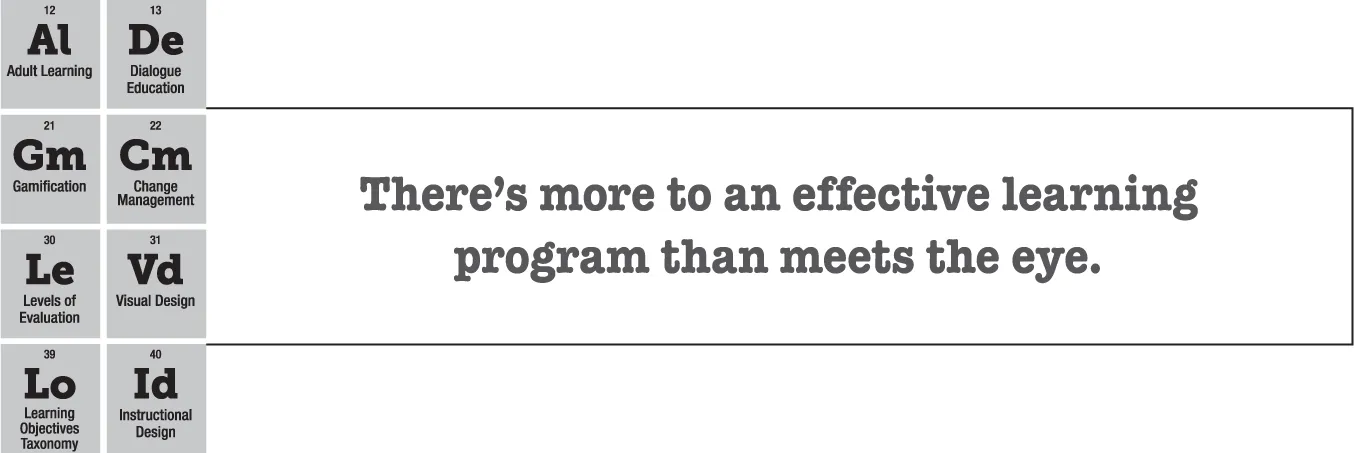
We begin our in-depth exploration of the Periodic Table of Amazing Learning Experiences by putting the big-picture, all-encompassing gas-like elements under the microscope. Gas-like elements are concepts, models, and theories that you may never see, but that constantly waft through the air of any training room. Some, like the air we breathe, are invisible and odorless, but you’d definitely know if they were suddenly vacuumed out of the training room. Without one or more of these elements constantly swirling around your learning programs, none of the other elements matter. There are eight gas-like elements: adult learning (Al), dialogue education (De), gamification (Gm), change management (Cm), levels of evaluation (Le), visual design (Vd), learning objectives taxonomy (Lo), and instructional design (Id).
In any quality adult learning (Al) experience, you must include the work of titans such as Malcolm Knowles and Robert Gagné. Perhaps less well-known—because their contributions to the field are newer—but no less important is the work of Jane Vella (dialogue education, De); Cammie Bean and Cathy Moore (instructional design, Id); Donald Kirkpatrick and Will Thalheimer (levels of evaluation, Le); Nancy Duarte and Melissa Marshall (visual design, Vd); and Karl Kapp, Kevin Werbach, and Dan Hunter (gamification, Gm).
Without integrating their work into your training program, a game will be just a time-consuming activity, not part of a truly gamified experience; the usefulness of smile sheet data will be limited because you’re not asking the right questions; and slides will continue to be repositories for presenters’ knowledge, not visual experiences that help learners more easily digest and process information.
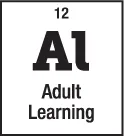
Element 12 Adult Learning (Al)
Adult learning theory, also known as andragogy, has been around for a long, long time but is perhaps best characterized by the work of Malcolm Knowles. The Adult Learner, which was published in 1973 (and has been updated several times since), is his most well-known book.
Depending on which source you cite, there are three, four, six, or seven key principles that characterize the adult learner. For the purposes of this discussion, the key properties of element 12, adult learning, are:
• Adults come into the training room with previous life and work experience.
• Adult learners are autonomous and self-directed learners.
• Adult learners need to see and understand the relevance of what’s being taught.
• Adult learners want to be able to use what’s being taught to solve a problem in the near future.
So, what does this mean in plain English? Basically, if we want a learning experience to truly be amazing, we can’t just get up in front of a group and start sharing content. We need to be intentional about what needs to be learned and how we present that information, all depending on who our audience is. For every learning experience, we need to reflect upon and answer some basic questions such as:
• How am I honoring the previous life and work experiences of my participants?
• What choices will I allow my participants to make during this learning experience?
• How will the relevance of my topic to my participants be made crystal clear?
• Will my participants know how to use my information to solve a problem by the end of the experience?
Perhaps more so than any other element in this gas-like category, when principles of adult learning are missing from a learning experience, it truly is as if the oxygen has been sucked out of the room. After a while, the absence of adult learning principles makes it uncomfortable, almost impossible to take in a dull, meandering presentation.
On the bright side, it’s been my experience that a lot of people know of the term adult learning. I’ve worked with a number of department heads and subject matter experts who have all said that they embrace adult learning and would like to see it woven throughout their learning programs.
The idea that adults should be at the center of their own learning experience, that they should be given autonomy (to some degree) over what happens in a training program, that they need relevant content, and that the content needs to solve a work-related problem is not controversial. However, it’s also been my experience that while department heads and subject matter experts say they embrace adult learning, very few are equipped with the knowledge and the skills to actually put these principles into action.
This is where talent development professionals need to shine. Subject matter experts and department heads aren’t paid to know how to put principles of adult learning into action, and we shouldn’t be frustrated by this fact. We need to take advantage of the fact that there are department heads and subject matter experts who are open to incorporating principles of adult learning into their training programs, and then we need to help them design learning programs that honor these principles.
You can show what’s possible when adult learning is integrated into each learning experience in many ways. Bonding principles of adult learning with the following elements can offer some ideas on where and how to begin:
• Lecture (Lc). When you design through the lens of adult learning, even the traditional lecture can look different. Asking a rhetorical question at the beginning of a lecture can give the audience an immediate clue to how the content can help them solve a problem. Incorporating a tightly woven story can make content seem more real and help listeners see the relevance. Keep in mind that lecture doesn’t always have to be synonymous with a machine-like reading of facts and figures from the podium. In fact, if you’re honoring the principles of adult learning, it never should by synonymous with that.
• PowerPoint (Pp). A quick way to integrate principles of adult learning into PowerPoint slides is to ensure that the relevance of each slide is clear. Sometimes this can be done by limiting the amount of text on a slide, highlighting key words when text cannot be limited, and ensuring imagery correlates to what’s being discussed. More advanced users of PowerPoint may choose to include hyperlinks on their slides and allow participants to choose the order in which certain topics are covered, giving them autonomy and allowing them to identify the most relevant topics.
• Learning boosts (Lb). It’s one thing to help learners understand the relevance of a topic when they’re immersed in a learning experience, whether it’s in-person or an e-learning course. Sending learning boosts after the initial learning experience has concluded is another opportunity to keep content relevant, build upon initial concepts, and help learners identify how the content can solve work-related problems.
• Google (Gg). There may be (many) times when formal training programs are not necessary. Reminding and encouraging learners to take control over their learning and professional development by conducting their own research using Google or other available resources allows them to find what they need in the flow of their workday.
• Subject matter experts (Ex). Keep in mind that nobody on the planet actually carries a business card listing “subject matter expert” as their job title. Subject matter experts have day jobs and are usually paid to make money for the organization by doing something other than training. So, if you’re able to help craft a message or lesson plan for your subject matter experts that abides by the principles of adult learning, you can support them and help ensure learners are exposed to meaningful learning experiences.
• Change management (Cm). If you’re working with an organization that understands the need to integrate adult learning theory into learning programs, then your life may be much easier. If you’re working with organizations that either have not bought in to, have not heard of, or claim they don’t have time for “touchy feely” concepts like adult learning theory, then change will be necessary, and it’s not likely to happen quickly. Change management components such as identifying the need to integrate adult learning into a program and identifying key influencers such as a department head or subject matter expert who would be open to the change are important initial steps. Designing programs that integrate key principles of adult learning to show the rest of the organization what’s possible may be necessary, because just talking about theory and dropping Malcolm Knowles’ name into your conversation won’t move the needle on this.
• E-learning (El). E-learning offers an almost-endless opportunity for learners to autonomously choose certain paths during a learning experience and simulate real-world applications of key concepts. The key to effective e-learning that provides an amazing learning experience, even when under tight deadlines and without a large budget, is to ask: How can I ensure the relevance of this content cannot be missed or mistaken?
Access to over 1.5 million titles for a fair monthly price.
Study more efficiently using our study tools.
Frequently asked questions
Yes, you can cancel anytime from the Subscription tab in your account settings on the Perlego website. Your subscription will stay active until the end of your current billing period. Learn how to cancel your subscription
No, books cannot be downloaded as external files, such as PDFs, for use outside of Perlego. However, you can download books within the Perlego app for offline reading on mobile or tablet. Learn how to download books offline
Perlego offers two plans: Essential and Complete
Essential is ideal for learners and professionals who enjoy exploring a wide range of subjects. Access the Essential Library with 800,000+ trusted titles and best-sellers across business, personal growth, and the humanities. Includes unlimited reading time and Standard Read Aloud voice.
Complete: Perfect for advanced learners and researchers needing full, unrestricted access. Unlock 1.5M+ books across hundreds of subjects, including academic and specialized titles. The Complete Plan also includes advanced features like Premium Read Aloud and Research Assistant.
Both plans are available with monthly, semester, or annual billing cycles.
We are an online textbook subscription service, where you can get access to an entire online library for less than the price of a single book per month. With over 1.5 million books across 990+ topics, we’ve got you covered! Learn about our mission
Look out for the read-aloud symbol on your next book to see if you can listen to it. The read-aloud tool reads text aloud for you, highlighting the text as it is being read. You can pause it, speed it up and slow it down. Learn more about Read Aloud
Yes! You can use the Perlego app on both iOS and Android devices to read anytime, anywhere — even offline. Perfect for commutes or when you’re on the go. Please note we cannot support devices running on iOS 13 and Android 7 or earlier. Learn more about using the app
Yes, you can access What’s Your Formula? by Brian Washburn in PDF and/or ePUB format, as well as other popular books in Business & Human Resource Management. We have over 1.5 million books available in our catalogue for you to explore.