A history and military analysis of the world-changing events following the fall of the Western Roman Empire.
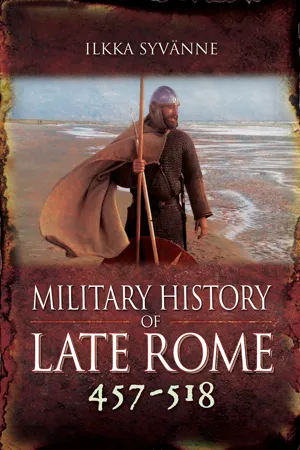
The Military History of Late Rome 457–518 provides a fresh new look into the events that led to the collapse of West Rome, while East Rome not only survived but went on to prosper despite a series of major defeats that included, most notably, the catastrophic campaign against the Vandals in 468. The author explains what mistakes the West Romans made and what the East Romans did right to survive. He analyzes the role of the barbarian generals and military forces in this and also offers an analysis of the tactical developments during this pivotal period as a result of which the cavalry, so famous from the accounts of Procopius, became the dominant arm in the East.
The book also offers a detailed study of a number of battles that have never before been subjected to such scrutiny, and puts these firmly into the context of their times. At the very end of this period in 518, East Rome was poised to start its reconquest under Anastasius' successors Justin I and Justinian I. This book explains why this was possible.
- 328 pages
- English
- ePUB (mobile friendly)
- Available on iOS & Android
eBook - ePub
Military History of Late Rome 457–518
About this book
Information
Chapter Twelve
Anastasius (11 April 491–9 July 518)1

Malalas (16.1, tr. by E. Jeffreys, M. Jeffreys and R. Scott, p.220) describes the appearance of Anastasius as follows: ‘He was very tall, with short hair, a good figure, a round face, both hair and beard greying; he had a grey pupil in his right eye and a black one in his left though his eyesight was perfect; and he shaved his beard frequently.’ This is clearly in evidence in his coins. He had a nickname Dicorus (twin-eyes).
The Coronation on 11 April 4912
Zeno died on 9 April 491 and on the following day the Senate, the Patriarch Euphemius, Empress Ariadne and other powerbrokers met at the Palace to discuss the question of succession while the soldiers and citizens waited in the hippodrome. This was high theatre in which the main roles were played by the Praepositus Sacri Cubiculi Urbicius, who is not to be confused with the MVM per Orientem Urbicius, the writer of military treatises, and Empress Ariadne. The expectation of Longinus, brother of Zeno, and the Isaurians in the capital was that Longinus would succeed his brother. This was not to be. At the meeting of the powerbrokers in front of the Delphax in the Palace, the PVC Urbicius took the lead and suggested that the choice of who would succeed Zeno should be left in the hands of Ariadne. Ariadne in her turn chose the 60-year-old silentiary Anastasius, a native of Dyrrachium in Nova Epirus. It is clear that this was merely theatre and that the decision to nominate Anastasius had been made well before this by Ariadne, Urbicius and their backers among the military who cannot have included any Isaurians. The worsening health of Zeno had been known for months and the key players must have started to make plans well before his death. The Isaurians were now so hated that they had to choose a native as Zeno’s successor. As noted above, it is possible or even probable that Anastasius was Ariadne’s lover, so the choice was a natural one. As a long serving silentiary, the 60-year Anastasius had in all probability once been a subordinate of Urbicius at some point so that these two men knew each other – Zeno had placed the silentiarii under the Magister Officiorum (Delmaire, 39), but the fact that both men had been in office for decades makes it clear that they knew each other. It is therefore clear that the principal players behind Anastasius’s nomination were precisely Ariadne and Urbicius, but it is still quite clear that these two must have obtained the backing of the key military men for their choice in advance. In my opinion, these must have included the unknown Comes Domesticorum3 and other commanders of the Scholae and Domestici, because in this case the Excubitores included too many Isaurians to be trusted, and it is clear that the conspirators kept all of this hidden from the overall commander of the bodyguards, the Magister Officiorum Longinus of Kardala. One may also speculate that Ariadne and Urbicius exploited the above-mentioned prediction that an ex-silentiary would succeed Zeno to press their case among the superstitious.
The only thorn in the situation was the Patriarch Euphemius who vehemently opposed the nomination of Anastasius. Euphemius knew that Anastasius held a favourable attitude towards the heretic views of Eutyches. Anastasius had also given private sermons in the Great Church in 488/491, which had resulted in riots. This had led to the interference of the Patriarch and Zeno with the result that Euphemius was able to silence Anastasius. John of Nikiu even claims that Zeno exiled Anastasius to Egypt, but this is not accepted by most historians even if it is still clear that Anastasius had at least visited Egypt at some point. It is clear that Anastasius was a charistmatic speaker and a religious person; he had even posted himself as a candidate for the Patriarchate of Antioch in 488. It is therefore not surprising that Euphemius agreed to carry out the coronation on 11 April 491, but only after Anastasius had signed a written declaration in which he accepted the Council of Chalcedon. To secure the legality of succession Ariadne married Anastasius on 20 May 491 so that the two lovebirds were finally united officially. This was certainly a marriage of love and not only a marriage of convenience for political reasons.
The Isaurians were presented with a fait accompli, and not unnaturally they were not satisfied with the situation. It is therefore not surprising that a purge of Isaurians from all positions of power followed soon after this. Very soon after Anastasius took the reins of power, Ariadne informed the populace that Julianus had been appointed as the new Praefectus Urbis Constantinopoleos (Urban Prefect of Constantinople). He was a native of Alexandria and a scholar whose actions provoked a riot, especially when he imposed restrictions on theatrical shows.4 The latter resulted in a riot in the Hippodorome, and after that a more widespread riot engulfing the city in fire. So Anastasius replaced Julianus with his brother-in-law Secundinus to satisfy the populace while still suppressing the revolt with a harsh hand. He accused the Isaurians of having instigated this revolt, and it is possible that they did, but it is also possible that he just exploited this for his own purposes. It appears probable that the Isaurians in Isauria revolted immediately after they had heard of Anastasius’ nomination, so that one can certainly consider it probable that those in the capital had the same tendencies. The simultaneous revolt in Isauria made all Isaurians even more suspect than they already were. The revolt in Isauria appears to have started under the leadership of Conon the ex-bishop of Apameia and Lilingis, the Comes et Praeses Isauriae.5
According to Malalas (16.2), Anastasius was also a supporter of the Red Faction at Constantinople so he took active measures against the Greens and Blues, who in their turn caused disturbances throughout the realm. One may also wonder whether the Green Faction in particular, which had been favoured by Zeno (Malalas 15.5), was behind this rioting. My suggestion is that the Greens sided now with their Isaurian backers and that the rioting had indeed been instigated by the Isaurians against the newly appointed PVC Julianus who failed to crush the revolt and was therefore replaced with one who could.6
Zeno’s brother Longinus was exiled to the Thebaid where he died of hunger eight years later. His mother, wife and daughter were exiled to Bithynia where they had to subsist on charity. The Magister Officiorum Longinus of Kardala, senator Athenodorus, and other Isaurians were expelled from the capital and their property confiscated to reward Anastasius’ supporters and to finance the war against the Isaurians. The expulsion of the unruly and badly behaving barbarian Isaurians from the capital was a crowd-pleaser and sure to make the Emperor’s position in the capital more secure. Anastasius cancelled the yearly donation of money to the Isaurians introduced by Illus in 484 and continued by Zeno. This was another wise move that saved money and punished the barbarians. He ordered the fortress at Papyrios to be demolished, probably to prevent it from becoming the place of refuge it had been during the previous revolt. His forces were apparently able to do this because the rebels had not yet managed to widen their revolt, which seems to have taken place only after the arrival of those who had been expelled from the capital.7 It might actually have been wiser to massacre the Isaurians than expel them, but it is probable that the situation was such that the expulsion was actually the better alternative because it removed the threat from Constantinople with less trouble.
It was also now that Anastasius purged the Excubitores from the Isaurians and replaced them with native Romans or Germans so that from this date onwards they were loyal to him. I would also suggest that it is likely that the future Emperor Justin I was now promoted as its commander with the title Comes Excubitorum, a title which he definitely held in 515–18, because he was probably a member of this corps. He was born into a poor peasant family and was uneducated, possibly even illiterate, Orthodox, and of Thracian or Illyrian descent, all of which made him an ideal candidate as a commander of the bodyguard.8 With this background it was difficult to think that he would rise to become Emperor, but as we shall see this is precisely what happened, and to the benefit of the Empire. He was to be one of the ‘good emperors’, as was Anastasius.
Anastasius started military reforms immediately after gaining power because the first piece of legislation was addressed to magister militum Longinus in 491. The aim of this law was to prevent the tribunes and other officers from stealing the pay of the troops. At the same time he sought to prevent the commissaries (actuarii, optiones, and chartularii) from stealing army provisions and from exploiting their position to make the soldiers pay for these provisions. He also ordered that the officers called ergatores were to pay the solatio directly to the soldiers, and that the actuaries could not demand exorbitant interest on any debts. Anastasius made it easier for the soldiers to obtain leave so that the tribunes could authorise leave for up to thirty men. The idea was presumably to make it less easy for the officers to extort payment in return for leaves. Next year in 492, Anastasius gave the duces judicial powers over all troops serving under them and prevented the soldiers from facing prosecution simultaneously in civilian and military courts. The fragments of imperial edicts preserved in inscriptions prove that Anastasius issued other edicts too that sought to prevent corruption in the military. In short, Anastasius sought to make service in the military more lucrative and to prevent the military corruption which spilled out into the civilian sphere in the form of the support that corrupt officers could give to local rich men.9 The rooting out of corruption in the military was also very good for the exchequer because money and supplies went to the troops rather into the pockets of the officers so that there were now actually more men in the service than before. It was also beneficial for the gathering of taxes because civilian rich men could no longer use the soldiers so easily for their nefarious purposes. In combination with subsequent reforms of coins, taxation and administration this was all to have a very positive result for the economy and tax base.
The Isaurian War 491–49810
Longinus of Cardala and Athenodorus then joined their brethren in a revolt led by Conon and Lilingis. As the highest ranking person, Longinus took charge and armed and supplied the rebels from the stores prepared by Zeno. According to Theophanes the army comprised 150,000 Isaurians, barbarians and bandits, while according to John of Antioch (Roberto ed. fr.308.33ff., esp. 40–44) the army of Lilinges and Athenodorus, Conon, magister Longinus and another Athenodorus comprised 100,000 Isaurians and Romans. Both figures are plausible for a major army collected from those who had stayed loyal to Longinus, but I would suggest that 150,000 should be thought of as the overall number with non-combatants included, while the figure of 100,000 would have represented the actual fighting strength of the rebels. Considering the fact that most of these consisted of Isaurians it is very likely that the vast majority of the army consisted of light foot equipped (see Proc. Pan. 9) with javelins, swords and shields. However, it is probable that the rebels also possessed cavalry because one of the commanders, Lilingis, achieved renown for his skills as a horseman and was probably in charge of rebel cavalry (Marcellinus 491/2). According to Procopius of Gaza (Pan. 9), Theophanes (AM5985) and Zonaras (14.3.22), the rebels pillaged a number of cities in the vicinity of Isauria and advanced to Kotyaeion/Cotyaeum in Phrygia probably with the idea of marching to the capital.

Anastasius had not been idle. According to Procopius (Anecdota 5.38.4ff.), he had assembled a large army under John the Hunchback (Ioannes to epiklên Kurtos; Ioannes qui et Gibbus) against the Isaurians. According to John of Antioch (Roberto ed. fr. 308.45ff.) and Theophanes (AM 5985), the army was under two commanders, John the Scythian and John the Hunchback. This army was drawn from Thrace so both could have been magistri militum per Thracias. On the basis of this it is generally assumed that this army was under the joint command of these two Johns. However, on the basis of Procopius’ statement and the success of the operation, it is in my opinion more likely that John the Hunchback was the overall commander, the strategos, while John the Scythian was his second-in-command, the hypostrategos, even if it is clear that Anastasius was in the habit of dividing the command which is well-proven by the Persian War of 502–6. It is therefore quite probable that the PLRE2 is correct in suggesting that John the Hunchback would have held the position of magister utriusque militiae praesentalis as stated by Malalas (16.3) rather than the position of magister militum per Thracias, while in my opinion John the Scythian would have held the rank of magister utriusque militiae per Thracias (or less likely MVM per Orientem or per Illyricum11), but it is of course impossible to know for certain. It is also quite possible that both were praesental magistri because Longinus of Cardala had lost his title and no praesental magister is known after Theoderic the Amal marched to Italy, and I would suggest that this was indeed the case. According to John of Antioch, the hypostrategoi of the Imperial Army were Justin from Bedriana near Naissus (the future Emperor), the Gothic Apskal/Apsical, Hun Sigizan, Hun Zolbo/Zolbon, and the Comes Scholarum Diogenianus/Diogenes, a relative of the Empress. John of Antioch claims that the size of this Imperial Army at Cotyaeum was about 2,000 men, which is clearly an underestimation and also contradicted by Procopius. I would suggest that it refers to the number of Scholarii present on the battlefield under Diogenianus.12
On the basis of the sources, it is probable that most of the regular army of the East sided with the Isaurians while the Imperial Army consisted mostly of the soldiers posted in Thrace, which in turn included the Praesental Army under John the Hunchback posted in Thrace, the Field Army of Thrace under John the Scythian, the Gothic Federates under Apskal, the Huns under Sigizan and Zolbo, the Scholarii under Diogenes, and the Excubitores plus some other soldiers under Justin. The reason why I give Justin more men than the Excubitores is as follows: even if he would have been able take the entire 300-men contingent with him – and this was not possible – this would not have made him a field commander. There is evidence from later periods for the use of the Comes Excubitorum or his subordinates in command of entire armies or units of soldiers, and I would suggest that this is the case now.13 Malalas (16.3) adds to the list the Bessoi. Should the Bessoi be identified with Bessas? The composition of the army, as detailed by John of Antioch and Theophanes, makes it clear that the Imperial Field Army consisted solely of forces posted in Thrace. My estimate based on the paper strengths is that one Praesental Army had 6,500 cavalry and 30,000 infantry; the Thracian Army 3,500 cavalry and 40,000 infantry; 10,000 Goths and Bessoi; 10,000 Huns; 2,000 Scholarii; and 2,000 other horsemen under Justin.14 My estimate for the overall size of this force is therefore 70,000 footmen and 34,000 cavalry. The armies would therefore have been evenly matched as far as numbers are concerned, b...
Table of contents
- Cover
- Title
- Copyright
- Contents
- Acknowledgements
- List of Plates
- List of Maps
- Introduction
- Abbreviations
- Introduction: The Roman Empire in 457
- Enemies and Allies
- The West 456–461: Majorian and Ricimer
- Ricimer the Kingmaker: 2 August 461–12 April 467
- Anthemius the Hellene (467–472) and Ricimer
- Ricimer, Gundobad, Olybrius, Glycerius 11 July 472–June 474
- The Fall of West Rome: Nepos, Orestes and Romulus Augustulus 19 or 24 June 474–ca. 4 September 476
- Leo I (7 February 457–18 January 474)
- Zeno/Zenon in Power (474–475) Leo II (18 January–7 November 474)
- Basiliscus (January 475–Summer 476)
- Zeno Back in the Saddle (August 476–9 April 491) The Mighty Struggle for Power in 477–489: Zeno, Illus, Marcian, Leontius and the Goths
- Anastasius (11 April 491–9 July 518)
- Appendix: Urbicius and the State of the Roman Armies under Anastasius
- Bibliography
- Notes
- Plate section
Trusted by 375,005 students
Access to over 1.5 million titles for a fair monthly price.
Study more efficiently using our study tools.
Frequently asked questions
Yes, you can cancel anytime from the Subscription tab in your account settings on the Perlego website. Your subscription will stay active until the end of your current billing period. Learn how to cancel your subscription
No, books cannot be downloaded as external files, such as PDFs, for use outside of Perlego. However, you can download books within the Perlego app for offline reading on mobile or tablet. Learn how to download books offline
Perlego offers two plans: Essential and Complete
- Essential is ideal for learners and professionals who enjoy exploring a wide range of subjects. Access the Essential Library with 800,000+ trusted titles and best-sellers across business, personal growth, and the humanities. Includes unlimited reading time and Standard Read Aloud voice.
- Complete: Perfect for advanced learners and researchers needing full, unrestricted access. Unlock 1.5M+ books across hundreds of subjects, including academic and specialized titles. The Complete Plan also includes advanced features like Premium Read Aloud and Research Assistant.
We are an online textbook subscription service, where you can get access to an entire online library for less than the price of a single book per month. With over 1.5 million books across 990+ topics, we’ve got you covered! Learn about our mission
Look out for the read-aloud symbol on your next book to see if you can listen to it. The read-aloud tool reads text aloud for you, highlighting the text as it is being read. You can pause it, speed it up and slow it down. Learn more about Read Aloud
Yes! You can use the Perlego app on both iOS and Android devices to read anytime, anywhere — even offline. Perfect for commutes or when you’re on the go.
Please note we cannot support devices running on iOS 13 and Android 7 or earlier. Learn more about using the app
Please note we cannot support devices running on iOS 13 and Android 7 or earlier. Learn more about using the app
Yes, you can access Military History of Late Rome 457–518 by Ilkka Syvänne in PDF and/or ePUB format, as well as other popular books in History & Military & Maritime History. We have over 1.5 million books available in our catalogue for you to explore.