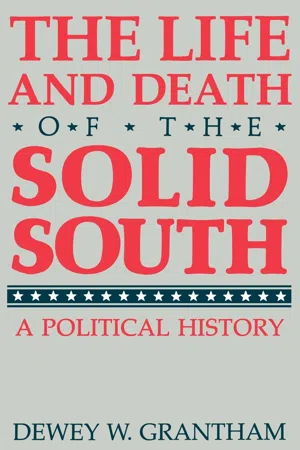
Southern-style politics was one of those peculiar institutions that differentiated the South from other American regions. This system—long referred to as the Solid South—embodied a distinctive regional culture and was perpetuated through an undemocratic distribution of power and a structure based on disfranchisement, malapportioned legislatures, and one-party politics. It was the mechanism that determined who would govern in the states and localities, and in national politics it was the means through which the South's politicians defended their region's special interests and political autonomy. The history of this remarkable institution can be traced in the gradual rise, long persistence, and ultimate decline of the Democratic Party dominance in the land below the Potomac and the Ohio.
This is the story that Dewey W. Grantham tells in his fresh and authoritative account of the South's modern political experience. The distillation of many years of research and reflection, is both a synthesis of the extensive literature on politics in the recent South and a challenging reinterpretation of the region's political history.
- 272 pages
- English
- ePUB (mobile friendly)
- Available on iOS & Android
eBook - ePub
About this book
Information
Publisher
The University Press of KentuckyYear
2021Print ISBN
9780813108131
9780813103082
eBook ISBN
9780813184227
1 Forging the Solid South
The political solidarity of the twentieth-century South originated in the great sectional conflict of the nineteenth century. In the 1850s a virulent southern sectionalism destroyed the existing party system and created a powerful compulsion toward political consensus in the South. The Civil War itself heightened southern self-consciousness and increased the social solidarity of the region’s white inhabitants, despite the divisions and enmities it brought to the surface. “Out of that ordeal by fire,” wrote Wilbur J. Cash, “the masses had brought, not only a great body of memories in common with the master class, but a deep affection for these captains, a profound trust in them, a pride which was inextricably intertwined with the commoners’ pride in themselves.”1 In the long run, the war did little to undermine the South’s political autonomy. As the historian Roy F. Nichols once observed, “Did not the South by its war experience insure what it sought, an autonomy within the nation and a political power which enables it at times, as now, for all practical purposes to control national legislation?”2
As a matter of fact, southern white unity was more apparent after the war than it had been during that drawn-out conflict. The divisions over secession were a source of continuing irritation and bitterness among southerners, and during the war years islands of disaffection developed in various parts of the Confederacy. The new government was never able to institute effective political machinery within its jurisdiction. Appomattox had surrendered Robert E. Lee’s armies but not the southern cause. As Robert Penn Warren declared long ago, the conflict of the 1860s “claimed the Confederate States for the Union, but at the same time, paradoxically, it made them more Southern.” Or, to put the matter in political terms, “In defeat the Solid South was born—not only the witless automatism of fidelity to the Democratic Party but the mystique of prideful ‘difference,’ identity, and defensiveness.”3 The Confederate flag and “Dixie” became strong unifying symbols for most white southerners. Outside the South, of course, the war strengthened the bonds of loyalty to the Republican party. Not surprisingly, the war and its turbulent aftermath infused the nation’s politics with sectional appeals and helped perpetuate the sectional alignment of party politics that had developed in the 1850s.
Reconstruction was no less important in the forging of the Solid South. Several developments of that era encouraged political competition in the southern states, and it is conceivable that the process of reconstruction could have contributed to a more rational and enduring political division among white southerners. With the collapse of the Confederacy, for example, many of the South’s old Whigs assumed an important role in postwar politics. While this Whiggish element was usually identified with southern interests, it had little liking for Democrats, who had led the section into war. A much greater challenge to southern Democrats came with the organization of the Republican party throughout the South following the inauguration of Congressional Reconstruction in 1867. This brought the enfranchisement of perhaps a million freedmen, virtually all of whom became Republicans, and the formation of political coalitions in every southern state made up of blacks, “carpetbaggers,” and “scalawags.” Something like a fifth of the southern whites were included in these Republican coalitions.
Most white southerners feared and resented the basic features of Radical Reconstruction, which they viewed as the source of harsh and vindictive policies, of Republican abuse and corruption, and of black effrontery and southern privation. Southern Democrats set about uniting as many whites as possible in the party of opposition. They made use of economic pressure and social ostracism, chicanery and fraud, intimidation and violence, and a shrewd campaign of racial propaganda, as well as more traditional political appeals. These techniques soon proved effective. One reason was the continuing prestige of the old, experienced ruling class in the South. Another factor was the inability of the southern Whigs to retain their identity as a separate group. The Whigs differed among themselves as to policy, and their efforts to secure a moderate reconstruction program received curiously little support from conservative Republicans in the North. Many of them were ultimately driven by their frustration into the arms of the Democrats, whose policies they had so often condemned in earlier years. Radical Republican policies and the blandishments of the Democrats (who resorted to the term conservative in some states as a gesture of conciliation toward the Whigs) eventually destroyed the Whigs as a clearly recognizable entity in southern politics, while enhancing the reputation of the Democrats among white southerners generally. The economic plight of the postwar South—its wartime losses and its poverty, one-crop economy, and shortage of money—also played into the hands of the Democrats.
The overthrow of Radical Reconstruction governments in the ex-Confederate states was made easier by the intense Republican conflict within several southern states, by the division between the northern and southern wings of the party, and by the inconsistent Reconstruction policies of Pres. Ulysses S. Grant. Passage by Congress of a general amnesty act in 1872 restored the right to hold office to most former Confederates. The northern retreat from Radical Reconstruction was evident by this time, and in 1874 the Democrats won control of the national House of Representatives. Meanwhile, the “redemption” of the South from Republican control moved forward steadily. In most white districts, conservatives had held control of local governments from the outset. Tennessee and Virginia were reclaimed by the Democrats as early as 1870, and by 1876 only Florida, Louisiana, and South Carolina remained in Republican hands. They were “redeemed” in 1877, the last two as part of the Compromise of 1877. Southern leaders acquiesced in the election of the Republican Rutherford B. Hayes, satisfied with the promise of troop removal, home rule, and federal money for internal improvements in the South.
The political hegemony of the conservative Democrats who redeemed the South from Radical Reconstruction was formidable. Having restored all of the ex-Confederate states to home rule, southern Democrats moved to liquidate their Republican opposition in the region. The party of Lincoln, Grant, and Hayes steadily lost strength in the South. One of the party’s members, Albion W. Tourgée, reported after the election of 1878 that “the Republican party of North Carolina is dead—dead beyond hope of resuscitation or resurrection!”4 In the presidential election two years later, the Democrats carried every southern state. The Solid South had emerged in its pristine form, although it would not become a thoroughgoing one-party system for another two decades.
Politics in the southern states from the end of Reconstruction to the early 1890s was dominated by the Redeemers. The original architects of the Solid South, they made an enduring contribution to the character of southern politics in the late nineteenth and early twentieth centuries. The system they inaugurated, while elaborated and perfected by later Democratic leaders, provided the fundamental structure of political solidarity in the region for more than three-quarters of a century. The Redeemers (or Bourbon Democrats) regarded themselves as the “natural leaders” of the South. There was a good deal of truth in this view. The bulk of the section’s traditional social and economic leaders, including most men of Whiggish persuasion, was identified with the Democratic party by the late 1870s. A Republican leader in Georgia warned as early as 1868 that recent elections “should teach us as Republicans that it is impossible to maintain the party in this State, or indeed in the South, without a division of the white vote.” The Democrats, he conceded, “possess most of the intelligence and wealth of the State, which will always control tenants and laborers.”5
One result of the Civil War, W.J. Cash suggested in 1941, was that “the habits of following and obedience” were more deeply engraved upon the common man than ever before. Cash also thought that the military leaders of the Confederacy were themselves profoundly influenced by their wartime service. “They were more set in the custom of command, much more perfectly schooled in the art of it, knew better how to handle the commoner, to steer expertly about his recalcitrance, to manipulate him without ever arousing his jealous independence.”6 These attitudes, one suspects, were reflected in southern politics during the Age of the Redeemers. Political candidates certainly found it advantageous to have served in the Confederate ranks. Indeed, Confederate veterans seem to have held a majority of the best offices at all levels of government during the period between Reconstruction and the 1890s. In Virginia, for example, James Lawson Kemper, a Confederate hero who had been wounded at Gettysburg, was elected governor in 1869. He became the first of a line of seven Confederate “brigadiers” to serve as governor of the Old Dominion. One study of 585 former Confederate leaders revealed that no fewer than 418 of them held elective or appointive offices after the war. It was, from the standpoint of the most prestigious political offices, the era of the Confederate brigadier. During the Forty-fifth Congress (1877–79), 77 of 107 members in the House of Representatives from the South had fought in the Confederate armies.
The Redeemers, of course, made good use of the romantic cult of the Lost Cause. They made the most of what David M. Potter has described as a “deeply felt southern nationalism” growing out of “the shared sacrifices, the shared efforts, and the shared defeat” of the war.7 They helped establish an explicit linkage between Confederate images and religious values, joining with other southerners in making “a religion out of their history.”8 The Redeemers’ version of Reconstruction provided another support for political conformity among white southerners. They told a grim story of human suffering and of the southern battle for civilization during Radical Reconstruction. “The slaughter and the sacrifices during our great civil war were terrible indeed,” declared Rep. Hilary A. Herbert of Alabama in 1890, “but those dark days were lighted by the shining valor of the patriot soldier; the storm clouds were gilded with glory.” In Reconstruction, on the other hand, Herbert could find “nothing but wretchedness and humiliation, and shame, and crime begetting crime. There was no single redeeming feature, except the heroic determination of the better classes in the several states to restore good government.”9 Conservatism, as one scholar has written of postbellum Virginia, “was not only a political party, it was also a social code and a state of mind.”10
As might have been expected, the Redeemers represented the South’s most influential social and economic elements. The bulwark of their political control was the black belt that stretched across the lower South, and planters constituted a major factor in the politics of the various states in the region, though not always the dominant one. There were patrician leaders among the Redeemers such as Francis T. Nicholls of Louisiana and Wade Hampton of South Carolina, who appealed to the traditions of the Old South, and a large number of conservative Democrats retained close ties with the land and with agriculture. Many if not most politicians in the new era lived in small towns and depended upon farmer constituencies. In short, as James Tice Moore writes, there is much evidence to support “the concept of a continuing and potent agricultural influence” in the politics of the Redeemer period.11
But if the planter exerted a controlling influence in the politics of the post-Reconstruction South, he was forced to share political power with a rising group of business-oriented politicians. “In the main,” C. Vann Woodward asserts in his familiar characterization of the Redeemers, “they were of middle-class, industrial, capitalistic outlook, with little but a nominal connection with the old planter regime.”12 Although Woodward may have exaggerated the discontinuity in the political leadership of the Old South and that of the New, there was a powerful Whig-industrial faction in every southern state after 1877, particularly in the upper South. Railroad and bondholding interests were closely identified with the Redeemer governments, and the New South emphasis on industrialization, economic diversification, and northern investments was warmly endorsed by the dominant political leaders in most southern states. Georgia’s leading Democrats “glorified the past, particularly the heroism of the Civil War; yet they emphasized youth, progress, and enterprise.”13 The state’s famous triumvirate of Joseph E. Brown, Alfred H. Colquitt, and John B. Gordon, who dominated Georgia politics in the post-Reconstruction period, had all been prominent Confederate leaders. Yet in the new era they became businessmen and New South advocates. That the character of Redeemer leadership was somewhat more diverse than is often maintained is revealed in the Louisiana experience. In that state three major political power centers emerged: the landowner class; the so-called Lottery-Ring combination, an alliance between the Louisiana State Lottery and the Democratic organization in New Orleans; and an avaricious clique of legislators and other officials who profited from such policies as the state’s convict lease system.
Having redeemed their individual states, Democratic leaders worked hard to maintain white unity and to perpetuate their control. While their tactics varied from state to state, their leadership tended to be oligarchical and conservative. In every southern state, a relatively small number of popular leaders dominated the Democratic party, determined the acceptable candidates for key offices, and decided upon the issues and candidates. The oligarchies moved quickly to secure control of the party organization in their respective states and to make sure that their lieutenants and friends were in charge of the election machinery. The concentration of authority in the hands of governors and legislators enabled these state leaders to appoint important local officials in every county. One of the steps taken by North Carolina Redeemers was to pass a law in 1876 designed to assure white Democratic supremacy throughout the state. It provided that the principal officers in each county would be appointed by justices of the peace, who were themselves to be named by the legislature. Conservative control depended on the popularity of Democratic leaders with white voters, but it also rested upon working alliances between state and local leaders. The latter were often part of what some contemporaries unflatteringly called courthouse “cliques” or “rings.” These influential local politicians looked after the interests of the party hierarchy in their towns and counties, particularly the operation of the election system and the selection of local officeholders, including members of the state legislature.
Redeemer dominance was reinforced by an assortment of clever techniques and sharp practices: gerrymandering legislative districts, discriminatory apportionment of seats in party conventions, intricate registration and election laws, and use of fraud and intimidation at the polls. In some cases these New Departure Democrats made use of a kind of “captive black vote” against their opponents, even as they characterized themselves as defenders of white supremacy. Indeed, their use of the race question assumed the quality of a fine art. As one historian says of the situation in Mississippi, conservative Democrats used the black man “unsparingly to crush all incipient revolts against their authority.”14
Lack of unity among the mass of small farmers and workers also aided the Redeemers. White yeomen in southern Appalachia generally supported the Republican party, as did most blacks throughout the South who continued to vote. The region’s exploitative social structure—increasing farm tenancy, the pervasive furnishing system, and the growth of textile mill villages and mining towns—debilitated the political role of more and more small farmers and laborers. Agricultural and industrial workers were the victims of a regional labor market that was shaped by high population growth and isolation from national labor norms and pressures. This condition facilitated the structuring of the work force along the lines desired by the planter-merchant-industrialist interests.
Critics referred to the Redeemers and their successors as “Bourbons,” likening them to the reactionary European monarchs who had “learned nothing and forgotten nothing.” The term is misleading, however, for the southern Bourbons were less inflexible and more innovative than the epithet suggests. “Generally speaking,” one historian concludes, “they were innovators in economic matters, moderates in race policy once white supremacy was assured, extremists in politics when their own supremacy was threatened, and profoundly conservative in most matters of social policy.”15 Their control reflected corporate and financial interests, especially those involved in railroad promotion, merchandising, and banking. The state governments under their leadership reduced taxes, starved public service agencies and eleemosynary institutions, and made economy in government a major priority. Yet many of them also advocated railroad subsidies and tax exemptions for new industries.
While proclaiming themselves the guardians of fiscal integrity and of a political climate favorable for economic developers, the Redeemers repudiated much of the Reconstruction debt in the southern states, took part in efforts to regulate railroads and other corporations, and supported appropriations for some state services, particularly to benefit farmers. If the new state constitutions whose drafting and adoption they spearheaded emphasized retrenchment in spending and low ceilings on taxation, they also included restrictions on state aid to private enterprises. Nor were the Bourbon Democrats as honest and fiscally responsible as they pictured themselves. They, too, were guilty in many instances of governmental corruption, financial peculation, and public scandals. Nevertheless, they left a lasting imprint on southern politics and society. Perhaps their greatest contribution was their influence in the cultural sphere—in their efforts to create a united southern people with a distinct cultural identity. Taking advantage of their reputation as natural leaders, they stressed the organic character of white society and appealed to the spirit of “Herrenvolk democracy”—a democratic society for whites only. They succeeded in large part because they were regarded as representing the “interests” of a majority of white southerners, who in the early post-Reconstruction years held conventional views on most economic questions and on the proper role of government, who considered race an important aspect of politics, and who were responsive to the pleas for southern white unity.
Although every southern state supported the Democratic presidential ticket in 1880, Republican strength in the South did not decline drastically during the last t...
Table of contents
- Cover
- Title
- Copyright
- Contents
- List of Tables and Graphs
- List of Maps and Illustrations
- Editor’s Preface
- Dedication
- Preface
- 1. Forging the Solid South
- 2. The One-Party System
- 3. In the National Arena
- 4. The Classic Period of Southern Politics
- 5. The South and the New Deal
- 6. The Politics of Massive Resistance
- 7. The Second Reconstruction
- 8. Toward a Two-Party South
- Epilogue
- Notes
- Bibliographical Essay
- Index
Trusted by 375,005 students
Access to over 1.5 million titles for a fair monthly price.
Study more efficiently using our study tools.
Frequently asked questions
Yes, you can cancel anytime from the Subscription tab in your account settings on the Perlego website. Your subscription will stay active until the end of your current billing period. Learn how to cancel your subscription
No, books cannot be downloaded as external files, such as PDFs, for use outside of Perlego. However, you can download books within the Perlego app for offline reading on mobile or tablet. Learn how to download books offline
Perlego offers two plans: Essential and Complete
- Essential is ideal for learners and professionals who enjoy exploring a wide range of subjects. Access the Essential Library with 800,000+ trusted titles and best-sellers across business, personal growth, and the humanities. Includes unlimited reading time and Standard Read Aloud voice.
- Complete: Perfect for advanced learners and researchers needing full, unrestricted access. Unlock 1.5M+ books across hundreds of subjects, including academic and specialized titles. The Complete Plan also includes advanced features like Premium Read Aloud and Research Assistant.
We are an online textbook subscription service, where you can get access to an entire online library for less than the price of a single book per month. With over 1.5 million books across 990+ topics, we’ve got you covered! Learn about our mission
Look out for the read-aloud symbol on your next book to see if you can listen to it. The read-aloud tool reads text aloud for you, highlighting the text as it is being read. You can pause it, speed it up and slow it down. Learn more about Read Aloud
Yes! You can use the Perlego app on both iOS and Android devices to read anytime, anywhere — even offline. Perfect for commutes or when you’re on the go.
Please note we cannot support devices running on iOS 13 and Android 7 or earlier. Learn more about using the app
Please note we cannot support devices running on iOS 13 and Android 7 or earlier. Learn more about using the app
Yes, you can access The Life and Death of the Solid South by Dewey W. Grantham in PDF and/or ePUB format, as well as other popular books in Politique et relations internationales & Histoire de l'Amérique du Nord. We have over 1.5 million books available in our catalogue for you to explore.