![]()
Orientation
I set aside the book I was reading when, with the sun reddening, the evening fly-past of crows and green parrots began. For ten minutes, squadrons of birds sped above or through the grove of coconut palms that separated the Indian Ocean from the terrace of my room in a Sri Lankan guest house. The book, as it happened, was about wildlife, crows included. I rather associate Sri Lankan crows with reading books about nature. Once, a flock of them tore to pieces my copy of Gaston Bachelard’s The Poetics of Space, left unguarded on a chair in a hotel garden. One chapter the birds shredded was called ‘Nests’.
The author of the book I was reading until the crows and parrots returned to their roosts would approve of my putting it down. He would think it more important to watch the birds than to read about them. The choice between looking at birds and reading about them does not sound like a grave one. But a related decision worried me for some months. The book you are holding discusses how a person might live in an appropriate relationship to nature; to animals and natural places, both wild and, like farms and parks, ‘humanised’. Now, what if writing about nature is the last form such a relationship should take? Maybe I should be engaging with the natural world in a more immediate, more muscular, and less parasitic way?
I haven’t resolved this question, although some later remarks in this book bear on it. But I have learnt to ignore it. In this, I’ve been encouraged by reading authors who write good books about nature and, at the same time, seem to enjoy a good relationship to it.
Nature writing
Several of those books belong to the genre of ‘nature writing’, which has enjoyed a renaissance in recent years. Some fine contemporary authors1 have written books that are worthy heirs to older classics such as Gilbert White’s The Natural History of Selborne, Rousseau’s Reveries of a Solitary Walker,Wordsworth’s A Guide through the District of the Lakes, and Thoreau’s Walden. Not all the authors I have in mind would usually be labelled ‘nature writers’, but their books also address questions about how human beings might properly relate to nature. Books, for example, on food – for questions about what and how we eat are, in part, about this relationship. Eating, as one of these writers puts it, is “our most profound engagement with the natural world”.2
Nature writing is different from natural scientific writing, even when the authors are themselves botanists or zoologists and lace their books with scientific information and conjecture. For nature writers also, and essentially, convey their personal experience of wildlife and natural environments – their moods, emotions and fancies. As an early reviewer of White’s Selborne observed, “not only is the understanding informed, but the imagination is touched”.3 To borrow from the title of a more recent book, the mountains that figure in nature writing are ‘mountains of the mind’4 as much as they are piles of limestone or granite.
Nature writing is different, too, from an environmentalist literature whose purpose is to enjoin us, with midnight said to be approaching, to ‘save the planet’. It is not that all nature writers pass over environmental issues or eschew occasional calls to collective action. But the main orientation is a personal one. The concern is with an individual person’s – the author’s own – relationship with animals and natural places. The focus, therefore, is not the triply impersonal one of environmental ethicists and activists. That is, it is not on the formulation of general principles that are supposed to apply to everyone. Nor is it on devising policies for collective, mass action. Nor is it on actions and attitudes that, in keeping with our pragmatic age, are judged solely by the effects they have on life in general, on ‘the human condition’, on ‘the environment’, on the planet.
People whose orientation is a personal one – whose concern is with self-cultivation – get accused of egoism and moral indifference or nihilism. This is unfair. That the ‘point of entry’5 for ethical reflection is a concern for the good of the self does not mean that the ‘point of exit’ is without implications for the enlightened treatment of other people and living beings. The ancient philosophers of Greece, China and India, whose initial question was how an individual’s life goes well, nearly all concluded that it does so only when the good of other people is attended to. If ‘the virtues’ refer to aspects of character that help a life to go well, then – so these ancients held – some of the virtues will be ‘other-regarding’. Compassion, say, or respect. But it certainly doesn’t follow that a relationship to the natural world that involves such other-regarding virtues has to be one of environmental activism or of commitment to universal principles of conduct that environmental ethicists seek to formulate. The relationship might be less strident, more intimate, less distracted by an ambition of effectiveness.
So, reflection on one’s personal relationship to nature is not disjoined from ethical reflection. The contrast, rather, is with an entrenched, modern style of moral reason – a style that allows little scope for personal reflection, focused as it is on how ‘one’ should act or live. I act rightly, the modern story goes, when I do what it would be beneficial for everyone to do. For the ancients – and for me, and for many nature writers – this modern style of moral reason is lacking in realism, in attention to the world and human conduct as they actually are, instead of to what they might be if only . . .
Here’s an illustration. I haven’t eaten meat since 1979, when I was given Peter Singer’s Animal Liberation as a Christmas present. It wasn’t Singer’s utilitarian arguments against the meat industry so much as his powerful descriptions of the conditions in factory farms that prevented me, on Boxing Day, from eating the cold turkey and ham. I still cannot eat meat and I am unmoved by the criticism that it would be disastrous if everyone were to give up eating meat. No lambs; no farmyards; no pastoral.
For a start, I have no idea – and nor do the critics – what a future world without meat-eaters would be like. Second, I know perfectly well that relatively few people will give up meat-eating. It would be frivolous to determine my relationship to animals – whether to eat them or not – on the basis of idle speculation about a world quite different from the one I am actually in. And perhaps worse than frivolous. Maybe impersonal deliberation on how to relate to animals is in itself to be in a wrong relationship to them, one that prevents their figuring in our experience and emotional life as they should.
The question I address in this book – encouraged by the personal orientation of nature writing – is this:
What should my relationship to nature – to animals, to plants, to natural places – be like if it is to be an appropriate one and to contribute to the good of my life as a whole?
Each of you, of course, can address a similar question to yourself and then judge the relevance to it of the remarks I make on mine.
Some modern moods
My question is not asked out of the blue. It has a context. This context is provided by a number of moods, each of which – though ancient in provenance – is voiced in contemporary nature writing.
One mood is a sort of yearning – for what has variously been called convergence, harmony, intimacy, even identification or unity with nature on the part of human beings. This yearning is typically accompanied by a sense that a greater convergence or unity between people and nature once existed. So a second mood is one of nostalgia, of regret for the passing of an age when people were, it is said, less estranged from the natural world.
It is human beings themselves – or the civilisations they have developed – who are usually held responsible for this estrangement from nature. Hence, a third mood is one of disillusion, whether bitter or resigned, with humanity or at least with the course it has taken. There is a spectrum of moods within this. At one end is the bleak misanthropy of an author who identified more with peregrine falcons than with human beings, and who “longed . . . to let the human taint wash away in emptiness and silence”, to lose his “predatory human shape” and to “shun” man, “that faceless horror of the stony places” with his “stink of death”.6 At the other, less dark, end of the spectrum bitterness is directed, not at humanity as such, but at a consumerist, hedonistic, hyper-technological society deemed responsible both for the devastation of the natural world and our estrangement from it.
One thing of which modern culture, with its predilections for technology, calculation and science, is often accused by nature writers is the loss of a sense of nature’s mystery. This accusation implies an ambiguous attitude towards science, which is at once applauded for its discoveries about plants, animals and natural processes, but castigated for its pretension to be telling a complete story. Thoreau believed that we require natural phenomena to be “mysterious and unexplorable”,7 a point taken up by a later American writer who speaks of natural places as “mysteries” that cannot be “fathomed, biologically” and exhorts us, if we are to acquire any wisdom about nature, to “pay attention to mystery”.8 A fourth mood, then, is a feel for nature’s mystery – for its ineffability – that cannot be dispelled by future scientific research.
I sympathise with these moods of yearning, nostalgia, bitterness or disillusion, and a feeling for mystery. Because I sympathise with them, my question about the shaping of an appropriate relationship to nature becomes more vital. For it is a question energised by the thought of a deep but atrophied convergence with the natural world that is worth reviving.
I want to justify these sympathies and to render attractive a certain conception of an appropriate relationship to the natural world. In doing so, there are different sources on which to draw. Poetry, for example, with its capacity, in an image or a line or two, to distil a mood. Disillusion with humanity’s relationship to animals, for instance, which D. H. Lawrence famously recorded after throwing a log at a viper that was drinking at a trough:
. . . How paltry, how vulgar, what a mean act!
I despised myself and the voices of my accursed human education.9
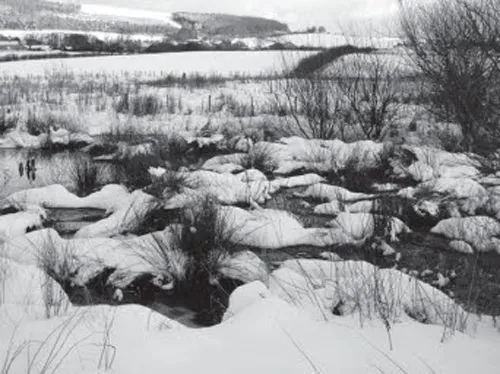
Or there’s the ability of a poet to give a fresh presence to an overfamiliar place. Gain’s Law is an austere, windswept hill in the Cheviots, close to my home. I hardly noticed it, until I read these spare verses, describing the place, by the Northumbrian poet Noel Hodgson:
Lumps of sheep
Scouring
Snow-plastered heather.
Their horned heads
Black-splotching The Whitescape.
Straggled
Whin bushes
Writhing at stabs
Of icy wind.10
I now walk over Gain’s Law on snowy mornings with a new attention and a fellow-feeling for the sheep and the bushes.
Direct, sinewy engagement with natural places – when kayaking, backpacking or climbing – is another source on which to draw, as are the gentler reveries of the solitary walker or watcher. Simple, close observation of little things – of wild flowers, insects, pebbles – can also evoke and invite a mood of yearning or nostalgia. As may thoughtful reflection on the place of plants, animals, lakes and hills in human culture and the civilised imagination.
Philosophy’s roles
As this last remark implies, one source will be philosophy, my own métier. Philosophy, though, is not a single source, but a range of traditions, practices and speculations. Several of these bear upon the concerns of this book – upon, especially, the idea of human convergence with nature.
To begin with, this is an idea that needs support from general accounts, of the type that philosophy endeavours to provide, of human beings and their world. For, if certain accounts are correct, then convergence sounds to be unattractive or impossible. Take, for instance, the view that is forcibly expressed in Matthew Arnold’s ironically titled poem ‘In harmony with nature’:
Know, man hath all which Nature hath, but more,
And in that more lies all his hopes of good. [. . .]
Man must begin, know this, where Nature ends;
Nature and man can never be fast friends.11
If the worth of human beings consists in cultural achievements made possible only through battling the processes of nature, then co...