![]()
Part 1
Preparation, planning and planting
![]()
Chapter 1
The site of your orchard
There is such a thing as a perfect site for growing fruit trees. It would be a south-facing spot sheltered from strong winds and away from frost pockets. The soil would be a fertile, well-drained loam with a pH of around 6.5. Although such sites are to be found, it is unlikely that you will live in such a place.
There are many variables affecting the cultivation of fruit trees. Some, such as soil fertility, drainage and shelter, can be adjusted, while others, such as altitude or aspect, must be worked with as they are. Although the site of your orchard might seem far from ideal, there is much that you should be able to do to improve it. Most places in the British Isles are suitable for growing fruit trees, although you will need to choose the type of fruit trees you intend to grow according to the locality. If you live on a sheltered site in the south of England, you can take your pick from the different fruits featured in this book. It is only if you live in a cold mountainous area with little topsoil that you will not be able to grow fruit trees. If, like most of us, you live somewhere in between, you will have to tailor your fruit growing to the conditions, but you will be able to harvest crops of delicious home-grown fruit.
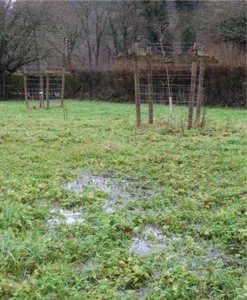
Observation over the seasons will show whether a site is suited to growing fruit trees. On a wet site like this, it would be best to improve the drainage before planting.
It may be that you have room for only one or two trees, but, unless you have a really small garden, you will have some choice about where you plant them. Choosing between different parts of your site involves understanding variables such as sun and shade, soil and exposure, and the effect that they have on your fruit trees. Making the right decisions about the position of your trees can be a key factor in the success of your orchard: it is not just a question of growing the right trees, but also of planting them in the right place.
Finding a suitable site for your trees is largely a matter of avoiding extremes of drainage, pH, exposure, soil type and microclimate. This chapter explains about the ideal conditions for growing fruit trees and ways to overcome any difficulties that may be present on your site.
The best way to assess the conditions is simply to observe the site over a period of time. Look to see where the frost lies heaviest in the winter, where the sunlight falls at different times of the year and how the water drains away after heavy rainfall. Such observation will build a picture of the conditions in your garden that you can then use to determine the best place to plant fruit trees. You can supplement your own knowledge with a soil test, which will give a scientific analysis of the soil, pinpointing any deficiencies that need remedying.
Soil
Soil is a miraculous substance that forms a thin skin over the surface of the earth. When you look at a landscape, what you see is the soil and the plants that grow in it, but this is almost a mirage, because what lies just underneath the surface is rock. It is this rock that the soil is formed from originally, but it also contains a host of other organisms that give life to the soil, such as fungi, earthworms, bacteria and humus.
Soil types
Soil types are divided into different classifications according to the biggest constituent, although, in practice, most soils contain a mixture of the different types.
Clay soils
The most common method of classifying soil types is by particle size. Clay soils contain the finest particles. They bind together into a tight mass, which can be heavy and sticky when wet, or hard and unforgiving when dry. Clay soils often crack as they dry out during the summer. They are easily damaged by treading on them while wet, which compacts the soil. They are potentially fertile soils, but this fertility can be locked away in the tightly bound structure.
Clay soils tend to warm up slowly in the spring and also drain more slowly than other soils.
Sandy soils
Sandy soils contain the largest particles. The resultant larger spaces between the particles mean that sandy soils drain well-often too well for the gardener’s liking. They warm up quickly in the spring, but also dry out quickly. They are often low in nutrients, which can be easily leached away by heavy rainfall. They tend to be more acidic and low in organic matter.
Silty soils
Silty soils contain intermediate-sized particles, somewhere between those of clay and sandy soils. They tend to have some of the characteristics of clay soils, such as high fertility and easy compaction, and some characteristics of sandy soils, such as good drainage, while avoiding the extremes of either.
Loamy soils
There are also a number of combination soil types, of which loamy soils are the most important. They are a mix of different types of soil types that may include clay, silt and sand. They often have a relatively high organic content, particularly where the soil has been improved over the years. Loamy soils tend to be ideal for growing fruit trees because they are fertile and avoid the extremes of drainage found in clay and sandy soils.
Peaty soils
Peaty soils are largely composed of decaying organic matter. As such, they hold moisture well and are generally very fertile. Peaty soils are mostly found in the area around The Wash, in East Anglia, as well as in other localised pockets.
Chalky soils
Chalk soils are found in large swathes of southern England. They are alkaline and often lacking in fertility. They are often described as ‘thin’ soils, being light and crumbly to the touch. They may contain pieces of chalk.
Identifying your soil type
Simply looking at your soil will give you clues to its composition. You might notice elements of the bedrock in the soil, such as shale or chalk, or you might see a dark peaty look or a light sandy texture. Digging the soil will give you further clues. A heavy cloddy texture will point you in the direction of a clay soil, for example. Digging deeper will provide more evidence; the greater the depth of soil you find, the better. Exposing the subsoil or bedrock will give you more idea of what the soil is composed of.
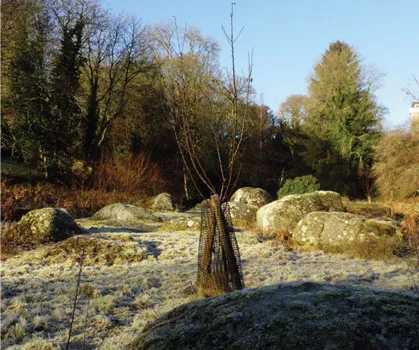
At first glance a site might seem unsuit able, but digging could reveal a sufficient depth of soil.
The easiest way of identifying the presence of clay in the soil is to attempt to roll the soil into a ball in your hand. Take a small lump of moist soil, then roll and squeeze in one hand until it forms a ball or otherwise. If the soil refuses to form a ball and feels gritty, then you have sandy soil. If the soil readily forms a tight ball, then you have soil with a high clay content. If the result is somewhere between the two, you are likely to have a loamy soil.
Soil pH
Soil pH is a way of measuring the acidity or alkalinity of the soil. In the UK, this might vary from 4, which is extremely acid, to 9, which is extremely alkaline. A measurement of 7 shows a neutral soil, which is close to ideal for most fruit trees. The pH requirements of particular fruits can be found in Chapters 12 to 16.
Soil tests
A soil test, or soil analysis as it also called, is a scientific method of determining the composition of your soil. The most important factors to test for are the pH of the soil and the amounts of the major nutrients present. Nitrogen, potassium, phosphorus and magnesium are the important nutrients and will show up with a simple testing kit. These are available from garden centres and are simple enough to use at home.
Alternatively, there are various professional bodies that will test your soil for you. Carefully chosen soil samples are tested in a laboratory. Although more expensive, having your soil tested professionally will produce a much more accurate result.
PROFESSIONAL SOIL TESTING
The Royal Horticultural Society (see Resources) is one organisation that will test your soil for potassium, phosphorus and magnesium, as well as testing the pH, structure of the soil and organic matter content. It will provide recommendations for improving any deficiencies found. There are also many companies that will provide a similar service.
Drainage
Achieving good drainage is, again, a matter of avoiding extremes. Sandy soil can be very free-draining, to the extent that trees will often be short of water, whereas clay soil can give rise to waterlogged conditions that can be detrimental to fruit trees. Poor drainage leads to a lack of oxygen for the tree roots and can also contribute to the development of fungal diseases such as phytophthora, which can kill fruit trees.
Where possible it is always best to avoid badly drained areas of your land when planting fruit trees. Where this is not possible, planting on ridges or mounds will help, but in serious cases you will need to consider installing land drains.
Quince trees will tolerate damp conditions better than most fruits, as will some varieties of apple – Lord Derby being the best-known example.
Improving the soil
You have a choice of improving the soil over the whole area, or improving conditions in the planting hole when the tree is planted. Improving the soil over a large area is a good investment for the future but it can require a lot of time and effort. Improving conditions at planting time will help the tree to establish, but won’t help once the tree roots have grown beyond the planting hole.
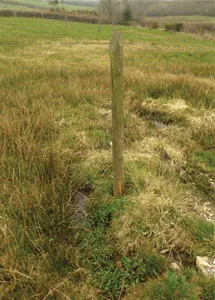
All that remains here is the stake where an apple tree was planted in an unsuitable location.
This section explains how to improve the soil before your trees are planted; improving the soil at planting time and ongoing feeding requirements are covered in Chapter 7. While specific deficiencies that show up in a soil test can be remedied as needed, there are more general ways of improving different types of soils, as described below.
Improving clay soils
Clay soils benefit from digging over in the autumn to break up the hard pan that tends to form. Leaving them exposed to winter frosts will also help to break them up. The addition of lime will assist this process, but it should be used only if the soil is not alkaline. If the soil is very heavy, adding course grit will help, although considerable quantities will be needed to make a real improvement. Adding organic matter, such as manure or compost, will provide extra nutrients at the same time as improving the soil structure, and therefore drainage. Manure should not be added at the same time as lime as they react badly with each other, releasing ammonia.
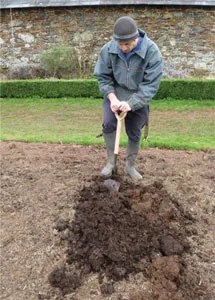
Adding manure to the soil will improve the structure as well as increasing nutrient levels.
If the only area you have to plant fru...