eBook - ePub
Available until 10 Dec |Learn more
The Green Self-build Book
How to Design and Build Your Own Eco-home
This book is available to read until 10th December, 2025
- 256 pages
- English
- ePUB (mobile friendly)
- Available on iOS & Android
eBook - ePub
Available until 10 Dec |Learn more
About this book
A highly illustrated, practical handbook on eco-friendly self-building
Frequently asked questions
Yes, you can cancel anytime from the Subscription tab in your account settings on the Perlego website. Your subscription will stay active until the end of your current billing period. Learn how to cancel your subscription.
At the moment all of our mobile-responsive ePub books are available to download via the app. Most of our PDFs are also available to download and we're working on making the final remaining ones downloadable now. Learn more here.
Perlego offers two plans: Essential and Complete
- Essential is ideal for learners and professionals who enjoy exploring a wide range of subjects. Access the Essential Library with 800,000+ trusted titles and best-sellers across business, personal growth, and the humanities. Includes unlimited reading time and Standard Read Aloud voice.
- Complete: Perfect for advanced learners and researchers needing full, unrestricted access. Unlock 1.4M+ books across hundreds of subjects, including academic and specialized titles. The Complete Plan also includes advanced features like Premium Read Aloud and Research Assistant.
We are an online textbook subscription service, where you can get access to an entire online library for less than the price of a single book per month. With over 1 million books across 1000+ topics, we’ve got you covered! Learn more here.
Look out for the read-aloud symbol on your next book to see if you can listen to it. The read-aloud tool reads text aloud for you, highlighting the text as it is being read. You can pause it, speed it up and slow it down. Learn more here.
Yes! You can use the Perlego app on both iOS or Android devices to read anytime, anywhere — even offline. Perfect for commutes or when you’re on the go.
Please note we cannot support devices running on iOS 13 and Android 7 or earlier. Learn more about using the app.
Please note we cannot support devices running on iOS 13 and Android 7 or earlier. Learn more about using the app.
Yes, you can access The Green Self-build Book by Jon Broome in PDF and/or ePUB format, as well as other popular books in Technology & Engineering & Construction & Architectural Engineering. We have over one million books available in our catalogue for you to explore.
Information
C H A P T E R
1
1
Why self-build, and
why build green?
why build green?
Building your own home can be a very satisfying thing to do, and many people have gained a great sense of achievement from doing it. At the same time you can ensure that your home does not make unsustainable impacts on the environment. Homes currently consume around 30% of all the energy used in the UK, and this figure is rising. However, a home which does not rely on fossil fuel is perfectly feasible using current technology. At the same time, more and more people are becoming aware of the limitations of the mass housing market and are looking for homes which are well designed, better equipped, and more energyefficient than the market provides.
What this book contains
The book describes examples of people who have successfully carried out green self-build projects, and shows what they have achieved. The examples include different forms of construction appropriate for self-builders: timber construction for speed and adaptability, steel for lightness and strength, straw for low embodied energy, earth-sheltered for storing energy, and cob for low cost. The book goes on to outline:
• the issues that you should consider when you design a house, including the need for a house to be capable of adapting to changing needs and expectation in the future
• sustainable methods of construction which are preferred for the walls, roof and floors and other principal elements of a house, together with the issues that have to be addressed to reduce the impact on the environment of building and occupying houses
• sources of materials and components which are suitable for low-environmental-impact construction
• the policy implications of a wider commitment to a more sustainable development process
What building your own home has to offer
My main aim is to inspire you to build for yourself. Organizing the designing and building of your own house is within the reach of us all. It is enjoyable and can have great economic, practical and social benefits. You can feel the satisfaction of making something really useful, and experience the excitement of dreaming about what your house will be like, how it will be laid out, what you are going to put in it and what it will be like to live in. You will see it slowly taking shape and will imagine the next steps in your mind and have a vision of the finished house. A handmade house is a pleasure to live in, and you will know every corner intimately. You will be able to afford a bigger, better house, arranged to suit your particular needs and desires, and you will be able to reduce your housing costs.
More and more people are becoming aware of the limitations of the mass housing market. It often offers expensive but poorly designed and equipped houses, badly built on characterless estates which are often located in areas which are not very desirable to live in. In many continental countries there is more awareness of how things could be otherwise – such as in Germany, where the housing market is not controlled to the same extent by speculative developers building for profit. The self-help sector there is four times larger than in Britain. Many people are able to commission a one-off house built in a village by the local builder to their particular requirements. Houses are larger, with basement storage and workshop space, with better kitchens and bathrooms, and are much more energy-efficient, with triple-glazing as standard.
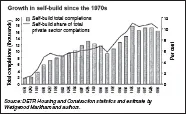
This rising awareness of an alternative, together with greater prosperity, have made the self-help sector in Britain rise from a meagre 4,000 dwellings, or 2% of the private housing market, in 1980 – the lowest proportion of any developed economy anywhere, lower than in North America, Australia, Japan as well as the rest of Europe – to a level estimated to be 18,000 dwellings or 11% of the market in 1999, and 25,000 or 15% at the time of writing. And it is this growing interest that has fuelled the success of television shows such as ‘Grand Designs’.
I should make clear at this point what I mean by self-build. I am referring to those homes which are commissioned by the people who live in them. They may or may not carry out the construction work themselves. They may commission a builder to do the building work, or they may employ subcontractors directly to do all or part of the building work whilst they carry out the project management work that is normally carried out by the builder. What is significant is that if you organize but do not necessarily actually build yourself, you are nevertheless in control of the process; you decide how your home is designed and how much money you want to spend. You will save money if you do all or most of the work yourself, but it will involve a greater time commitment – which may have costs associated with it, through loss of earnings arising from part-time working, for example.
All sorts of different people self-build for all sorts of different reasons. Some people have come together in groups because they wish to create a community and live with other like-minded people; disabled people have self-built, relying on their able-bodied friends and relations to carry out most of the physical work, so that they could lay out the house to suit their particular needs and to have the adaptability to change the arrangements if necessary in the future.
I have worked with self-builders from all walks of life, and have shared their excitement and enjoyment of their individually designed houses. They have been from very different backgrounds and with very different personalities. They included young people, older people building for their retirement, single mothers, unemployed people, people with low incomes, and almost all of them have had no experience of building. They have enjoyed the satisfaction of making a home for their household which is designed to their needs and desires, well built, energy-efficient and inexpensive to live in, all achieved at less cost. There is no doubt in my mind that there are many people who, like them, would jump at the chance to organize building houses for themselves if they thought that it was a real possibility. Anyone can do it if they have the opportunities and determination – and are prepared to work hard.
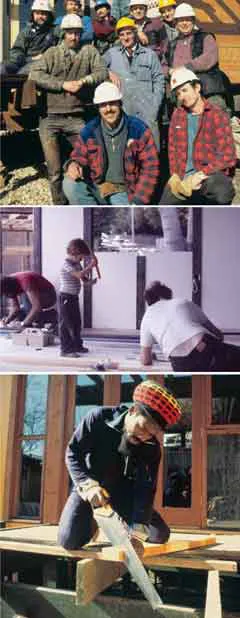
Top: Building together in Brighton.
Centre: Family self-build.
Bottom: A member of a black self-build housing co-operative.
Centre: Family self-build.
Bottom: A member of a black self-build housing co-operative.
Building your own home requires a great deal of effort and commitment, depending on how much of the building work you do yourself. This can be particularly difficult if you are doing it in your spare time and holding down a job. It can take over your life for a couple of years. It will put your relationships with your partner, children and friends under pressure. However, most people who have done it would tell you that the effort had been well worthwhile.
The benefits of a green approach to building
From the 1960s onwards there has been an impetus to reduce the use of energy because of concern that primary resources, and particularly oil, were going to run out. Since then the emphasis has changed to a concern about the level of pollution and the resulting global warming effect. Meanwhile, the Rio Earth Summit in 1992 broadened the areas of concern to include the ecology of the planet and the environment as a whole: the holes in the ozone layer, shortage of adequate water supplies, exploitation of the rainforests, reduction in biodiversity, and threats to human health posed by urban living. These are all now part of a global awareness of environmental issues which goes beyond the important issue of energy to include less tangible and more philosophical issues, for example those connected with health and stress. The ideas of sustainability and sustainable development have been developed as a framework for bringing energy, other finite resources and non-human species into balance with humanity – a humanity placed squarely within the environment, and not in any way separate from nature. This is the background against which the practice of sustainable design and building has developed.
Society’s current way of life is not sustainable. It is estimated that if the population of the Earth consumed resources at the rate presently current in Britain, three Planet Earths would be required to supply them and to dispose of the waste being generated. Building can have an important role to play in addressing this state of affairs. It is estimated that the environmental impacts of buildings can be halved using current technology. The potential benefits of a sustainable approach to building include:
• Reducing the use of natural resources: fuel for heating and for generating electricity for lighting and power; materials and energy required to manufacture and transport the material used in the construction itself; and water for drinking, bathing and disposing of waste.
• Conserving man-made resources: ensuring that buildings have a long useful life, are built to last and to adapt to changing needs and expectations.
• Building social capital: people’s capacity to organize and work together by making sure that they have an active part to play in the system.
The elements of green building
The government published the Stern Review of the Economics of Climate Change in November 2006, which concluded amongst other things that carbon emissions need to be reduced by at least 60% and possible as much as 80% by 2050 in order to stabilize the environment of the planet. The government published the Code for Sustainable Homes in December 2006, which set voluntary standards for reducing the environmental impacts of homes. The highest level of the code, Level 6, calls for the net carbon emissions from a home to be zero, and a target has been set for all new homes to achieve this standard by 2016. Some authorities, including the Welsh government and the Greater London Authority, have set more ambitious targets to achieve zero-carbon new homes by 2012.
Homes currently consume around 30% of all the energy used in the UK, and the figure is rising. However, a home which does not rely on imported energy is perfectly feasible using current technology. A substantial development of 82 homes called BedZed was completed in 2002 in South London as a demonstration of zero-emissions homes, and there are other examples shown in some detail in this book.
The energy used in heating, lighting and supplying power to a dwelling needs to be reduced, but the energy that is required to build it has to be addressed. This is the so-called embodied energy, the energy required to dig the raw materials out of the ground, transport them to a factory where they are turned into metal or plastic for example, and are then transported to another factory where they are manufactured into products and components such as windows, which in turn are transported to the site and incorporated into the building using...
Table of contents
- Cover
- Half Title
- Title Page
- Copyright
- Contents
- Acknowledgements
- 1 Why self-build, and why build green?
- 2 Who has successfully built a green self-build house?
- 3 Designing a good house
- 4 How can you encourage others to think green?
- 5 Environmental issues and the site
- 6 Building for longevity
- 7 Reducing energy in use
- 8 Reducingenvironmentalimpacts
- 9 Reducing potentially harmful impacts on health
- 10 Reducing waste
- 11 Reducing water consumption
- 12 Environmentally preferred forms of construction
- 13 Designing a sustainable garden
- 14 Why we should build green for the future
- 15 How to specify green
- 16 Useful links, references and contacts
- Index