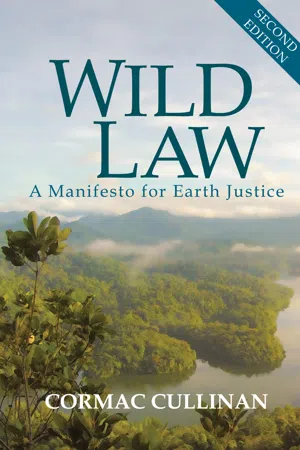
Wild Law fuses politics, legal theory, quantum physics and ancient wisdom into a fascinating story. It has been seminal in informing and inspiring the global movement to recognise rights for Nature; a movement destined to shape the twenty-first century as significantly as the human rights movements shaped the twentieth century. This revised edition includes a new preface, postscript and the Universal Declaration of the Rights of Mother Earth proclaimed on 22 April 2010. Wild Law presents a vision of how we could transform the systems that structure and order industrialised societies to enable us to rediscover a viable role for our species within the Earth community. It reveals how the goverance systems of today legitimise and promote the disastrous juxpolitation and destruction of Earth. The author explains how to begin transforming these systems to ensure that the pursuit of human well-being enhances the beauty, health and diversity of Earth instead of diminishing it. Wild Law describes an Earth-centred approach to ordering human societies (Earth jurisprudence), how to apply it, and it's emerging role as a common manifesto for promoting social and environmental justice, the conservation of biological and cultural diversity, animal rights and welfare, and green spirituality.
- 208 pages
- English
- ePUB (mobile friendly)
- Available on iOS & Android
eBook - ePub
About this book
Information
PART 1
Rethinking governance
We are planted here. Man is a plant that grows and branches and flowers on Earth.
Nahuatl-speaking descendant of the Aztecs, Mexico
Chapter 1
Anthills and aardvarks
THE ANTHILL
It was a clear African morning, with the freshness of overnight rain. Glossy Hadeda Ibises were preening themselves in the thorn trees and the earth was steaming softly in the warmth of the morning sun. As I walked back to my hotel in Lilongwe, Malawi, after a morning meeting, I noticed a small anthill next to the path. The rain had softened the protective outer dome and a passer-by had kicked off a cranium-sized section, exposing the cortex of cool, dark tunnels inside. The pale termites were working quickly and purposefully to repair the damage and to stop the rapidly warming sunlight streaming in. The workers moved back and forth, efficiently sealing the hole with spittle and earth. The soldier termites positioned themselves at strategic intervals so that they could protect the workers and prevent invaders gaining access to the nest.
I paused for a moment, struck by the organised efficiency with which they worked. Each termite knew exactly what it needed to do, and the actions of each tiny individual combined seamlessly to produce the outcome that the welfare of the community demanded. I remembered having been told that scientists were trying to puzzle out exactly how commands were relayed within the complex social structures of insects like ants and termites. Did the termite queen secrete special chemicals that were then passed on to each of the individuals, effectively giving them complex coded instructions as to what they were to do in any given circumstances? How was it that termites everywhere could build such marvellously complex structures with underground gardens, sophisticated ventilation systems, and a staggering degree of social organisation?
As I watched the tiny creatures moving about, it seemed to me highly improbable that they were either simply implementing instructions from the queen or deciding for themselves what to do. Each one might simply be responding to the external stimuli on the basis of internal ‘programmes’ or instincts. However, would this really explain their choreographed efficiency? Just how detailed could such internal codes be before they became too inflexible to deal with the immensely varied circumstances of life? It appeared to me that what I was observing was more like the functioning of a single consciousness expressing itself through many creatures than many individuals co-ordinating their activities in some cunning way.
Then it occurred to me that each termite might be a tiny receiver, finely tuned to a narrow bandwidth of the great symphony of the universe that gave it the melody to which it should dance. Perhaps they did not need great brains or complex instructions, because when they felt the juddering of a boot against their home and light flooding in, each of them had the capacity to tap into a greater source of termite lore? A kind of psychic website from which they instinctively downloaded the knowledge of what they must do in order to maintain the integrity of their community, and ultimately of their species and of the ecosystem of which they are such an important part. In other words, their actions were determined by the interaction between an information source outside their bodies, and their own innate qualities, which allowed them both to tap into termite-specific information and to act on it.
To this day I do not know what conclusions, if any, scientists have reached regarding the functioning of termite communities, and whether or not my musings were correct. Right or wrong, the image from that warm Malawi morning has stayed with me. I have suspected ever since that building complex communities that are well functioning, harmonious, and resilient is probably less about developing complex decision-making hierarchies and far more about fine tuning our ability to ‘hear’ the universe, and to act accordingly. My guess is that more complex animals like humans probably have the capacity to tune into a broader band of information than termites, and we certainly have a greater capacity to choose how to respond to what we ‘receive’. Of course, any such enhanced capacity will not help if we choose not to tune in, or respond to, our environment.
A HYPOTHESIS GROWS
As I continued doing environmental law and policy work in various countries during the 1990s, I became more interested in what made laws more or less effective instruments for governing social behaviour. I became convinced that, in my field at least, if laws are to be effective they need to recognise the inherent nature of the subject matter with which they are concerned. This means that a governance system must to some extent reflect, or at least correspond with, the qualities of that which it is seeking to regulate. For example, if we observe that one of the qualities of the environment is that it is constantly changing, we need environmental laws and governance structures that are flexible and adaptable. Equally, the pervasive nature of the environment requires that the environmental governance system must have a very broad scope.
I gradually formed a working hypothesis in my mind that the prospects of a governance system being successful could be increased by designing it in a way that took account of the attributes of what was being governed. Over time I began unconsciously to embroider this rudimentary hypothesis with scraps of ideas picked up from here and there. One such idea was the conscious recognition that the way in which most governance systems rely on economic considerations and the functioning of markets to guide human behaviour is often highly inappropriate. Making certain decisions in this way virtually guarantees that from a long-term perspective, bad or sub-optimal decisions will result. This is so even if market distortions are corrected by full cost accounting that, for example, ensures that the costs of pollution are borne by the polluter and incorporated into the prices of commodities.
For example, reading The Human Body Shop by Andrew Kimbrell, and observing his predictions about the commercialisation of every aspect of the human body come true, year by year, reinforced my belief that the market is no place to make ethical decisions about the use of the human body. These decisions go to the heart of who we are as humans, and require careful consideration and wisdom. Furthermore, it is not simply a matter of deciding what should be done. Why and how something is done are vitally important. Paying blood donors may be fully justifiable on the grounds of efficiency and cost-effectiveness. However, as Kimbrell’s book makes vividly clear, commercialising blood leads, quite literally, to bleeding dry the poorest and most vulnerable members of society. On the other hand, as was so graphically illustrated by the response of New Yorkers to the tragedy of 11 September 2001, the selfless ritual of giving blood to benefit unknown people who need it, can connect people and strengthen communities in a profound way.
While working on wildlife legislation in Namibia I was struck by how our unquestioning adoption of myopically human-centred laws often leads to results that are perverse and obstruct healthy relations between humans and other species. In Namibia (as in many countries) farmers who want to own wild game animals like rhinos, oryx and kudu on their land must fence them in with game-proof fences. In this way the law creates an incentive for farmers in this arid country to game-fence huge areas, which in turn prevents the natural migration of the herds in search of water and grazing. Worse still, there is no legal obligation on farmers to provide water or fodder, or to open the fences in times of drought. Some farmers simply keep all the water and fodder for their cattle and let the game die.
The same law encourages humans to slaughter innocent termite-eating aardvarks on sight by defining them as ‘problem animals’. The ‘problem’ that condemns the aardvark to rogue status is that resourceful jackals use aardvark burrows to get under jackal-proof fences and into sheep farms. These laws would be unthinkable if these native inhabitants were not defined as objects that could be destroyed at the whim of human landlords.
My basic hypothesis—that there should be a correlation between the regulatory system and what was being regulated — was further encouraged by conversations with a friend in London who is a retired professor. He liked theorising about the development of new forms of business organisations in the information economy. One day he mentioned to me that he was reading up on embryology (the study of how embryos develop) to gain inspiration and insight into how new forms of business organisation might grow. At first this approach seemed rather a long shot to me, but I was attracted by the idea of consciously drawing on the rich library of experience offered by nature. Although the basic idea of being inspired by nature recurs in human history in different forms, I was initially rather wary of applying this approach to governance systems. I was well aware that the diversity of nature and our limited knowledge of it allows ample scope for everyone from fascists to nihilists and beyond to claim that nature supports their theories. Like many people with a background in the humanities rather than the sciences, I thought that any suggestion that we should, for example, draw lessons for the regulation of human societies from termite colonies, was likely to be misinterpreted as a new and crankier form of social Darwinism. These theories often involve projecting our ideas onto nature, like Moses Rusden’s 1679 work, A Further Discovery of Bees, which claimed that bees were organised into social hierarchies with a king, dukes and plebeians.
It was only much later, when I read The Universe Story by Brian Swimme and Thomas Berry, that I realised why studying nature’s patterns and methods is likely to be productive. The reason, of course, is that we are part of nature and not separate from it. It therefore stands to reason that those patterns that have evolved and which have stood the tests of the millennia, are likely to have inherent qualities that are consistent with the basic principles of the Earth system. Furthermore, as I discuss in Chapter Six, since we are part of nature, being conscious of the need to adapt human governance systems to human nature is likely to be helpful. Obviously there is a lot of room for error if we seek to cut patterns from one context and paste them down in another. Nonetheless, my guess is that if we consciously draw inspiration from the rich diversity of natural patterns, structures and processes, the probability of success will increase.
This is now increasingly recognised, and many different disciplines are engaged in consciously drawing inspiration from nature in designing anything from cities to industrial processes. For example, even the simple observation that in natural systems one organism’s waste is another’s food and that materials and energy are endlessly recycled, has profound implications for the redesign of our industrial processes. Almost all human processing systems are linear. They take in vast quantities of materials and energy at one end, transform it into something of transient use to humans and then return it all to Earth as (virtually) unusable waste.
As far as I know, public institutions in modern western cultures have not consciously drawn on nature when designing or reforming human regulatory systems. There are probably several reasons for this, including the fact that most lawyers and legislators do not know enough about natural regulatory systems, and in any case do not believe that they are relevant to humans.
However, my primary concern in this book is not with the redesign of legislation. One of the most important things that I learned from Thomas Berry was that reforming our governance systems will require us to entirely reconceptualise our idea of law from a biocentric or Earth-centred perspective. Reforming national legislation and entering into new international agreements will be insufficient unless these are done on the basis of a new understanding that the essential purpose of human governance systems should be to support people to play a mutually enhancing role within the community of life on Earth. This requires us first to recognise that at the moment the governance systems of most countries and of the international ‘community’ actually facilitate and legitimise the exploitation and destruction of Earth by humans. One of the implications of this, I believe, is that excellent initiatives such as the development of an ‘Earth Charter’, or the movement to popularise the groundbreaking ‘World Charter for Nature’ adopted by the General Assembly of the United Nations in 1982,1 cannot succeed in isolation. Although these documents embody many of the values advocated in this book, they still exist within a governance context that is fundamentally opposed to prioritising these values.
In this book, I follow in the footsteps of Thomas Berry and argue that in order to change completely the purpose of our governance systems, we must develop coherent new theories or philosophies of governance (‘Earth jurisprudence’) to supplant the old. This Earth jurisprudence is needed to guide the realignment of human governance systems with the fundamental principles of how the universe functions (which I refer to in Chapter Six as the ‘Great Jurisprudence’). Giving effect to Earth jurisprudence and bringing about systemic changes in human governance systems will also require the conscious fostering of wild law.
WALKING ON THE WILD SIDE
I know that ‘wild law’ sounds like nonsense—a contradiction in terms. Law, after all, is intended to bind, constrain, regularise and civilise. Law’s rules, backed up by force, are designed to clip, prune and train the wilderness of human behaviour into the manicured lawns and shrubbery of the civilised garden. ‘Wild’, on the other hand, is synonymous with unkempt, barbarous, unrefined, uncivilised, unrestrained, wayward, disorderly, irregular, out of control, unconventional, undisciplined, passionate, violent, uncultivated, and riotous. In fact, the ‘Wild West’ of North America was described as ‘wild’ specifically because of the general lawlessness that prevailed there.
In wildness is the preservation of the world.
Henry David Thoreau
It is precisely the rigidity of this false dichotomy between the ‘wild’ and ‘law’, between ‘nature’ and ‘civilisation’, that we need to overcome. Like the Chinese symbol for Yin and Yang, both are part of the whole, and it is the dynamic balance that is important, not the triumph of one over the other. We need to find the wild Yin spot in the heart of the Yang of law, and also to perceive the core of law within the wilderness of Yin. Governing in a manner that stamps out wildness and promotes the dull conformity of monoculture is not desirable. Much of what is best in us is contained within our wild hearts. Wildness is associated with creativity and passion, with that part of us that is most connected with nature. It can also be understood as a metaphor for the life force that flows through us all and drives the evolutionary process. In this sense it has an eternal, sacred quality that both defines us and connects us most intimately with this planet.
Wildness is a quality that can only be experienced by straying off the orthodox path of civilisation as we know it. As we know, it is to be found most obviously in the wilderness, those special places where wildness rules. However, we would do well to remember that in many cultures the wilderness is also strongly associated with wisdom. It is the place to which people go in times of transition or confusion, and it is the place from which new insights emerge.
As will become apparent, particularly from Chapters Seven and Eleven, wild time, wild places and what used to be called ‘wild people’ are all important for wild law. If all this sounds like gobbledegook, bear with me a while longer and I will try to give you a clearer idea of what I mean.
WILD LAW
Firstly, the term ‘wild law’ cannot easily be snared within the strictures of a conventional legal definition. It is perhaps better understood as an approach to human governance, rather than as a branch of law or a collection of laws. It is more about ways of being and doing than the right thing to do.
Wild law expresses Earth jurisprudence. It recognises and embodies the qualities of the Earth system within which it exists. As an approach it seeks both to foster passionate and intimate connections between people and nature and to deepen our connection with the wild aspect of our own natures. It tends to focus more on relationships and on the processes by which they can be strengthened, than on end-points and ‘things’ like property. It protects wilderness and the freedom of communities of life to self-regulate. It aims to encourage creative diversity rather than to impose uniformity. Wild law opens spaces within which different and unconventional approaches can spring up, perhaps to flourish, perhaps to run their course and die.
Wild laws are laws that regulate humans in a manner that creates the freedom for all the members of the Earth Community to play a role in the continuing co-evolution of th...
Table of contents
- Cover
- Title Page
- Copyright
- Contents
- Preface to the second edition
- Preface to the first edition
- Author’s note
- Foreword by Thomas Berry
- Part 1: Rethinking governance
- Part 2: The world as we know it
- Part 3: Earth governance
- Part 4: The journey into wildness
- Part 5: The terrain ahead
- Postscript The emergence of Wild Law
- Appendix Universal Declaration of the Rights of Mother Earth
- References
- Bibliography
- Index
Trusted by 375,005 students
Access to over 1.5 million titles for a fair monthly price.
Study more efficiently using our study tools.
Frequently asked questions
Yes, you can cancel anytime from the Subscription tab in your account settings on the Perlego website. Your subscription will stay active until the end of your current billing period. Learn how to cancel your subscription
No, books cannot be downloaded as external files, such as PDFs, for use outside of Perlego. However, you can download books within the Perlego app for offline reading on mobile or tablet. Learn how to download books offline
Perlego offers two plans: Essential and Complete
- Essential is ideal for learners and professionals who enjoy exploring a wide range of subjects. Access the Essential Library with 800,000+ trusted titles and best-sellers across business, personal growth, and the humanities. Includes unlimited reading time and Standard Read Aloud voice.
- Complete: Perfect for advanced learners and researchers needing full, unrestricted access. Unlock 1.5M+ books across hundreds of subjects, including academic and specialized titles. The Complete Plan also includes advanced features like Premium Read Aloud and Research Assistant.
We are an online textbook subscription service, where you can get access to an entire online library for less than the price of a single book per month. With over 1.5 million books across 990+ topics, we’ve got you covered! Learn about our mission
Look out for the read-aloud symbol on your next book to see if you can listen to it. The read-aloud tool reads text aloud for you, highlighting the text as it is being read. You can pause it, speed it up and slow it down. Learn more about Read Aloud
Yes! You can use the Perlego app on both iOS and Android devices to read anytime, anywhere — even offline. Perfect for commutes or when you’re on the go.
Please note we cannot support devices running on iOS 13 and Android 7 or earlier. Learn more about using the app
Please note we cannot support devices running on iOS 13 and Android 7 or earlier. Learn more about using the app
Yes, you can access Wild Law by Cormac Cullinan in PDF and/or ePUB format, as well as other popular books in Law & International Law. We have over 1.5 million books available in our catalogue for you to explore.