eBook - ePub
Available until 10 Dec |Learn more
Timeless Simplicity
Creating Living in a Consumer Society
This book is available to read until 10th December, 2025
- 112 pages
- English
- ePUB (mobile friendly)
- Available on iOS & Android
eBook - ePub
Available until 10 Dec |Learn more
About this book
This is a book about simplicity not destitution, parsimoniousness or self-denial, but the restoration of wealth in the midst of an affluence in which we are starving the spirit. It is a book about the advantages of living a less cluttered, less stressful life than that which has become the norm in the overcrowded and manic-paced consuming nations. It is a book about having less and enjoying more, enjoying time to do the work you love, enjoying time to spend with your family, enjoying time to pursue creative projects, enjoying time for good eating, enjoying time just to be.
Frequently asked questions
Yes, you can cancel anytime from the Subscription tab in your account settings on the Perlego website. Your subscription will stay active until the end of your current billing period. Learn how to cancel your subscription.
At the moment all of our mobile-responsive ePub books are available to download via the app. Most of our PDFs are also available to download and we're working on making the final remaining ones downloadable now. Learn more here.
Perlego offers two plans: Essential and Complete
- Essential is ideal for learners and professionals who enjoy exploring a wide range of subjects. Access the Essential Library with 800,000+ trusted titles and best-sellers across business, personal growth, and the humanities. Includes unlimited reading time and Standard Read Aloud voice.
- Complete: Perfect for advanced learners and researchers needing full, unrestricted access. Unlock 1.4M+ books across hundreds of subjects, including academic and specialized titles. The Complete Plan also includes advanced features like Premium Read Aloud and Research Assistant.
We are an online textbook subscription service, where you can get access to an entire online library for less than the price of a single book per month. With over 1 million books across 1000+ topics, we’ve got you covered! Learn more here.
Look out for the read-aloud symbol on your next book to see if you can listen to it. The read-aloud tool reads text aloud for you, highlighting the text as it is being read. You can pause it, speed it up and slow it down. Learn more here.
Yes! You can use the Perlego app on both iOS or Android devices to read anytime, anywhere — even offline. Perfect for commutes or when you’re on the go.
Please note we cannot support devices running on iOS 13 and Android 7 or earlier. Learn more about using the app.
Please note we cannot support devices running on iOS 13 and Android 7 or earlier. Learn more about using the app.
Yes, you can access Timeless Simplicity by John Lane in PDF and/or ePUB format, as well as other popular books in Biological Sciences & Ecology. We have over one million books available in our catalogue for you to explore.
Information
CHAPTER THREE
Obstacles to Simplicity
If we have only trash and trivialities to sell, we must produce
trashy and trivial personalities to serve as consumers.
trashy and trivial personalities to serve as consumers.
LEWIS MUMFORD1
The fact is that this is probably the most unhappy average citizen in the history of the world. He has not the power to provide himself with anything but money, and his money is inflating like a balloon and drifting away, subject to historical circumstances and the power of other people. From morning to night he does not touch anything that he has produced himself, in which he can take pride.
For all his leisure and recreation he feels bad.
For all his leisure and recreation he feels bad.
WENDELL BERRY2
THOSE WHO BELIEVE that we are living in the best of times have reasons to be satisfied. During the last century, grinding poverty has largely disappeared in the West. No one is starving, or living off bread and dripping. People no longer survive in one-room cold-water flats under conditions of Victorian poverty. Their possessions amount to a great deal more than those which could be kept in a few boxes. Even if, alas, there still exists an underclass where broken homes and domestic violence, alcoholism and drugs are the norm, the acutest degradations of the 19th century have now been broadly eliminated. The relative material affluence of the present contrasts sharply with the material adversity recorded by Dickens, Mayhew and Engels.
Since my own coming of age in the 1950s, the standard of living has risen enormously: people are three to four times more affluent than they were at that time. The pill has liberated sexuality, the washing machine has liberated drudgery, the car has liberated mobility and the telephone and computer have liberated communication. Women especially enjoy freedoms and opportunities inconceivable in even the recent past.
I simplify, of course, but one is obliged to simplify as otherwise one couldn’t see the wood for the trees. A simplified summary presents a society enjoying unparalleled material prosperity, but at the same time one presenting an abhorrent picture of sickness of heart and spirit. It is not necessary to have recourse to all the statistics to understand that if the ‘outside’ of our society shows that we are now better off than ever before, its ‘inside’ demonstrates a deep lack of emotional and spiritual health. Anxiety, alcoholism, suicide, aggression and impulsive violence, gambling and drug abuse, chronic fatigue and depression, are commonplace. To take some examples of these calamitous symptoms: as many as twenty million British people are on antidepressants, with the number prescribed having doubled in the last decade.3 Violence has gone up 40-fold since 1970, and rates of suicide have trebled since the same date. Since the 1950s, time off work with stress-related illnesses has also increased by as much as 500 per cent. The social cost of these factors is staggering. In Britain, the annual expense of major depression in 1993 (in terms of lost days at work and reduced productivity) has been estimated to be £3 billion. Crime, too, costs some £60 billion a year, which amounts to 6.7 per cent of the UK’s Gross Domestic Product.
In the US, the figures are no more comforting. Suicide and drug use are at epidemic levels, and still growing. In 1990, the National Institute of Mental Health reported that suicide was the third leading cause of death among young people aged 15 to 24; and that 28 million American adults over 18 years of age suffer some mental disorder during a six-month period. About 16 million suffer anxiety disorders, about 10 million suffer depressive disorders, and about 2 million are classified as schizophrenics. Rates of crime are also high: the US prison population now exceeds the one million mark. The national murder rate in the US exceeds 30,000 a year.
If it were true that economic affluence, convenience and a wealth of contrivances guaranteed contentment, then we should be enjoying unequalled levels of wellbeing — but this, as the film American Beauty so effectively demonstrated, is far from the case. We may be comfortable, but many of us are hardly satisfied, hardly contented, hardly even at ease.
There is ample evidence to show that there is little correlation between material wealth and emotional satisfaction. Many surveys have shown that when a nation moves from a developing to a developed status, there can be a significant increase in people’s wellbeing — at least in the first instance. Then, inexorably, the population raises its levels of aspiration to keep pace with rising standards of living. On this point I quote Ronald Inglehart, a much cited authority:4 “In the short term,” he writes, “getting what you want may produce euphoria, but in the long run it does not. . . . After a while, people take what they have for granted, and either want more or, when they reach saturation point, turn to the pursuit of other goals. . . . One’s subjective satisfaction with life reflects the gap between one’s aspiration and one’s perceived situation.” Sadly, even the reverse can occur; once expectation and entitlement have peaked, and people are left with the necessity of working harder in order to maintain what has now become the accepted standard of living — a bigger car, an improved kitchen, holidays at ever more exotic destinations — there is often neither a comparable increase of enjoyment nor even as much satisfaction as previously. A general but unspecified dissatisfaction can prevail.
This analysis of the effects of greed is supported by the Indian physicist Vandana Shiva, who says of her country: “If you go into a village, there is never (any) hankering for what someone else may have. There is never greed. That comes from the fact that there is contentment.”
The widely travelled Dalai Lama supports a similar view: “I think it is genuinely true,” he writes, “that members of certain traditional, rural communities do enjoy a greater harmony and tranquillity than those settled in our modern cities. My impression is that those living in the materially developed countries, for all their industry, are in some ways less satisfied, are less happy, and to some extent suffer more than those living in the least developed countries. Indeed, if we compare the rich with the poor, it often seems that those with less are often less anxious. As for the rich . . . they are so caught up with the idea of acquiring more that they make no room for anything else in their lives. As a result, they are constantly plagued by mental and emotional suffering — even though outwardly they may appear to be leading entirely successful and comfortable lives. This is suggested by the disturbing prevalence among the populations of materially developed countries of anxiety, discontent, frustration, uncertainty, and depression.” 5
In considering these issues, I would like to devote this chapter to an examination of some of the factors that are inhibiting or preventing people from realizing their full potential and sensing fullness of being. Other contributory trends might have been included, and my picture is, of necessity, subjectively biased and incomplete. Nonetheless it must serve as a sampler of prevalent contemporary trends. For the sake of simplicity I have organized this chapter into four parts. Firstly I consider the fallacy that money can purchase happiness; second, the influence of living in a mass society; third, mass leisure and consumption; and finally, life in the cities. Of course no culture can be separated in this way; no single part can be considered in isolation from the rest. With the light come the shadows, and with everything positive come all the negative elements which are related to it, either as cause or effect. We should also remember that every culture is virtually inescapable; we are all influenced by aspects of its presuppositions and character.
Every culture lives within its dream.
LEWIS MUMFORD6
THE FALLACY THAT MONEY CAN PURCHASE CONTENTMENT
In plain language, the dream of our society is wealth and its multiplication. Wealth, the dream suggests, brings not only ease and luxury but unequivocal happiness. It allows us to do whatever we please, whatever we want to do.
The underlying foundation of this dream, its unspoken assumption, has three elements:
Success equals material success.
Material success and prosperity equal happiness.
Material success is the goal of every human being.
Material success and prosperity equal happiness.
Material success is the goal of every human being.
These are beliefs which have prospered and taken root in Western society: easy money, a narcotic as harmful as heroin, is now so commonplace that it draws but minimal comment because it is what the majority wants.
The evidence of this lust for money, leisure and ‘success’ is incontrovertible. Quiz programmes with substantial cash prizes regularly feature on TV. In 1999, the audience for Who Wants to be a Millionaire was about 14 million, the same number who weekly enter the National Lottery. The allure of money is inescapably registered in hundreds of other ways: there is hardly a newspaper, a magazine, an advertisement, a billboard or a TV commercial which does not, one way or another, refer to and emphasize the advantages of wealth — and conversely, the restrictions imposed by its absence. Hence, in part, our money madness, our unabashed struggle for ‘success’.
In a shipwreck one of the passengers fastened a belt about him with two hundred pounds of gold on it, with which he was afterwards found at the bottom. Now, as he was sinking — had he the gold? Or had the gold him”?
JOHN RUSKIN
Successful money-makers — Premier League footballers, rock stars, film actors, IT pioneers, the partners of city law firms and the corporate finance directors of the merchant banks — are held up as models of a new aristocracy, and their exaggerated incomes reported with the reverence formerly reserved for accounts of miraculous events. The gap in earnings between rich and poor is also steadily growing.
Why has money become so important? Because it is now the criterion by which all else is judged. As the power of money is elevated as never before, making commodities of people and placing a price tag on many human activities, it becomes obvious that the wealthiest — and the Microsoft founder Bill Gates now has personal wealth greater than most of sub-Saharan Africa — are considered the most ‘successful’. It is they who have ‘made it’. In contrast, poverty is regarded as an incontrovertible misfortune, bringing restriction and an enforced misery.
It is, of course, true that to survive in today’s society requires a certain size of income, but not the levels of remuneration earned by the minority and sought by the majority. I am not arguing in favour of a destitution that brings misery, a lack of warmth and a real sense of hopelessness; but what I am suggesting is that poverty is as much a cultural and a spiritual matter as an economic one, and that even the latter is a variable factor as much dependent on the accepted norms of a particular society as any quantifiable measurement.
Let us then consider an alternative. Those on a Hindu pilgrimage will fast, and experience harsh physical discomfort by walking daily for many hours on the road in the hot sun; yet they will consider their sufferings no deprivation — rather, as Irawati Karve reports on the basis of first hand experience, “an intoxication with happiness”.7 Contrast this with people in a run-down industrial town in the north of England, who (according to one TV report) considered that without a microwave oven and video recorder they could be defined as ‘poor’. Poverty and wealth are relative terms, and only understandable in the context of the prevailing preconceptions of a society. What we need and what we want are clearly not one and the same thing.
But here I am more concerned with another matter: the personal and social consequences of this worship of and insatiable hunger for money. This is widespread, and is colouring all our values. It includes the denigration of work that is poorly paid. In 2001, a corporate finance director of a merchant bank could earn a basic salary of around £130,000, but could be paid up to ten times as much again in bonuses based on performance. In 2000, the world heavyweight boxing champion, Lennox Lewis, earned £30 million, as did the golfer Tiger Woods. Meanwhile, a nurse, a thatcher, a librarian, a hill farmer or a specialist shoemaker could barely hope to earn one thousandth of this amount. The idea that money is a primary cause of wellbeing distorts values, intentions and actions; at the same time it corrupts the quest for a simpler life.
It is little imagined that the children of the so-called Third World countries, peasants who husbanded and lived simply in the past, and rejecting the frenzied pace of modern life today, can be intensely alive and fulfilled, whilst many socalled ‘successful’ people may live rather useless, futile lives. The quest for achievement can lead to a sacrifice of true well-being.
SOME ASPECTS OF THE MASS SOCIETY
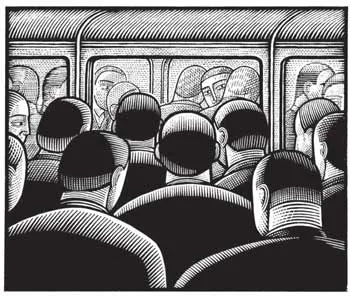
Mass conformity, mass values and mass beliefs are the undeniable order of the day. Show me those who reject the basic idea of modern social goals — maximum economic growth generated by maximum corporate production, fuelled by mass production, fuelled by mass consumption — if they do exist, they must do so in almost invisibly small numbers. Size is the fetish; economies of scale an unchallenged assumption, fashion a tyrant few dare to question. The masses rule; and mass opinion determines.
The writer and psychologist Erich Fromm saw...
Table of contents
- Cover
- Reviews
- Title Page
- Copyright
- Contents
- Acknowledgements
- Poem
- Introduction
- Chapter One Why Voluntary Simplicity?
- Chapter Two A Short History of Simplicity
- Chapter Three Obstacles to Simplicity
- Chapter Four Laying the Foundations for a Simpler Lifestyle
- Chapter Five The Gifts of Simplicity
- Chapter Six The Sacred Arts of Life
- Chapter Seven Conclusion
- References and Notes
- Recommended Reading