In 2008, the best selling The Transition Handbook suggested a model for a community-led response to peak oil and climate change. Since then, the Transition idea has gone viral across the globe, from universities and London neighbourhoods to Italian villages and Brazilian favelas. In contrast to the ever-worsening stream of information about climate change, the economy and resource depletion, Transition focuses on solutions, on community-scale projects and on positive results. The Transition Companion picks up the story today, describing one of the most fascinating experiments now under way in the world. It shows how communities are working for a future where local enterprises are valued and nurtured; where lower energy use is seen as a benefit; and where cooperation, creativity and the building of resilience are the cornerstones of a new economy. The first part discusses where we are now in terms of resilience to the problems of rising oil prices, climate change and economic uncertainty. It presents a vision of how the future might look if we succeed in addressing these issues. The book then looks in detail at the process a community in transition goes through, drawing on the experience of those who have already embarked on this journey. These examples show how much can be achieved when people harness energy and imagination to create projects that will make their communities more resilient. The Transition Companion combines practical advice; the tools needed to start and maintain a Transition initiative; with numerous inspiring stories from local groups worldwide.
eBook - ePub
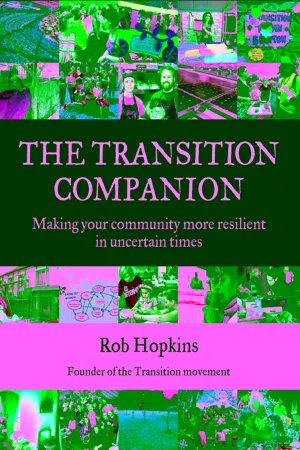
The Transition Companion
Making your community more resilient in uncertain times
- 320 pages
- English
- ePUB (mobile friendly)
- Available on iOS & Android
eBook - ePub
About this book
Information
The Transition Companion
Making your community more resilient in uncertain times
“Get ready for a smaller world. Soon, your food is going to come from a field much closer to home, and the things you buy will probably come from a factory down the road rather than one on the other side of the world. You will almost certainly drive less and walk more, and that means you will be shopping and working closer to home. Your neighbours and your neighbourhood are about to get a lot more important in the smaller world of the none-too-distant-future.”
Jeff Rubin, Why Your World is About to Get a Whole Lot Smaller (2009)1
“Maybe all this [Transition initiatives] sounds a bit goody-two-shoes to you – a bit ecofreaky – but what’s wrong with that? We’ve been here before. When our food supplies were threatened in the last war the government urged us to dig for victory…and we did. Never in our history have we had a more healthy diet. And the fact is that people are responding to Transition schemes. They’re packing town and village halls around the country to support them. You don’t believe there’s any need even to think about this sort of thing? You reckon this latest oil crisis is just another scare and the danger of global warming is being exaggerated? Well maybe you’re right. I hope you are. But if you’re wrong, doesn’t it make sense to think local rather than rely on politicians at national and world level to get us out of the mess they’ve helped create?”
John Humphrys, Sunday Mirror, 25 November 2007
“It was a funny little path, winding here and there, dashing off in different directions, and sometimes even tying a knot in itself from sheer joy. (You don’t get tired of a path like that, and I’m not sure that it doesn’t get you home quicker in the end.)”
Tove Jansson, Comet in Moominland (1946)
The Transition Companion
Making your community more resilient in uncertain times
Rob Hopkins

First published in 2011 by
Green Books,
Dartington Space, Dartington Hall,
Totnes, Devon TQ9 6EN
Dartington Space, Dartington Hall,
Totnes, Devon TQ9 6EN
© 2011 Rob Hopkins
All rights reserved
All rights reserved
No part of this book may be used or reproduced in any manner
without written permission, except in the case of brief quotations in
critical articles or reviews.
without written permission, except in the case of brief quotations in
critical articles or reviews.
Design by Jayne Jones
Print format ISBN 978 1 900322 97 3
PDF format ISBN 978 0 85784 040 0
ePub format ISBN 978 0 85784 055 4
To my family, Tessa, Mum, Dad, Jo, Ian, Jake, Archie, Steve, Hilary, Robert, Harriet and Helen.
To Colin Campbell, Richard Heinberg, David Holmgren and Howard Odum for sowing the seeds of this concept.
To the Transition Network team and to everyone testing the Transition model out, doing extraordinary work and having so much fun in the process.
To Geshe Jampa Gyatso, who taught me everything that really matters.
To my wonderful sons, Rowan, Finn, Arlo and Cian: take this world by the horns, boys.
To Emma: companion, lover, friend and wife.
Finally, to two of the twentieth century’s great geniuses lost to us in 2010/11: the dear David Fleming, and Captain Beefheart – both brilliant in very different ways, but brilliant nonetheless.
Contents
Forewords
Introduction
PART ONE: Why the Transition movement does what it does
Chapter 1: The emergence of an idea: a potted history of Transition
Chapter 2: Why Transition initiatives do what they do
Chapter 3: Where we might be headed: the power of future scenarios
Chapter 4: Resilience and localisation
Chapter 5: A taste of a powered-down future
PART TWO: What the Transition response looks like in practice
Chapter 6: Framing Transition
Chapter 7: The story of four Transition initiatives told using ingredients and tools
PART THREE: How the Transition movement does what it does – ingredients for success
Starting out
1. Coming together as groups
2. Inclusion and diversity
Tools for Transition No.1: Permaculture design
3. Respectful communication
4. Forming an initiating group
Tools for Transition No.2: Standing up to speak
5. Understanding scale
6. Measurement
Tools for Transition No.3: Transition Training
7. Visioning
8. Arts and creativity
Tools for Transition No.4: Running effective meetings
9. Awareness raising
10. Forming working groups
Tools for Transition No.5: Forming a legal entity
11. Building partnerships
12. The evolving structure
Tools for Transition No.6: Communicating with the media
13. Backcasting
14. Creating a space for inner Transition
Deepening
1. ‘Transition Towers’ – having an office, or not?
2. Practical manifestations
Tools for Transition No.7: Volunteers and volunteering
3. The ‘Great Reskilling’
4. How we communicate
Tools for Transition No.8: Financing your Transition initiative
5. Celebrating
6. Celebrate failure
7. “How are we doing?”
8. Local food initiatives
9. Momentum
10. Ensuring land access
Tools for Transition No.9: Supporting each other
11. Personal resilience
Tools for Transition No.10: Unleashings
Tools for Transition No.11: Healthy conflict
12. Education for Transition
Connecting
1. Forming networks of Transition initiatives
Tools for Transition No.12: Street-by-street behaviour change
2. Involving the council
Tools for Transition No.13: Becoming the media
3. Working with local businesses
Tools for Transition No.14: Energy Resilience Assessment
4. Oral histories
Tools for Transition No.15: Community brainstorming tools
5. Engaging young people
Tools for Transition No.16: Meaningful maps
6. The role of storytelling
Tools for Transition No.17: Speaking up for Transition
7. Pausing for reflection
Building
1. Energy Descent Action Plans
2. Social enterprise and entrepreneurship
3. Scaling up
Tools for Transition No.18: Community renewable energy companies
4. Strategic local infrastructure
Tools for Transition No.19: Tools for plugging the leaks
5. Appropriate technologies
6. Community ownership of assets
Tools for Transition No.20: Community-supported farms, bakeries and breweries
7. Strategic thinking
Tools for Transition No.21: Peak oil resolutions
Daring to dream
1. Policies for Transition
2. A learning network
3. Investing in Transition
Epilogue: Where might all this be going?
Appendices
Notes and references
Resources
Acknowledgements
Trailblazers and assorted sources of inspiration
Christopher Alexander, Peter Bane, Albert Bates, Graham Bell, David Boyle, Lester Brown, Colin Campbell, Fritjof Capra, Alec Clifton-Taylor, Phil Corbett, Martin Crawford, Chris Day, Charles Dickens, Dr Carlo DiClemente, Chris Dixon, Richard Douthwaite, Matt Dunwell, Paul Ekins, Ianto Evans, Simon Fairlie, David Fleming, Masanobu Fukuoka, Clive Hamilton, James Hansen, Stephan Harding, Tim and Maddy Harland, Peter Harper, Lea Harrison, Robert Hart, Emilia Hazelip, Richard Heinberg, Colin Hines, Arthur Hollins, David Holmgren, Barbara Jones, Ken Jones, Martin Luther King, Naomi Klein, Satish Kumar, John Lane, Andy Langford, Jeremy Leggett, Aldo Leopold, Bernard Lietaer, Richard Mabey, Joanna Macy, Marcus McCabe, Bill McKibben, Dennis Meadows, Bill Mollison, George Monbiot, Sterling Morrison, Helena Norberg-Hodge, Howard and Elisabeth Odum, Harrison Owen, Rosa Parks, Jonathan Richman, Dr Stephen Rollnick, Mark Rudd, Kirkpatrick Sale, E. F. Schumacher, John Seymour, Vandana Shiva, Michael Shuman, Andrew Simms, Chris Skrebowski, Linda Smiley, Gary Snyder, Sufjan Stevens, Ruth Stout, Tom Vague, Don Van Vliet and Meg Wheatley.
Collaborators, idea-shapers and co-conspirators
Gary Alexander, Paul ...
Table of contents
- Cover
- Contents
- PART TWO: What the Transition response looks like in practice
- PART THREE: How the Transition movement does what it does – ingredients for success
- Epilogue: Where might all this be going?
Trusted by 375,005 students
Access to over 1.5 million titles for a fair monthly price.
Study more efficiently using our study tools.
Frequently asked questions
Yes, you can cancel anytime from the Subscription tab in your account settings on the Perlego website. Your subscription will stay active until the end of your current billing period. Learn how to cancel your subscription
No, books cannot be downloaded as external files, such as PDFs, for use outside of Perlego. However, you can download books within the Perlego app for offline reading on mobile or tablet. Learn how to download books offline
Perlego offers two plans: Essential and Complete
- Essential is ideal for learners and professionals who enjoy exploring a wide range of subjects. Access the Essential Library with 800,000+ trusted titles and best-sellers across business, personal growth, and the humanities. Includes unlimited reading time and Standard Read Aloud voice.
- Complete: Perfect for advanced learners and researchers needing full, unrestricted access. Unlock 1.5M+ books across hundreds of subjects, including academic and specialized titles. The Complete Plan also includes advanced features like Premium Read Aloud and Research Assistant.
We are an online textbook subscription service, where you can get access to an entire online library for less than the price of a single book per month. With over 1.5 million books across 990+ topics, we’ve got you covered! Learn about our mission
Look out for the read-aloud symbol on your next book to see if you can listen to it. The read-aloud tool reads text aloud for you, highlighting the text as it is being read. You can pause it, speed it up and slow it down. Learn more about Read Aloud
Yes! You can use the Perlego app on both iOS and Android devices to read anytime, anywhere — even offline. Perfect for commutes or when you’re on the go.
Please note we cannot support devices running on iOS 13 and Android 7 or earlier. Learn more about using the app
Please note we cannot support devices running on iOS 13 and Android 7 or earlier. Learn more about using the app
Yes, you can access The Transition Companion by Robert Hopkins in PDF and/or ePUB format, as well as other popular books in Biological Sciences & Ecology. We have over 1.5 million books available in our catalogue for you to explore.