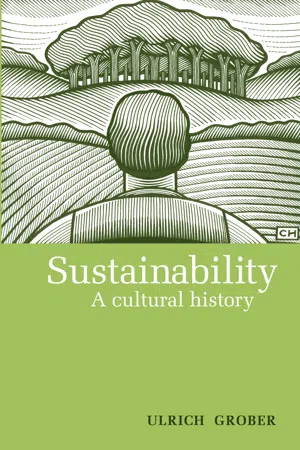
"A compelling analysis of the meaning of sustainability and development of the modern concept... Well researched and written... I recommend it to all environmentally-minded readers." Paul Fitzpatrick, Green World From diets to economic growth, everything these days has to be sustainable. But the word's currency should not obscure its origins: sustainability is an age-old aspiration; a concept deeply rooted in human culture. Though in danger of abuse and overuse today, it can still be recovered from its present inflationary coinage. In clear and thought-provoking terms, Ulrich Grober reassesses the concept of sustainability using a range of fascinating historical instances of its application. He considers the vision of men such as Hans Carl von Carlowitz, credited with having first formulated the three pillars of sustainability: environmental equilibrium, economic security and social justice. The journey takes in Francis of Assisi's thirteenth-century Canticle of the Sun, as well as Greek philosophers and Enlightenment scholars. Whether in the court of Louis XIV or the silver mines of Saxony, Grober reveals that sustainability is always born of crisis and yet also marks the birth of a new awareness, a realisation that the planet we live on has to be sustained and preserved for future generations. This book offers a historically rich and nuanced introduction to a concept that could not be of more pressing importance for the twenty-first century.
- 222 pages
- English
- ePUB (mobile friendly)
- Available on iOS & Android
eBook - ePub
About this book
Information
CHAPTER ONE
“. . . an innate ability . . .”?
Prologue
Last year’s harvest had been meagre. In the villages of the arid regions of western Senegal in 2008, March had already seen the onset of the soudure. The French word for a soldering joint, or, by analogy, for any gap which needs to be bridged, has a particular secondary meaning in francophone Africa. It signifies the period between the point when the stocks put aside from the previous year’s harvest begin to run out and the start of the new harvest. In the local language the term is ngekh. Usually this period of scarcity lasts from early June to mid-September. But in 2008 the rainy season held off. The first fruits of the new harvest didn’t appear on the table until late October.
In many regions of Africa, the following scene is repeated every year. After the harvest, every family fills small leather bags with millet, barley or rice. These are laid down, as cool and dry as possible, in the furthest corner of the storehouse. What the farmers are setting aside, are keeping in reserve, are the seeds for the coming year – their life insurance, the only one they have. The little bags lie there, invisible to prying eyes, safe from hungry mouths. Even when the fruits of the last harvest have all been consumed.
Africa is a great teacher. Her ancient wisdom tells us that the human community consists of those who went before us, those who are alive here and now, and those who are yet to come. She teaches us resilience – that is, the ability to withstand repeated blows of all kinds, and to mobilise our powers of resistance, in order not just to survive periods of hardship but actively to overcome them, and in so doing to preserve and to strengthen our courage, our zest for life, our cheerfulness. Mia Farrow, the Hollywood icon and Darfur activist, speaks of the “resilience of the soul”. We could also speak of indestructibility. It is a quality we will be in urgent need of in the future, not just in Africa but all over the world.
In periods of catastrophic drought, such as the 1980s, the soudure is unbearably prolonged. The iron rule of survival then is to sell all your worldly goods rather than touch the seeds laid aside. Slaughter your cattle, your goats. Send your children to work in the city. Roam far and wide to earn a little money or food. But keep your seeds. Don’t bring out the little bags until the hunger threatens your very lives. And then think long and hard about whether you are going to open them. When families in the Sahel and other African regions begin to consume the seeds put aside for the next sowing, then they are on the edge of the abyss. And so there began in the middle of the 1980s an exodus along the roads and tracks of the Sahel region which many did not survive. Journalists and aid workers reported at that time how women from the tiny farms would bring out their very last little bag and proudly pile up the grains of millet in front of them on the table as if they were diamonds.
In December 2008 I heard Adama Sarr, the young coordinator of a small NGO from an arid region of Senegal, talking to a small audience about the soudure. How can the vicious circle of chronic hunger be broken at a time when the first symptoms of climate change are threatening? Sarr reported on what was going on in the twelve villages covered by his network of women farmers, cattle herders and village teachers. How the members protect the baobab, the African tree of life, plant new trees, lay hedges to protect the plantations from the hot winds; how they create microcredits, and teach people how to build cooking stoves to replace the open fires which devour their wood supplies; how they set up composting systems, drill wells, teach reading and writing. As for seedcorn, the group encourages a return to traditional, locally cultivated plants, for example the native varieties of millet. Because the imported commercial seedcorn is usually hybrid – which means it is not germinable, and so useless for sowing.
What is the vision that lies behind the work of this Senegalese farmers’ organisation? I found it in the brochure that I took home with me from the lecture: “accéder à un développement durable”. To achieve a sustainable development*
Seedcorn should not be ground.1 Timeless wisdom, and a wonderful metaphor for sustainability. However, the phrase originates not in Africa, but in the writings of Goethe. The great poet, who was also a Minister of a small and impoverished German duchy, drew on his own immediate experience in formulating it. His early years in office were marked by failed harvests and famines afflicting the peasants of Thuringia. Even in the green heart of Germany, the soudure at that time was growing more acute with every early summer. In July 1779, for example, whole villages pleaded with the Cammer in Weimar, the ducal treasury, for tax relief. A begging letter from a village near Jena states that nobody knows where the poor folk can find the seedcorn for the next sowing. As Minister, Goethe was involved with the work of the Cammer. Shocked, he recounted to his lover Charlotte von Stein how he had met a man “who in the misery of hunger had seen his wife expire beside him in the barn” and had had to “scrape out a grave for her with his own hands”.
Goethe coined the phrase in his Bildungsroman Wilhelm Meister’s Apprenticeship. A mysterious Abbé, a member of a secretive ‘society of the tower’ which the hero of the novel, Wilhelm Meister, becomes involved in, hands him some writing ‘containing something of importance’. This ‘guide’, he is told, deals with the ‘education of the artistic faculty’. But its second part deals ‘with life’. And this part begins with the words, “Art is long, life is short” and ends with this: “Baked bread is tasty and satisfying for one day. But flour cannot be sown and seed-corn should not be ground.”
As Goethe was writing these lines, the ducal forestry department was conducting a huge reafforestation programme. In an ordinance from the Duchess Anna Amalia of 1761, it was decreed that the woods of the duchy should be subject to “a new and sustainable forest management plan”.
Over the course of the month of September 2008, the international financial system collapsed. The newspapers printed wide-angle photos of the granite palaces of the banks. In this perspective, financial institutions which had until then appeared as solid as the ancient rock of their architecture seemed as precarious as the Tower of Babel. So-called economic experts who had until then boasted of performing surgery on national economies ‘without anaesthetic’ fell momentarily silent. “Where is my money?” the documentary maker Michael Moore asked a banker on Wall Street. “I don’t know,” she replied. During those days British capitalism, according to the Daily Telegraph, felt as if it was on its last legs. Billionaires wept on camera. Dazed politicians declared that they had glimpsed ‘the abyss’. Overnight, they put together huge bail-out programmes. Then they filled ‘economic stimulus packages’. The sums of money that now came into play were beyond comprehension. They exceeded by a large multiple the amount which UN experts had calculated as sufficient to free humanity from hunger.
With the fresh money and securities the banks continued business as usual. And it happened again. The European debt crisis of 2011 followed just the same patterns. “I see our system in the painful process of breaking down”, wrote Paul Gilding, the former Greenpeace director. “Our system of economic growth, of ineffective democracy, of overloading planet earth – our system – is eating itself up.”
There is no alternative? Really? What about calmly allowing unsustainable structures to collapse, while at the same time gradually strengthening extant sustainable structures, and creating new ones – would that not have been a better strategy for coming out of the crisis stronger? But such a strategy would of course depend on an ability to distinguish with precision between what is sustainable and what is not.
I went hiking in those late summer days of 2008, in the mountain world of the higher Ötztal valley, under an azure blue sky, with the thermometer showing 25oC in the shade. Beyond the last houses of the old Tyrolean mountaineering village of Vent I clambered upwards towards the glacier zone. Ahead of me, at 3,000 metres, lay the dirty grey mouth of the Rofenkarferner glacier. Foaming, milky-green water welled from around the edges of the glacier, then plunged down into the valley, flowing considerably more strongly in the heat of the midday Sun than in the early morning. Like almost all of the world’s glaciers, the Rofen is shrinking. In the lush meadows to either side of the stony path, arnica and monkshood, saxifrage and purple gentian were in full bloom. To the south, the view to the main Alpine ridge opened up.
The Texel group of peaks, including Similaun and Hauslabjoch, was within reach. Up there on the ridge, in a gully in the gneiss rocks, on an early summer’s day some 5,300 years ago the nameless wanderer we call Ötzi had breathed his last, and had found his presumed final resting-place in the seemingly eternal ice. He was one of us – the first European with whom we have come face to face. The paths he took on his trek from the south over the ridge into the Ötz valley are still there. So are the springs where he drank, and the herbs he used as medicines, for himself and perhaps for others.
It is five days’ journey on foot from there to Bolzano. I am standing in front of a refrigerated glass case in the museum on the edge of the old city. Only a pane of glass separates me from the ice man. The mummy from the 4th millennium before the start of our own calendar is surprisingly narrow-shouldered and finelimbed. His desiccated eyes, their original blue colouring still faintly detectable, are turned upwards. The right hand which swung the axe and drew the bow is now grasping thin air. All around the glass coffin the remnants of his equipment are laid out. Every item reflects his semi-nomadic way of life. Everything is thought through to the last detail and adapted perfectly to his natural environment, his needs and his objectives. The boots, with their bearskin soles, leather uppers and lining of woven lime bark, are ideal for the high mountains. The copper axe is masterfully cast; the yew hunting bow almost the equal of modern sports bows for distance and impact. The construction of the frame of the rucksack is considered by modern manufacturers of camping equipment to be perfect for the carrying of heavy loads. Nine native varieties of wood have been used; exactly the right variety has been selected for each distinct function. The diligence with which the full range of native resources has been utilised, and the elegant simplicity which characterises each of his artefacts, are evidence – bridging thousands of years – of a creative spirit. The man from the glacier – is he the archetypal homo sustinens? Does he belong to the long genealogical line of the ancestors of sustainability?
One small detail, discovered only later, disturbs the picture. An arrowhead is buried in Ötzi’s left shoulder. This, and not cold, snow and ice, is what killed him. Hunters call it a shoulder shot. It seems he was fleeing. Victim or attacker, hunter or hunted in a bloody tribal feud? The previous week, in Vent, in the crowded dining-room of the town’s biggest hotel, I had heard a lecture given by a glacier researcher from Innsbruck. There was considerable evidence from research into climate history, he told us, that a freeze had struck the Alpine region during Ötzi’s epoch. He surmised that Ötzi’s violent death might be connected with the competition for shrinking pasture lands. Climate wars, over 5,000 years ago? Now, in front of the glass case in the museum, I was struck by a strange vision: his icy coffin thawing as a result of global warming, allowing a silent messenger to emerge from the depths of time into our present day.
In order to grasp the time horizon, it is useful to bear in mind that when Ötzi was alive, Babylon was nothing but a pile of mud huts in the land between the two rivers. But it is possible that at that period already, much further to the east, in the river basin of the Indus, voices were being raised in song to the “all-bearing, firmly grounded, gold-breasted Mother Earth”. And also in prayer: “What of thee, O earth, I dig out, let that quickly grow over; let me not hit thy vitals nor thy heart.”2 Can one not read these verses, too, later carried over into the Vedic Hymn to the Earth, as an expression of the idea of sustainability? It was in this sense that Indira Gandhi, then Prime Minister of India, quoted them in 1972 in Stockholm, at the first great United Nations environment conference.
One thing seems clear to me. The idea of sustainability is neither an abstract theory dreamt up by modern technocrats nor a wild fantasy hatched by Woodstock-generation eco-freaks. It is our earliest, our primordial world cultural heritage. It was Prince Charles, heir to the British throne, who a few years ago posed the question whether there was not, “deep within our human spirit . . . an innate ability to live sustainably with nature.”?3
But what is sustainable? The ‘Dictionary of the German Language’ published in 1809 by Joachim Heinrich Campe, Alexander von Humboldt’s teacher, defines Nachhalt (the root of nachhaltig, the German word for ‘sustainable’) as “that which one holds on to when nothing else holds any longer”. That sounds comforting. Like a message in a bottle, from a distant past, for our precarious times. “We are searching for a model output that represents a world system that is: 1. sustainable without sudden and uncontrollable collapse; and 2. capable of satisfying the basic material requirements of all of its people.”4 Another message in a bottle, this one from the famous 1972 report to the Club of Rome on The Limits to Growth.
In both cases, sustainability is the antonym to ‘collapse’. It denotes that which stands fast, which bears up, which is long-term, resilient. And that means: immune to ecological, economic or social breakdown. What is striking is that the two terms, from such different epochs, are remarkably congruent. They locate ‘sustainability’ in the basic human need for security.
“In an age”, said Christopher G. Weeramantry, former judge at the International Court of Justice, “in which we are denuding the resources of the planet as never before and endangering the very future of humanity, sustainability is the key to human survival. It is the concept which needs to be nourished from every discipline, every culture and every tradition.”5
To get to the inner meaning of this word, you have to approach it from several angles. It is the aim of this book to contribute to a greater clarity and to a heightened sensibility – for all of us – through an approach based on both linguistics and conceptual history. It tells the story of how intuitive precautionary thinking crystallised over long timespans into a specific concept. How under the umbrella of this concept a semantic field emerged which produced such now familiar terms as ecology, environment, quality of life and even management. How one word gathered the optimistic dreams and hopes from all epochs of human history and bundled them together into a vision for the future. How ancient survival wisdom was married to modern high-tech innovations. It recounts the slow growth of an idea, and the complex interrelationships to the everyday worlds in which that idea grew. But it also identifies the wrong turnings which were taken on the way. This book invites you to take a step back, in order to take the measure of things from the new perspective; and then to use this new scale to judge for yourself the ideological context, the meaning and the associations of ‘sustainability’; to comprehend its gravity – that is, its weight – but also its flexibility.
* Phrases which relate to key definitions of sustainability are shown in italics throughout the book.
CHAPTER TWO
Word games
Conceptual confusion
What do you understand by the term ‘sustainability’? Is it clear or is it cloudy? Too unwieldy? Too bland? A ray of hope, carrying positive expectations? Or just a bore? Does it free the imagination? Does it clarify? Or does it obscure? However you use it within your own vocabulary, you ought to know what exactly you’re talking about.
In recent years complaints about the ‘inflated use’ of the term, about dilution and confusion of meaning, have developed into a mantra. In my work as a journalist I know people who never utter the word without waggling their fingers in the air to signal quotation marks. It has entered into the l...
Table of contents
- Cover
- Half Title
- Title Page
- Copyright
- Contents
- Dedication
- Foreword by Prof. Klaus Bosselmann
- 1. “ . . . An Innate Ability . . . “?
- 2. Word Games
- 3. “The Most Beautiful Star in the Heavens”
- 4. Ur-Texts
- 5. A European Dream
- 6. Virtuosi
- 7. The Creation of the Word
- 8. The Birth of Ecology
- 9. Measuring the Forests
- 10. Fossil, Nuclear, Solar
- 11. Translating ‘Sustainability’
- 12. Earth Politics I: New Beginnings
- 13. Earth Politics II: Moving on to the Next Level
- 14. What Next?
- Epilogue
- Acknowledgements
- References
- Bibliography
- Index
Trusted by 375,005 students
Access to over 1.5 million titles for a fair monthly price.
Study more efficiently using our study tools.
Frequently asked questions
Yes, you can cancel anytime from the Subscription tab in your account settings on the Perlego website. Your subscription will stay active until the end of your current billing period. Learn how to cancel your subscription
No, books cannot be downloaded as external files, such as PDFs, for use outside of Perlego. However, you can download books within the Perlego app for offline reading on mobile or tablet. Learn how to download books offline
Perlego offers two plans: Essential and Complete
- Essential is ideal for learners and professionals who enjoy exploring a wide range of subjects. Access the Essential Library with 800,000+ trusted titles and best-sellers across business, personal growth, and the humanities. Includes unlimited reading time and Standard Read Aloud voice.
- Complete: Perfect for advanced learners and researchers needing full, unrestricted access. Unlock 1.5M+ books across hundreds of subjects, including academic and specialized titles. The Complete Plan also includes advanced features like Premium Read Aloud and Research Assistant.
We are an online textbook subscription service, where you can get access to an entire online library for less than the price of a single book per month. With over 1.5 million books across 990+ topics, we’ve got you covered! Learn about our mission
Look out for the read-aloud symbol on your next book to see if you can listen to it. The read-aloud tool reads text aloud for you, highlighting the text as it is being read. You can pause it, speed it up and slow it down. Learn more about Read Aloud
Yes! You can use the Perlego app on both iOS and Android devices to read anytime, anywhere — even offline. Perfect for commutes or when you’re on the go.
Please note we cannot support devices running on iOS 13 and Android 7 or earlier. Learn more about using the app
Please note we cannot support devices running on iOS 13 and Android 7 or earlier. Learn more about using the app
Yes, you can access Sustainability by Ulrich Grober, Ray Cunningham in PDF and/or ePUB format, as well as other popular books in Economics & Sustainable Development. We have over 1.5 million books available in our catalogue for you to explore.